Struggling with WASSCE Maths? Stop guessing. Let’s fix the gap step by step.

WAEC Chief Examiner’s Report 2025 for Mathematics: What It Says and How to Win the Marks Back
A teacher’s plain-English guide to the 2025 WAEC Chief Examiner’s Report for Mathematics (Core): every question, every weakness, and what to do about it.

📚 Part of our WAEC report series: 12 years of Chief Examiners’ reports, year by year.
Quick answer: what does the WAEC Chief Examiner’s Report 2025 say about Mathematics (Core)?
The examiners judged the paper comparable to previous years and described performance as satisfactory and encouraging compared with 2024. Candidates did well on midpoints, mensuration, simple average speed and the distance between two points. They were weak at showing information in a diagram, global (earth) mathematics, cumulative frequency tables, deductions from real-life problems, simple interest applications, and turning word problems into mathematical expressions.
Every year WAEC publishes a Chief Examiner’s Report. It is the closest thing a candidate has to sitting beside the marker: it says which questions went well, which went badly, and why. Most learners never read it. This guide goes through the 2025 report for Mathematics (Core), Paper 2, in plain English, and turns each finding into something you can practise.
Everything below comes from the report itself. The question descriptions are summarised in my own words; the source is linked at the end.
The 2025 report in one minute
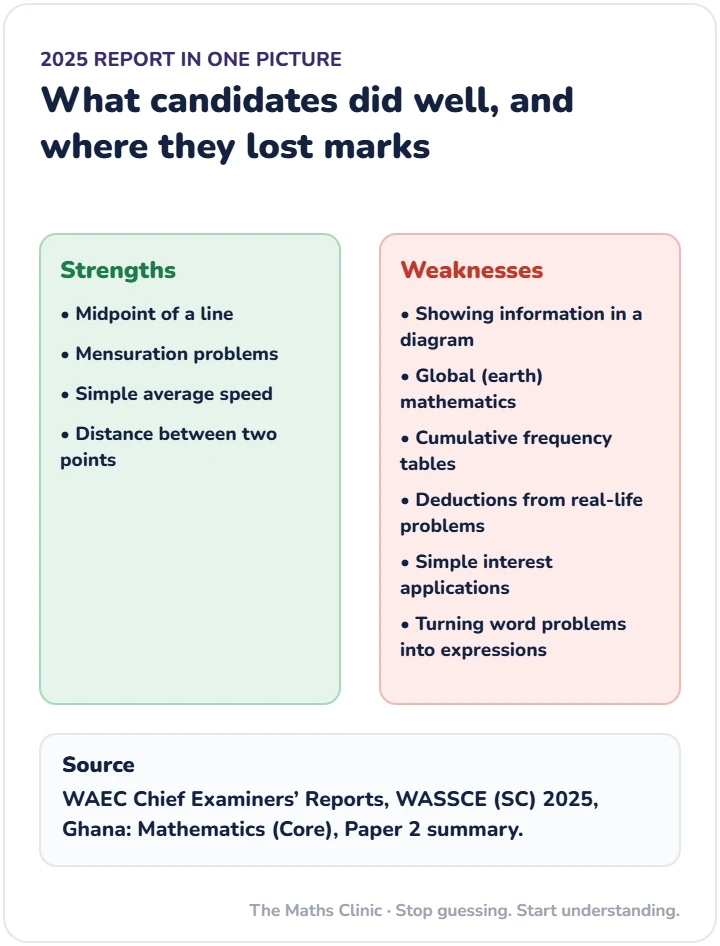
| Strengths | Weaknesses |
|---|---|
| Using the midpoint of a line | Representing information in a diagram |
| Solving mensuration problems | Global (earth) mathematics |
| Simple average speed problems | Constructing a cumulative frequency table |
| Distance between two points | Deductions from real-life problems |
| Applications of simple interest | |
| Translating word problems into expressions |
Question by question: where the marks went
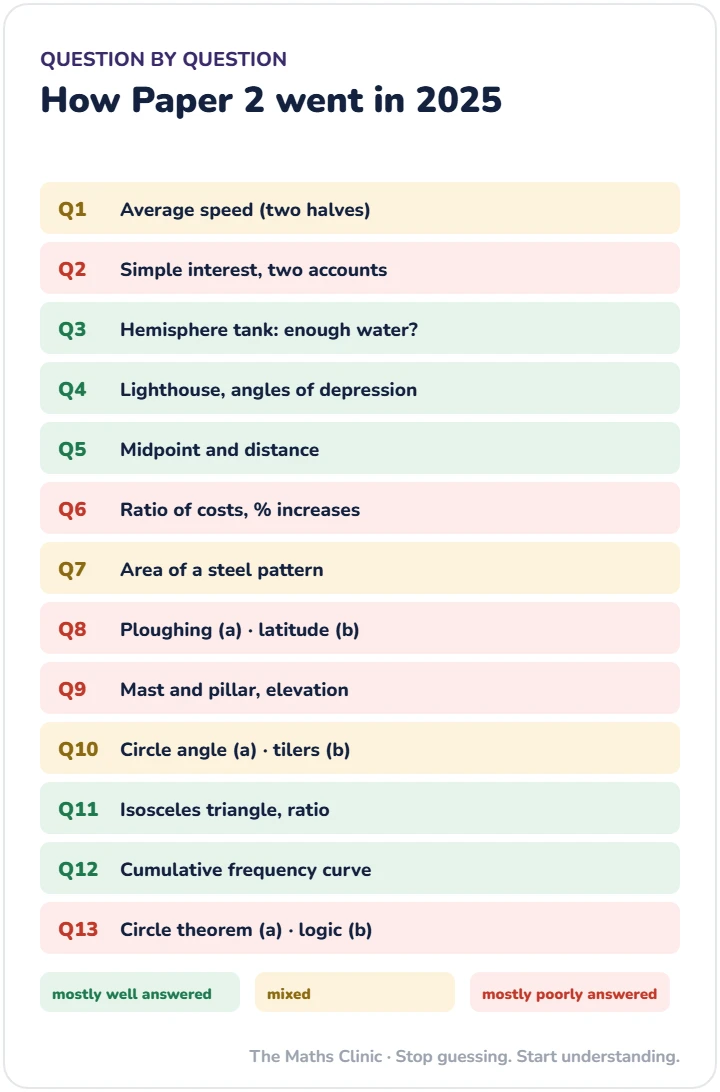
| Q | Topic | What the examiners reported |
|---|---|---|
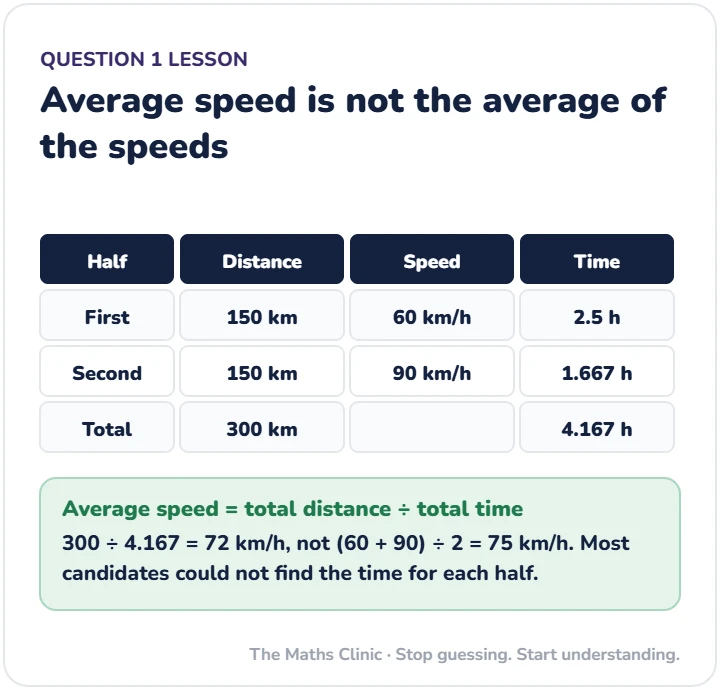
| 1 | Average speed over two halves of a journey | Average. Most could not find the time for each half; part (b) was mostly correct. |
| 2 | Simple interest in two accounts | Poorly answered. Candidates could not work out each interest to form the equation. |
| 3 | Water in a hemispherical tank | Well answered, but most could not give the correct conclusion. |
| 4 | Angles of depression from a lighthouse | Well answered. Some could not draw the diagram. |
| 5 | Midpoint and length of a line | Answered correctly by most. |
| 6 | Costs in a ratio, then percentage increases | Part (a) mixed; part (b) poorly answered. |
| 7 | Area and perimeter of a steel pattern | Part (a) well answered; many poor solutions overall. |
| 8 | (a) Ploughing a farm (b) distance along a meridian | (a) Not well answered. (b) Average. |
| 9 | Angles of elevation of a mast and a pillar | Poorly answered. Many could not draw the diagram. |
| 10 | (a) Angle in a circle (b) two tilers working together | (a) Most did not answer it. (b) Mixed. |
| 11 | Isosceles triangle with sides in a ratio | Popular and well answered. |
| 12 | Cumulative frequency curve of test marks | Popular and well answered; some could not build the table. |
| 13 | (a) Circle theorems (b) logic with a Venn diagram | (a) Few did well; the report notes candidates’ dislike for geometry and trigonometry. (b) Poorly answered. |
Notice one thing: the summary lists cumulative frequency tables as a weakness, yet Question 12 was mostly well answered. That is common in these reports. The question comments describe the actual scripts, so they are the better guide to what to practise.
Weakness 1: showing information in a diagram
This is the weakness that cost the most. Question 9 (a mast and a pillar seen from the midpoint between them) was poorly answered because many candidates could not draw the diagram, and every later part depended on it. Question 4, a similar trigonometry question, was well answered by candidates who drew it correctly.
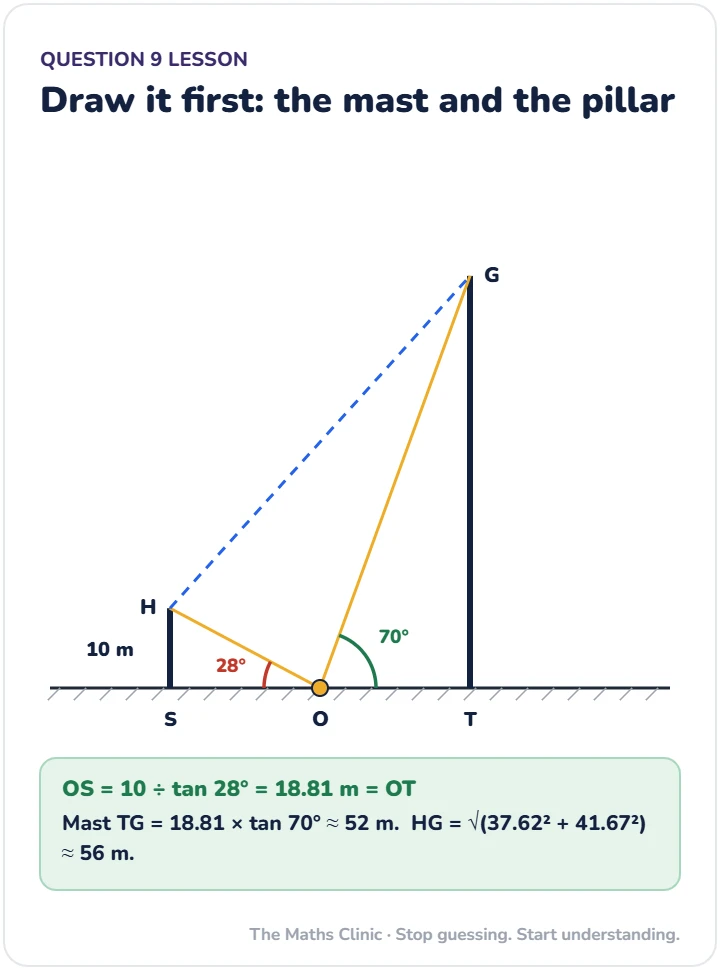
The fix: draw a horizontal at every observer, mark each angle where it is measured from, and only then choose a ratio. Full lessons: Angle of Elevation and Depression and Elevation and Depression Questions With Solutions.
Weakness 2: word problems and deductions from real life
Questions 1, 2, 6 and 8(a) were all word problems, and all four lost marks at the same step: turning the story into the right expression or equation. In Question 1, most candidates could not find the time for each half of the journey, so they could not find the average speed.
Question 3 shows the “deduction” part of this weakness. Most candidates calculated correctly, then did not state what the numbers meant.
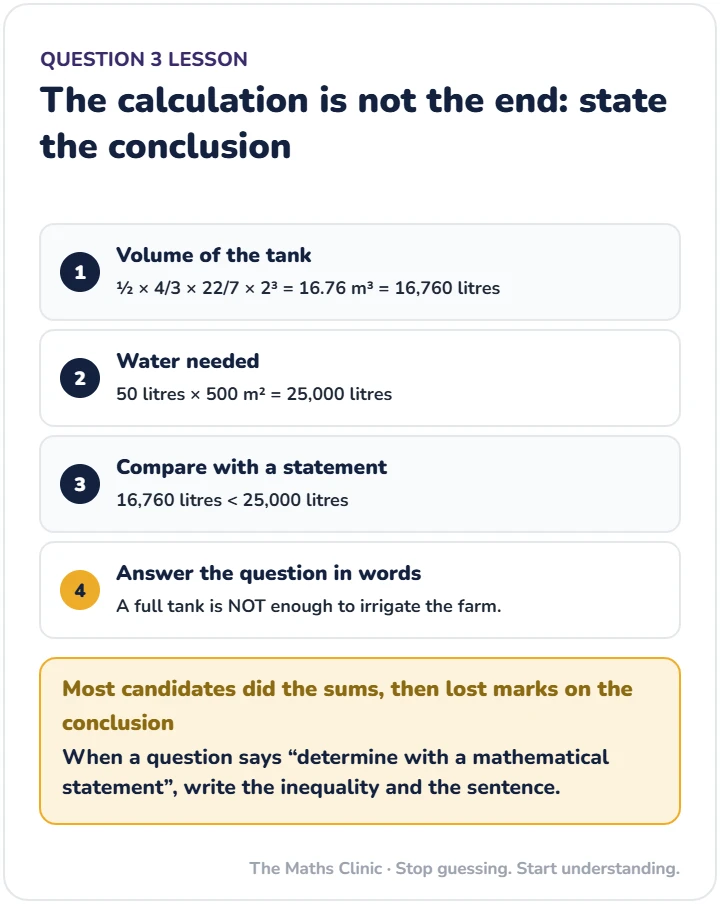
The fix: write what each number means before you calculate, and finish with a sentence. See Word Problems in WASSCE Mathematics: Questions and Answers.
Weakness 3: simple interest applications
Question 2 was poorly answered. Candidates could not work out the interest from each account, so they could not form the equation.
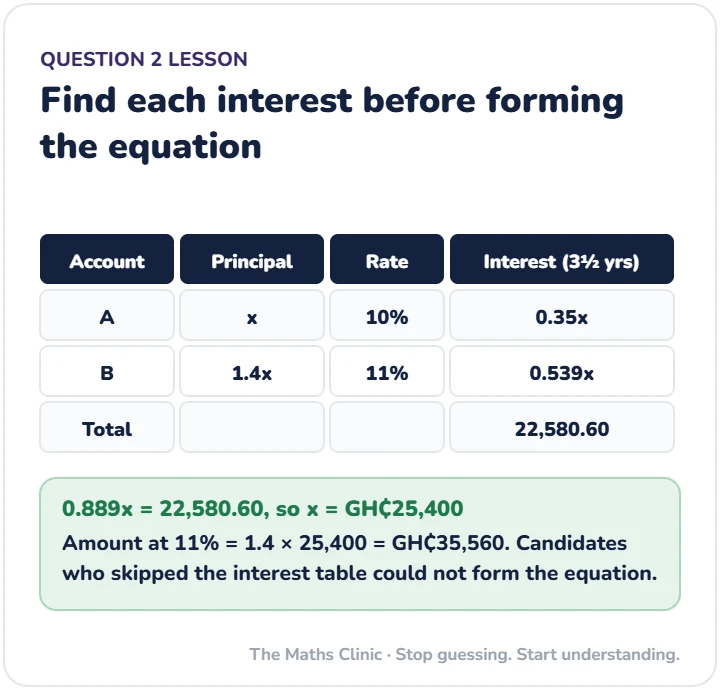
The fix: name one unknown, find each interest separately, then add. See Simple Interest Questions With Answers.
Weakness 4: cumulative frequency tables
The summary names constructing a cumulative frequency table as a weakness, and some candidates in Question 12 could not build it. The rule is simple: add the frequencies as you go, and plot against the upper class boundary. See the Graphs Clinic.
Weakness 5: global mathematics
Question 8(b) asked for the distance between two towns on the same line of longitude, and was averagely answered. Note that latitude and longitude were not found in the 2023 SHS curriculum, so check with your teacher whether your examination still includes them.
Weakness 6: geometry and circle theorems
Questions 10(a) and 13(a) were circle-theorem questions that most candidates either avoided or answered poorly, and the report links this to candidates’ dislike for geometry and trigonometry. Avoiding a topic is a decision you can change. See the Mensuration and Geometry Clinic.
What the examiners recommend
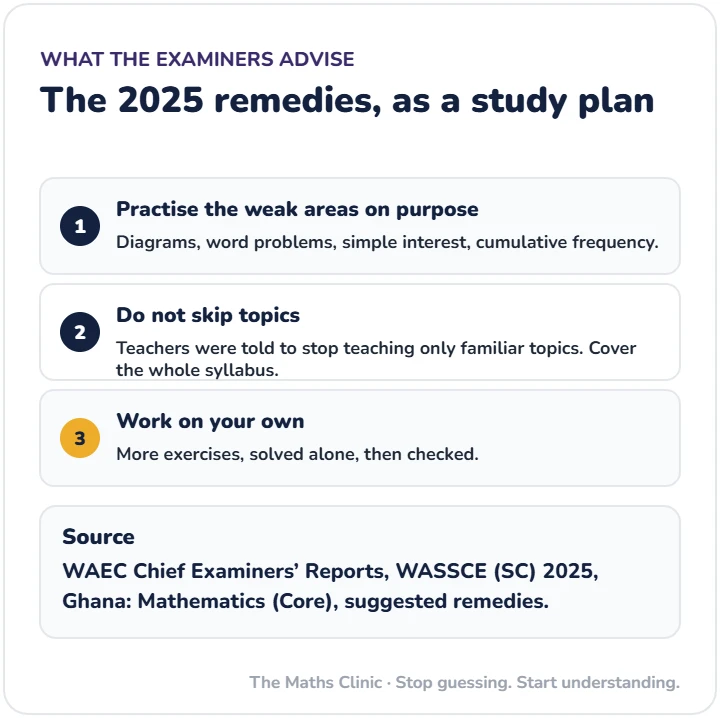
- Teachers should give more exercises on the weak areas and guide candidates through them.
- Teachers should stop teaching only the topics they are comfortable with.
- Candidates should be given more exercises and encouraged to practise on their own.
For a learner, that becomes: practise the six weak areas on purpose, do not skip topics, and solve questions alone before you check them.
Frequently asked questions
Where can I download the WAEC Chief Examiner’s Report 2025?
WAEC Ghana publishes the reports on its website. The 2025 WASSCE (School Candidates) reports are here: WAEC Chief Examiners’ Reports, WASSCE (SC) 2025, Ghana: Mathematics (Core).
Was Mathematics performance better in 2025?
The report describes performance as “satisfactory and encouraging” compared with the previous year. Pass-rate figures are published separately by WAEC with the results.
How should I use a Chief Examiner’s Report?
Find the questions that were poorly answered, solve them yourself, and compare your working with the report’s expected solution. The weaknesses repeat from year to year, so they tell you what to practise. See 12 years of reports, year by year.
Source: WAEC Chief Examiners’ Reports, WASSCE (SC) 2025, Ghana: Mathematics (Core). Question descriptions are summarised; quotations are short extracts from the report.
Keep learning
- What WAEC Examiners Report: 12 Years of Mathematics (2011–2025)
- Angle of Elevation and Depression Questions With Solutions
- How to Pass WASSCE and NOVDEC Core Maths
📚 12 years of WAEC Chief Examiners’ reports, in one place
✏️ Practise in the Practice Zone

Written by
Dickson Sarpong
NTC-certified SHS Mathematics teacher in Ghana with WAEC marking experience, and author of The Bridge Series textbooks. Every lesson here is built around the mistakes WAEC examiners keep reporting.
About DicksonStuck? Ask a question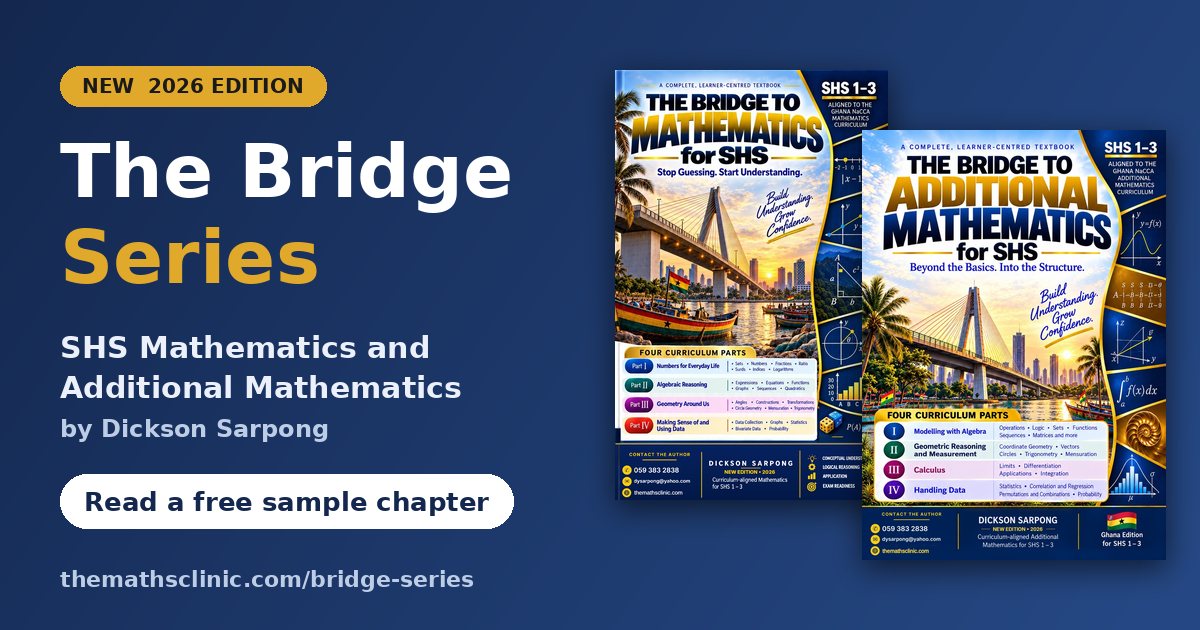
Want the whole topic, step by step? My textbooks, The Bridge to Mathematics and The Bridge to Additional Mathematics for SHS, follow the new curriculum and rebuild the basics as you go.
Read a free chapter →