Struggling with WASSCE Maths? Stop guessing. Let’s fix the gap step by step.
WAEC Chief Examiner’s Report 2023 for Mathematics: What It Says and How to Win the Marks Back
A teacher’s plain-English guide to the 2023 WAEC Chief Examiner’s Report for Mathematics (Core), with a three-year comparison of what keeps going wrong.

📚 Part of our WAEC report series: 12 years of Chief Examiners’ reports, year by year.
Quick answer: what does the WAEC Chief Examiner’s Report 2023 say about Mathematics (Core)?
The examiners found the paper comparable to the previous year and described performance as better and encouraging on the whole. Candidates were strong in vectors and transformations, three-set problems, probability and bearings. They were weak in plane geometry, translating word problems into equations, illustrating information on a diagram, and logical reasoning.
This guide takes the 2023 report for Mathematics (Core), Paper 2, question by question, in plain English. It ends with something no single report can show you: three years of reports side by side, and the weaknesses that keep coming back.
Everything below comes from the report. The question descriptions are summarised in my own words.
The 2023 report in one minute
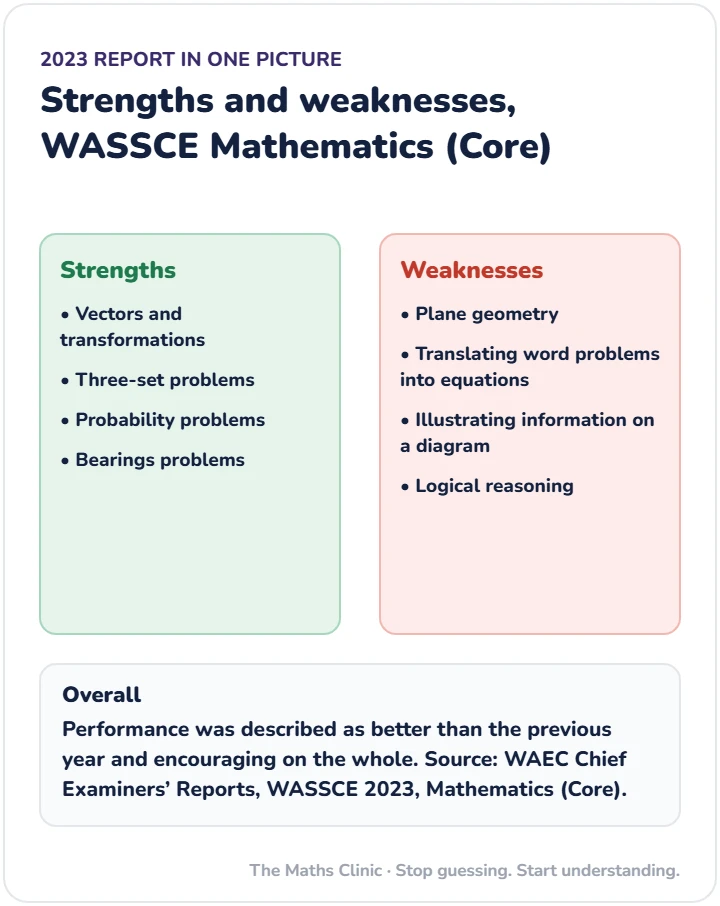
| Strengths | Weaknesses |
|---|---|
| Vectors and transformations | Plane geometry |
| Three-set problems | Translating word problems into equations |
| Probability problems | Illustrating information on a diagram |
| Bearings problems | Logical reasoning |
Question by question: where the marks went
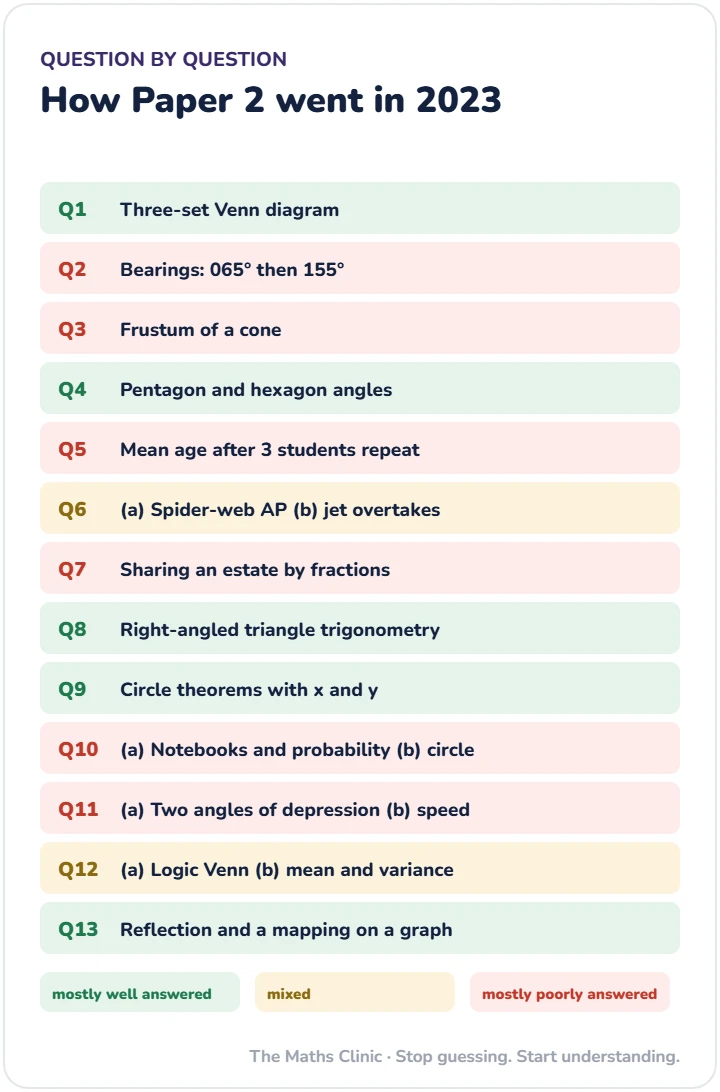
| Q | Topic | What the examiners reported |
|---|---|---|
| 1 | Three-set Venn diagram (musical instruments) | Drawn correctly by most, who then answered the rest. |
| 2 | Bearings: 2t km on 065°, then 3t km on 155° | Most could not draw the diagram, so could not find the bearing. |
| 3 | Frustum of a cone | Poorly answered. Many used 36 cm instead of 18 cm for the full height. |
| 4 | Angles in a regular pentagon and hexagon | Answered satisfactorily by most. |
| 5 | Mean age after three students repeat | Most found it challenging and could not form the equation. |
| 6 | (a) Arithmetic progression (b) a jet overtaking a plane | (a) Popular and easily done. The report says little about (b). |
| 7 | Sharing an estate by fractions | Unpopular. Most could not work out each person’s fraction. |
| 8 | Right-angled triangle trigonometry | Easily done by most, though some did not round as asked. |
| 9 | Circle theorems with x and y | Attempted by most; above-average performance. |
| 10 | (a) Notebooks and probability (b) circle angles | (a) Most could not link the numbers; many multiplied for “K or L”. (b) Challenging. |
| 11 | (a) Two angles of depression (b) speed and time | (a) Many diagrams were missing or inaccurate. (b) Many could not form the equation. |
| 12 | (a) Logic with a Venn diagram (b) mean and variance | (a) Unpopular; the Venn diagram was drawn wrongly. (b) Good, but rounding errors. |
| 13 | Reflection and a mapping on a graph | Very popular and well answered; a few used the wrong scale. |
Weakness 1: illustrating information on a diagram
Questions 2 and 11(a) both depended on a diagram, and both went wrong for that reason. In Question 2 most candidates could not draw the journey; in Question 11(a) many diagrams were missing or inaccurate.
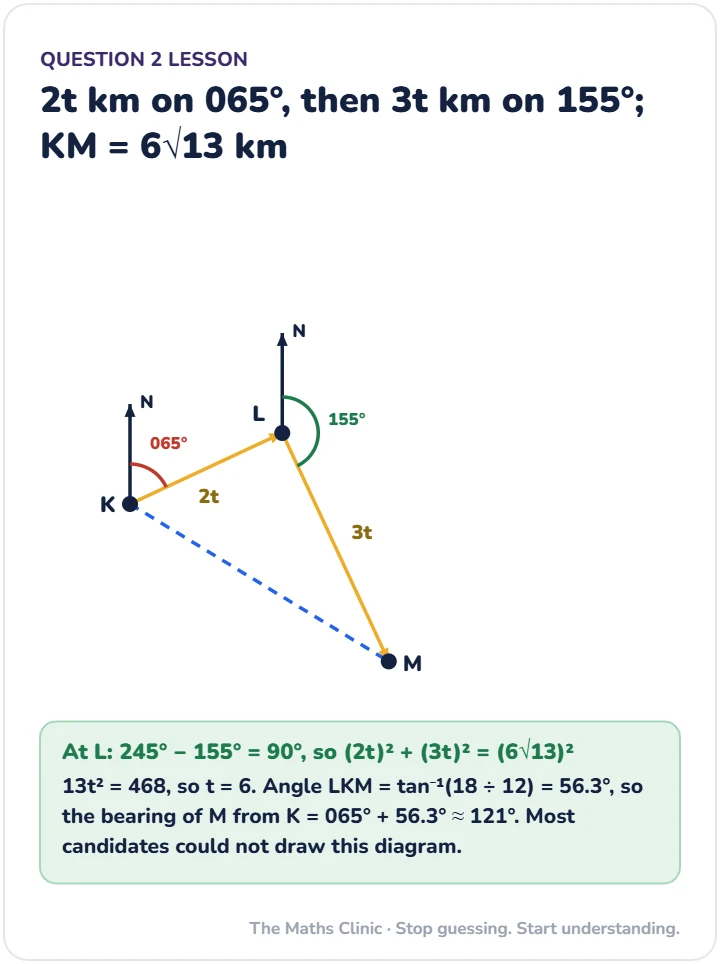
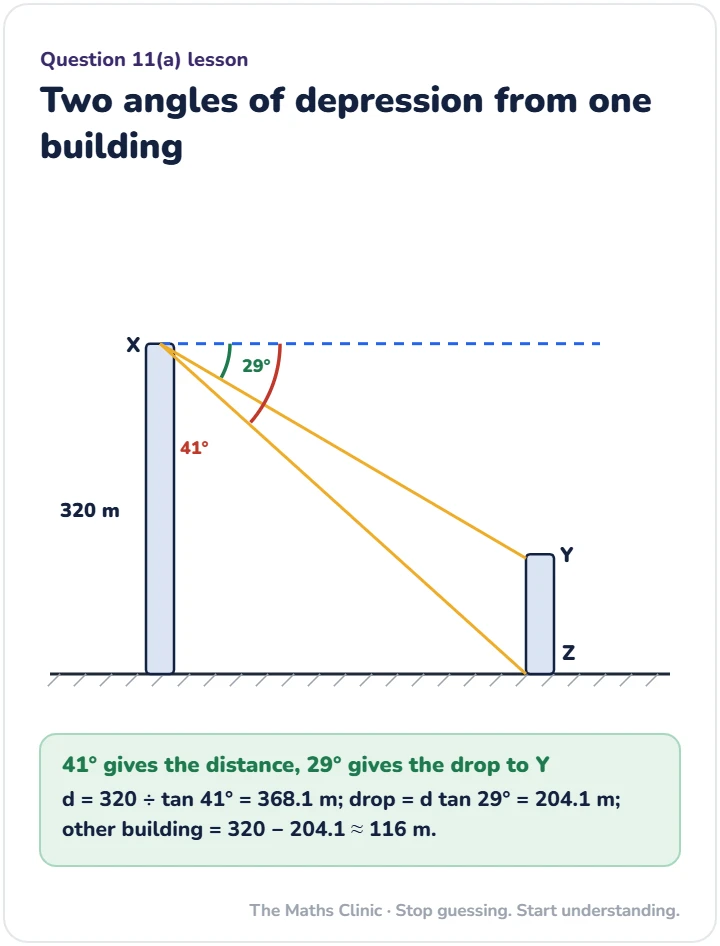
The fix: draw the horizontal or north line at every point first. See Angle of Elevation and Depression Questions With Solutions and Bearings in Mathematics.
Weakness 2: translating word problems into equations
Questions 5, 7, 10(a) and 11(b) all lost marks at the same step: turning the story into an equation.
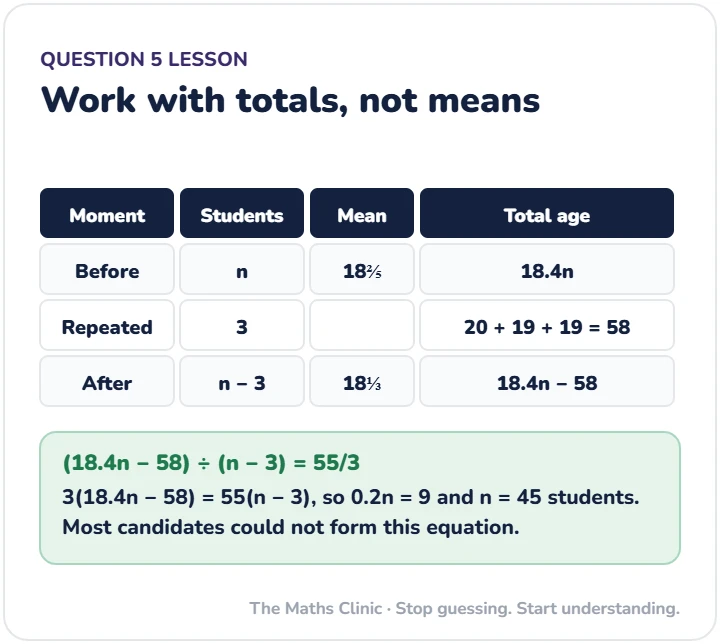
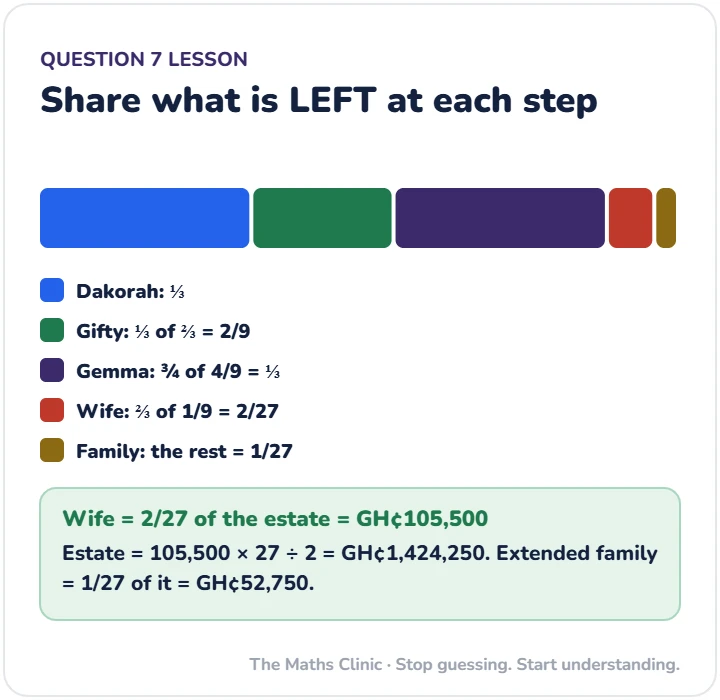
The fix: write what each quantity means before you calculate. See Word Problems in WASSCE Mathematics: Questions and Answers.
Weakness 3: plane geometry and the frustum
Question 10(b) on circle angles was challenging, and Question 3 on the frustum of a cone was poorly answered. Candidates who sketched the full cone and used similar shapes found the full height (18 cm) correctly; many used 36 cm. Note that the frustum was not found in the 2023 SHS curriculum, so check whether it is still in your examination.
Weakness 4: logical reasoning
Question 12(a) asked candidates to draw a Venn diagram for statements such as “most businessmen are rich” and judge whether conclusions were valid. It was unpopular, and the diagrams were drawn wrongly. Logical reasoning was poorly answered again in 2025. See the Sets and Logic Clinic.
Cheap marks that were lost
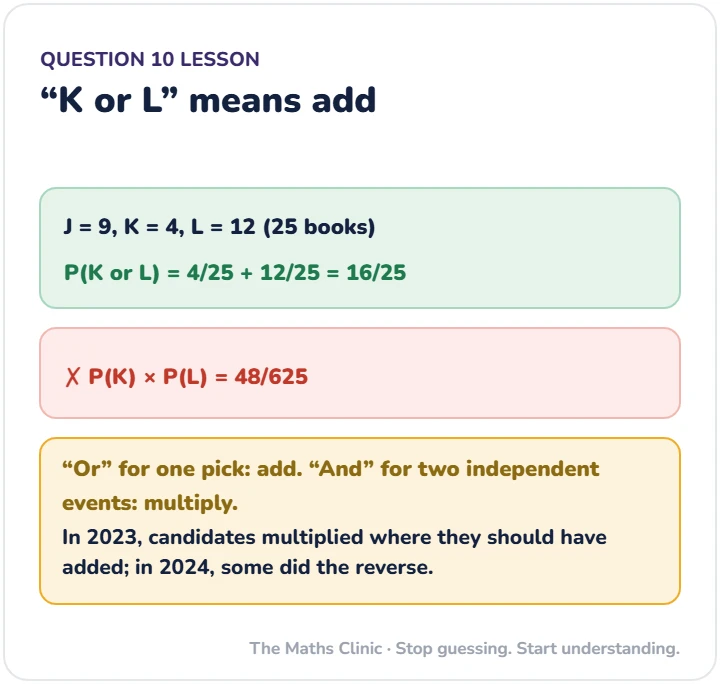
Rounding cost marks in Questions 8 and 12(b). In Question 10(a)(ii) many candidates multiplied probabilities for “K or L”. These are marks you can protect simply by reading what the question asks.
Three years of reports compared
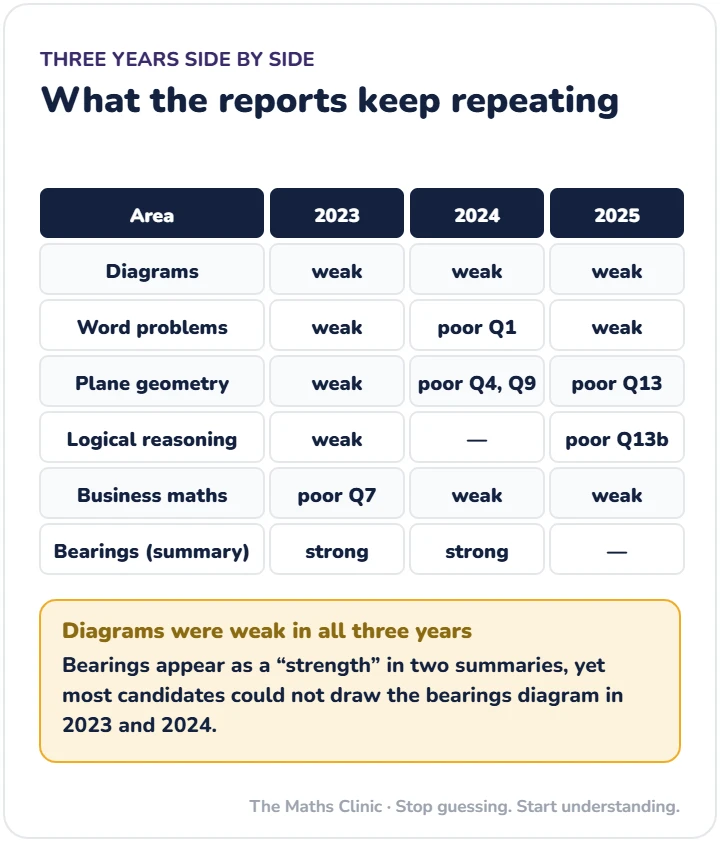
Read together, the reports are clear. Diagrams were a weakness in all three years. Word problems and plane geometry caused poor answers every year. Bearings appear as a “strength” in two summaries, yet the bearings diagram defeated most candidates in 2023 and 2024. Read the other two years: 2024 explained and 2025 explained.
What the examiners recommend
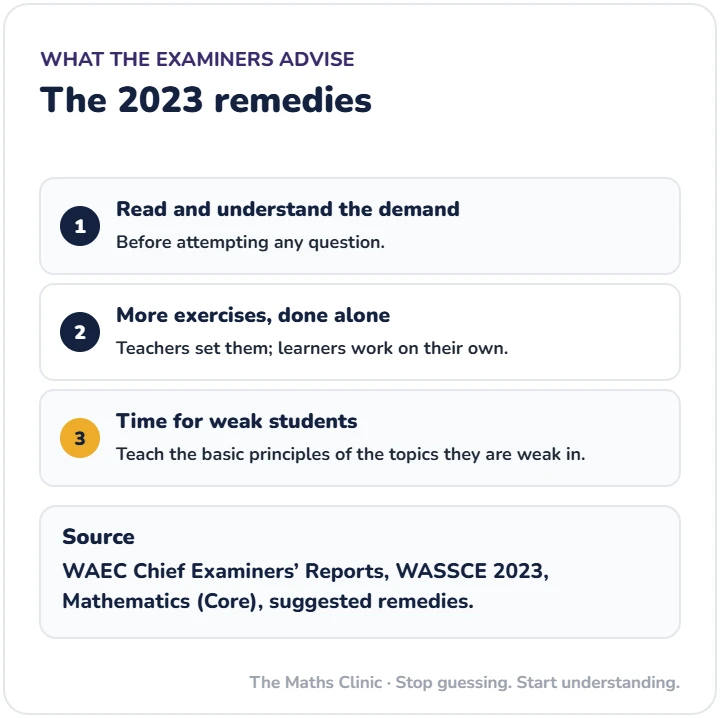
- Candidates should read carefully and understand what each question demands before attempting it.
- Teachers should give more exercises and encourage candidates to work on their own.
- Teachers should make time for weak students and teach the basic principles of the topics they are weak in.
Frequently asked questions
Was Mathematics performance better in 2023?
Yes. The report describes performance as better than the previous year and encouraging on the whole.
Which 2023 questions should I practise?
Question 2 (bearings), Question 5 (mean), Question 7 (fractions of what remains) and Question 11 (depression and speed). They were the poorly answered ones, and the same skills were tested again in 2024 and 2025.
Source: WAEC Chief Examiners’ Reports, WASSCE 2023, Mathematics (Core) 2, published by WAEC. Question descriptions are summarised; quotations are short extracts from the report.
Keep learning
- WAEC Chief Examiner’s Report 2024 for Mathematics
- WAEC Chief Examiner’s Report 2025 for Mathematics
- Angle of Elevation From Two Points
📚 12 years of WAEC Chief Examiners’ reports, in one place
✏️ Practise in the Practice Zone

Written by
Dickson Sarpong
NTC-certified SHS Mathematics teacher in Ghana with WAEC marking experience, and author of The Bridge Series textbooks. Every lesson here is built around the mistakes WAEC examiners keep reporting.
About DicksonStuck? Ask a question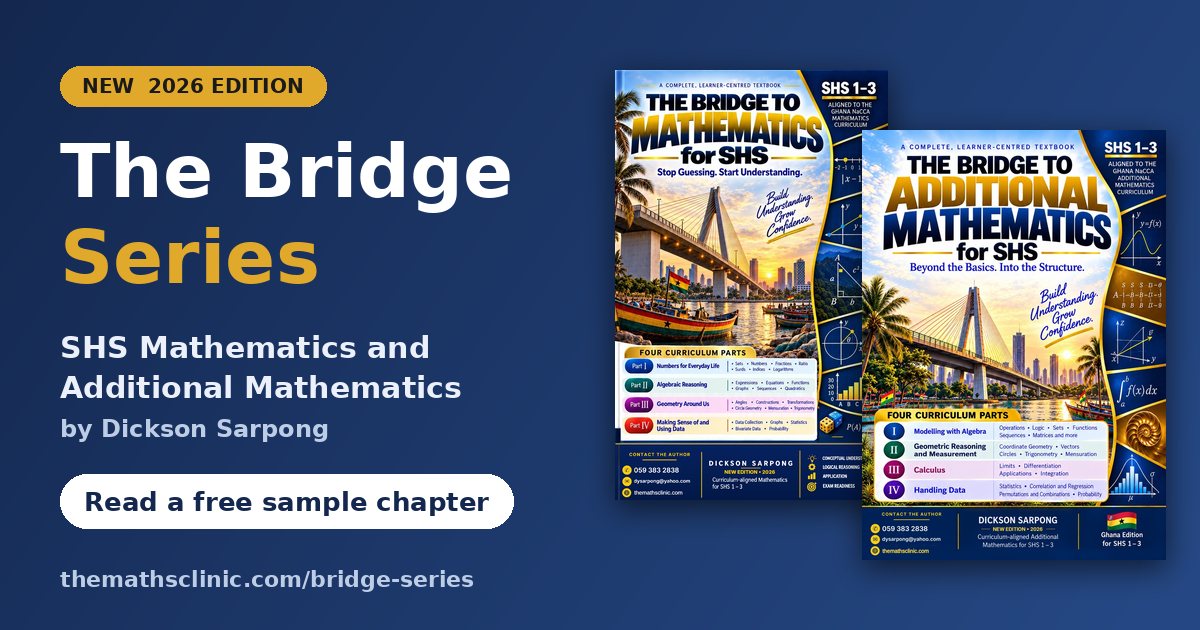
Want the whole topic, step by step? My textbooks, The Bridge to Mathematics and The Bridge to Additional Mathematics for SHS, follow the new curriculum and rebuild the basics as you go.
Read a free chapter →