Struggling with WASSCE Maths? Stop guessing. Let’s fix the gap step by step.

Bearings and Distance Questions: Two-Leg Journeys Step by Step
A ship or a cyclist travels two legs on two bearings. How far is it from the start, and on what bearing? Two methods, worked step by step.

📚 Part of the Trigonometry Clinic: every lesson on trigonometry, elevation, depression and bearings, in one place.
Quick answer: how do you find the distance and bearing after a two-leg journey?
Draw the journey with a north line at the start of each leg. If the angle at the turn is 90°, use Pythagoras for the distance and tan for the angle. If it is not 90°, split each leg into components (east = d sin θ, north = d cos θ, where θ is the bearing), add them, then find the distance \sqrt{E^2+N^2} and the bearing \tan^{-1}(E\div N).
“A ship sails from A on a bearing of … for … km, then changes course …” is one of the most common WASSCE bearings questions. The examiners report that candidates lose it in the diagram, not in the arithmetic. Here is a method that works every time.
The question describes a journey in two parts and asks how far the traveller is from the start, and in what direction. Many candidates add the two distances, or average the two bearings. The straight-line distance and the final bearing need a diagram and one of two methods, both shown here with every step.
Example 1: when the turn is a right angle
A ship sails from A on a bearing of 072° for 15 km to B, then on a bearing of 162° for 9 km to C. Find the distance AC and the bearing of C from A, to one decimal place.
Step 1: draw. North line at A; turn 72° clockwise; draw AB = 15 km. New north line at B; turn 162° clockwise; draw BC = 9 km.
Step 2: the angle at the turn. The bearing of A from B is 072° + 180° = 252°. The angle between the two legs at B is 252° − 162° = 90°.
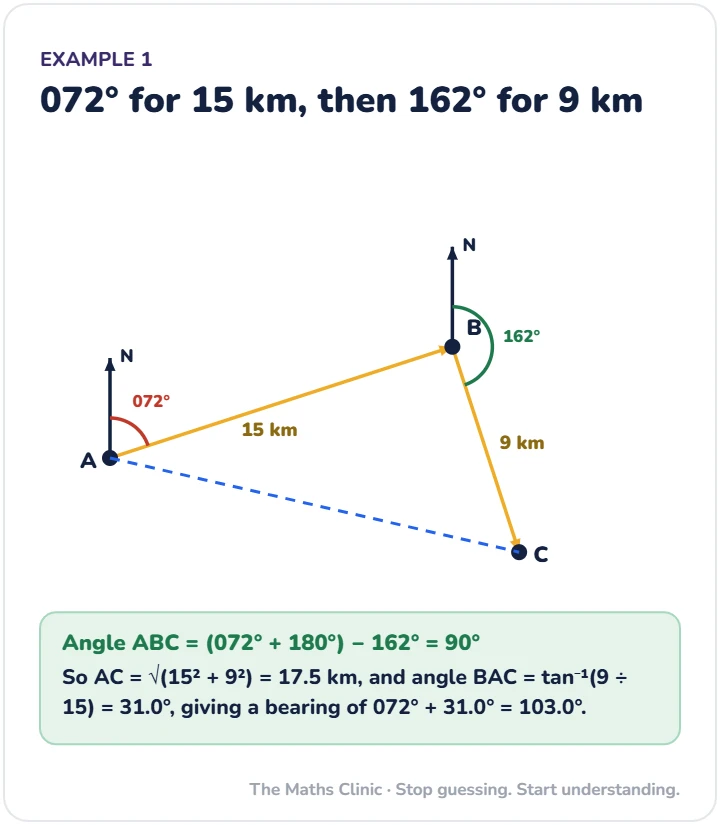
Step 3: distance by Pythagoras. AC² = 15² + 9² = 225 + 81 = 306, so AC = √306 = 17.49 km.
AC=\sqrt{15^2+9^2}=17.5\text{ km}Step 4: the angle at A. In the right-angled triangle, tan(∠BAC) = opposite ÷ adjacent = 9 ÷ 15 = 0.6, so ∠BAC = 31.0°.
\angle BAC=\tan^{-1}\tfrac{9}{15}=31.0^\circStep 5: the bearing. C is clockwise from the line AB (the ship turned right at B), so add: 072° + 31.0° = 103.0°.
\text{bearing of }C=103.0^\circCheck. AC (17.5 km) is longer than either leg but shorter than 15 + 9 = 24 km. ✔
The wrong way. Giving 24 km. That is the distance travelled, not the straight-line distance from A.
When the turn is not a right angle: components
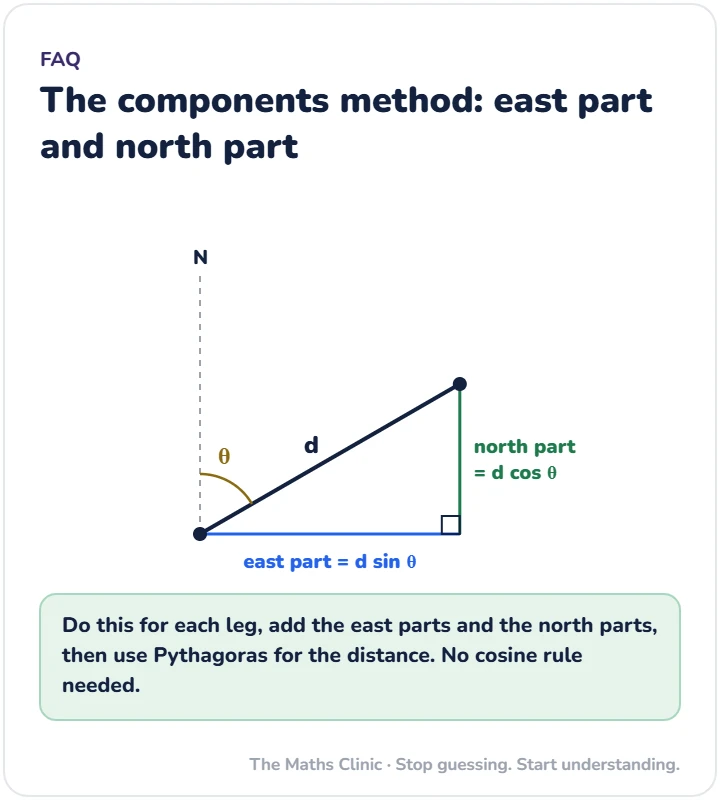
Most two-leg journeys do not turn through exactly 90°. Then the cleanest method is to split each leg into an east part and a north part.
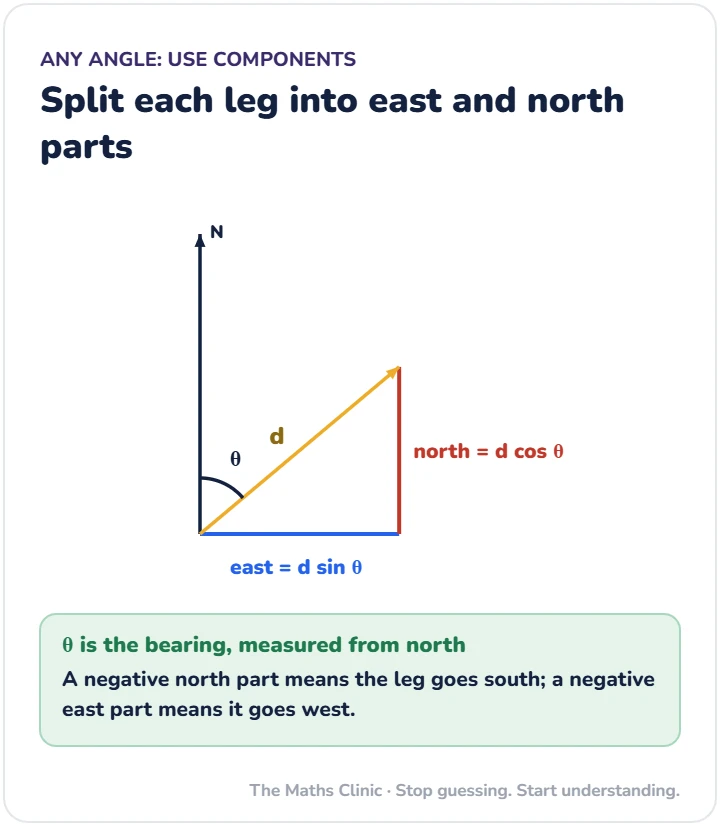
Example 2: using components
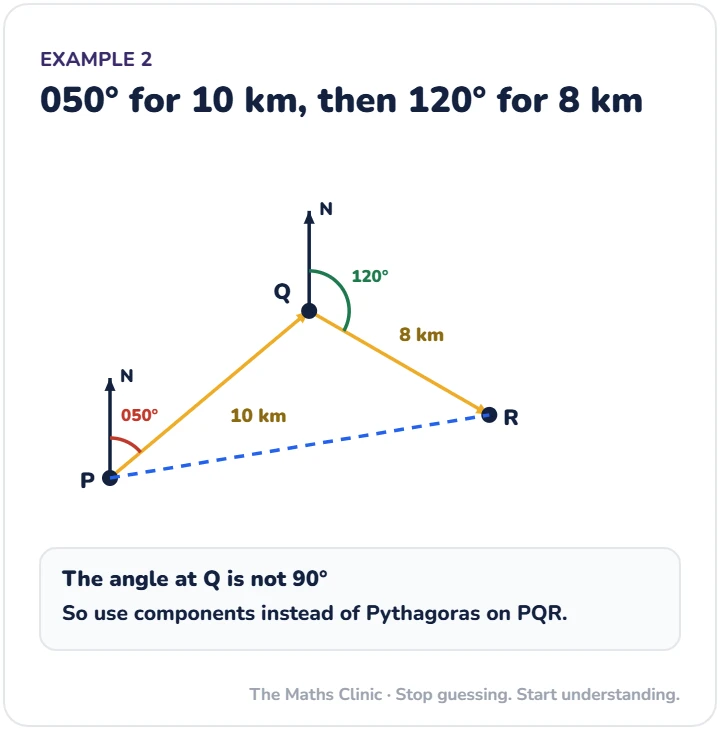
A cyclist rides from P on a bearing of 050° for 10 km to Q, then on a bearing of 120° for 8 km to R. Find the distance PR and the bearing of R from P.
Step 1: east and north parts of leg 1 (bearing 050°, 10 km). East = 10 × sin 50° = 10 × 0.7660 = 7.660. North = 10 × cos 50° = 10 × 0.6428 = 6.428.
Step 2: east and north parts of leg 2 (bearing 120°, 8 km). East = 8 × sin 120° = 8 × 0.8660 = 6.928. North = 8 × cos 120° = 8 × (−0.5) = −4.000. The minus sign means this leg goes south.
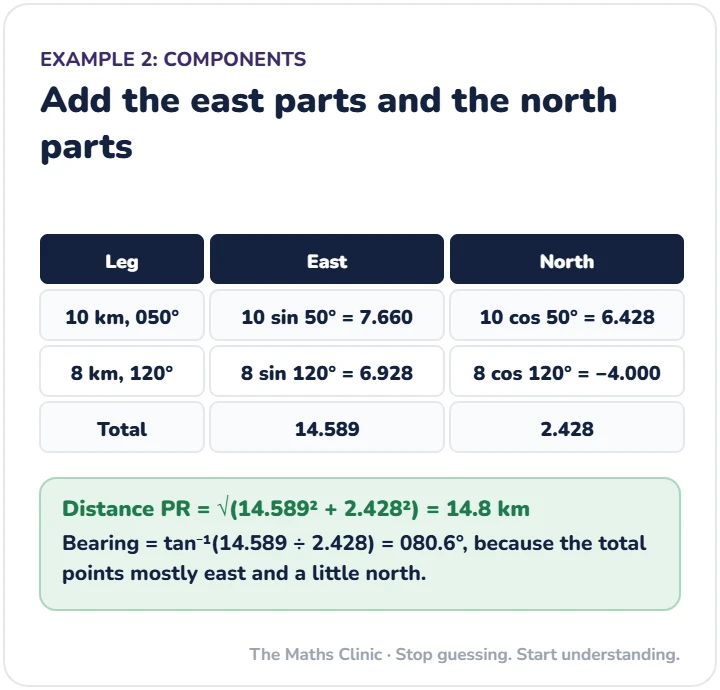
Step 3: add the parts. Total east E = 7.660 + 6.928 = 14.588 ≈ 14.59. Total north N = 6.428 − 4.000 = 2.428 ≈ 2.43.
Step 4: distance. PR² = 14.59² + 2.43² = 212.9 + 5.9 = 218.8, so PR = 14.8 km.
PR=\sqrt{14.59^2+2.43^2}=14.8\text{ km}Step 5: bearing. E and N are both positive, so R is north-east of P, and the bearing is the angle from north: tan⁻¹(E ÷ N) = tan⁻¹(14.59 ÷ 2.43) = 80.6°.
\text{bearing}=\tan^{-1}\tfrac{14.59}{2.43}=080.6^\circCheck: this method also gives 17.5 km on 103.0° for Example 1, so you can use it for every two-leg question.
The method in five steps
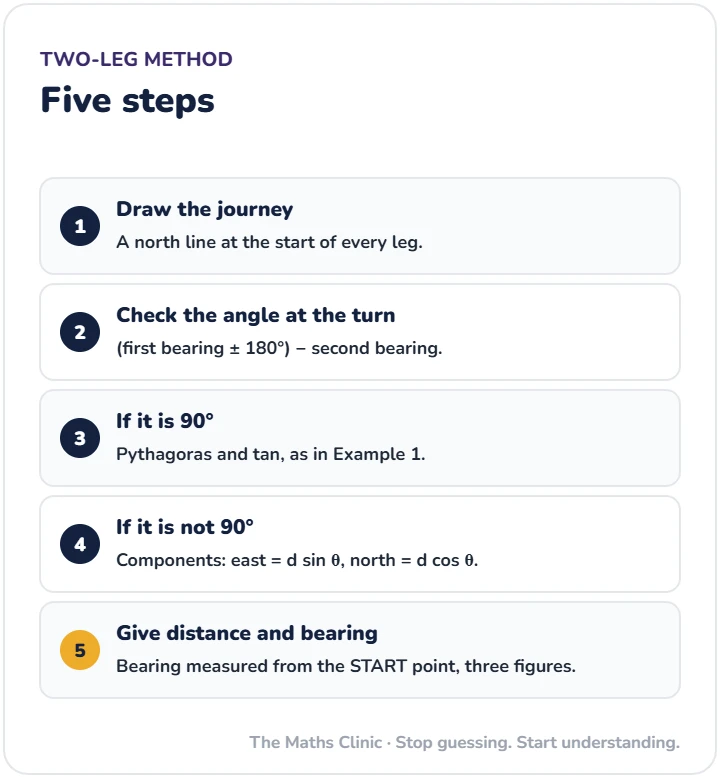
The mistakes that cost marks

- Adding the two distances.
- Averaging the two bearings.
- Measuring the second bearing at the start point instead of at the turn.
- Giving the bearing of the start from the end instead of the end from the start.
📋 What the WAEC Chief Examiner reported
- 2021: in a cyclist’s two-leg journey, illustrating the journey was not correctly answered by most candidates.
- 2023 and 2024: most candidates could not draw the bearings diagram, even though bearings were listed as a strength.
- 2016: a bearings question was poorly done because candidates could not analyse it.
What WAEC recommends
In 2021 the Chief Examiner advised: “Candidates should be advised to read carefully and understand the demands of questions before attempting them.” In journey questions, that means drawing each leg from its own north line, in the order the question gives them, before any calculation.
How to win these marks back
- Draw a new north line at the start of every leg.
- Find the angle at the turn from the bearings, never by eye.
- Measure the final bearing from the starting point.
- Give bearings with three figures and distances to the accuracy asked.
Source: WAEC Chief Examiners’ Reports, Mathematics (Core), 2016, 2021, 2023, 2024
Try it now
Cover the solutions. Draw each journey with a north line at the start of every leg, then decide: right angle or components?
Question 1
A boat sails 6 km on a bearing of 030° and then 8 km on a bearing of 120°. Find its distance and bearing from the start.
Question 2
A hiker walks 12 km due east and then 5 km due north. Find the distance and bearing from the start.
Question 3
A car travels 7 km on a bearing of 040° and then 5 km on a bearing of 100°. Find its distance and bearing from the start.
Question 4
A cyclist rides from P on a bearing of 048° for 12 km to Q, then on a bearing of 138° for 7 km to R. Find PR.
Question 5 (WASSCE style)
A ship sails from A on a bearing of 120° for 10 km to B, then on a bearing of 210° for 6 km to C. Illustrate the information in a diagram and find (a) |AC|, (b) the bearing of C from A.
Question 6 (real life)
A delivery rider leaves the shop and rides 4 km due north, then 3 km due east. How far is the rider from the shop, and on what bearing?
Solutions
Solution 1
Back bearing at the turn: 030° + 180° = 210°. Angle at the turn: 210° − 120° = 90°. Distance² = 6² + 8² = 100, so distance = 10 km. Angle at the start: tan⁻¹(8 ÷ 6) = 53.1°. The boat turned clockwise, so bearing = 030° + 53.1° = 083.1°.
Solution 2
East then north makes a right angle. Distance² = 12² + 5² = 144 + 25 = 169, so distance = 13 km. Angle from east: tan⁻¹(5 ÷ 12) = 22.6°. Bearings are measured from north, so bearing = 090° − 22.6° = 067.4°.
Solution 3
Leg 1: E = 7 sin 40° = 4.4995, N = 7 cos 40° = 5.3623. Leg 2: E = 5 sin 100° = 4.9240, N = 5 cos 100° = −0.8682. Totals: E = 9.4235, N = 4.4941. Distance = √(9.4235² + 4.4941²) = √109.0 = 10.44 km. Both positive, so bearing = tan⁻¹(9.4235 ÷ 4.4941) = 064.5°.
Solution 4
Back bearing at Q: 048° + 180° = 228°. Angle at Q: 228° − 138° = 90°. PR² = 12² + 7² = 144 + 49 = 193, so PR = 13.9 km.
Solution 5
Back bearing at B: 120° + 180° = 300°. Angle at B: 300° − 210° = 90°. (a) |AC|² = 10² + 6² = 136, so |AC| = 11.66 km. (b) Angle at A: tan⁻¹(6 ÷ 10) = 31.0°. The ship turned clockwise, so bearing = 120° + 31.0° = 151.0°. Check with components: E = 10 sin 120° + 6 sin 210° = 8.660 − 3 = 5.660; N = 10 cos 120° + 6 cos 210° = −5 − 5.196 = −10.196; distance √136 ✔; E positive, N negative, so bearing = 180° − tan⁻¹(5.660 ÷ 10.196) = 180° − 29.0° = 151.0° ✔
Solution 6
North then east makes a right angle. Distance² = 4² + 3² = 25, so 5 km. Angle from north: tan⁻¹(3 ÷ 4) = 36.9°. Bearing = 036.9°.
📘 New SHS curriculum link
Bearings and distances use Year 1 of the new SHS Mathematics curriculum (1.3.1.LO.1: parallel lines and Pythagoras’ theorem) and Year 2 (2.3.2.LO.2: using trigonometric ratios to calculate distances).
For parents
Ask your child: “If I walk 3 km and then 4 km, am I always 7 km from home?” The answer is no: it depends on the turn. If they can explain that with a sketch, they understand the most common bearings mistake.
Frequently asked questions
Do I need the cosine rule for bearings?
Not with the components method, which uses only sin, cos and Pythagoras. The cosine rule was not found in the 2023 SHS curriculum.
How do I know which quadrant the final bearing is in?
Look at the signs of the totals. East positive and north positive: between 000° and 090°. East positive and north negative: between 090° and 180°. Draw a quick sketch to confirm.
What to do next
If the bearing of the start from the end confuses you, read Back Bearing: How to Find the Bearing of A From B, then practise in the Practice Zone.
Keep learning
- Back Bearing: How to Find the Bearing of A From B
- “Illustrate the Information in a Diagram”
- Bearings in Mathematics: Questions and Answers With Diagrams
📚 See every lesson in the Trigonometry Clinic
✏️ Practise trigonometry in the Practice Zone

Written by
Dickson Sarpong
NTC-certified SHS Mathematics teacher in Ghana with WAEC marking experience, and author of The Bridge Series textbooks. Every lesson here is built around the mistakes WAEC examiners keep reporting.
About DicksonStuck? Ask a question
Want the whole topic, step by step? My textbooks, The Bridge to Mathematics and The Bridge to Additional Mathematics for SHS, follow the new curriculum and rebuild the basics as you go.
Read a free chapter →