Struggling with WASSCE Maths? Stop guessing. Let’s fix the gap step by step.

Trigonometric Ratios of Special Angles (30°, 45°, 60°) Without a Calculator
The exact values of sin, cos and tan for 30°, 45° and 60°, where they come from, and how to simplify no-calculator WASSCE expressions.

📚 Part of the Trigonometry Clinic: every lesson on trigonometry, elevation, depression and bearings, in one place.
Quick answer: what are the trigonometric ratios of the special angles?
\sin 30^\circ=\tfrac12, \cos 30^\circ=\tfrac{\sqrt3}{2}, \tan 30^\circ=\tfrac{\sqrt3}{3}; \sin 45^\circ=\cos 45^\circ=\tfrac{\sqrt2}{2}, \tan 45^\circ=1; \sin 60^\circ=\tfrac{\sqrt3}{2}, \cos 60^\circ=\tfrac12, \tan 60^\circ=\sqrt3. They come from two simple triangles, shown below.
Some WASSCE questions say “without using mathematical tables or calculators” and then ask you to simplify an expression such as \sin 60^\circ\cos 30^\circ+\sin 30^\circ\cos 60^\circ. These are some of the quickest marks on the paper, if you know the exact values. You do not need to memorise a table. You can rebuild it from two triangles in less than a minute.
Then the question arrives: “Without using tables or a calculator, evaluate sin 60° cos 30° + sin 30° cos 60°.” You know what sin and cos are. But what is sin 60° exactly? And when √3 meets √3, what do you get? This lesson builds the values from scratch and shows every surd step, so nothing is left to memory alone.
Where the 45° values come from
Draw a square with sides of 1 unit. Cut it along a diagonal. You get a right-angled triangle with two sides of 1 and two angles of 45° (the diagonal cuts the 90° corner in half).
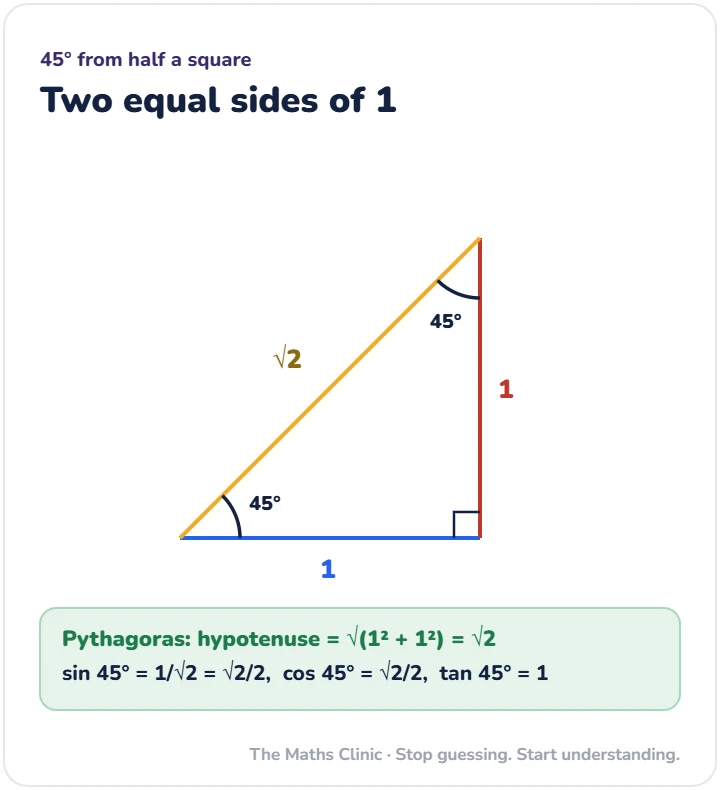
- Find the long side (the hypotenuse) with Pythagoras: 1² + 1² = 2, so the hypotenuse is √2.
- sin 45° = opposite ÷ hypotenuse = 1 ÷ √2.
- Rationalise: multiply top and bottom by √2. (1 × √2) ÷ (√2 × √2) = √2 ÷ 2. So sin 45° = √2/2.
- cos 45° = adjacent ÷ hypotenuse = 1 ÷ √2 = √2/2 as well.
- tan 45° = opposite ÷ adjacent = 1 ÷ 1 = 1.
Where the 30° and 60° values come from
Draw an equilateral triangle with sides of 2 units. Every angle is 60°. Draw a line from the top straight down to the middle of the base. It cuts the triangle into two right-angled triangles.
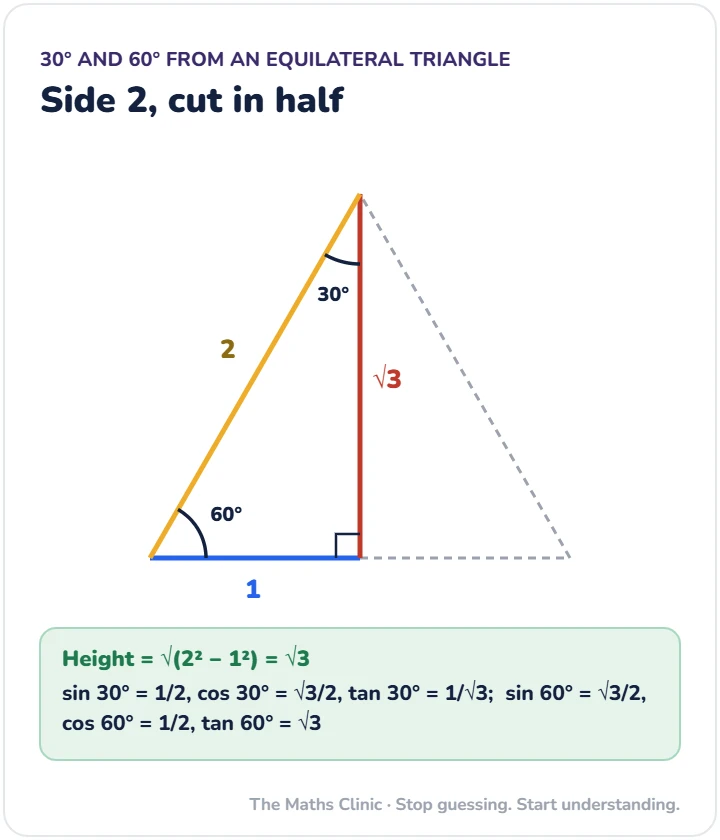
- The base of each half is 2 ÷ 2 = 1.
- The top angle is cut in half: 60° ÷ 2 = 30°. The bottom angle stays 60°.
- Height by Pythagoras: 2² − 1² = 4 − 1 = 3, so the height is √3.
- From the 30° angle: opposite = 1, adjacent = √3, hypotenuse = 2. So sin 30° = 1/2, cos 30° = √3/2, tan 30° = 1/√3 = √3/3.
- From the 60° angle: opposite = √3, adjacent = 1, hypotenuse = 2. So sin 60° = √3/2, cos 60° = 1/2, tan 60° = √3/1 = √3.
Trigonometric ratios of special angles: the table
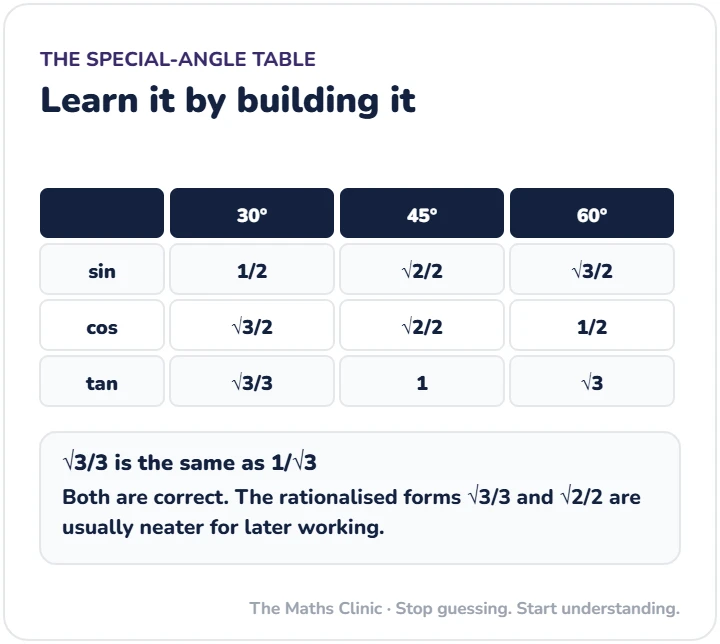
| 30° | 45° | 60° | |
|---|---|---|---|
| sin | 1/2 | √2/2 | √3/2 |
| cos | √3/2 | √2/2 | 1/2 |
| tan | √3/3 | 1 | √3 |
A quick way to remember them
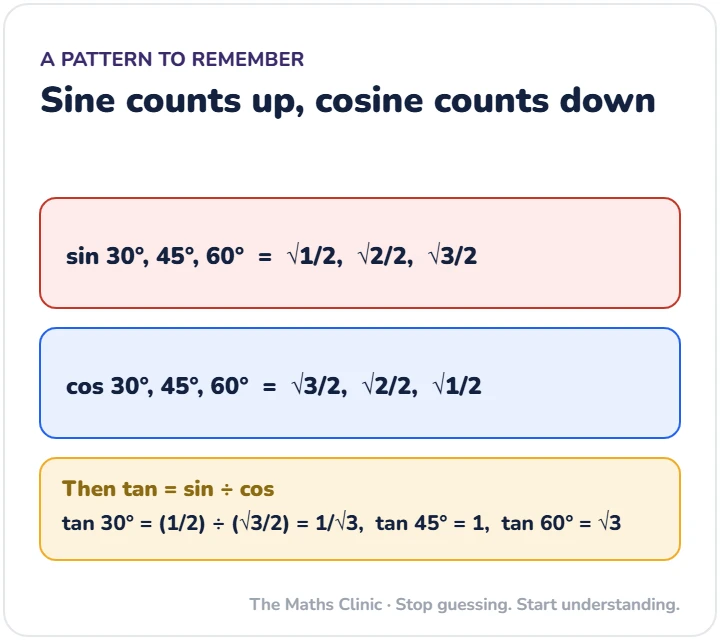
Notice the pattern: sin goes 1/2, √2/2, √3/2 as the angle grows (that is √1/2, √2/2, √3/2). Cos is the same list backwards.
Worked example 1
Without using a calculator, evaluate \sin 60^\circ\cos 30^\circ+\sin 30^\circ\cos 60^\circ.
Step 1: replace each ratio with its exact value. sin 60° = √3/2, cos 30° = √3/2, sin 30° = 1/2, cos 60° = 1/2.
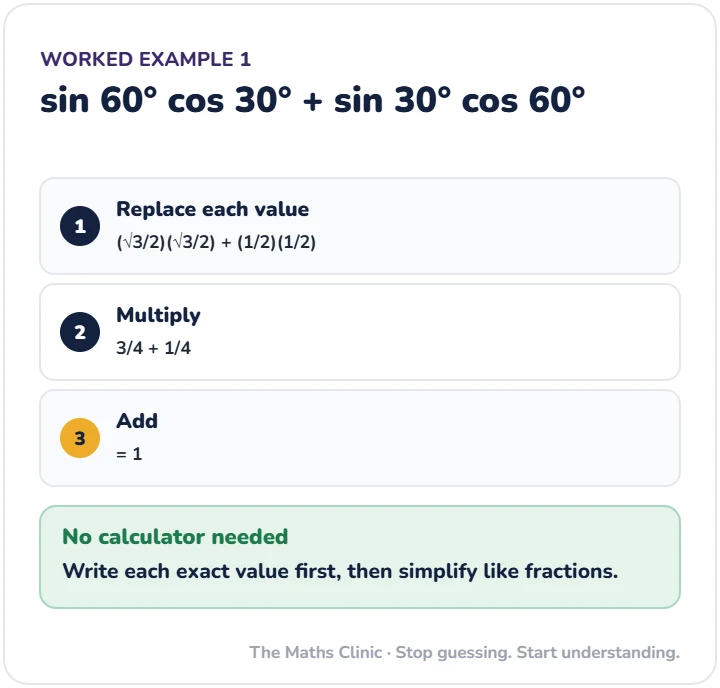
=\tfrac{\sqrt3}{2}\cdot\tfrac{\sqrt3}{2}+\tfrac12\cdot\tfrac12Step 2: multiply each pair. Tops: √3 × √3 = 3. Bottoms: 2 × 2 = 4. So the first product is 3/4. The second: (1 × 1)/(2 × 2) = 1/4.
=\tfrac34+\tfrac14=1
Step 3: add. The denominators are the same, so add the tops: 3/4 + 1/4 = 4/4 = 1.
Check. Estimate: √3 ≈ 1.73, so 1.73/2 ≈ 0.87, and 0.87 × 0.87 ≈ 0.75. Then 0.75 + 0.25 = 1. ✔
The wrong way. Writing √3/2 × √3/2 = √3/4. The tops multiply too: √3 × √3 = 3, not √3.
Worked example 2
Without using a calculator, simplify \dfrac{\tan 60^\circ-\tan 30^\circ}{1+\tan 60^\circ\tan 30^\circ}.
Step 1: exact values. tan 60° = √3 and tan 30° = 1/√3.
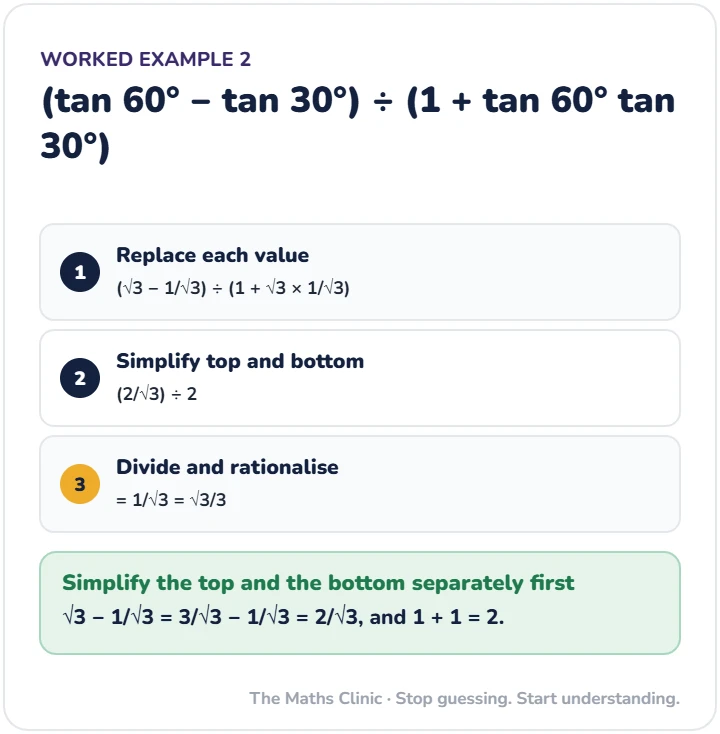
Step 2: the top. √3 − 1/√3. Write √3 as a fraction over √3: √3 = (√3 × √3)/√3 = 3/√3. So the top is 3/√3 − 1/√3 = 2/√3.
Step 3: the bottom. 1 + √3 × 1/√3 = 1 + 1 = 2.
=\dfrac{\sqrt3-\tfrac{1}{\sqrt3}}{1+1}=\dfrac{\tfrac{2}{\sqrt3}}{2}Step 4: divide. (2/√3) ÷ 2 = 1/√3. Rationalise: (1 × √3)/(√3 × √3) = √3/3.
=\tfrac{1}{\sqrt3}=\tfrac{\sqrt3}{3}Check. √3/3 ≈ 1.73 ÷ 3 ≈ 0.58, and tan 30° ≈ 0.58 on a calculator. ✔
Worked example 3: a WASSCE-style surd product
Question. Without using tables or a calculator, evaluate (tan 60° − 1)(tan 60° + 1).
Step 1: exact value. tan 60° = √3, so the expression is (√3 − 1)(√3 + 1).
Step 2: expand every term. √3 × √3 = 3; √3 × 1 = √3; −1 × √3 = −√3; −1 × 1 = −1.
Step 3: collect. 3 + √3 − √3 − 1. The √3 terms cancel, leaving 3 − 1 = 2.
Check. (1.73 − 1)(1.73 + 1) = 0.73 × 2.73 ≈ 2.0. ✔
The wrong way. Expanding only the first and last terms and forgetting the middle ones. Here the middle terms cancel, but you must show them.
The mistake that costs marks
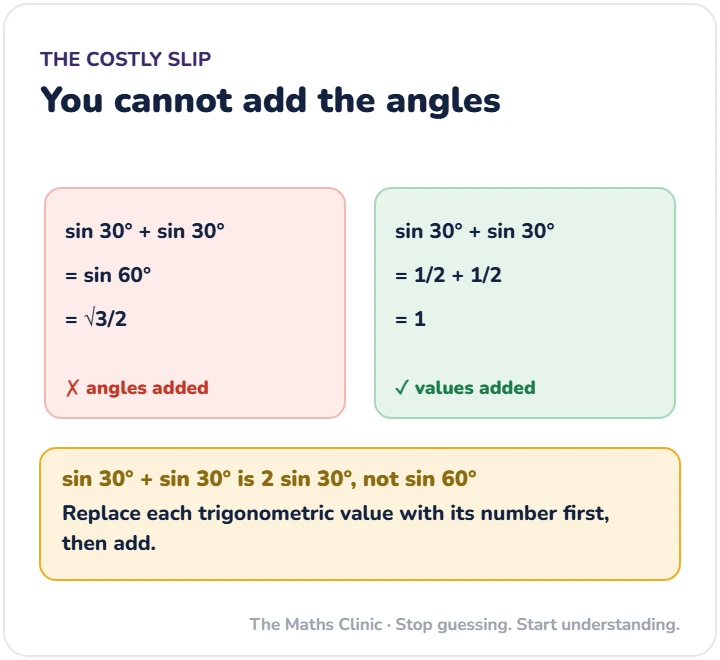
- Adding angles: \sin 30^\circ+\sin 30^\circ is not \sin 60^\circ.
- Mixing up sin and cos of 30° and 60°. Rebuild the half-equilateral triangle if unsure.
- Leaving \tfrac{\sqrt3}{2}\cdot\tfrac{\sqrt3}{2} as \tfrac{\sqrt3}{4}. The product \sqrt3\times\sqrt3=3.
📋 What the WAEC Chief Examiner reported
- In 2012, on a question using sin 45°, cos 60° and tan 45° without tables: “Some candidates however, were unable to handle the surds that were involved in the simplification of the expression.”
- In 2019, WAEC listed “solving basic computation without the use of calculator” among candidates’ weaknesses.
- In 2023 and 2024, trigonometric ratios were listed as a strength. Candidates know sin, cos and tan; the marks go on the exact values and the surd arithmetic.
What WAEC recommends
In 2021 the Chief Examiner advised that teachers should “teach them the basic principles and skills in the topic that they are weak in.” This lesson does exactly that: it rebuilds the exact values from two triangles and shows every surd step.
How to win these marks back
- Rebuild the two triangles and write each exact value before you simplify.
- Do one surd step per line: √3 × √3 = 3, and rationalise 1/√2 to √2/2.
- Check your final answer with a quick estimate (√3 ≈ 1.73).
Source: WAEC Chief Examiner’s Reports, WASSCE (School Candidates) 2012, 2019, 2021, 2023 and 2024, Mathematics (Core).
Try it now
Cover the solutions. No calculator. Write each exact value first, then one step per line.
Question 1
Evaluate 2 sin 30° cos 30°.
Question 2
Evaluate tan 45° + cos 60°.
Question 3
Show that (sin 45°)² + (cos 45°)² = 1.
Question 4
Find the value of cos 30° × tan 60°.
Question 5 (WASSCE style)
Evaluate tan 30° × tan 60° + sin² 45°.
Question 6 (real life)
A ladder 6 m long leans against a wall and makes an angle of 60° with the ground. Without a calculator, find how high up the wall it reaches, in surd form.
Solutions
Solution 1
2 × 1/2 × √3/2. First 2 × 1/2 = 1. Then 1 × √3/2 = √3/2.
Solution 2
tan 45° = 1 and cos 60° = 1/2. So 1 + 1/2 = 3/2.
Solution 3
(√2/2)² = (√2 × √2)/(2 × 2) = 2/4 = 1/2. The same for cos 45°. So 1/2 + 1/2 = 1. ✔
Solution 4
√3/2 × √3 = (√3 × √3)/2 = 3/2.
Solution 5
tan 30° × tan 60° = 1/√3 × √3 = 1. sin² 45° = (√2/2)² = 1/2. Total: 1 + 1/2 = 3/2.
Solution 6
The height is opposite the 60° angle and the ladder is the hypotenuse, so height = 6 × sin 60° = 6 × √3/2 = 3√3 m (about 5.2 m).
📘 New SHS curriculum link
This is Year 1 of the new SHS Mathematics curriculum (1.3.2.LO.2): investigate and determine the trigonometric functions of special angles, and solve problems using the three primary trigonometric ratios.
For parents
Ask your child to draw a square, cut it along the diagonal, and tell you the length of the diagonal without a calculator. If they can say “√2, by Pythagoras” and explain why, they can rebuild every value in this lesson on exam day.
Frequently asked questions
Do I have to memorise the special angles table?
It helps, but you can always rebuild it: half a square for 45°, and half an equilateral triangle of side 2 for 30° and 60°.
What about 0° and 90°?
\sin 0^\circ=0, \cos 0^\circ=1, \sin 90^\circ=1 and \cos 90^\circ=0. \tan 90^\circ is undefined.
Is 1/√3 the same as √3/3?
Yes. Multiply the top and bottom of \tfrac{1}{\sqrt3} by \sqrt3 to get \tfrac{\sqrt3}{3}.
Why does √3 × √3 equal 3?
Because √3 means “the number that multiplies by itself to give 3”. So √3 × √3 = 3 by definition.
What to do next
Use these exact values in real problems in Angle of Elevation and Depression, and practise mixed questions in the Practice Zone.
Keep learning
- SOHCAHTOA: Meaning, Formula and Examples
- How to Find an Angle in a Right-Angled Triangle
- Angle of Elevation and Depression: Meaning, Diagrams and the Difference
📚 See every lesson in the Trigonometry Clinic
✏️ Practise trigonometry in the Practice Zone

Written by
Dickson Sarpong
NTC-certified SHS Mathematics teacher in Ghana with WAEC marking experience, and author of The Bridge Series textbooks. Every lesson here is built around the mistakes WAEC examiners keep reporting.
About DicksonStuck? Ask a question
Want the whole topic, step by step? My textbooks, The Bridge to Mathematics and The Bridge to Additional Mathematics for SHS, follow the new curriculum and rebuild the basics as you go.
Read a free chapter →