Struggling with WASSCE Maths? Stop guessing. Let’s fix the gap step by step.

Mensuration in Mathematics: 7 WASSCE Fixes
Square, triangle, trapezium, circle, sector, cuboid, cylinder, cone. That’s a lot of formulas, and many students panic and guess which one to use. This lesson starts with a simpler question: what are you actually measuring? Get that right, and the formula follows.

📚 Part of the Mensuration & Geometry Clinic: every lesson on this topic, in one place.
Quick answer: how do you avoid mistakes in mensuration questions?
First decide what the question measures: length (cm), area (cm²) or volume (cm³). Halve every diameter to get the radius, convert all lengths to the same unit, and check whether a container is open or closed. Write the formula, then the values, then the answer with its unit.
Square, triangle, trapezium, circle, sector, cuboid, cylinder, cone. That’s a lot of formulas, and many students panic and guess which one to use. This lesson starts with a simpler question: what are you actually measuring? Get that right, and the formula follows.
In many classrooms, mensuration becomes frightening when the board is filled with formulas for:
- Perimeter
- Area
- Circumference
- Sector area
- Volume
- Curved surface area
- Total surface area
- Capacity
The learner looks at the question and says,
“Sir, I do not know which formula to use.”
However, the real problem is not always failure to memorize a formula. Very often, the learner has not identified what is being measured.
Is the question asking for:
- A boundary length?
- A flat region?
- Material covering the outside?
- Space inside a solid?
- Liquid capacity?
- The cost of covering or filling something?
This Mensuration Formulas Clinic identifies the confidence-and-meaning gap, corrects it visibly, and prepares the learner for WASSCE and other WAEC-organized examinations.
The central correction is:
Name the measurement before choosing the formula.
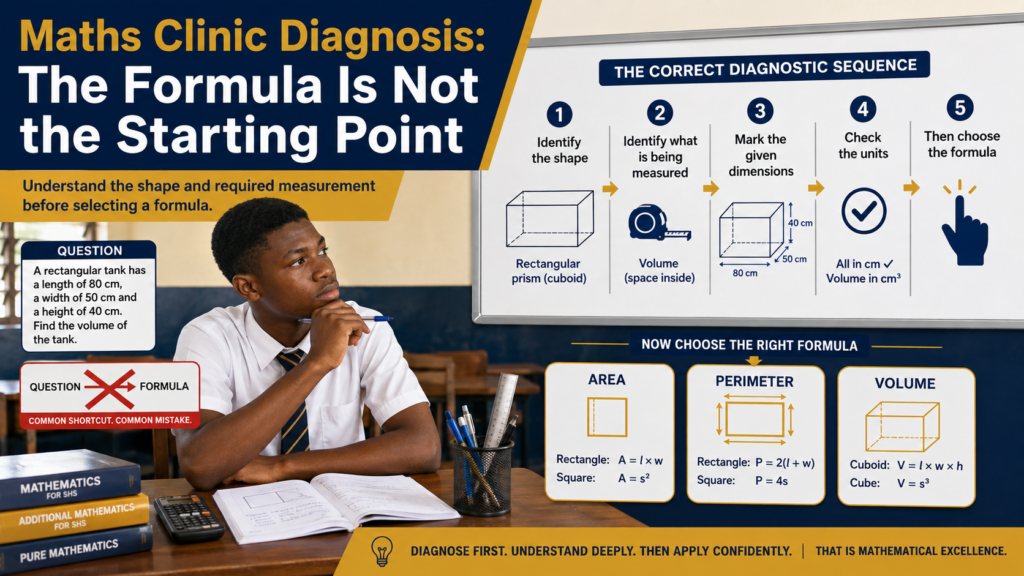
Maths Clinic Diagnosis: The Formula Is Not the Starting Point
The hidden gap is:
The learner searches for a formula before deciding whether the question requires length, area, surface area, volume, capacity, or cost.
This gap appears in several ways:
- An area formula is used when volume is required.
- Circumference is confused with the area of a circle.
- Curved surface area is confused with total surface area.
- Diameter is used as radius.
- Slant height is confused with vertical height.
- Square units and cubic units are mixed.
- The learner calculates area correctly but forgets to find cost.
- Measurements in different units are substituted without conversion.
- Every number in the question is forced into the formula.
- The final answer is accepted without checking its meaning.
The learner doesn’t only need more formulas. The learner needs a method for selecting the correct formula.
Current Curriculum Connection
A learner studying mensuration should be able to:
- Observe or sketch the figure
- Identify the shape or solid
- Label the given dimensions
- Decide what measurement is required
- Explain why a formula fits the question
- Calculate accurately
- Convert units where necessary
- Solve practical problems involving capacity or cost
- Check whether the final unit matches the measurement
- Communicate the reasoning clearly
Where suitable, learners may use:
- A ruler
- A grid
- Paper cut-outs
- Cardboard models
- Cylindrical containers
- Measuring tapes
- Dynamic geometry tools
- Spreadsheets for repeated calculations
These tools help learners connect formulas to actual lengths, surfaces, and spaces.

Mensuration in Mathematics: The Learner’s Exact Problem
A learner may know that area is measured in square units and still use an area formula when the question asks for volume.
Another learner may know:
V=\pi r^2h
but use the diameter in place of (r).
Another may correctly calculate the floor area of a room but stop before multiplying by the cost per square meter.
These errors show that mensuration is not only a formula topic. It is also a topic about:
- Reading
- Visualization
- Units
- Formula selection
- Substitution
- Practical interpretation
- Multi-step reasoning
What Mensuration Means
Mensuration is the branch of mathematics concerned with measuring geometric figures and solids.
It includes measurements such as:
- Length
- Perimeter
- Circumference
- Area
- Surface area
- Volume
- Capacity
The same shape can produce different questions.
For a cylinder, a learner may be asked to find:
- The circumference of its circular base
- The area of one circular end
- Its curved surface area
- Its total surface area
- Its volume
- Its capacity
- The cost of painting its outside
- The material needed to make it
Seeing the word “cylinder” is therefore not enough. The learner must still identify what is required.
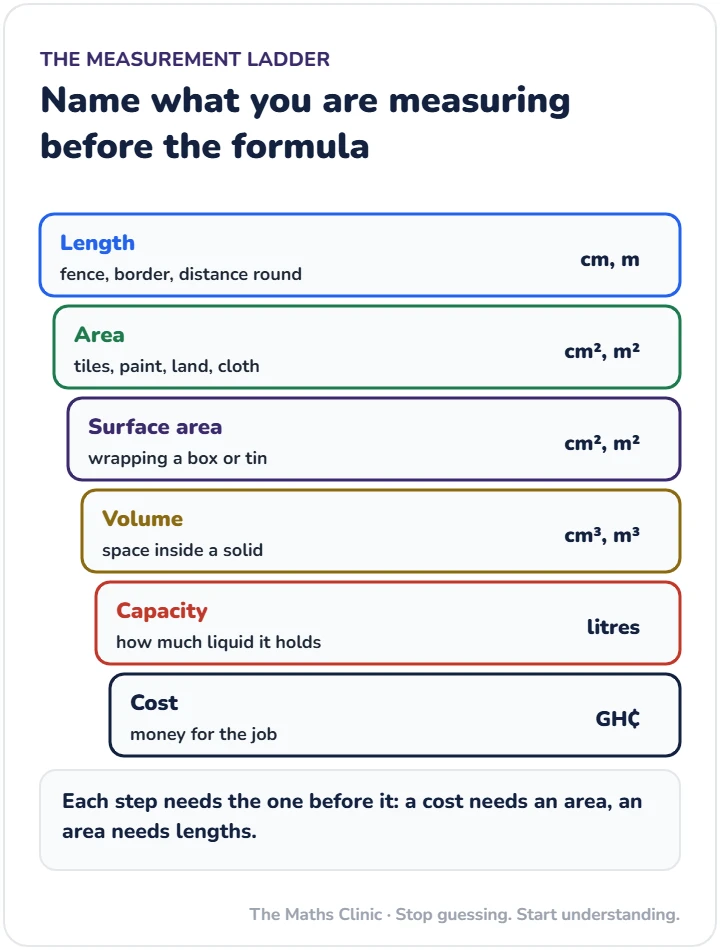
The Measurement Ladder
Level 1: Length
Length measures distance.
Examples include:
- A side
- Height
- Radius
- Diameter
- Slant height
- Perimeter
- Circumference
- Arc length
Common units:
- mm
- cm
- m
- km
Length uses ordinary units, not square or cubic units.
Level 2: Area
Area measures the flat space inside a two-dimensional figure.
Examples include:
- Floor space
- Land surface
- Wall face
- Circular top
- Triangular region
- Sector of a circle
Common units:
- (\text{mm}^2)
- (\text{cm}^2)
- (\text{m}^2)
- (\text{km}^2)
Area uses square units.
Level 3: Surface Area
Surface area measures the total area covering the outside of a three-dimensional solid.
It may refer to:
- Curved surface only
- Lateral surface only
- Total surface, including ends or bases
- Exposed surfaces only
Surface area also uses square units.
Level 4: Volume
Volume measures the space occupied by a three-dimensional solid or the space available inside it.
Common units:
- (\text{cm}^3)
- (\text{m}^3)
- (\text{mm}^3)
Volume uses cubic units.
Level 5: Capacity
Capacity measures how much liquid a container can hold.
Common units:
- Milliliters
- Liters
Useful relationships include:
1\text{ cm}^3=1\text{ mL}1000\text{ cm}^3=1\text{ L}1\text{ m}^3=1000\text{ L}Level 6: Cost
Cost questions usually require two stages:
- Find the relevant length, area, surface area, or volume.
- Multiply by the cost per unit.
For example:
\text{Cost}=\text{Area}\times\text{Cost per square metre}The final unit is money, such as GH₵.

Words That Reveal the Measurement Type
| Wording in the question | Likely measurement |
|---|---|
| Distance around | Perimeter |
| Boundary | Perimeter |
| Length of wire around | Perimeter or circumference |
| Distance around a circle | Circumference |
| Space inside a flat figure | Area |
| Floor to be tiled | Area |
| Land to be grassed | Area |
| Wall to be painted | Area |
| Curved part only | Curved surface area |
| Outside of a closed solid | Total surface area |
| Material used to make an open container | Exposed surface area |
| Space occupied by a solid | Volume |
| Space inside a tank | Volume |
| Liquid a container holds | Capacity |
| Price per meter | Length and cost |
| Price per square meter | Area and cost |
| Price per cubic meter | Volume and cost |
These phrases are clues, but the complete question must still be read.
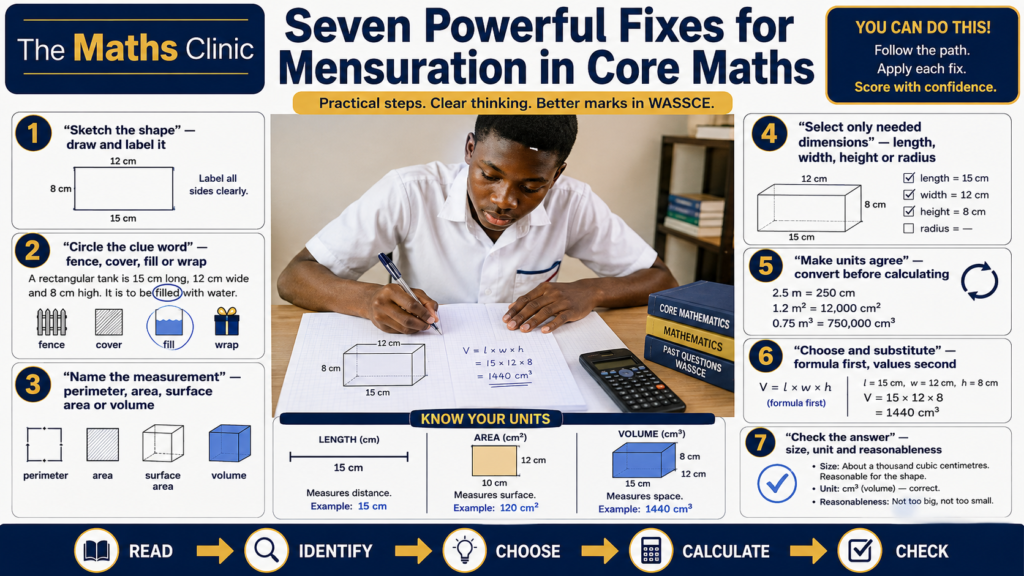
Seven Fixes for Mensuration in Mathematics
Fix 1: Name the measurement before the formula.
Before writing any formula, complete this sentence:
The question wants me to find __________.
Possible answers include:
- Length
- Perimeter
- Area
- Curved surface area
- Total surface area
- Volume
- Capacity
- Cost
This first decision controls the rest of the solution.
Fix 2: Identify and redraw the shape
Ask:
- Is it a rectangle?
- Triangle?
- Circle?
- Sector?
- Cuboid?
- Prism?
- Cylinder?
- Cone?
- Sphere?
- Hemisphere?
- Composite shape?
If the original diagram is crowded, redraw a simpler version and label only the useful measurements.
Fix 3: Label every given value
Do not copy an unnamed number into a formula.
For example:
A cylinder has a diameter of 14 cm and a height of 10 cm.
Write:
d=14\text{ cm}r=\frac{14}{2}=7\text{ cm}h=10\text{ cm}Do not write (r=14\text{ cm}).
Fix 4: Match the formula to its meaning
Do not choose a formula because it contains familiar letters.
Ask what each formula measures.
For a cylinder:
\pi r^2
finds the area of one circular base.
2\pi rh
finds the curved surface area.
2\pi r^2+2\pi rh
finds the total surface area of a closed cylinder.
\pi r^2h
finds the volume.
Fix 5: Make the units consistent
Do not substitute centimeters and metres into the same formula.
Convert all required lengths to one unit before calculating.
For example:
2\text{ m}=200\text{ cm}A common trap is area conversion:
1\text{ m}=100\text{ cm}but:
1\text{ m}^2=10,000\text{ cm}^2Similarly:
1\text{ m}^3=1,000,000\text{ cm}^3Fix 6: Distinguish curved, open, and total surfaces.
Ask which surfaces are included.
- Curved cylinder only → exclude both circular ends.
- Closed cylinder → include the curved part and both circular ends.
- Open cylinder → include the curved part and one circular base.
- Hollow pipe → may involve inner and outer curved surfaces.
- Cone without base → use curved surface area only.
- Complete cone → include the circular base.
Fix 7: Check the unit and reasonableness.
Before submitting, ask:
- Is length written in ordinary units?
- Is the area written in square units?
- Is volume written in cubic units?
- Is capacity written in liters or milliliters?
- Is the cost written in GH₵?
- Should the total surface area be greater than the curved surface area?
- Did I use radius or diameter correctly?
- Is the result sensible for the dimensions?
Essential Two-Dimensional Formulas
Rectangle
Perimeter:
P=2(l+b)
Area:
A=lb
where (l) is length and (b) is breadth.
Square
Perimeter:
P=4a
Area:
A=a^2
where (a) is the side length.
Triangle
Area:
A=\frac12 bh
The height must be perpendicular to the selected base.
Do not automatically use a sloping side as the height.
Parallelogram
Area:
A=bh
The height is the perpendicular distance between the parallel sides.
Trapezium
Area:
A=\frac12(a+b)h
where (a) and (b) are the parallel sides.
Circle
Circumference:
C=2\pi r
or:
C=\pi d
Area:
A=\pi r^2
Remember:
d=2r
and:
r=\frac d2
Sector
Arc length:
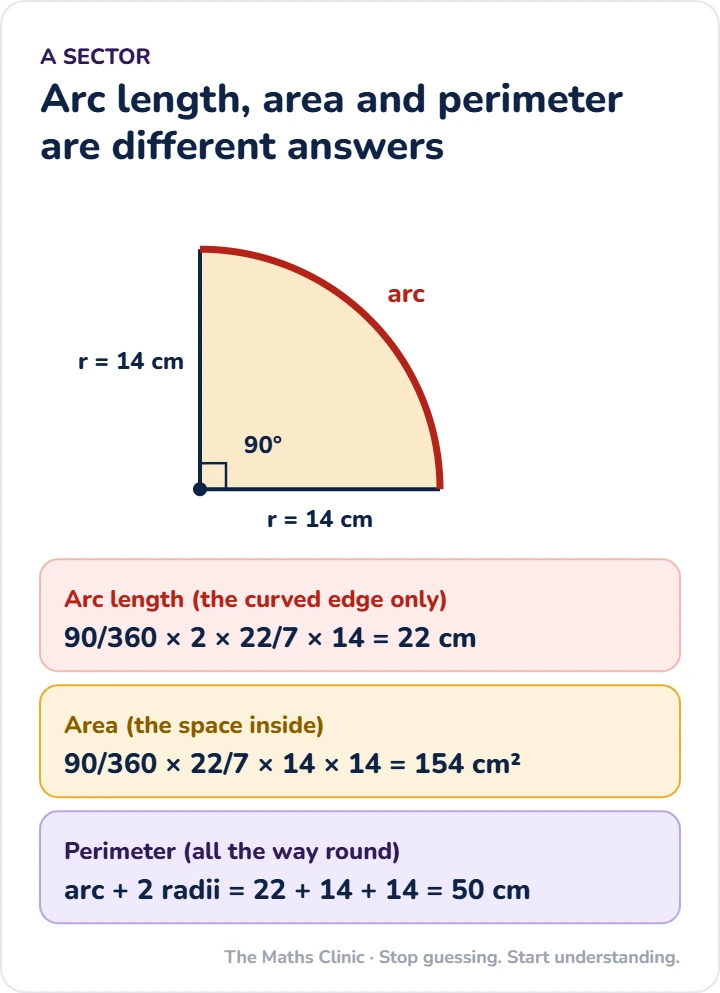
L=\frac{\theta}{360^\circ}\times2\pi rSector area:
A=\frac{\theta}{360^\circ}\times\pi r^2where \theta is the angle at the centre.
Perimeter of a sector
The perimeter of a sector includes:
- The arc
- Two radii
Therefore:
P=\text{Arc length}+2rDo not give only the arc length when the complete perimeter is required.
📋 What the WAEC Chief Examiner reported
- WAEC listed “solving problems involving mensuration” as a weakness in 2018 and 2019, and “solving problems on mensuration” in 2024. In 2025, the same skill was listed as a strength, so these marks can be won.
- On 2021 Question 4 (a metal pipe), “they were not able to find the external radius of the cylinder”: the external diameter was 16 cm, so the radius is 8 cm.
- On 2021 Question 8(a), “Most candidates could not notice the difference in units (cm, m)”, so their volumes were wrong.
What WAEC recommends
In 2019 the Chief Examiner advised: “The concept of mensuration must be taught well in schools.” This lesson teaches it from the meaning up: what each formula measures, why the radius and the slant height matter, and every step of every calculation.
How to win these marks back
- Decide first: is the question about length, area or volume?
- Halve every diameter to get the radius, and convert all lengths to one unit before calculating.
- Write the formula, then the values, then the answer with its unit.
Source: WAEC Chief Examiner’s Report, WASSCE 2018, Mathematics (Core); WAEC Chief Examiner’s Report, WASSCE 2019, Mathematics (Core); WAEC Chief Examiner’s Report, WASSCE 2021, Mathematics (Core); WAEC Chief Examiner’s Report, WASSCE 2024, Mathematics (Core); WAEC Chief Examiners’ Reports, WASSCE (SC) 2025, Ghana: Mathematics (Core).
Essential Three-Dimensional Formulas
Cuboid
Volume:
V=lbh
Total surface area:
TSA=2(lb+lh+bh)
Cube
Volume:
V=a^3
Total surface area:
TSA=6a^2
Prism
Volume:
V=\text{Cross-sectional area}\times\text{Length}The cross-section must remain the same throughout the prism.
Cylinder
Volume:
V=\pi r^2h
Curved surface area:
CSA=2\pi rh
Total surface area of a closed cylinder:
TSA=2\pi rh+2\pi r^2
or:
TSA=2\pi r(h+r)
Surface area of an open cylinder with one base:
A=2\pi rh+\pi r^2
Cone
Volume:
V=\frac13\pi r^2h
Curved surface area:
CSA=\pi rl
Total surface area:
TSA=\pi rl+\pi r^2
or:
TSA=\pi r(l+r)
For a right circular cone:
l^2=r^2+h^2
where:
- (l) is slant height
- (h) is perpendicular height
Use (h) for volume and (l) for curved surface area.
Sphere
Volume:
V=\frac43\pi r^3
Surface area:
A=4\pi r^2
A sphere has no flat circular base.
Hemisphere
Volume:
V=\frac23\pi r^3
Curved surface area:
CSA=2\pi r^2
Total surface area, including the circular base:
TSA=3\pi r^2
Pyramid
Volume:
V=\frac13\times\text{Base area}\times hThe height (h) is perpendicular to the base.
The Meaning Behind Similar-Looking Formulas
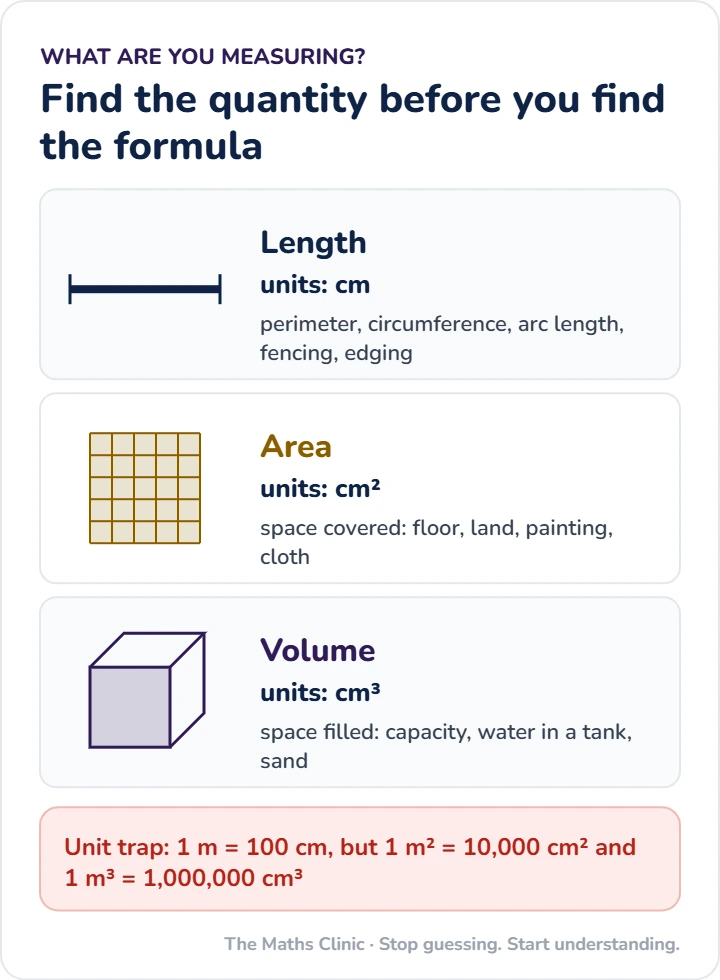
Why area contains squared lengths
For a rectangle:
A=l\times b
If both measurements are in centimetres:
\text{cm}\times\text{cm}=\text{cm}^2That is why area uses square units.
Why volume contains cubic units
For a cuboid:
V=l\times b\times h
If all measurements are in centimetres:
\text{cm}\times\text{cm}\times\text{cm}=\text{cm}^3That is why volume uses cubic units.
Why the cone has \frac13
A cone with the same circular base and perpendicular height as a cylinder has one-third of the cylinder’s volume.
Cylinder:
V=\pi r^2h
Cone:
V=\frac13\pi r^2h
The factor \frac13 must not be omitted.
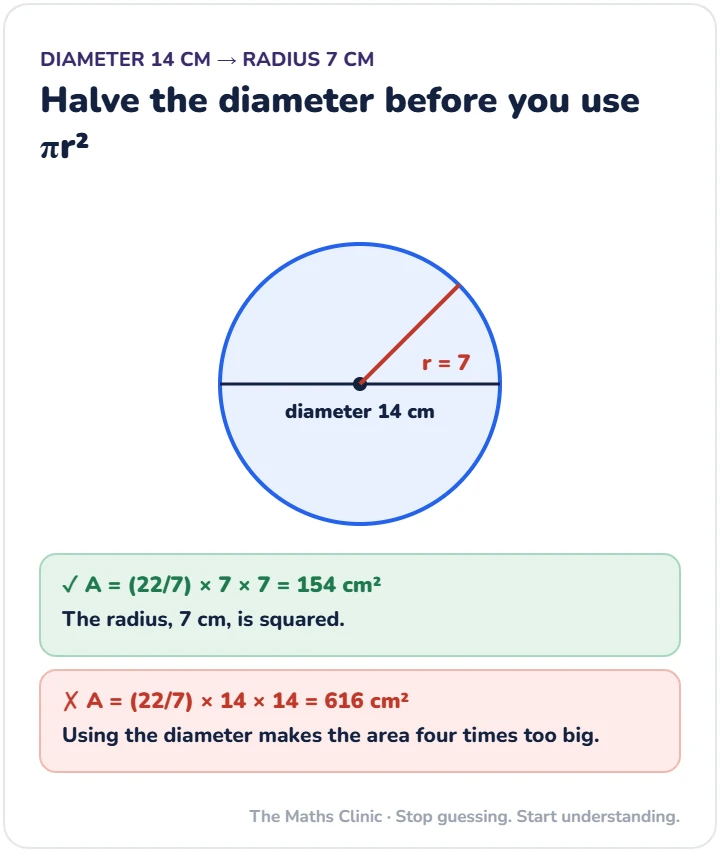
Radius and Diameter Trap
The formulas for circles, cylinders, cones and spheres normally use radius.
If:
d=10\text{ cm}then:
r=\frac{10}{2}=5\text{ cm}Using r=10\text{ cm} does more than double many answers.
For circle area:
A=\pi r^2
Using 10 instead of 5 makes the area four times too large because the radius is squared.
Height and Slant Height Trap
A cone may have:
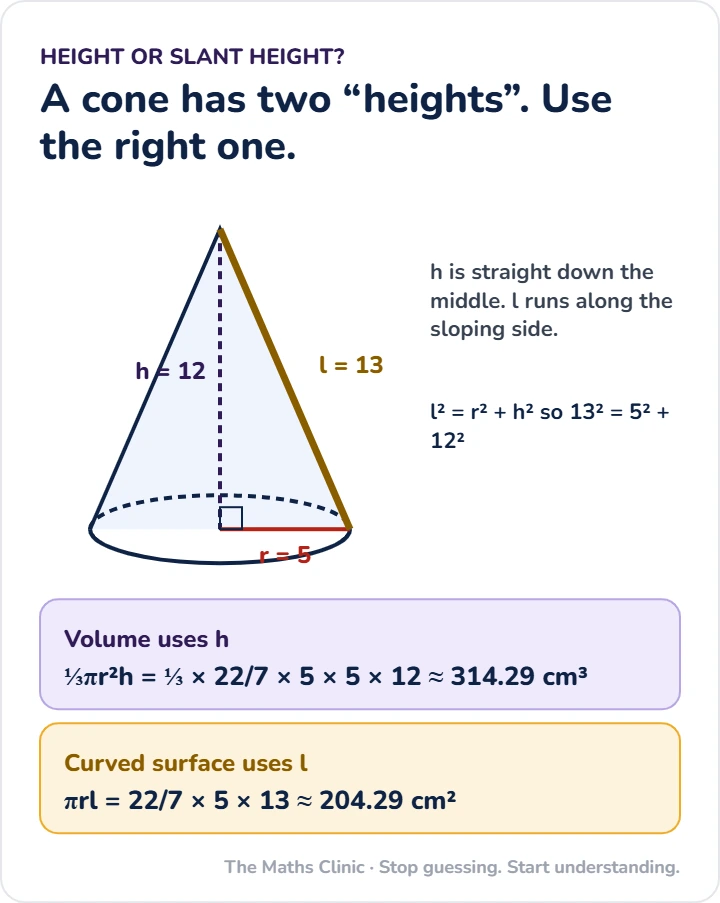
- Perpendicular height, (h)
- Slant height, (l)
Use:
V=\frac13\pi r^2h
for volume.
Use:
CSA=\pi rl
for curved surface area.
Do not use slant height as the perpendicular height unless the question establishes that value as (h).
For a right circular cone:
l=\sqrt{r^2+h^2}Using \pi Correctly
Follow the instruction in the question.
The question may require:
\pi=\frac{22}{7}or:
\pi=3.142
If no approximation is requested, an exact answer may be left in terms of \pi, depending on the question.
Do not replace \pi with \frac{22}{7} automatically when the question provides another value.
Avoid rounding too early. Keep the calculator value during the working and round only the final answer to the required number of decimal places or significant figures.
Worked Example: Volume of a Cylinder
A cylindrical container has radius 7\text{ cm} and height 20\text{ cm}. Find its volume. Use:
\pi=\frac{22}{7}Step 1: Identify the shape
The solid is a cylinder.
Step 2: Identify the request
The question wants the space inside the cylinder.
Therefore, the required measurement is volume.
Step 3: Label the values
r=7\text{ cm}h=20\text{ cm}Step 4: Select the formula
V=\pi r^2h
Step 5: Substitute
V=\frac{22}{7}\times7^2\times20V=\frac{22}{7}\times7\times7\times20V=3,080
Step 6: State the answer
\boxed{V=3,080\text{ cm}^3}\text{Answer}: \text{Volume} = (3{,}080\\text{text}{ cm}^3).Unit check
Volume measures three-dimensional space, so the answer must use cubic units.
Common Wrong Approach
A learner sees “cylinder” and writes:
2\pi rh
That formula finds the curved surface area, not the volume.
The learner recognised the solid but failed to identify the measurement requested.
The correction is:
Shape first, request second, formula third.
- Shape: cylinder
- Request: volume
- \text{Formula}: (V=\pi r^2h)
Worked Example: Diameter Must Become Radius
A cylinder has diameter 10\text{ cm} and height 14\text{ cm}. Find its volume using:
\pi=\frac{22}{7}Diameter:
d=10\text{ cm}Therefore:
r=\frac{10}{2}=5\text{ cm}Volume:
V=\pi r^2h
V=\frac{22}{7}\times5^2\times14V=\frac{22}{7}\times25\times14V=1,100\text{ cm}^3\text{Answer}: \text{Volume} = (1{,}100\\text{text}{ cm}^3).Worked Example: Curved or Total Surface Area?
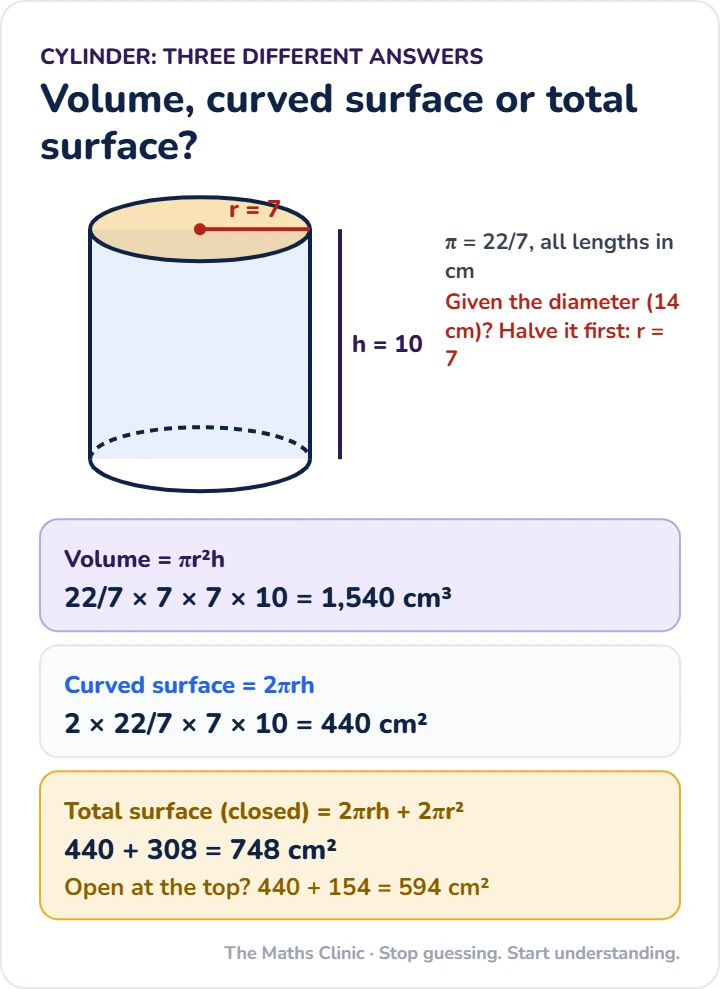
A closed cylinder has radius 3\text{ cm} and height 10\text{ cm}.
Curved surface area
CSA=2\pi rh
CSA=2\pi(3)(10)
CSA=60\pi\text{ cm}^2Total surface area
A closed cylinder has:
- One curved surface
- Two circular ends
Therefore:
TSA=2\pi rh+2\pi r^2
TSA=60\pi+2\pi(3^2)
TSA=60\pi+18\pi
TSA=78\pi\text{ cm}^2The total surface area is greater because it includes both circular ends.
Worked Example: Capacity of a Tank
A rectangular tank measures 2.5\text{ m} by 1.2\text{ m} by 0.8\text{ m}. Find its capacity in litres.
Volume:
V=lbh
V=2.5\times1.2\times0.8
V=2.4\text{ m}^3Since:
1\text{ m}^3=1000\text{ L}then:
2.4\text{ m}^3=2.4\times10002.4\text{ m}^3=2,400\text{ L}\text{Answer}: \text{Capacity} = (2{,}400\\text{text}{ L}).Worked Example: Area and Cost
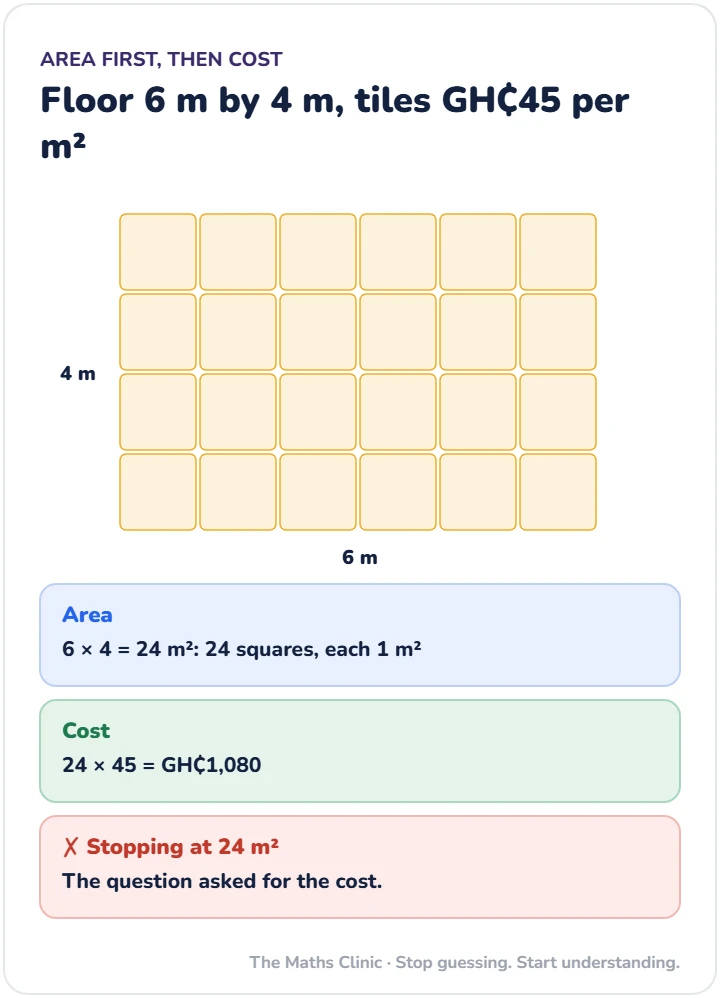
A classroom floor is 6\text{ m} long and 4\text{ m} wide. Tiles cost GH₵45 per square metre. Find the total cost.
Step 1: Find the area
A=lb
A=6\times4
A=24\text{ m}^2Step 2: Find the cost
\text{Cost}=24\times\text{GH₵45}\text{Cost}=\text{GH₵1,080}\text{Answer}: \text{Total cost} = \text{GH₵}1{,}080.The area is not the final answer because the question asks for cost.
Worked Example: Composite Area
A rectangular compound measures 10\text{ m} by 6\text{ m}. A rectangular pond measuring 4\text{ m} by 2\text{ m} occupies part of the compound. Find the remaining area.
Area of compound:
10\times6=60\text{ m}^2Area of pond:
4\times2=8\text{ m}^2Remaining area:
60-8=52\text{ m}^2\text{Answer}: \text{Remaining area} = (52\\text{text}{ m}^2).The learner must decide whether the smaller shape is being added or removed.
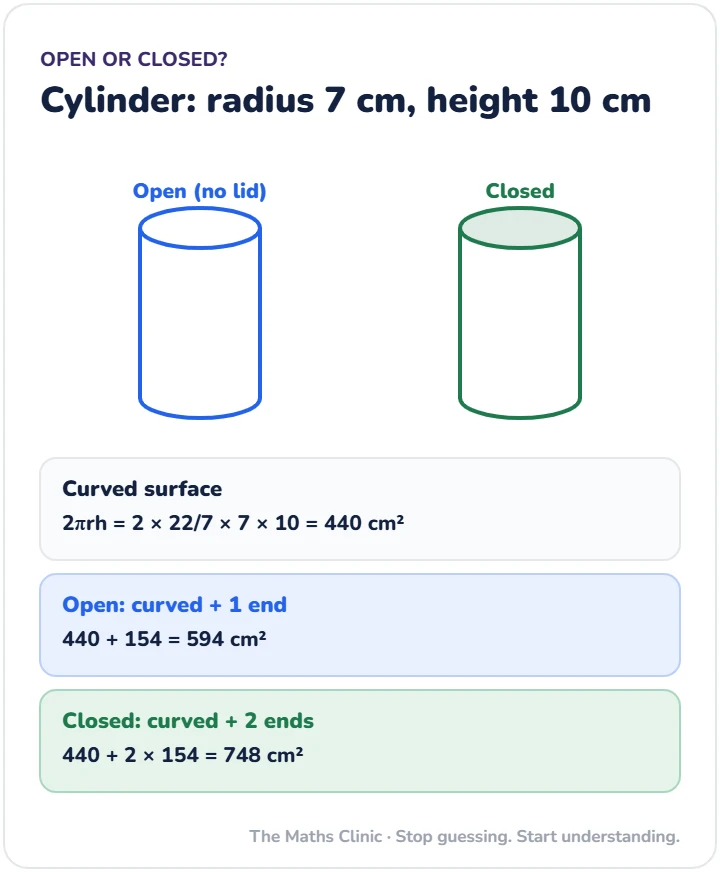
Open and Closed Container Trap
Before calculating material needed to make a container, ask:
- Is it open at the top?
- Is it closed?
- Does it have a base?
- Are both ends included?
- Is the thickness ignored?
- Are inner and outer surfaces required?
For a cylindrical container:
| Container description | Surfaces included |
|---|---|
| Curved part only | 2\pi rh |
| Open at one end | 2\pi rh+\pi r^2 |
| Closed at both ends | 2\pi rh+2\pi r^2 |
| No circular ends | 2\pi rh |
Do not assume “total surface area” if the question says the container is open.
Common Mensuration Mistakes
Mistake 1: Formula hunting
The learner sees a circle or cylinder and writes the first remembered formula.
Correction: Name the measurement first.
Mistake 2: Using diameter as radius
\text{Correction}: \text{Write} (r=\dfrac{d}{2}) \text{before substitution}.Mistake 3: Confusing circumference and area
Circumference:
C=2\pi r
Area:
A=\pi r^2
Circumference measures distance around. Area measures space inside.
Mistake 4: Confusing area and volume
Area uses square units. Volume uses cubic units.
Mistake 5: Confusing curved and total surface area
Correction: List the surfaces included before choosing the formula.
Mistake 6: Using slant height in the volume formula
Correction: Cone volume uses perpendicular height.
Mistake 7: Ignoring different units
Correction: Convert all required lengths to one unit before substitution.
Mistake 8: Converting square and cubic units as ordinary lengths
Wrong:
1\text{ m}^2=100\text{ cm}^2Correct:
1\text{ m}^2=10,000\text{ cm}^2Mistake 9: Stopping before finding cost
Correction: Return to the demand after finding area or volume.
Mistake 10: Rounding too early
Correction: Keep accurate intermediate values and round the final answer as instructed.
Mistake 11: Trusting a diagram’s appearance
A diagram may not be drawn to scale.
Correction: Use stated measurements and geometric relationships.
Mistake 12: Omitting or using the wrong unit
Correction: Match the unit to the measurement type.
The Maths Clinic Mensuration Routine
Use this routine before every mensuration calculation.
Step 1: Read the final demand
What exactly must be found?
Step 2: Name the measurement
Write:
Required measurement = __________.
Step 3: Identify the shape or solid
Name every important part.
Step 4: Draw or redraw
Label the dimensions on a clear sketch.
Step 5: Convert units
Make the length units consistent.
Step 6: Separate radius and diameter
Write:
r=\frac d2
where necessary.
Step 7: List the surfaces
For surface-area questions, decide which surfaces are included.
Step 8: Select and explain the formula
Write why the formula fits.
Step 9: Substitute with units
Place each labelled measurement in the correct position.
Step 10: Calculate carefully
Follow any instruction about \pi or rounding.
Step 11: Complete the practical step
Find capacity, cost, number of tiles or material where required.
Step 12: Check the answer
Confirm the size, meaning and unit.
WASSCE Mensuration Check Box
Before submitting, complete these statements:
- The shape or solid is __________.
- The question requires __________.
- The given dimensions are __________.
- The radius is __________.
- All measurements are now in __________.
- The surfaces included are __________.
- The correct formula is __________.
- My answer should be in __________.
- A further cost or capacity step is/is not required.
- My final answer represents __________.
Mensuration in Mathematics Practice and Retest
Attempt every question before checking the answers.
Questions
- A rectangle is 12\text{ cm} long and 8\text{ cm} wide. Find its area.
- A cylinder has diameter 10\text{ cm} and height 14\text{ cm}. Find its volume using \pi=22/7.
- A cone has radius 3\text{ cm} and perpendicular height 8\text{ cm}. State the formula required to find its volume.
- A room floor is 6\text{ m} by 4\text{ m}. Tiles cost GH₵45 per square metre. Find the total cost.
- A sphere has radius 7\text{ cm}. State the formula for its volume and give the correct unit of the answer.
- A rectangular field is 15\text{ m} long and 8\text{ m} wide. A 3\text{ m}-wide gate is left in the boundary. Find the length of fencing required.
- Find the curved surface area of a cylinder with radius 3\text{ cm} and height 10\text{ cm}. Leave the answer in terms of \pi.
- Find the total surface area of a closed cylinder with radius 3\text{ cm} and height 10\text{ cm}. Leave the answer in terms of \pi.
- A cone has radius 6\text{ cm} and perpendicular height 8\text{ cm}. Find its slant height and curved surface area in terms of \pi.
- A rectangular tank measures 2.5\text{ m} by 1.2\text{ m} by 0.8\text{ m}. Find its capacity in litres.
- A sector has radius 7\text{ cm} and angle 90^\circ. Find its area and perimeter using \pi=22/7.
- A rectangular compound measures 10\text{ m} by 6\text{ m}. A pond measuring 4\text{ m} by 2\text{ m} occupies part of it. The remaining area is paved at GH₵35 per square metre. Find the paving cost.
Answers and Gap Diagnosis
1. Area = 96\text{ cm}^2
A=lb
A=12\times8
A=96\text{ cm}^2If you wrote 40\text{ cm}: You calculated perimeter instead of area.
2. Volume = 1,100\text{ cm}^3
r=\frac{10}{2}=5\text{ cm}V=\pi r^2h
V=\frac{22}{7}\times5^2\times14V=1,100\text{ cm}^3If you used r=10\text{ cm}: You used diameter as radius.
3. Cone-volume formula
V=\frac13\pi r^2h
The answer would be measured in cubic centimetres.
If you selected \pi rl: You chose curved surface area instead of volume.
4. Total cost = GH₵1,080
A=6\times4=24\text{ m}^2\text{Cost}=24\times45\text{Cost}=\text{GH₵1,080}If you stopped at 24\text{ m}^2: You did not complete the cost step.
5. Sphere-volume formula and unit
V=\frac43\pi r^3
The answer is measured in:
\text{cm}^3If you wrote \text{cm}^2: You confused volume with surface area.
6. Fencing required = 43\text{ m}
Perimeter:
P=2(15+8)
P=46\text{ m}Subtract the gate:
46-3=43\text{ m}If you calculated 15\times8: You found area instead of boundary length.
7. Curved surface area = 60\pi\text{ cm}^2
CSA=2\pi rh
CSA=2\pi(3)(10)
CSA=60\pi\text{ cm}^28. Total surface area = 78\pi\text{ cm}^2
TSA=2\pi rh+2\pi r^2
TSA=60\pi+18\pi
TSA=78\pi\text{ cm}^2If you wrote 60\pi\text{ cm}^2: You omitted the two circular ends.
9. Slant height = 10\text{ cm}; curved surface area = 60\pi\text{ cm}^2
l^2=r^2+h^2
l^2=6^2+8^2
l^2=36+64
l^2=100
l=10\text{ cm}Then:
CSA=\pi rl
CSA=\pi(6)(10)
CSA=60\pi\text{ cm}^210. Capacity = 2,400\text{ L}
V=2.5\times1.2\times0.8
V=2.4\text{ m}^32.4\text{ m}^3=2.4\times1000\text{Capacity}=2,400\text{ L}11. Sector area = 38.5\text{ cm}^2; perimeter = 25\text{ cm}
Sector area:
A=\frac{90}{360}\times\frac{22}{7}\times7^2A=\frac14\times154
A=38.5\text{ cm}^2Arc length:
L=\frac{90}{360}\times2\times\frac{22}{7}\times7L=\frac14\times44
L=11\text{ cm}Perimeter of sector:
P=L+2r
P=11+14
P=25\text{ cm}If you wrote 11\text{ cm} as the perimeter: You found only the arc length.
12. Paving cost = GH₵1,820
Area of compound:
10\times6=60\text{ m}^2Area of pond:
4\times2=8\text{ m}^2Area to be paved:
60-8=52\text{ m}^2Cost:
52\times35=\text{GH₵1,820}If you used 60\text{ m}^2: You did not remove the pond area.
Use the Results to Locate the Gap
| Error pattern | Likely gap | Repair action |
|---|---|---|
| Perimeter found instead of area | Measurement-type gap | Name the required measurement first |
| Diameter used as radius | Dimension-label gap | Write (r=\frac{d}{2}) |
| Area formula used for volume | Formula-meaning gap | Connect each formula to its measurement |
| Curved area used as total area | Surface-selection gap | List the included surfaces |
| Slant height used for volume | Height-meaning gap | Separate (h) and (l) |
| Mixed metres and centimetres | Unit-conversion gap | Convert before substitution |
| Wrong square or cubic unit | Dimension gap | Check whether the answer is 1D, 2D or 3D |
| Cost not calculated | Question-target gap | Return to the final demand |
| Pond or opening not removed | Composite-shape gap | Decide whether regions are added or subtracted |
| Early decimal error | Accuracy gap | Round only at the required stage |
Score Guide
| Score | What it suggests | Next action |
|---|---|---|
| 10–12 correct | Measurement and formula selection are becoming secure | Attempt unfamiliar mixed mensuration problems |
| 7–9 correct | One or two formula or unit traps remain | Correct the missed measurement types |
| 4–6 correct | Area, surface area and volume are being mixed | Return to the measurement ladder |
| 0–3 correct | Formula use begins before the request is understood | Rebuild length, area and volume meanings |
Correction and Retest Record
Complete one row for every wrong answer.
| Question | Shape | Measurement required | Formula used | First wrong step | Retest |
|---|---|---|---|---|---|
Use this repair cycle:
- Name the shape.
- Name the measurement.
- Label the dimensions.
- Identify the first wrong step.
- Correct that exact gap.
- Solve the question again.
- Attempt a similar question without help.
- Record the retest result.
Learner-Centred Clinic Activity
Activity 1: Formula sorting
Write different formulas on cards.
Write these measurement names on separate cards:
- Perimeter
- Area
- Curved surface area
- Total surface area
- Volume
The learner matches each formula to:
- Its shape
- Its measurement
- Its correct unit
Activity 2: Measure a classroom object
Choose a safe classroom object such as:
- A book
- A table
- A box
- A cylindrical container
Measure the necessary dimensions and find an appropriate:
- Perimeter
- Area
- Surface area
- Volume
The learner must explain why the selected formula fits.
Activity 3: Build a cylinder model
Use a paper rectangle and two paper circles to form a closed cylinder.
Observe:
- The rectangle forms the curved surface.
- The two circles form the ends.
This makes the formula:
TSA=2\pi rh+2\pi r^2
more meaningful.
Activity 4: Retest
After correcting one identified gap, solve a fresh question involving the same measurement without looking at the original solution.
Depth of Knowledge Progression
| Depth of Knowledge | Main demand | Questions or activity |
|---|---|---|
| DoK 1 | Recall a formula and identify the measurement | Questions 1, 3 and 5 |
| DoK 2 | Apply formulas, convert dimensions and calculate practical results | Questions 2, 4 and 6–10 |
| DoK 3 | Solve composite, multi-stage and justification problems | Questions 11–12 |
| Extended investigation | Measure, model, compare and explain | Learner-centred activities |
The depth comes from the reasoning required, not merely the number of formula steps.
Learner Reflection
Tick each statement only when you can do it without copying.
- I name the measurement before selecting a formula.
- I can distinguish length, area and volume.
- I know that surface area uses square units.
- I know that volume uses cubic units.
- I can change diameter to radius.
- I can distinguish perpendicular height from slant height.
- I can separate curved surface area from total surface area.
- I check whether a container is open or closed.
- I make all units consistent before substitution.
- I can convert cubic centimetres to millilitres or litres.
- I can solve a question involving area and cost.
- I can add or subtract regions in a composite shape.
- I follow the stated instruction for \pi.
- I check whether my final unit fits the question.
- I can explain why my chosen formula is correct.
📘 New SHS curriculum link
Mensuration runs through the new SHS Mathematics curriculum: Year 1 (1.3.2.LO.3: perimeter and area of 2D shapes and volume of prisms) and Year 2 (2.3.2.LO.3: volume and capacity of solid shapes, with SI units).
For parents
Pick up a tin of milk with your child and ask: “If I tell you its width is 8 cm, what number goes into πr²h?” The answer is 4 cm, the radius, not 8. If they halve it without thinking, they have the habit that saves the most mensuration marks.
Questions learners ask
What is the difference between area and volume?
Area measures a flat surface in square units (cm²); volume measures the space inside a solid in cubic units (cm³).
Do I use the radius or the diameter in formulas?
The radius. If the question gives the diameter, halve it first.
What is the difference between curved and total surface area?
Curved surface area is only the curved side; total surface area adds the flat ends or base.
How do I change cm³ to litres?
1 litre = 1000 cm³, so divide the volume in cm³ by 1000.
How Mensuration in Mathematics Helps Before WASSCE
This lesson helps the learner to:
- Read mensuration questions for meaning
- Identify what is being measured
- Connect formulas to pictures
- Label dimensions correctly
- Separate radius and diameter
- Distinguish height and slant height
- Separate curved and total surface area
- Handle open and closed containers
- Use consistent units
- Convert volume to capacity
- Solve area-and-cost questions
- Handle composite regions
- State correct square and cubic units
- Check whether an answer is reasonable
- Diagnose the exact source of a wrong solution
The official WAEC Ghana Chief Examiner’s Reports may be consulted when studying reported examination performance and weaknesses.
Continue the Mensuration Intervention
If the learner still struggles to identify the measurement type, visit the Maths Intervention Hub and repair the named gap.
When the meanings and formulas are becoming clear, attempt mixed mensuration questions in the WASSCE Maths Practice Zone.
For examination errors involving diagrams, units and wrong formula selection, explore WAEC Maths Traps.
Related lessons may include:
- Area and perimeter
- Circles and sectors
- Surface area of solids
- Volume and capacity
- Composite shapes
- Unit conversion
- Scale drawing
Conclusion: Understand Mensuration Before Memorising
Mensuration in Mathematics improves when the learner can see, explain and check the measurement before calculating.
Before selecting a formula, ask:
- What shape or solid is involved?
- What does the question want me to measure?
- Is it length, area, surface area, volume, capacity or cost?
- Have I labelled the dimensions?
- Is the given value a radius or diameter?
- Is the height perpendicular or slanting?
- Which surfaces are included?
- Are all measurements in the same unit?
- What unit should the final answer have?
- Is another practical step required?
Remember the safe order:
Shape first. Request second. Formula third.
The learner who fears mensuration does not need shame. The learner needs the exact gap to be identified.
Once the learner can identify the measurement, label the values, choose the correct formula and check the unit, mensuration becomes more organised and less frightening.
Stop Guessing. Start Understanding.
Practice Zone CTA
Do not guess your way through mensuration.
Visit the WASSCE Maths Practice Zone and attempt more mensuration questions with purpose.
For every wrong answer, identify whether the mistake came from:
- Measurement identification
- Shape recognition
- Radius–diameter confusion
- Height–slant-height confusion
- Formula selection
- Surface selection
- Unit conversion
- Substitution
- Composite-shape interpretation
- An unfinished cost or capacity step
Correct that exact gap before attempting a fresh question.
✏️ Try it yourself
A closed cylindrical tin has radius 7 cm and height 20 cm. Find its total surface area. (Take π = \frac{22}{7}.)
Tap to see the answer
Curved surface = 2 \times \frac{22}{7} \times 7 \times 20 = 880 \,\text{cm}^2. Two ends = 2 \times \frac{22}{7} \times 7 \times 7 = 308 \,\text{cm}^2. Total = 880 + 308 = 1,188 cm².
Keep learning
- Area, Perimeter or Volume? A Teacher’s Quick Diagnostic Checklist
- Area and Volume in WASSCE: 10 Formula Errors and How to Fix Them
📚 See every lesson in the Mathematics Topic Lessons
✏️ Practise mensuration and geometry
💬 Stuck on a step? Ask Dickson and send the line where you got lost.

Written by
Dickson Sarpong
NTC-certified SHS Mathematics teacher in Ghana with WAEC marking experience, and author of The Bridge Series textbooks. Every lesson here is built around the mistakes WAEC examiners keep reporting.
About DicksonStuck? Ask a question
Want the whole topic, step by step? My textbooks, The Bridge to Mathematics and The Bridge to Additional Mathematics for SHS, follow the new curriculum and rebuild the basics as you go.
Read a free chapter →