Struggling with WASSCE Maths? Stop guessing. Let’s fix the gap step by step.

Curved Surface Area of a Cone, Slant Height and Volume, Step by Step
Curved surface area πrl, total surface area πr(r + l), slant height by Pythagoras and volume ⅓πr²h, every step shown. Includes the sector-to-cone question, four worked examples and six practice questions with full solutions.

📚 Part of the Mensuration & Geometry Clinic: every lesson on this topic, in one place.
Quick answer: the cone formulas
Curved surface area = πrl. Total surface area = πr(r + l), which is πrl + πr². Slant height: l = √(r² + h²). Volume = ⅓πr²h. Here r is the base radius, h is the straight height and l is the slant height down the side. The curved surface uses l; the volume uses h.
The question says: a cone has radius 6 cm and height 8 cm; find its curved surface area. You remember “πrl”, see two numbers, and write π × 6 × 8. It feels right. It is wrong, because 8 cm is the height, and the formula needs the slant height.
Cone questions catch candidates every year in exactly this way: two lengths that look alike, and one hidden step to get from one to the other. This lesson shows that step, then every formula, one line at a time.
The step nobody tells you: height and slant height are different
A cone has three lengths you must keep apart:
- r, the radius of the circular base.
- h, the height: straight down from the tip to the centre of the base, inside the cone.
- l, the slant height: from the tip down the outside edge to the rim of the base.
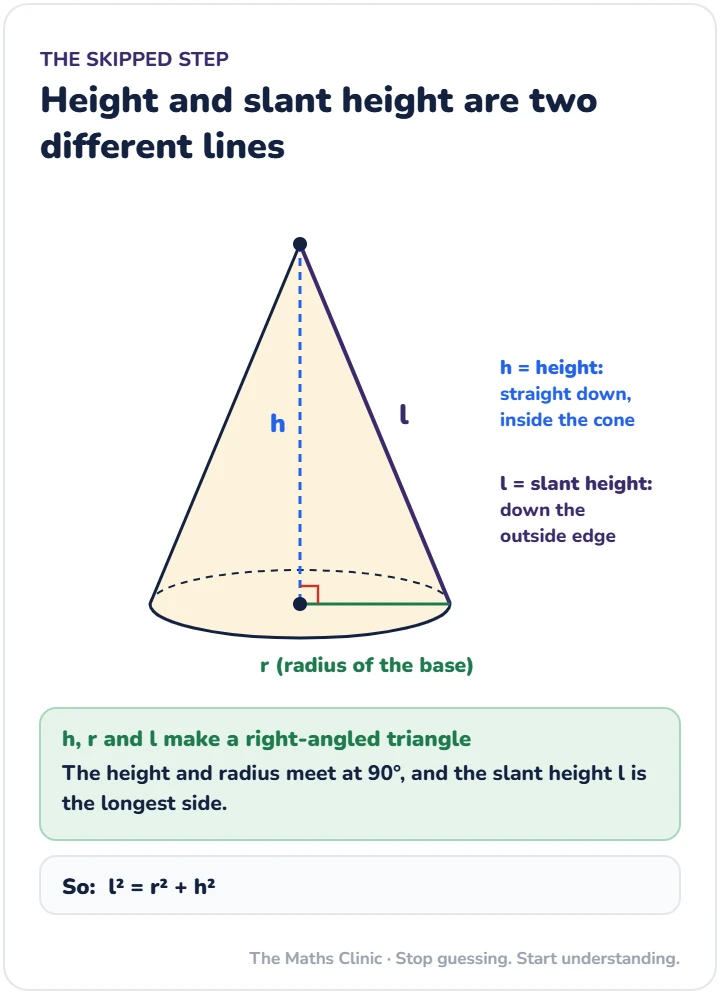
The height and the radius meet at a right angle at the centre of the base. So h, r and l form a right-angled triangle, with l as the longest side (the hypotenuse). That gives the key rule: l² = r² + h².
Where the curved surface area formula comes from
Take a paper party hat, cut it straight down one side, and flatten it. The curved surface of a cone opens out into a sector of a circle.

- The radius of the sector is the slant height l (the cut edge).
- The curved edge of the sector wrapped round the base, so its length is the base circumference, 2πr.
Now work out the area of that sector, step by step.
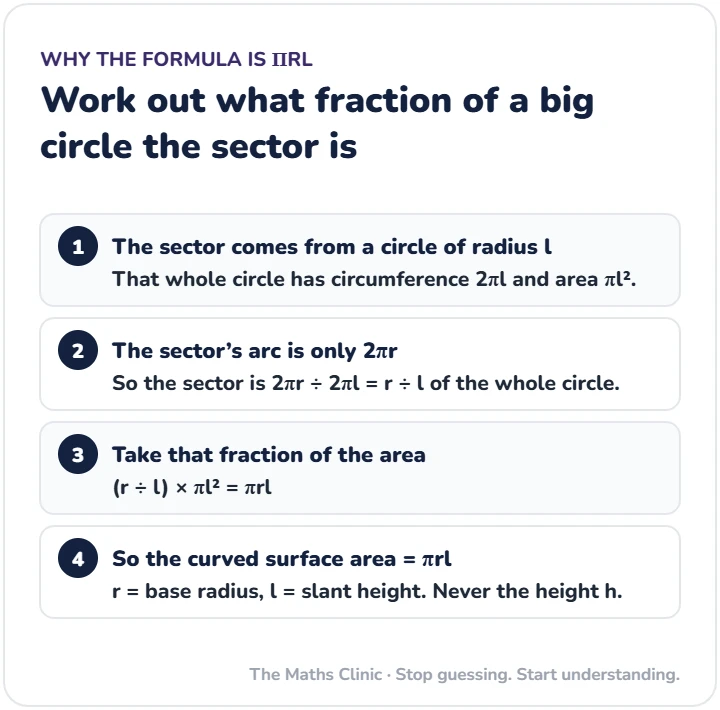
- A full circle of radius l has circumference 2πl and area πl².
- The sector’s arc is only 2πr, so the sector is 2πr ÷ 2πl = r ÷ l of that full circle.
- Take the same fraction of the area: (r ÷ l) × πl² = πrl.
So curved surface area = πrl. You do not need to memorise it blindly: it is just a sector.
How to find the slant height of a cone
If the question gives r and h, find l with Pythagoras before anything else.

- Write the rule: l² = r² + h².
- Put in the numbers: l² = 6² + 8² = 36 + 64 = 100.
- Take the square root: l = √100 = 10 cm.
Going the other way, if you know l and r and need the height: h² = l² − r², so h = √(l² − r²).
Curved surface area or total surface area?
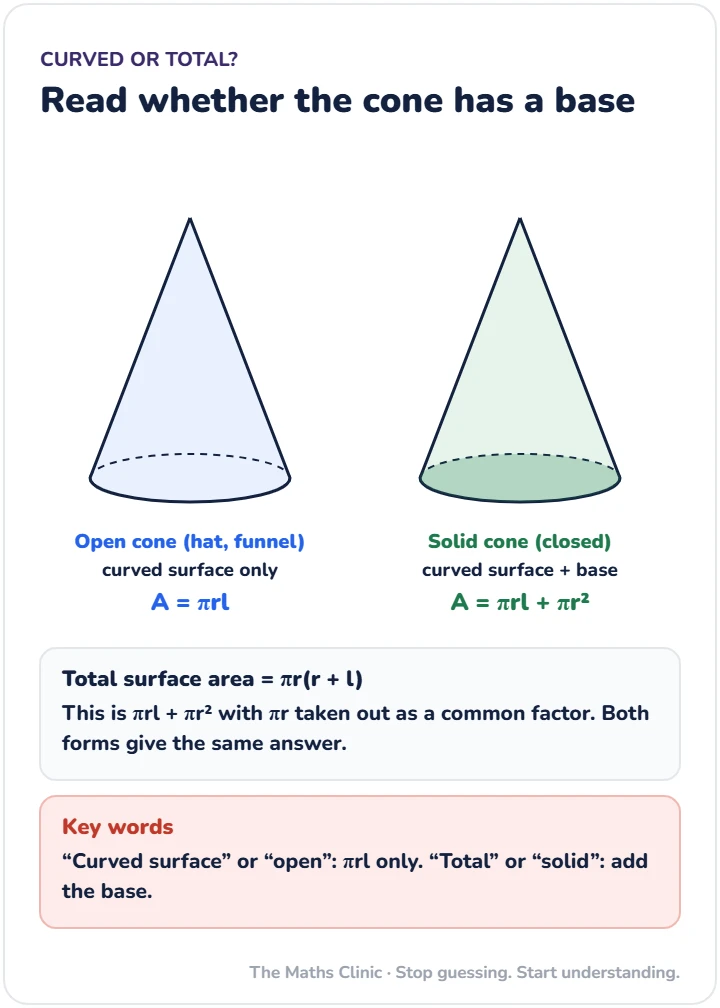
- An open cone (a hat, a funnel, a tent with no floor) has only the curved surface: A = πrl.
- A solid or closed cone also has a circular base, area πr². Total surface area = πrl + πr² = πr(r + l).
Volume of a cone

A cylinder with base radius r and height h has volume πr²h. A cone with the same base and the same height holds exactly one third of that: V = ⅓πr²h. Volume uses the straight height h, never the slant height.
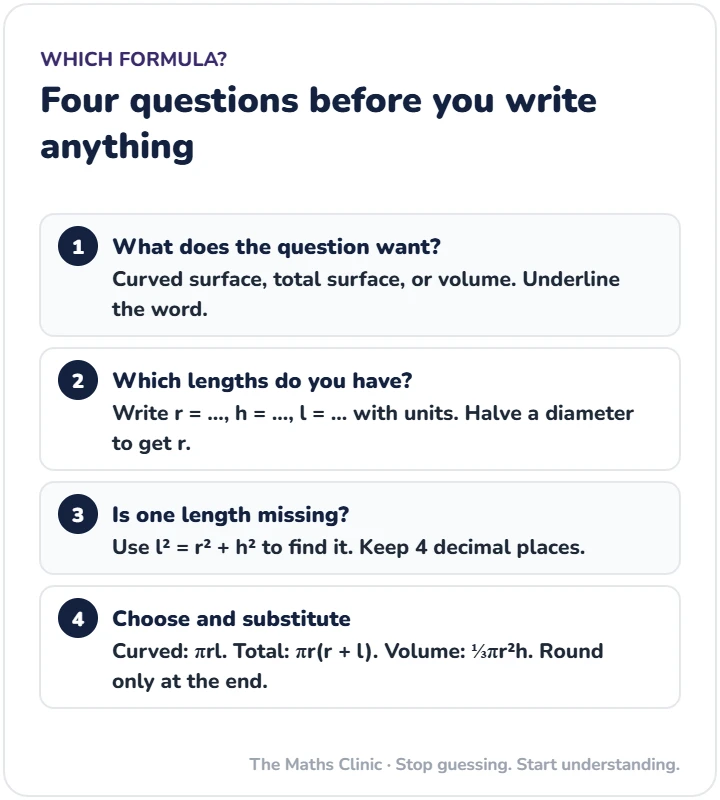
Which cone formula? Four questions
Worked example 1: curved and total surface area
Question. A solid cone has base radius 7 cm and slant height 10 cm. Find (a) its curved surface area, (b) its total surface area. Take π = 22/7.
Step 1: label. r = 7 cm, l = 10 cm. Both lengths we need are given.
Step 2: curved surface. πrl = 22/7 × 7 × 10. The 7s cancel: 22 × 10 = 220 cm².
Step 3: base. πr² = 22/7 × 7 × 7 = 22 × 7 = 154 cm².
Step 4: total. 220 + 154 = 374 cm².
Check. πr(r + l) = 22/7 × 7 × (7 + 10) = 22 × 17 = 374 cm². ✔ Same answer by the other form.
The wrong way. Giving 220 cm² for the total. The cone is solid, so the base must be added.
Worked example 2: when only the height is given
Question. A solid cone has radius 6 cm and height 8 cm. Find (a) the slant height, (b) the curved surface area, (c) the total surface area, correct to 1 decimal place. Take π = 22/7.
Step 1: find l. l² = 6² + 8² = 100, so l = 10 cm.
Step 2: curved surface. πrl = 22/7 × 6 × 10 = 1320/7 = 188.5714… = 188.6 cm².
Step 3: total. πr(r + l) = 22/7 × 6 × (6 + 10) = 22/7 × 96 = 2112/7 = 301.7142… = 301.7 cm².
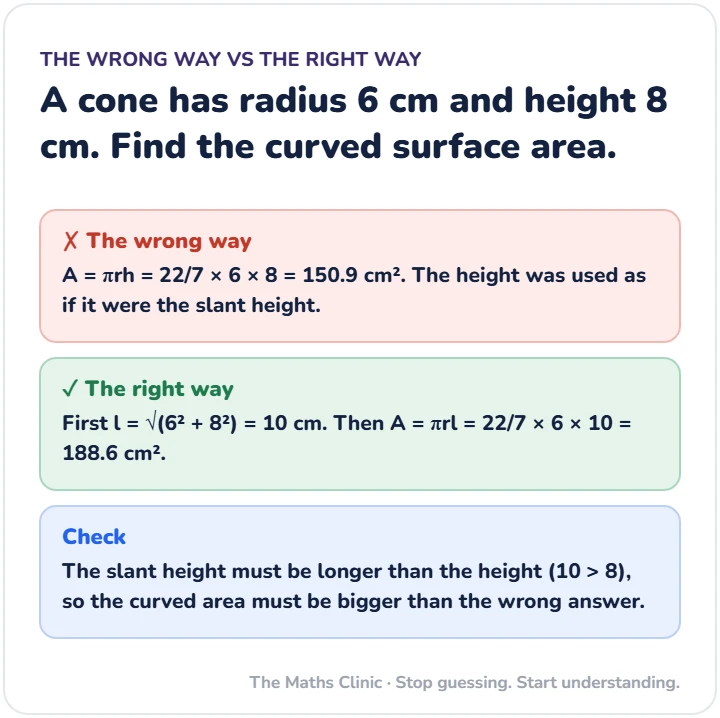
The wrong way. Writing π × 6 × 8 = 150.9 cm². The slant height (10 cm) is always longer than the height (8 cm), so the true curved area must be larger.
Worked example 3: a sector folded into a cone (WASSCE style)
Question. A sector of a circle of radius 21 cm has angle 120°. It is folded so that its straight edges meet, forming a cone. Find (a) the base radius, (b) the height, correct to 1 decimal place, (c) the volume, correct to 1 decimal place. Take π = 22/7.
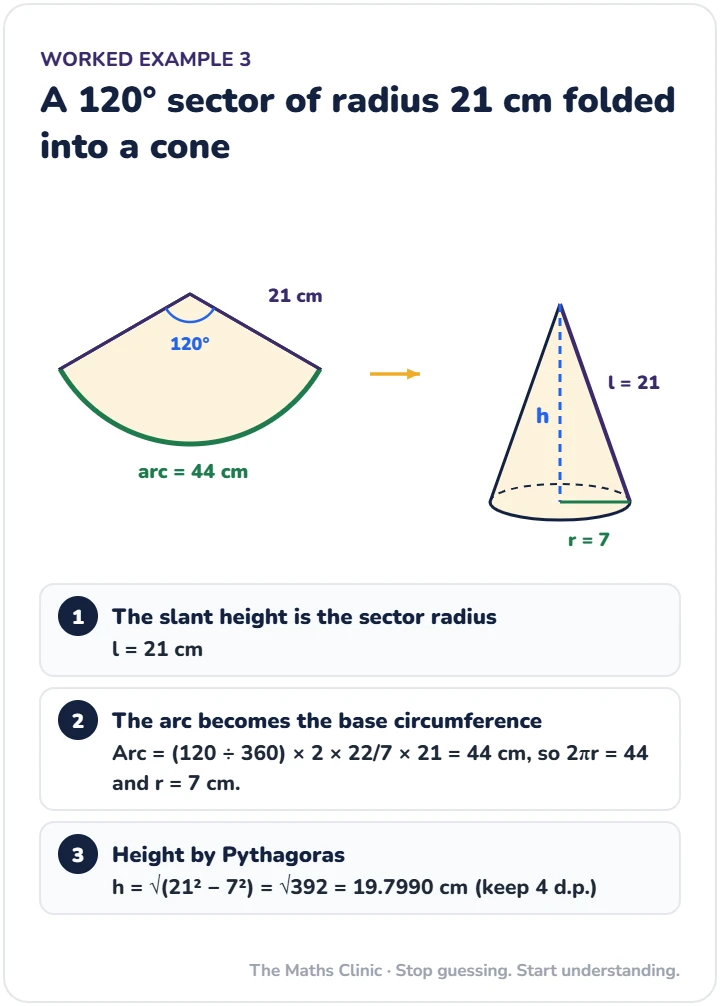
Step 1: the slant height. The straight edges of the sector become the slant of the cone, so l = 21 cm.
Step 2: the arc length. Arc = (120 ÷ 360) × 2 × 22/7 × 21 = ⅓ × 132 = 44 cm.
Step 3: the base radius. The arc wraps round the base, so 2πr = 44. That is 2 × 22/7 × r = 44, so 44r/7 = 44 and r = 7 cm.
Step 4: the height. h² = l² − r² = 21² − 7² = 441 − 49 = 392. So h = √392 = 19.7990 cm. Keep this. The answer to (b) is 19.8 cm (1 d.p.).
Step 5: the volume. V = ⅓ × 22/7 × 7² × 19.7990 = ⅓ × 154 × 19.7990 = 1016.349… = 1016.3 cm³ (1 d.p.).

Check. The curved surface πrl = 22/7 × 7 × 21 = 462 cm², and the sector’s area is (120 ÷ 360) × 22/7 × 21² = ⅓ × 1386 = 462 cm². ✔ The paper did not change size.
The wrong way. Using 19.8 in the volume gives 1016.4 cm³, which is wrong at 1 decimal place. You may write 19.8 as the answer to (b), but carry 19.7990 into (c).
Worked example 4: melted into a cone
Question. A solid cube of side 6 cm is melted and made into a solid cone of base radius 3 cm. Find the height of the cone, correct to 1 decimal place. Take π = 22/7.
Step 1: what stays the same? Melting changes the shape, not the amount of metal. So volume of cone = volume of cube.
Step 2: volume of the cube. 6 × 6 × 6 = 216 cm³.
Step 3: volume of the cone in terms of h. ⅓ × 22/7 × 3² × h = ⅓ × 22/7 × 9 × h = 66h/7.
Step 4: make the equation and solve. 66h/7 = 216, so h = 216 × 7 ÷ 66 = 1512 ÷ 66 = 22.909… = 22.9 cm.
Check. 66 × 22.909 ÷ 7 = 215.99… ≈ 216 cm³. ✔
The wrong way. Forgetting the ⅓ (you would get h = 7.6 cm), or setting the cone’s surface area equal to the cube’s volume. Melting keeps volume.
The wrong ways that cost marks
- Using the height h in πrl instead of the slant height l.
- Using the slant height l in the volume formula instead of h.
- Forgetting to add the base for a solid cone (or adding it for an open one).
- Using the diameter as the radius.
- Rounding the height or slant height before the last step.
- Forgetting the ⅓ in the volume.
- Leaving out the units: cm² for area, cm³ for volume.
📋 What the WAEC Chief Examiner reported
- In 2018, on a sector folded into a cone: “Most of the candidates did not attempt this question although it was compulsory.” Those who did “approximated prematurely and hence obtained wrong answers at the final stage of the solution.”
- In 2019, on a cube melted into a cone: “Candidates were able to find the volume of the cube but could not find the volume of the cone.”
- WAEC listed “solving problems involving mensuration” as a weakness in 2019, and “solving problems on mensuration” in 2024.
What WAEC recommends
In 2019 the Chief Examiner advised: “The concept of mensuration must be taught well in schools.” This lesson teaches it from the shape up: where each formula comes from, and every step of every calculation.
How to win these marks back
- Label r, h and l on a sketch before you choose a formula.
- Find any missing length with l² = r² + h², and keep 4 decimal places.
- Round once, on the last line, exactly as the question asks.
Source: WAEC Chief Examiner’s Reports, WASSCE (School Candidates) 2018, 2019 and 2024, Mathematics (Core).
Try it now
Cover the solutions. For each one, sketch the cone, label r, h and l, and write the formula before you substitute. Take π = 22/7.
Question 1
Find the curved surface area of a cone with base radius 14 cm and slant height 20 cm.
Question 2
A solid cone has radius 3.5 cm and slant height 9 cm. Find its total surface area.
Question 3
A cone has radius 5 cm and height 12 cm. Find (a) its slant height, (b) its curved surface area, correct to 1 decimal place.
Question 4
A cone has slant height 17 cm and base radius 8 cm. Find (a) its height, (b) its volume, correct to 1 decimal place.
Question 5 (WASSCE style)
A sector of radius 14 cm and angle 90° is folded to form a cone. Find (a) the base radius of the cone, (b) its height, correct to 1 decimal place.
Question 6 (real life)
A conical tent with no floor has base radius 3.5 m and slant height 5 m. Canvas costs GH₵12 per m². Find the cost of the canvas.
Solutions
Solution 1
πrl = 22/7 × 14 × 20 = 22 × 2 × 20 = 880 cm².
Solution 2
Curved: 22/7 × 3.5 × 9 = 11 × 9 = 99 cm². Base: 22/7 × 3.5 × 3.5 = 11 × 3.5 = 38.5 cm². Total: 99 + 38.5 = 137.5 cm². Check: πr(r + l) = 22/7 × 3.5 × 12.5 = 11 × 12.5 = 137.5 cm² ✔
Solution 3
(a) l² = 5² + 12² = 25 + 144 = 169, so l = 13 cm. (b) πrl = 22/7 × 5 × 13 = 1430/7 = 204.2857… = 204.3 cm².
Solution 4
(a) h² = 17² − 8² = 289 − 64 = 225, so h = 15 cm. (b) V = ⅓ × 22/7 × 8² × 15 = 22/7 × 64 × 5 = 7040/7 = 1005.714… = 1005.7 cm³.
Solution 5
(a) l = 14 cm. Arc = (90 ÷ 360) × 2 × 22/7 × 14 = ¼ × 88 = 22 cm. So 2πr = 22, which gives 44r/7 = 22 and r = 3.5 cm. (b) h² = 14² − 3.5² = 196 − 12.25 = 183.75, so h = 13.5554… = 13.6 cm.
Solution 6
No floor, so curved surface only: πrl = 22/7 × 3.5 × 5 = 11 × 5 = 55 m². Cost = 55 × 12 = GH₵660.
📘 New SHS curriculum link
Cones sit in Year 2 of the new SHS Mathematics curriculum (2.3.2.LI.1): the measurement of surface area, volume and capacity of solid shapes. The curriculum asks you to draw nets of 3D objects, including cones, and its surface area table gives exactly the formulas in this lesson: curved surface area πrl and total surface area πr(r + l).
For parents
Make a cone from a sheet of paper with your child, then cut it open down one side. Ask: “What shape is it now, and which edge was the slant?” Then ask them to point to the height. If they point down the outside edge, that is the mistake this lesson fixes.
Frequently asked questions
Is the slant height of a cone the same as the height?
No. The height goes straight down the middle, inside the cone. The slant height goes down the outside edge. The slant height is always longer, because it is the hypotenuse of the right-angled triangle made with the height and the radius.
What is the formula for the curved surface area of a cone?
Curved surface area = πrl, where r is the base radius and l is the slant height.
Why is the curved surface area of a cone πrl?
Unrolled, the curved surface is a sector of radius l with arc length 2πr. That sector is r ÷ l of a full circle of radius l, so its area is (r ÷ l) × πl² = πrl.
How do I find the slant height of a cone?
Use Pythagoras: l = √(r² + h²). For r = 6 cm and h = 8 cm, l = √(36 + 64) = 10 cm.
How do I find the height of a cone using Pythagoras?
Rearrange: h = √(l² − r²). For l = 17 cm and r = 8 cm, h = √(289 − 64) = 15 cm.
What is the total surface area of a cone?
Total surface area = πrl + πr² = πr(r + l): the curved surface plus the circular base. Use it for a solid or closed cone.
How do I find the radius if I know the curved surface area?
Start from πrl = area and divide by πl. For a curved surface area of 220 cm² and l = 10 cm: r = 220 ÷ (22/7 × 10) = 7 cm.
What to do next
If the sector part felt new, read Area of a Sector and Arc Length, Step by Step. If your answers in cm² sometimes come out 100 times too big, go to how to convert cm² to m². Then try mixed questions in the Practice Zone.
Keep learning
- Area of a Sector and Arc Length, Step by Step (and the Cone Question)
- Circle Theorems, Step by Step: The Rules, the Reasons and WASSCE Questions with Answers
- Area, Perimeter or Volume? How to Tell Which One a Question Wants
📚 See every lesson in the Mensuration & Geometry Clinic
✏️ Practise mensuration and geometry
💬 Stuck on a step? Ask Dickson and send the line where you got lost.

Written by
Dickson Sarpong
NTC-certified SHS Mathematics teacher in Ghana with WAEC marking experience, and author of The Bridge Series textbooks. Every lesson here is built around the mistakes WAEC examiners keep reporting.
About DicksonStuck? Ask a question
Want the whole topic, step by step? My textbooks, The Bridge to Mathematics and The Bridge to Additional Mathematics for SHS, follow the new curriculum and rebuild the basics as you go.
Read a free chapter →