Struggling with WASSCE Maths? Stop guessing. Let’s fix the gap step by step.

Why Your Area Answer Is 100 Times Too Big: Converting cm² to m², Step by Step
Why dividing cm² by 100 gives the wrong answer, how to convert cm² to m², cm³ to m³ and litres, and square feet to square metres, with WASSCE-style examples.

📚 Part of the Mensuration & Geometry Clinic: every lesson on this topic, in one place.
Quick answer: how do you convert cm² to m²?
Divide by 10 000, not 100. A metre is 100 cm, so a square metre is 100 cm × 100 cm = 10 000 cm². For volume, divide cm³ by 1 000 000 to get m³, and remember that 1 m³ holds 1 000 litres. Safest habit: change every length to the same unit before you multiply.
You worked out the area of your classroom floor and got 480 000 cm². You divided by 100 to change it to square metres and wrote 4 800 m². That is a classroom bigger than half a football pitch. The correct answer is 48 m².
If this has happened to you, nothing is wrong with your brain. Somewhere along the way, someone said “1 m = 100 cm” and moved on, and nobody showed you what happens to that 100 when you work with area or volume. This lesson fills that gap, one step at a time.
Why your area answer comes out 100 times too big
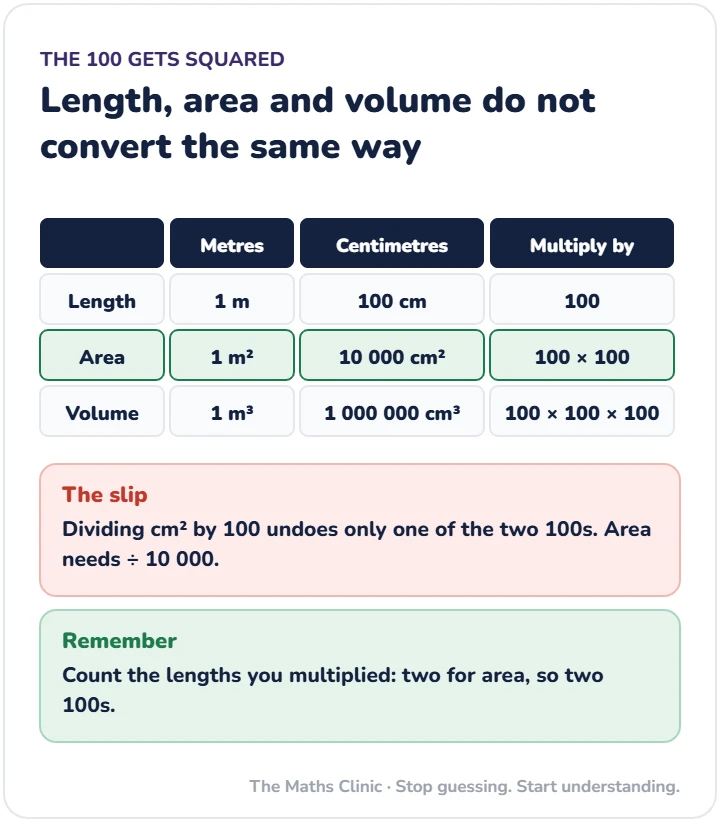
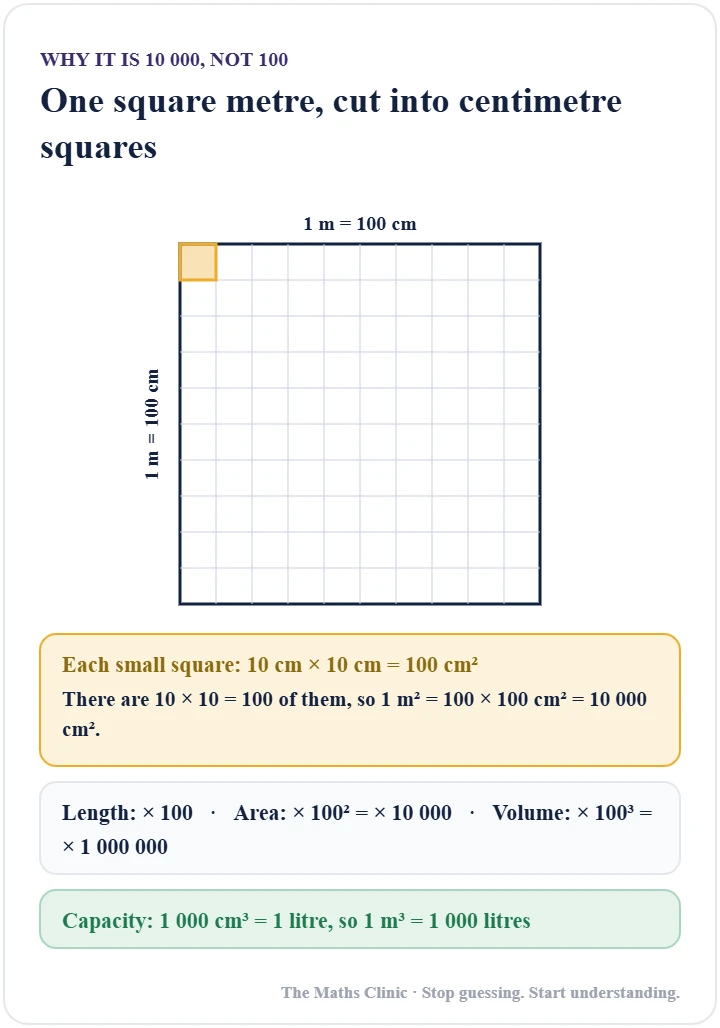
Area is length × length. When you multiply the lengths, you also multiply their units: cm × cm = cm². So when you change units, the change happens twice, once for each length.
- Length: 1 m = 100 cm, so you multiply or divide by 100.
- Area: 1 m² = 100 cm × 100 cm, so you multiply or divide by 100 × 100 = 10 000.
- Volume: 1 m³ = 100 cm × 100 cm × 100 cm, so you multiply or divide by 1 000 000.
Dividing an area by 100 only changes one of the two lengths. That is why the answer is 100 times too big.
The method, every step
The safest way: change the lengths first
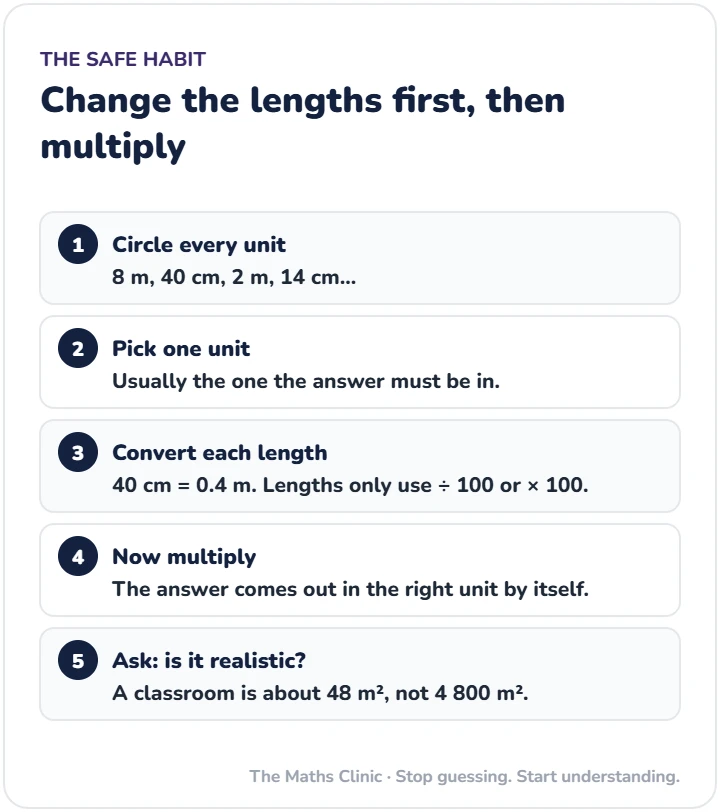
- Write down every measurement with its unit.
- Choose one unit for the whole question (usually the unit the answer asks for).
- Change every length into that unit: m to cm, × 100; cm to m, ÷ 100.
- Only now use the formula.
- Write the answer with the correct unit: cm², m², cm³ or m³.
- Ask: is this answer realistic? A classroom is about 40 to 80 m², not 4 800 m².
The other way: convert the answer
If you have already calculated in cm and need m, use the right factor for what you found:
| You found | To change to | Do this |
|---|---|---|
| a length in cm | m | ÷ 100 |
| an area in cm² | m² | ÷ 10 000 |
| a volume in cm³ | m³ | ÷ 1 000 000 |
| a volume in cm³ | litres | ÷ 1 000 |
| a volume in m³ | litres | × 1 000 |
Calculator tip: type 10 000 as 1 × 10⁴ using the ×10x key (on most Casio school calculators it is in the bottom row, next to Ans). Then 480 000 ÷ 1 × 10⁴ gives 48 with no zeros miscounted.
Worked example 1: tiling a classroom floor
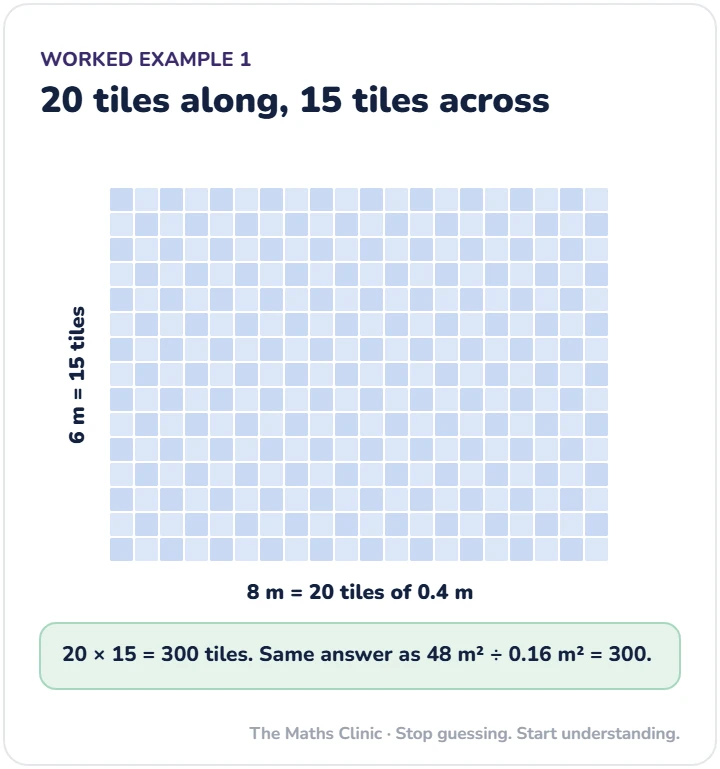
A classroom floor is 8 m long and 6 m wide. It is covered with square tiles of side 40 cm. How many tiles are needed?
Step 1. Choose one unit. The floor is in metres, so change the tile to metres: 40 cm = 40 \div 100 = 0.4 m.
Step 2. Area of the floor. 8 \times 6 = 48 m².
Step 3. Area of one tile. 0.4 \times 0.4 = 0.16 m².
Step 4. Number of tiles.
48 \div 0.16 = 300
Answer: 300 tiles. Check: 8 m holds 8 ÷ 0.4 = 20 tiles along the length and 6 ÷ 0.4 = 15 across. 20 × 15 = 300 ✓
The wrong way: 48 ÷ (40 × 40) = 48 ÷ 1 600 = 0.03 tiles. Mixing m² with cm² gives an answer that makes no sense, which is your signal to go back and match the units.
Worked example 2: melting and recasting (WASSCE style)
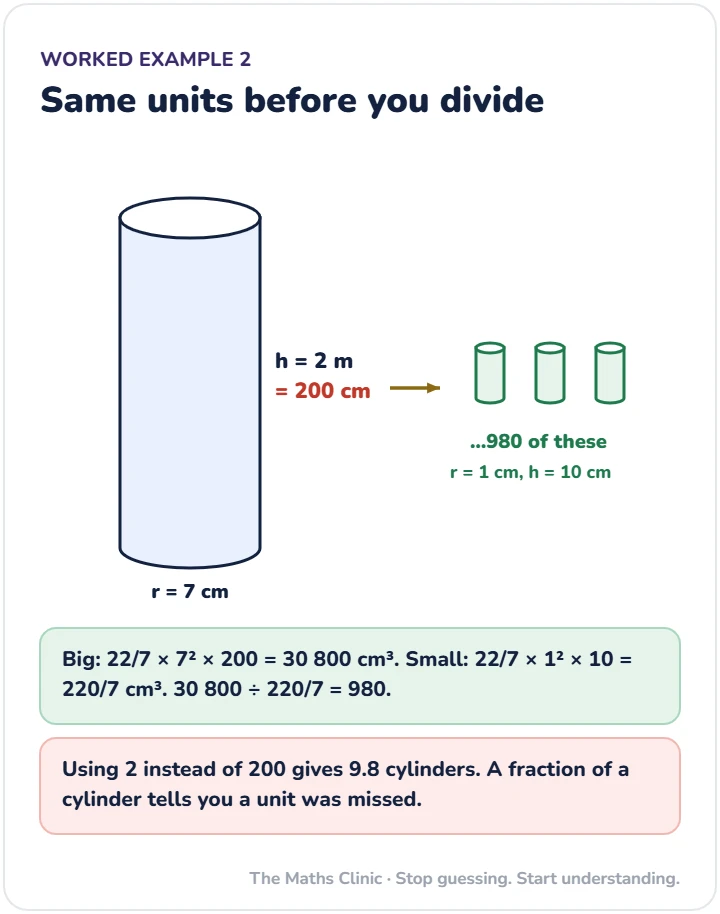
A solid metal cylinder 2 m high with diameter 14 cm is melted and recast into small cylinders, each 10 cm high with diameter 2 cm. How many small cylinders are made? [Take π = 22/7]
Step 1. Spot the trap. The height is in metres but everything else is in centimetres. Change it first: 2 m = 2 \times 100 = 200 cm.
Step 2. Radii. Big cylinder: 14 \div 2 = 7 cm. Small cylinder: 2 \div 2 = 1 cm.
Step 3. Volume of the big cylinder.
V = \tfrac{22}{7} \times 7^2 \times 200 = 30\,800 \text{ cm}^3Step 4. Volume of one small cylinder.
v = \tfrac{22}{7} \times 1^2 \times 10 = \tfrac{220}{7} \text{ cm}^3Step 5. Number of small cylinders. The metal does not change when it is melted, so divide:
30\,800 \div \tfrac{220}{7} = 30\,800 \times \tfrac{7}{220} = 980Answer: 980 small cylinders. If you had used 2 instead of 200 for the height, you would get 9.8 cylinders, which is impossible, and that is how you know something went wrong.
Worked example 3: how many litres does the polytank hold?
A cylindrical water tank has diameter 1.4 m and height 2 m. Find how many litres it holds when full. If a family uses 140 litres a day, how many days will a full tank last? [Take π = 22/7]
Step 1. Radius = 1.4 \div 2 = 0.7 m.
Step 2. Volume = \tfrac{22}{7} \times 0.7^2 \times 2 = 3.08 m³.
Step 3. Change to litres. 1 m³ = 1 000 litres, so 3.08 \times 1000 = 3080 litres.
Step 4. Days = 3080 \div 140 = 22.
Answer: 3 080 litres, enough for 22 days.

Feet and square feet: buying land in Ghana
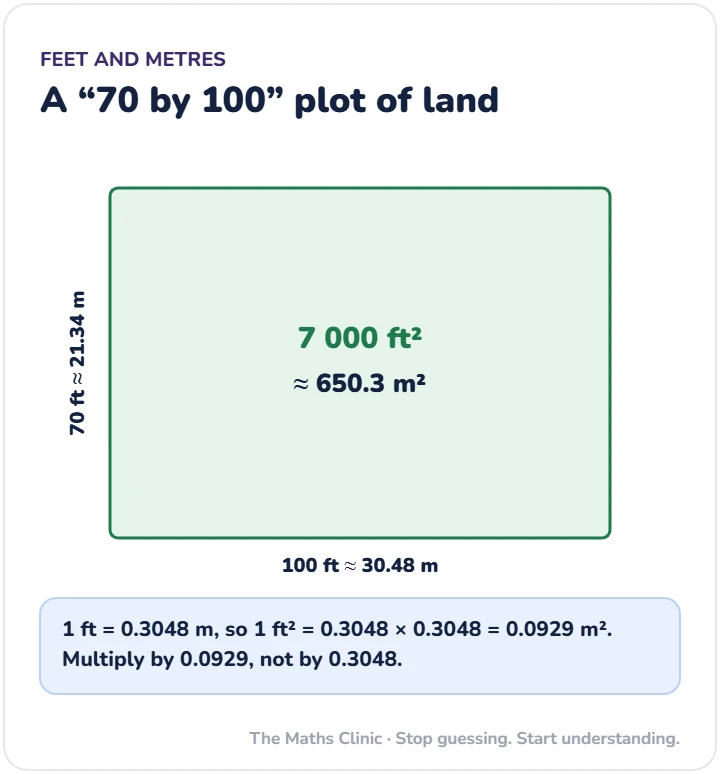
Plots of land in Ghana are often sold in feet, for example a “70 by 100” plot. The new SHS curriculum asks you to work with both SI units (metres) and imperial units (feet). The same rule applies: square the length factor.
1 foot = 0.3048 m, so 1 ft² = 0.3048^2 = 0.09290304 m².
A plot measures 100 ft by 70 ft. Find its area in square metres.
Area = 100 \times 70 = 7000 ft². In square metres: 7000 \times 0.09290304 \approx 650.3 m².
The wrong way: 7 000 × 0.3048 = 2 133.6 m². That multiplies by the length factor only once, just like dividing cm² by 100.
📋 What WAEC advises, turned into your plan
In 2021, a cylinder 6 m high was melted into small cylinders measured in centimetres. WAEC reported that “most candidates could not notice the difference in units (cm, m) did not convert them and this affected their answers.” Mensuration was also named a weakness in 2018, 2019 and 2024, and WAEC’s 2019 advice was that “the concept of mensuration must be taught well in schools.”
Here is how to put that advice into practice yourself:
- Before any calculation, circle every unit in the question.
- Change all lengths to one unit first. Write the conversion as a line of working; it can earn a method mark.
- After answering, ask: is this realistic? Then do the five practice questions below without looking at the solutions.
Encouragingly, in 2025 WAEC listed “solving problems on mensuration” as a strength. These marks can be won.
Source: WAEC Chief Examiner’s Report, WASSCE 2018, Mathematics (Core); WAEC Chief Examiner’s Report, WASSCE 2019, Mathematics (Core); WAEC Chief Examiner’s Report, WASSCE 2021, Mathematics (Core); WAEC Chief Examiner’s Report, WASSCE 2024, Mathematics (Core); WAEC Chief Examiners’ Reports, WASSCE (SC) 2025, Ghana: Mathematics (Core).
Try it now
Cover the solutions. Write every conversion as a line of working.
Question 1
Change 25 000 cm² to m².
Question 2
Change 3.2 m² to cm².
Question 3
A rectangular tank is 2 m long, 1.5 m wide and 80 cm deep. How many litres does it hold?
Question 4
How many square tiles of side 20 cm are needed to cover a floor 4 m by 3 m?
Question 5 (WASSCE style)
A metal block 1.2 m by 50 cm by 40 cm is melted and recast into cubes of side 10 cm. How many cubes are made?
Question 6 (new curriculum)
A bedroom measures 12 ft by 10 ft. Find its area in square metres, correct to 2 decimal places.
Solutions
Solution 1
25000 \div 10000 = 2.5. Answer: 2.5 m².
Solution 2
3.2 \times 10000 = 32000. Answer: 32 000 cm².
Solution 3
80 cm = 0.8 m. Volume = 2 \times 1.5 \times 0.8 = 2.4 m³ = 2.4 \times 1000 = 2400 litres.
Answer: 2 400 litres.
Solution 4
Tile side 20 cm = 0.2 m, so tile area = 0.04 m². Floor = 12 m².
12 \div 0.04 = 300. Answer: 300 tiles. Check: 20 × 15 = 300 ✓
Solution 5
Change to cm: 1.2 m = 120 cm. Block volume = 120 \times 50 \times 40 = 240\,000 cm³. Cube volume = 10^3 = 1000 cm³.
240\,000 \div 1000 = 240. Answer: 240 cubes.
Solution 6
Area = 120 ft². In m²: 120 \times 0.09290304 \approx 11.15.
Answer: 11.15 m².
Check yourself: did you change all lengths to one unit before multiplying? Did you square the factor for area and cube it for volume? Is your answer realistic?
📘 New SHS curriculum link
Year 1 (1.3.2): identify and compare SI and imperial area measurements. Year 2 (2.3.2): solve problems with SI and imperial units in surface area, volume and capacity. This lesson covers both, with metres, centimetres, litres and feet.
For parents
A quick way to help at home: ask your child why 1 m² is 10 000 cm² and not 100 cm². If they can explain it with the tile picture above, they understand it. If not, read the “Why your area answer comes out 100 times too big” section together.
Frequently asked questions
How many cm² are in 1 m²?
10 000, because 1 m² = 100 cm × 100 cm.
How many litres are in 1 m³?
1 000 litres. One litre is 1 000 cm³, and 1 m³ is 1 000 000 cm³.
How do I change square feet to square metres?
Multiply by 0.09290304 (that is 0.3048²). For example, 7 000 ft² ≈ 650.3 m².
How do I convert cm³ to litres?
Divide by 1 000. Here is why: 1 litre is exactly 1 000 cm³, so every 1 000 cm³ makes one litre.
Example: convert 4 000 cm³ to litres. 4 000 ÷ 1 000 = 4 litres.
Also worth knowing: 1 cm³ is the same as 1 millilitre (1 ml). So a 500 ml sachet of water holds 500 cm³.
How do I convert m³ to litres, and litres to m³?
m³ to litres: multiply by 1 000, because 1 m³ holds 1 000 litres. So 3.08 m³ × 1 000 = 3 080 litres.
Litres to m³: divide by 1 000. So 2 500 litres ÷ 1 000 = 2.5 m³.
Quick check: m³ is the big unit, so the number of m³ must be the smaller number.
How do I find the volume of a cylinder in litres?
Work in centimetres, then divide by 1 000 at the very end. Example: a bucket-shaped tank has radius 35 cm and height 80 cm. Take π = 22/7.
Step 1: square the radius. 35 × 35 = 1 225.
Step 2: multiply by π. 22/7 × 1 225 = 3 850 (cm², the area of the base).
Step 3: multiply by the height. 3 850 × 80 = 308 000 cm³.
Step 4: change to litres. 308 000 ÷ 1 000 = 308 litres.
Is converting cm² to m² different in physics?
No. It is the same 10 000 in every subject, because it comes from 100 × 100. In physics books you may see it written as 1 cm² = 10⁻⁴ m², which means the same thing: divide by 10 000.
Is “centimetre square” the same as “square centimetre”?
Many of us say “centimetre square” when we mean cm². The correct name is square centimetre: the space inside a square that is 1 cm long and 1 cm wide.
Be careful in a question: “a 10 cm square” means a square with sides of 10 cm. Its area is 10 × 10 = 100 cm², not 10 cm².
What to do next
Once units no longer catch you out, practise choosing the right formula in Area, Perimeter or Volume? How to Tell Which One a Question Wants, then try mixed questions in the Practice Zone.
Keep learning
- Area, Perimeter or Volume? How to Tell Which One a Question Wants
- Area and Volume Formulas: 10 Common Errors and How to Fix Them
- Word Problems in WASSCE Mathematics: Questions and Answers, Step by Step
📚 See every lesson in the Mensuration & Geometry Clinic
✏️ Practise mensuration and geometry
💬 Stuck on a step? Ask Dickson and send the line where you got lost.

Written by
Dickson Sarpong
NTC-certified SHS Mathematics teacher in Ghana with WAEC marking experience, and author of The Bridge Series textbooks. Every lesson here is built around the mistakes WAEC examiners keep reporting.
About DicksonStuck? Ask a question
Want the whole topic, step by step? My textbooks, The Bridge to Mathematics and The Bridge to Additional Mathematics for SHS, follow the new curriculum and rebuild the basics as you go.
Read a free chapter →

