Struggling with WASSCE Maths? Stop guessing. Let’s fix the gap step by step.

Simple Interest Clinic: The Complete 8-Part Series
An 8-part Mathematics series that fixes the simple interest gaps that cost marks in WASSCE and NOVDEC.
Simple interest looks like one of the easiest topics in Mathematics. There’s one formula, and most students can say it from memory. Yet it keeps costing marks in WASSCE and NOVDEC, because the questions hide the numbers inside money stories, mix up months and years, and ask for the amount when you’ve only found the interest.
This series fixes those gaps one at a time. Start with Part 1 and work through in order. Each part builds on the one before.
What you’ll be able to do by the end
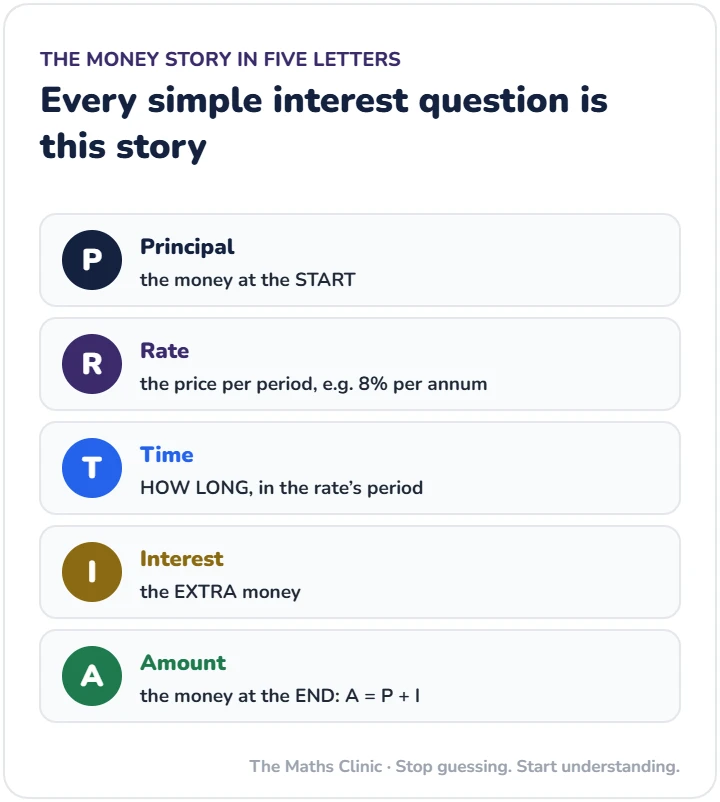
- Say exactly what P, R, T, I and A stand for in any money story
- Match the rate and the time correctly, whether they’re in years, months or days
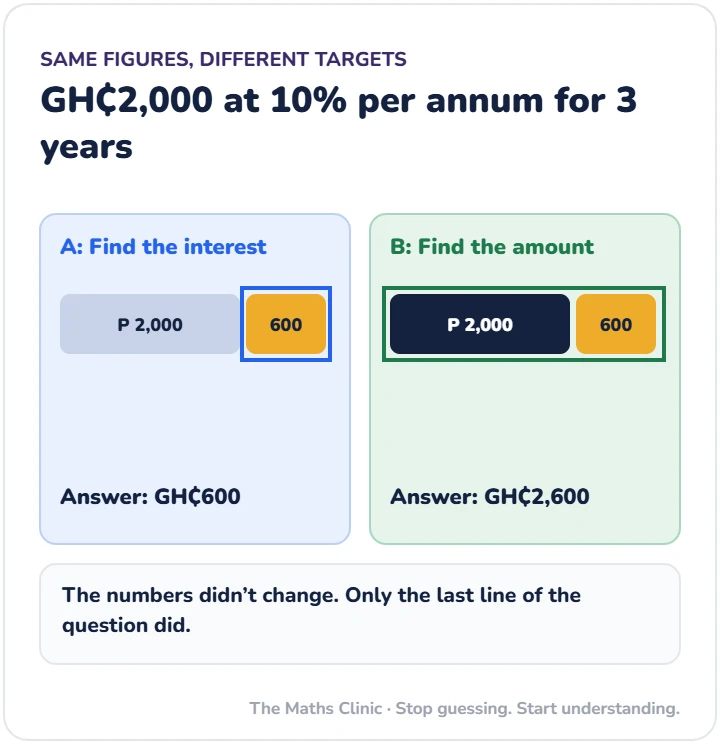
- Tell whether a question wants the interest or the amount
- Find the principal, rate or time when the question works backwards
- Spot the exact line where a wrong answer first went wrong
Simple interest in one page
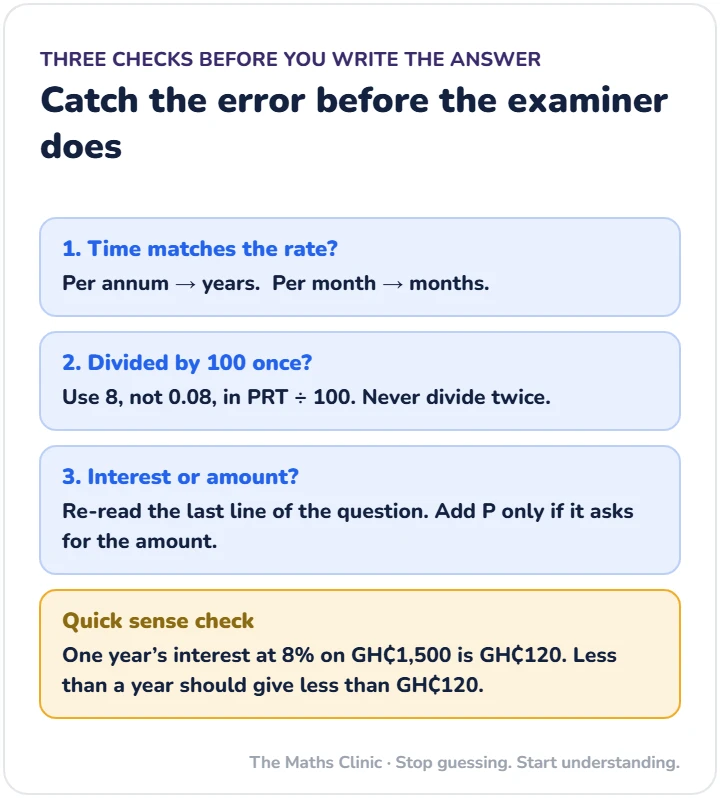
Simple interest questions appear in almost every Core Maths paper, and they are full of small traps: the wrong time unit, the wrong money quantity, or a percentage divided by 100 twice. Here is the whole topic in six ideas. Each lesson below goes deeper.
1. Five letters, one money story
2. One formula, four jobs
I = \frac{PRT}{100} \qquad A = P + I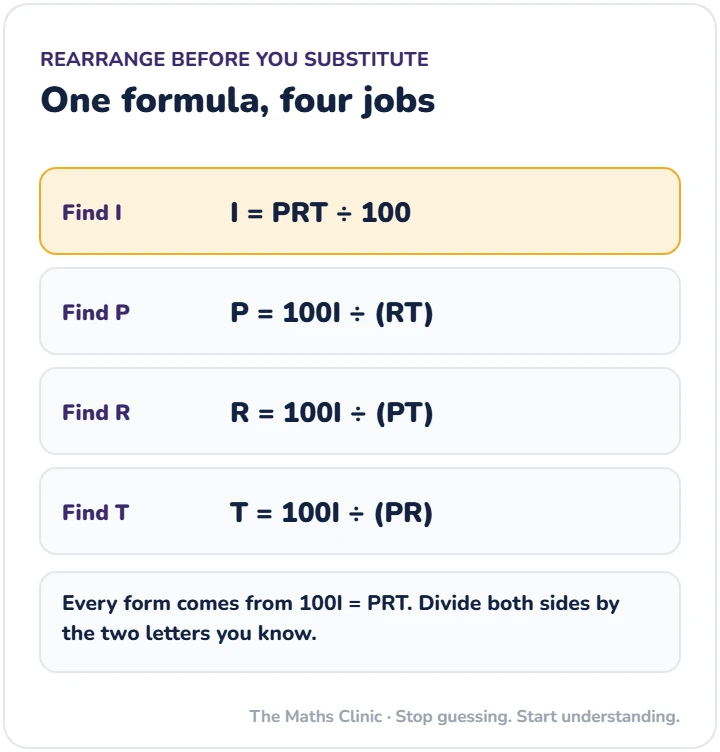
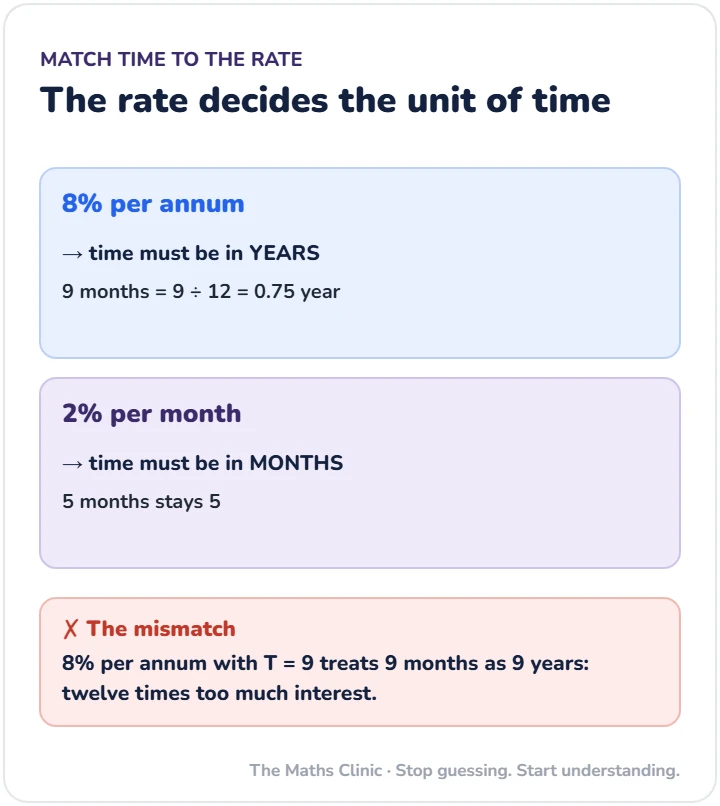
3. Time must match the rate
A rate per annum needs the time in years: 9 months is 9 ÷ 12 = 0.75 year. A rate per month keeps the time in months.
4. Interest or amount?
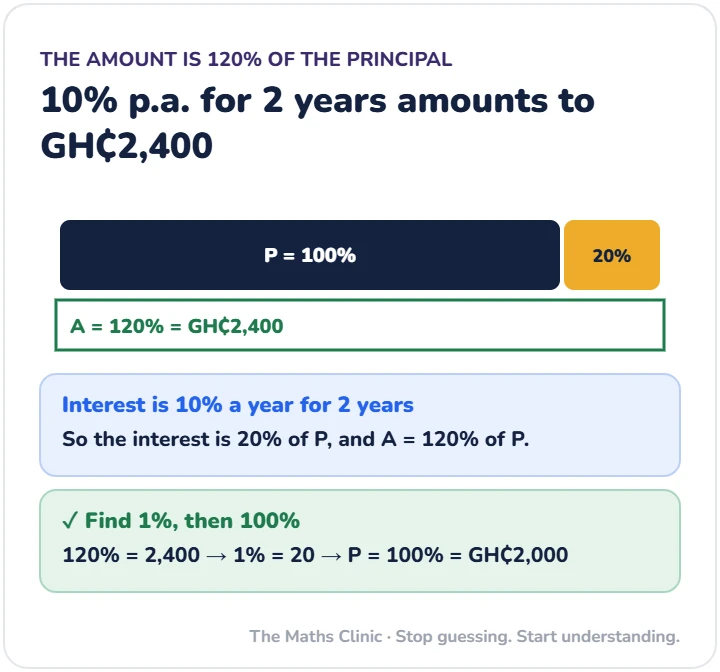
5. Working backwards
When the amount is given, think of it as a percentage of the principal. At 10% for 2 years, the amount is 120% of the principal.
6. Check before you write
The lessons
-
Simple Interest in Mathematics: What P, R, T, I and A Really Mean
You can probably say “I = PRT/100” in your sleep. But when the question hides the principal inside a story, gives the time in months or asks for the amount, the marks still slip away. This lesson makes every letter in the formula mean something real, so you know exactly what goes where. Start this part →
Practise as you go
After each part, try a few questions in the Business Maths Practice Zone. The feedback on each answer shows you which gap is still there. Stuck on a question? Send it to me.
Want a quick recap first? Read Financial Maths: 5 Simple Interest Mistakes to Correct.
The simple interest mistakes examiners see most
| Mistake | Fix |
|---|---|
| Nine months used as T = 9 with a yearly rate | T = 9 ÷ 12 = 0.75 |
| Interest given when the amount was asked | Add the principal: A = P + I |
| Amount used as the principal | Start money is P; end money is A |
| 0.08 used and then divided by 100 again | Divide by 100 once only |
| T = I ÷ R when finding time | T = 100I ÷ (PR) |
Questions learners often ask
What is the simple interest formula?
I = PRT ÷ 100, where P is the principal, R the rate per period and T the time in the same period.
How do I find the amount?
Add the interest to the principal: A = P + I.
What is the difference between simple and compound interest?
Simple interest is always worked out on the original principal, so it adds the same amount each year. Compound interest is worked out on a growing balance.
This clinic is part of How to Pass WASSCE and NOVDEC Core Maths. Simple interest also connects to the Business Maths Clinic.
Sources and further reading
The mistakes and topics in these lessons come from what WAEC examiners report year after year, matched to Ghana’s SHS curriculum. You can read the original sources here:
- WAEC Chief Examiner’s Reports: the yearly reports on where candidates lose marks, which these lessons are built on
- NaCCA SHS curriculum: the official Ghana Senior High School curriculum
- Ghana curriculum resources: official teaching and learning resources for the new curriculum
- WASSCE for private candidates (NOVDEC): WAEC’s information for candidates rewriting Mathematics

Written by
Dickson Sarpong
NTC-certified SHS Mathematics teacher in Ghana with WAEC marking experience, and author of The Bridge Series textbooks. Every lesson here is built around the mistakes WAEC examiners keep reporting.
About DicksonStuck? Ask a question
Want the whole topic, step by step? My textbooks, The Bridge to Mathematics and The Bridge to Additional Mathematics for SHS, follow the new curriculum and rebuild the basics as you go.
Read a free chapter →