Struggling with WASSCE Maths? Stop guessing. Let’s fix the gap step by step.

Financial Maths: 5 Simple Interest Mistakes to Correct

Simple interest mistakes are common in many Ghanaian SHS classrooms, even though it seems like one of the friendliest topics in core mathematics. The formula is short. The numbers are usually clear. The question may even mention bank, loan, savings, principal, rate, or time. So the learner feels, “This one deɛ, I can do it.”
But when scripts are marked, some students who know the formula still lose marks. Not because the question was impossible, but because one small misunderstanding changed the whole working.
Simple interest is like giving directions to a trotro driver. If you mention the wrong junction, the driver may still move confidently, but he is going to the wrong place. In the same way, a learner may substitute numbers confidently, but one wrong interpretation of principal, rate, time, or amount can spoil the answer.
This Maths Clinic post diagnoses the hidden mistakes in simple interest questions and shows how to correct them step-by-step before WASSCE exposes them.
| Classroom Hook Knowing the formula is good, but knowing what each letter means is what protects your marks. |

1. The Learner’s Problem
The common learner problem is this: the student can recite the simple interest formula, but cannot control the meaning of the values in the question.
I = (P × R × T) / 100
The learner may know that I means interest, P means principal, R means rate, and T means time. But when the question is written in ordinary English, confusion begins.
- The learner uses the amount as principal.
- The learner forgets that the rate is per annum unless stated otherwise.
- The learner writes 18 months as 18 years instead of 1.5 years.
- The learner finds interest when the question asks for an amount.
- The learner substitutes correctly but does not show clear working.
That is why a learner may finish the question and still lose marks. The formula was correct, but the reading and interpretation were weak.
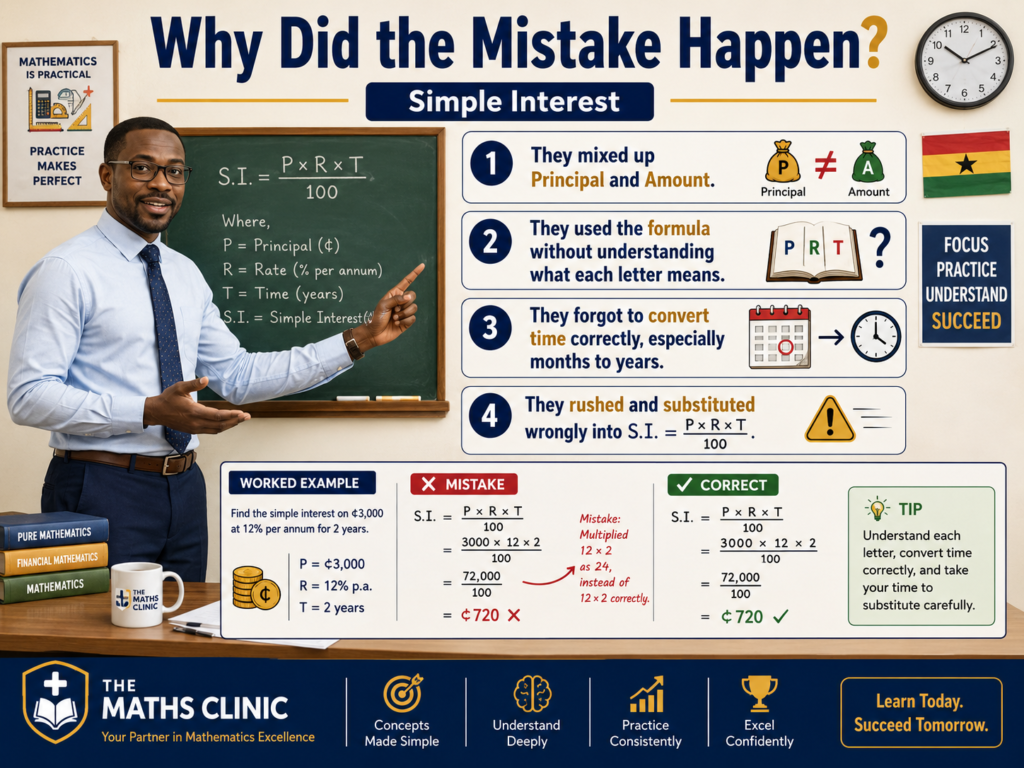
2. Why Did the Mistake Happen?
The mistake usually happens because simple interest sits between arithmetic, percentages, reading comprehension, and substitution. When any one of these areas is weak, the learner struggles.
Mistake 1: Confusing Principal with Amount
Principal is the original money invested, saved, or borrowed. The amount is the principal plus interest. When a learner uses “amount” in place of “principal,” the answer changes.
Mistake 2: Treating Rate as an Ordinary Number Without Understanding Percent
A rate such as 12% means 12 out of 100. The formula already handles the division by 100, so the learner must not divide by 100 again unless using the decimal method correctly.
Mistake 3: Using Time Without Converting It Properly
In most schools, for simple interest questions, the rate is given per annum. This means time must be in years unless the rate is given per month or another period.
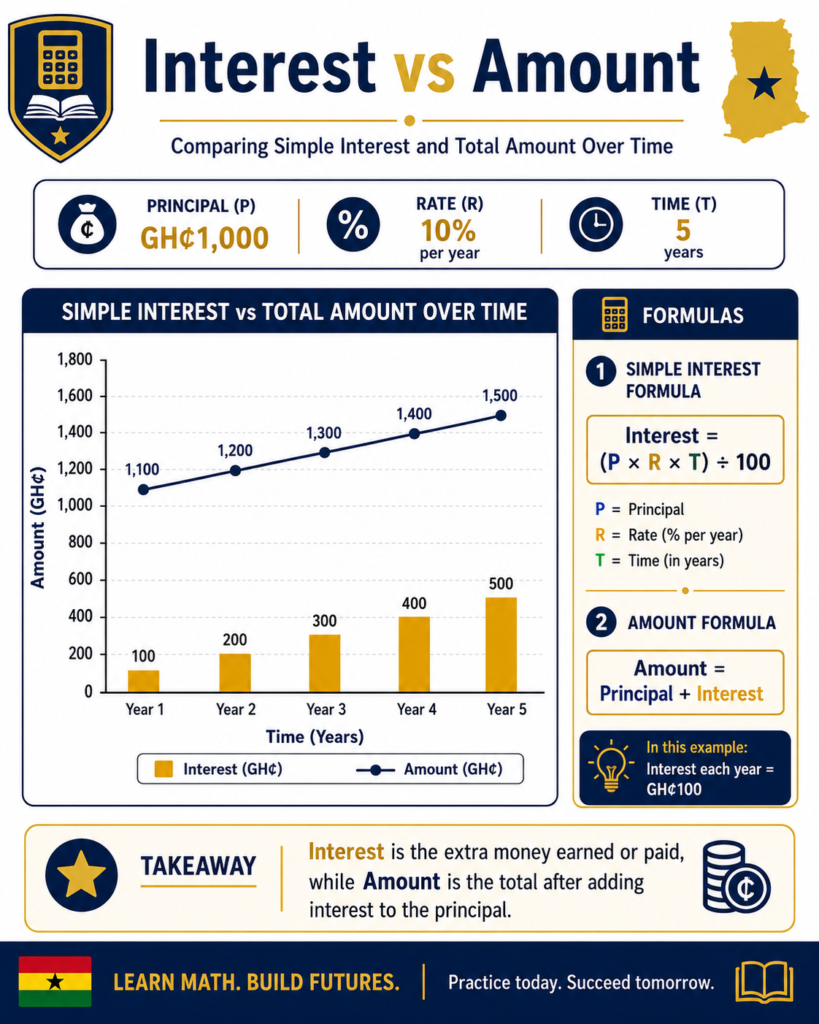
Mistake 4: Finding Interest When the Question Asks for an Amount
Interest is only the extra money gained or paid. The amount is the total money after adding interest to the principal.
Mistake 5: Poor Substitution and Arrangement of Formula
Some learners know the formula but struggle when they are asked to find P, R, or T instead of I. They may cross-multiply wrongly or divide by the wrong value.
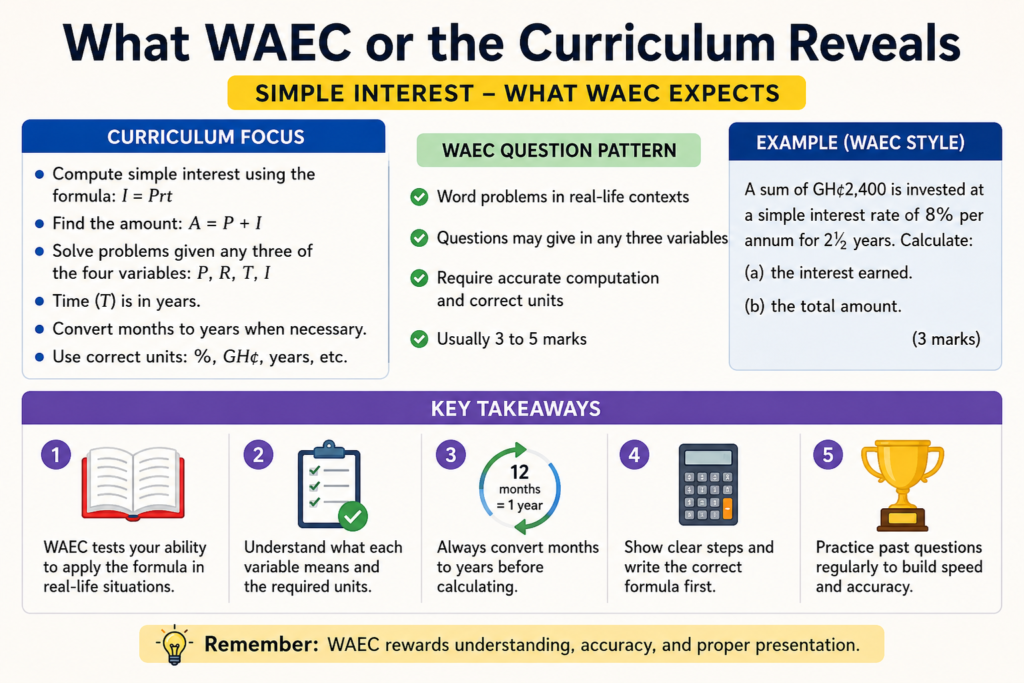
3. What WAEC or the Curriculum Reveals
WASSCE Core Mathematics does not reward formula memorization alone. A learner must interpret the question, select the correct values, substitute accurately, and present the work clearly.
The curriculum direction also expects learners to apply mathematics to real-life financial situations. This means simple interest questions may appear through savings, loans, investments, hire purchase agreements, business transactions, or personal finance situations.
- A learner must know what the question is asking for before using the formula.
- A learner must identify the principal, rate, time, interest, and amount correctly.
- A learner must convert time correctly when months are involved.
- A learner must avoid copying values blindly from the question.
- A learner must write enough work to show the method clearly.
| WAEC-Style Lesson In financial maths, the marks are not only in the final answer. The marks are also in correct interpretation, substitution, conversion, and presentation. |
4. Simple Explanation
Simple interest is the extra money added to a principal after a given time at a given rate.
Simple Interest = (Principal × Rate × Time) / 100
In short form:
I = (P × R × T) / 100
Meaning of the Letters
| Letter | Meaning | What the learner should look for |
| I | Interest | The extra money gained or paid |
| P | Principal | The original amount saved, invested, or borrowed |
| R | Rate | The percentage given, usually per annum |
| T | Time | The period, usually in years if rate is per annum |
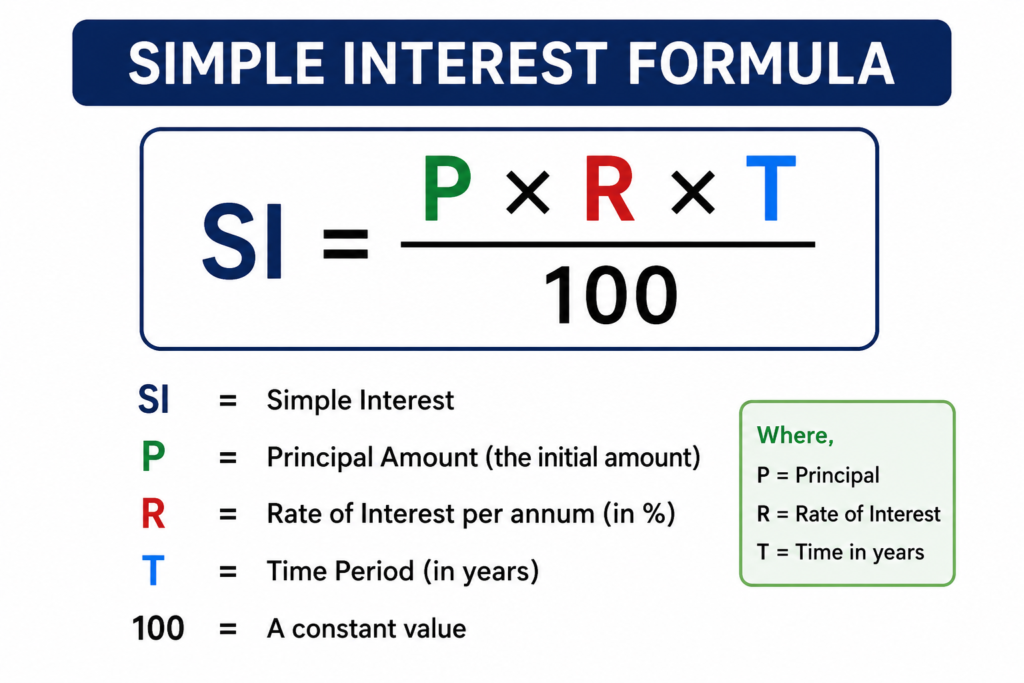
To find the amount, use:
A = P + I
Where A is the total amount after adding interest to the principal.
5. Worked Example
Example 1: Finding Simple Interest and Amount
Ama deposits GH₵800 in a bank at a rate of 12% per annum for 3 years. Find the simple interest and the amount after 3 years.
Step 1: Write the formula.
I = (P × R × T) / 100
Step 2: Identify the Values
- P = GH₵800
- R = 12%
- T = 3 years
Step 3: Substitute Correctly
I = (800 × 12 × 3) / 100
Step 4: Calculate Carefully
I = 28800 / 100
I = GH₵288
Step 5: Find the Amount
A = P + I
A = 800 + 288
A = GH₵1088
Final Answer
Simple interest = GH₵288
Amount after 3 years = GH₵1088.00
6. Common Wrong Approach
A common wrong approach is to treat the amount and the interest as the same thing.
A wrong learner may write the following: Answer = GH₵288
But GH₵288 is only the interest. It is not the total amount in the account after 3 years.
Why This Approach Is Wrong
The question asked for both simple interest and the amount. Once the interest is found, the learner must add it to the principal to get the amount.
Amount = Principal + Interest
A = P + I
| Mark-Loss Warning: If the question asks for an amount and you stop at interest, you have not finished the question. |
7. Correct Method
The correct method is to read the question slowly and decide whether you are finding interest, amount, principal, rate, or time.
- Underline the money given as the original amount. That is usually the principal.
- Circle the rate and check whether it is per annum or per month.
- Convert time into the correct unit before substitution.
- Use I = (P × R × T) / 100 when finding interest.
- Use A = P + I when finding the amount.
- Check the final answer with the wording of the question.
Quick Simple Interest Checklist
| Question to Ask Yourself | Why It Matters |
| What is the original money? | This gives the principal. |
| Is the rate per annum? | This tells you the correct time unit. |
| Is time given in months? | You may need to divide by 12. |
| Does the question ask for interest or amount? | This prevents stopping too early. |
| Have I included GH₵ or % where necessary? | This keeps the answer complete. |
The 5 Costly Simple Interest Mistakes and How to Correct Them
Mistake 1: Confusing Principal with Amount
Principal is the original money invested, saved, or borrowed. The amount is the principal plus interest. When a learner uses “amount” in place of “principal,” the answer changes.
Correction
Ask: Which money was there at the beginning? That is the principal. If the question gives the final amount, do not treat it automatically as principal.
Mistake 2: Treating Rate as an Ordinary Number Without Understanding Percent
A rate such as 12% means 12 out of 100. The formula already handles the division by 100, so the learner must not divide by 100 again unless using the decimal method correctly.
Correction
If you use I = (P × R × T) / 100, write R as the whole percentage number, for example, 10, 12, or 15. Do not write 0.12 inside this same formula unless you are using the decimal version.
Mistake 3: Using Time Without Converting It Properly
In most schools, for simple interest questions, the rate is given per annum. This means time must be in years unless the rate is given per month or another period.
Correction
If the rate is per annum and time is in months, convert months to years.
T = number of months / 12
Mistake 4: Finding Interest When the Question Asks for an Amount
Interest is only the extra money gained or paid. The amount is the total money after adding interest to the principal.
Correction
When the question asks for an amount, first find the interest, then add it to the principal.
A = P + I
Mistake 5: Poor Substitution and Arrangement of Formula
Some learners know the formula but struggle when they are asked to find P, R, or T instead of I. They may cross-multiply wrongly or divide by the wrong value.
Correction
When a different subject is required, rearrange carefully before substituting or use clear cross-multiplication.
I = (P × R × T) / 100
100I = PRT
More Worked Examples for Common WAEC-Style Situations
Example 2: Time Given in Months
A sum of GH₵600 is invested at 10% per annum for 18 months. Find the simple interest.
Step 1: Convert Time
T = 18 / 12 = 1.5 years
Step 2: Substitute
I = (600 × 10 × 1.5) / 100
I = 9000 / 100
I = GH₵90
So, the simple interest is GH₵90.
Example 3: Finding the Principal
The simple interest on a sum of money for 4 years at 5% per annum is GH₵200. Find the principal.
Step 1: Write the formula.
I = (P × R × T) / 100
Step 2: Substitute Known Values
200 = (P × 5 × 4) / 100
200 = 20P / 100
Step 3: Clear the Denominator
200 × 100 = 20P
20000 = 20P
P = 20000 / 20
P = GH₵1000
So, the principal is GH₵1000.
8. Practice Task
Try these before checking the solutions. Do not rush. First, identify P, R, T, I, and A where necessary.
- Find the simple interest on GH₵500 at 8% per annum for 2 years.
- A student saves GH₵1200 at 6% per annum for 3 years. Find the amount in the account after 3 years.
- Find the simple interest on GH₵900 at 10% per annum for 9 months.
- The simple interest on a sum for 5 years at 4% per annum is GH₵300. Find the principal.
- A trader borrows GH₵1500 at 12% per annum. How much interest will he pay after 2 years?
Practice Task Solutions
Solution 1
I = (500 × 8 × 2) / 100
I = 8000 / 100 = GH₵80
Answer: GH₵80
Solution 2
I = (1200 × 6 × 3) / 100
I = 21600 / 100 = GH₵216
A = P + I = 1200 + 216 = GH₵1416
Answer: GH₵1416
Solution 3
T = 9 / 12 = 0.75 years
I = (900 × 10 × 0.75) / 100
I = 6750 / 100 = GH₵67.50
Answer: GH₵67.50
Solution 4
300 = (P × 4 × 5) / 100
300 = 20P / 100
300 × 100 = 20P
30000 = 20P
P = GH₵1500
Answer: GH₵1500
Solution 5
I = (1500 × 12 × 2) / 100
I = 36000 / 100 = GH₵360
Answer: GH₵360
Frequently Asked Questions
Why do students fail simple interest even when they know the formula?
Many students know the formula but misread the values in the question. They may use the amount as principal, forget to convert months to years, or stop at interest when the question asks for the amount.
H3: What is the most common simple interest mistake?
One common mistake is confusing interest with amount. Interest is the extra money. The amount is the principal plus interest.
When should time be converted to simple interest?
Time should be converted when the rate is per annum, but the time is given in months. For example, 18 months should be written as 18/12 = 1.5 years.
What is the best way to avoid simple interest mistakes?
Before substituting, write P, R, T, I, and A clearly. Then check what the question is asking for.
Can simple interest appear in WASSCE word problems?
Yes. Simple interest can be tested through savings, loans, investments, borrowing, and real-life financial situations.
Conclusion: Fix the Meaning Before You Use the Formula
Simple interest is not difficult when the learner understands the meaning of the values. The real danger is not the formula. The real danger is using the right formula with the wrong values.
In the classroom, a student may say, “Sir, I know the formula.” That is good. But the Maths Clinic question is this: do you know what the question is asking you to find?
If you can identify the principal, rate, time, interest, and amount correctly, simple interest becomes a mark-gaining topic. If you rush, it becomes a WAEC trap.
So slow down. Read the question. Label the values. Convert the time. Substitute carefully. Then answer exactly what the question asked.
That is how weak marks become stronger marks, one corrected mistake at a time.