Struggling with WASSCE Maths? Stop guessing. Let’s fix the gap step by step.

Algebra for Beginners: 8 Simple Rules to Stop Guessing in Maths

In many Ghanaian classrooms, the moment algebra appears on the board, some students begin to panic before the teacher even finishes writing the question.
You will hear quiet comments like, “Sir, I do not like letters in maths,” or “Madam, why should x and y enter calculations?”
But the truth is this: algebra is not the enemy. The real problem is that many learners were introduced to algebra as if it were a trick. So instead of understanding what the letters mean, they start guessing.
Algebra for Beginners must start from meaning, not fear. A student may know how to add ordinary numbers; however, the same student becomes confused when the numbers are mixed with letters. Another student may know how to solve a simple equation but lose marks when brackets, negative signs, or fractions appear.
The Maths Clinic message is simple: algebra becomes easier when the learner stops guessing and starts following meaning.
This post explains 8 simple algebra rules every beginner must understand before the WASSCE core mathematics exposes the weak foundation.
1. The Learner’s Problem
The learner’s problem is not always that he or she cannot calculate. Many students can calculate when only numbers are involved. The confusion begins when letters enter the work.
For example, a learner may solve the following:
5 + 3 = 8
But when the question becomes the following:
5x + 3x
The learner may write:
5x + 3x = 8
That answer is not complete because the letter x must remain part of the expression.
5x + 3x = 8x
The learner did not fail because the question was too difficult. The learner failed because the meaning of like terms was not clear.
This is why Algebra for Beginners should not rush learners into difficult questions. The first work is to help them understand what the letters, signs, and terms mean.
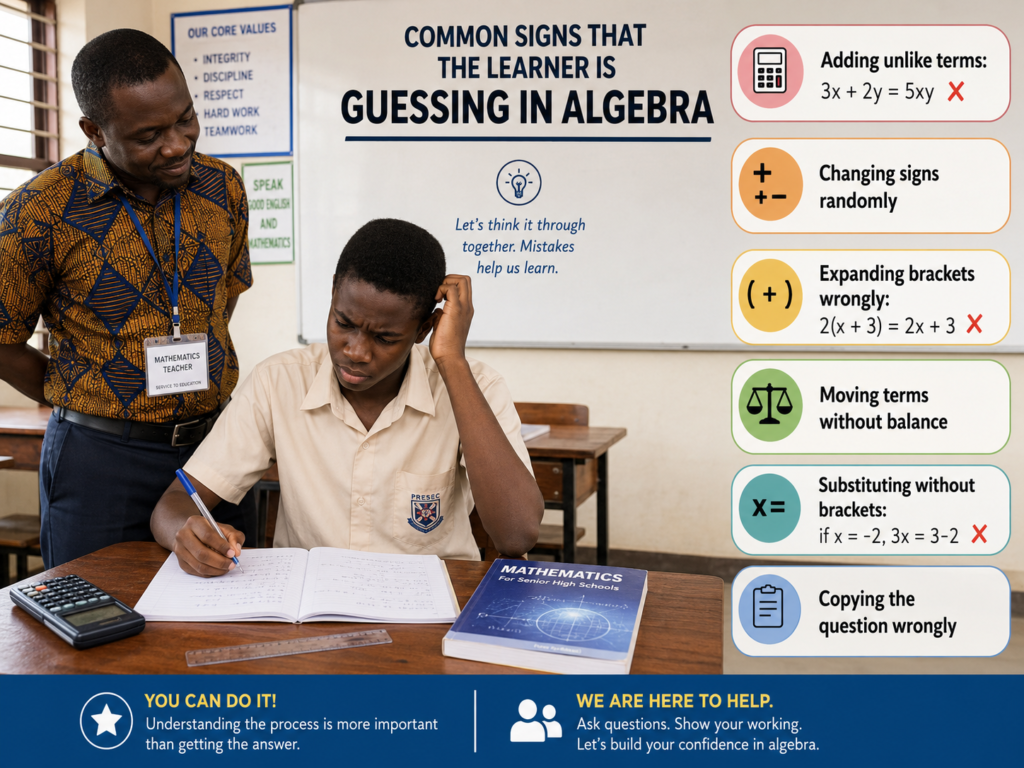
Common signs that the learner is guessing in algebra
The learner may be guessing if he or she:
- adds unlike terms, such as 3x + 2y = 5xy;
- changes signs without any clear reason;
- expands brackets wrongly;
- moves terms across the equal sign but forgets the correct operation;
- divides only one term instead of the whole side of an equation;
- substitutes values without using brackets;
- thinks every letter must be replaced immediately by a number;
- copies the question wrongly before solving it.
2. Why Did the Mistake Happen?
The mistake usually happens because the learner missed the early meaning of algebra. Algebra is not just about letters. Algebra is a language for representing numbers, patterns, and unknown values.
When students memorize steps without understanding the rules behind the steps, they begin to behave as if they are playing a guessing game.
The hidden foundation gaps behind algebra mistakes
Most algebra mistakes come from:
- weak understanding of positive and negative numbers;
- poor handling of brackets;
- confusion between multiplication and addition of letters;
- poor knowledge of fractions;
- weak understanding of equality signs;
- careless copying of terms and signs;
- memorizing transposition without understanding inverse operations.
This is why a student may understand one example in class but fail the next question in an exercise. The learner is not following a rule. The learner is trying to remember what the teacher did.
A good Algebra for Beginners lesson must therefore slow the learner down and fix the foundation first.
3. What WAEC or the Curriculum Reveals
In WASSCE Core Mathematics, algebra appears directly and indirectly in many topics. A learner may think algebra is only one topic, but algebra hides inside several areas of the paper.
Where algebra appears in Core Mathematics
Algebra can appear in:
- linear equations;
- simultaneous equations;
- word problems;
- graphs;
- functions;
- variation;
- inequalities;
- mensuration formulas;
- financial mathematics formulas;
- geometry and trigonometry substitutions.
The curriculum direction also expects learners to reason, communicate mathematically, and apply concepts. This means students must not only know the final answer. They must understand the steps and explain why each step is correct.
WAEC-style algebra questions often punish careless signs, poor substitution, wrong expansion of brackets, and weak manipulation of expressions. So if a learner is weak in algebra, the learner may lose marks in many different parts of the paper.
In core maths, algebra is like the wiring inside a building. You may not always see it, but if it is faulty, many rooms will have problems.
4. Simple Explanation: What Algebra Means
Algebra is a way of using letters to represent numbers or unknown values.
If a teacher says, “I am thinking of a number,” that unknown number can be represented as:
x
If the teacher says, “Five times the number,” we write:
5x
If the teacher says, “Five times the number plus 3,” we write:
5x + 3
So algebra is not magic. It is just a short way of writing mathematical ideas.
For Algebra for Beginners, this is the first idea learners must accept: the letter is not there to frighten you. It stands for a number.
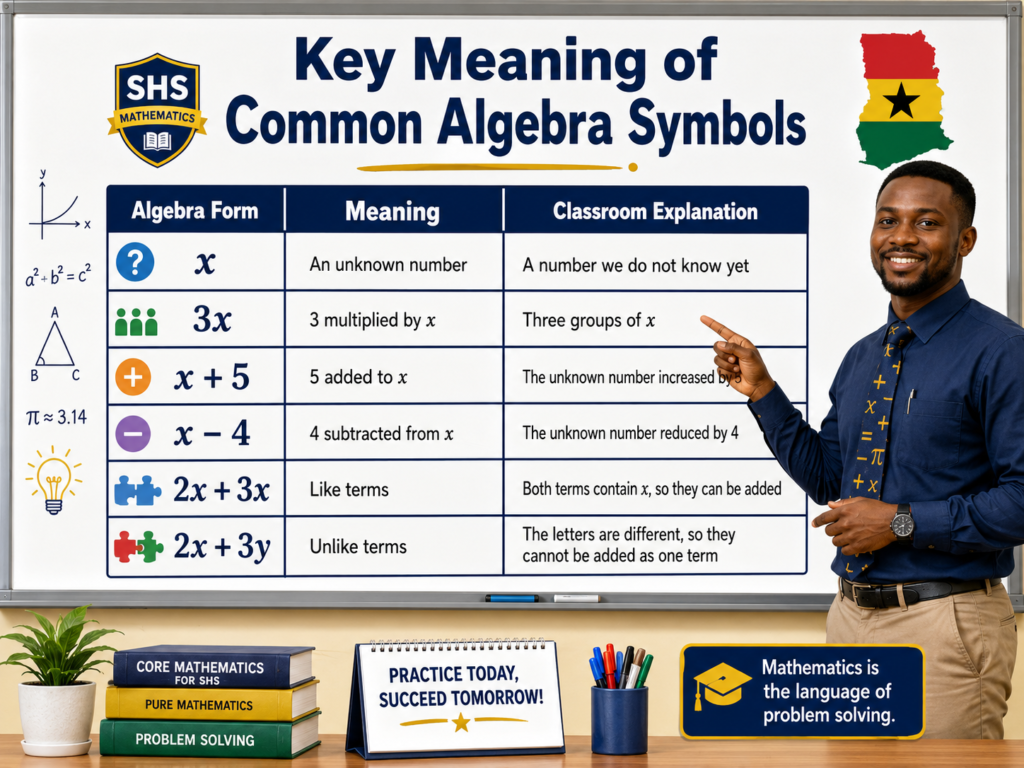
Key meaning of common algebra symbols
| Algebra Form | Meaning | Classroom Explanation |
|---|---|---|
| x | An unknown number | A number we do not know yet |
| 3x | 3 multiplied by x | Three groups of x |
| x + 5 | 5 added to x | The unknown number increased by 5 |
| x – 4 | 4 subtracted from x | The unknown number reduced by 4 |
| 2x + 3x | Like terms | Both terms contain x, so they can be added |
| 2x + 3y | Unlike terms | The letters are different, so they cannot be added as one term |
5. Worked Example
Example: Solve the equation
3x + 5 = 20
Step 1: Understand what the equation is saying
The left side says, “Multiply x by 3, then add 5.” The answer is 20.
3x + 5 = 20
Step 2: Remove the +5 first
Since 5 was added, we remove it by subtracting 5 from both sides.
3x + 5 – 5 = 20 – 5
3x = 15
Step 3: Remove the multiplication by 3
Since x is multiplied by 3, we divide both sides by 3.
3x / 3 = 15 / 3
x = 5
Step 4: Check the answer
Substitute x = 5 into the original equation.
3(5) + 5 = 20
15 + 5 = 20
20 = 20
So the answer is correct.
Final Answer: x = 5
6. Common Wrong Approach
A common wrong approach is this:
3x + 5 = 20
3x = 20 + 5
3x = 25
x = 25 / 3
This is wrong because the learner moved +5 to the other side and changed it incorrectly. When removing +5, you subtract 5 from both sides. You do not add 5 to 20.
Why does this wrong approach happen
This mistake usually happens because:
- The learner memorized “when it crosses the equal sign, the sign changes” without understanding why;
- The learner did not see the equal sign as a balance;
- The learner rushed and did not check the answer in the original equation.
In algebra, do not move terms like you are dragging chairs in class. Keep the equation balanced. Whatever you do to one side, do the same thing to the other side.
This is one reason why Algebra for Beginners must teach the concept of balance early.
7. Correct Method
The correct method is to treat the equation like a balance. The left and right sides must remain equal.
The balance rule
If you add to one side, add to the other side.
If you subtract from one side, subtract from the other side.
If you multiply one side, multiply the other side.
If you divide one side, divide the other side.
Correct solution again
3x + 5 = 20
3x + 5 – 5 = 20 – 5
3x = 15
3x / 3 = 15 / 3
x = 5
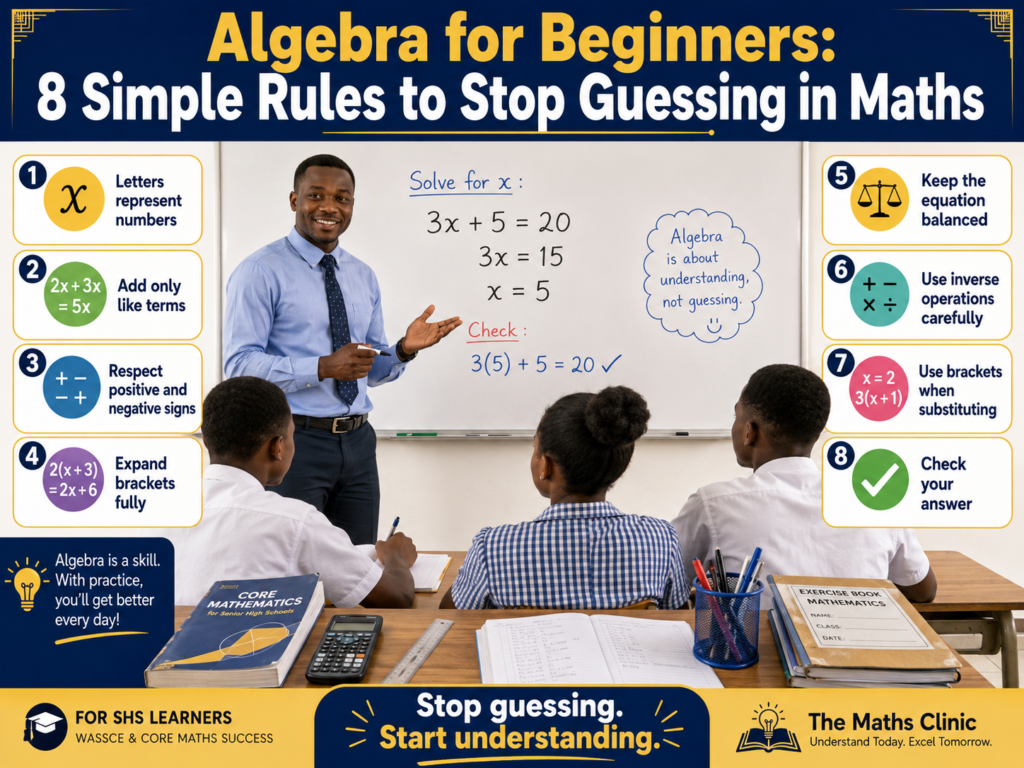
8. Algebra for Beginners: 8 Simple Rules to Stop Guessing in Maths
These 8 rules will help beginners stop guessing and start solving algebra with meaning.
Rule 1: Know that letters represent numbers
A letter like x, y, or a can stand for a number. Do not fear the letter. Treat it as a number you do not know yet.
Wrong idea: x means multiplication only.
Correct idea: x can be an unknown number when used as a letter in algebra.
Rule 2: Do not add unlike terms
Terms can be added only when they have the same letter part.
Correct: 3x + 2x = 5x
Wrong: 3x + 2y = 5xy
Rule 3: Respect signs before numbers and letters
A negative sign belongs to the term after it. If you ignore the sign, your whole answer can change.
Example:
7x – 2x = 5x
Not:
7x – 2x = 9x
Rule 4: Brackets mean multiplication
When a number is outside a bracket, multiply every term inside the bracket by that number.
Correct:
3(x + 4) = 3x + 12
Wrong:
3(x + 4) = 3x + 4
Rule 5: Keep the equal sign balanced
An equation is like a balance. Whatever you do to one side must also be done to the other side.
Example:
x + 6 = 14
x + 6 – 6 = 14 – 6
x = 8
Rule 6: Use inverse operations carefully
Addition is undone by subtraction.
Subtraction is undone by addition.
Multiplication is undone by division.
Division is undone by multiplication.
Example:
2x = 18
x = 9
Rule 7: Use brackets when substituting values
When replacing a letter with a number, especially a negative number, use brackets to avoid sign mistakes.
Example:
If x = -3, then:
2x = 2(-3) = -6
Trap:
Writing 2-3 can confuse the meaning.
Rule 8: Check your answer in the original question
After solving, put your answer back into the original equation. This helps you catch careless mistakes before WAEC catches them.
Example:
If x = 4 in 2x + 1 = 9, then:
2(4) + 1 = 9
8 + 1 = 9
9 = 9
So the answer is correct.
9. Practice Task
Try these questions before checking the solutions. Do not guess. Follow the rules step by step.
- Simplify: 4x + 3x
- Simplify: 5a + 2b + 3a
- Expand: 2(x + 5)
- Solve: x + 7 = 15
- Solve: 4x = 28
- Solve: 2x + 3 = 11
- If y = -2, find the value of 3y + 5.
- Expand and simplify: 3(x + 2) + 2x
Practice Task Solutions
Solution to Question 1
4x + 3x = 7x
Both terms contain x, so they are like terms.
Solution to Question 2
5a + 2b + 3a
5a + 3a + 2b = 8a + 2b
Only the a terms can be added. The 2b remains separate.
Solution to Question 3
2(x + 5)
= 2(x) + 2(5)
= 2x + 10
Solution to Question 4
x + 7 = 15
x + 7 – 7 = 15 – 7
x = 8
Solution to Question 5
4x = 28
4x / 4 = 28 / 4
x = 7
Solution to Question 6
2x + 3 = 11
2x + 3 – 3 = 11 – 3
2x = 8
2x / 2 = 8 / 2
x = 4
Solution to Question 7
3y + 5
= 3(-2) + 5
= -6 + 5
= -1
Solution to Question 8
3(x + 2) + 2x
= 3x + 6 + 2x
= 5x + 6
10. Link to Practice Zone or Intervention Hub
If you made a mistake in any practice question, do not treat it as a failure. Treat it as a diagnosis. The mistake is showing you the exact area that needs treatment.
Suggested internal links
| Page | Suggested Anchor Text | Purpose |
|---|---|---|
| Practice Zone | Try WASSCE Maths practice questions. | For guided algebra practice |
| Intervention Hub | Find and Fix My Maths Learning Gaps | For diagnosing weak foundations |
| WAEC Trap Page | Learn Common WAEC Maths Traps and How to Avoid Them | For avoiding mark-loss mistakes |
| Word Problems Page | Learn How to Translate English Sentences into Algebra | For algebra in word problems |
| Linear Equations Page | Solve Equations Without Guessing | For equation practice |
Common WAEC Algebra Traps to Watch
Watch out for these traps:
- changing signs without applying the same operation to both sides;
- expanding only the first term inside a bracket;
- adding unlike terms because the numbers can be added;
- substituting negative values without brackets;
- dividing only one term instead of the whole expression;
- forgetting that 3x means 3 multiplied by x;
- copying x² as x or x as x²;
- leaving the answer without checking it in the original equation.
Frequently Asked Questions
1. Why do beginners struggle with algebra?
Beginners struggle with algebra because they often see letters as strange symbols instead of unknown numbers. Once the learner understands the meaning of the letter, the fear reduces.
2. Is Algebra for Beginners important for WASSCE Core Mathematics?
Yes. Algebra for Beginners is important because it builds the foundation learners need for equations, graphs, functions, word problems, variation, formulas, and many other Core Maths topics.
3. How can a weak student improve in algebra?
A weak student should start from basic rules: like terms, signs, brackets, equality, inverse operations, and substitution. Jumping straight into difficult questions without fixing these basics will cause more confusion.
4. What is the biggest algebra mistake students make?
One of the biggest mistakes is guessing signs when solving equations. Students must understand that an equation is a balance. Whatever is done to one side must also be done to the other side.
5. Can algebra be learned without memorizing too much?
Yes. Algebra becomes easier when the learner understands the rules and practices step by step. Some formulas may be remembered, but understanding is what helps when the question changes.
Conclusion: Algebra Is Not Guesswork
In a Ghanaian classroom, the student who fears algebra is often not lazy. Many times, that learner is carrying old gaps in signs, brackets, fractions, and basic operations.
That is why shouting “learn hard” is not enough. The learner needs to know exactly what is wrong and how to correct it.
Algebra for Beginners is about rebuilding the foundation slowly. The learner must understand that letters represent numbers, as terms must match, brackets must be expanded fully, and equations must remain balanced.
At The Maths Clinic, we do not want learners to guess their way through core mathematics. We want them to see the mistake, understand the gap, and fix it step by step.
So if algebra has been confusing you, do not conclude that you are bad at mathematics. Start from the rules. Practice slowly. Check your answers. Build the foundation again. That is how guessing stops and understanding begins.