Struggling with WASSCE Maths? Stop guessing. Let’s fix the gap step by step.
7 Powerful Ways to Diagnose Maths Weaknesses

Focus question: How does this help a struggling SHS learner understand Core Maths better? It helps the learner stop treating every Core Maths mistake as the same problem. Once the learner knows whether the weakness is algebra, geometry, or word problems, revision becomes clearer, practice becomes targeted, and WASSCE preparation becomes less confusing.
Algebra, geometry, or word problems may be the real reason many Ghanaian SHS learners struggle in WASSCE Core Maths, but most learners do not know how to separate the weaknesses. They sit quietly through lessons and conclude, “Sir, I don’t understand Maths.” But that statement is too broad. It is like going to the clinic and telling the nurse, “My whole body is worrying me,” without showing where the pain is.
A struggling learner needs a proper diagnosis. The problem may not be the whole of Core Maths. It may be an algebra weakness, a geometry weakness, or a word problem weakness. Sometimes it may even be one small foundation skill hiding under those topics.
This post will help Ghana SHS students separate the three common areas that disturb many learners before WASSCE: algebra, geometry, and word problems.
When you know the real area of weakness, you stop guessing your revision. You begin to fix the exact gap that is blocking your understanding, instead of repeating the same Core Maths mistakes again and again.
1. Check What Happens When Letters Enter the Question
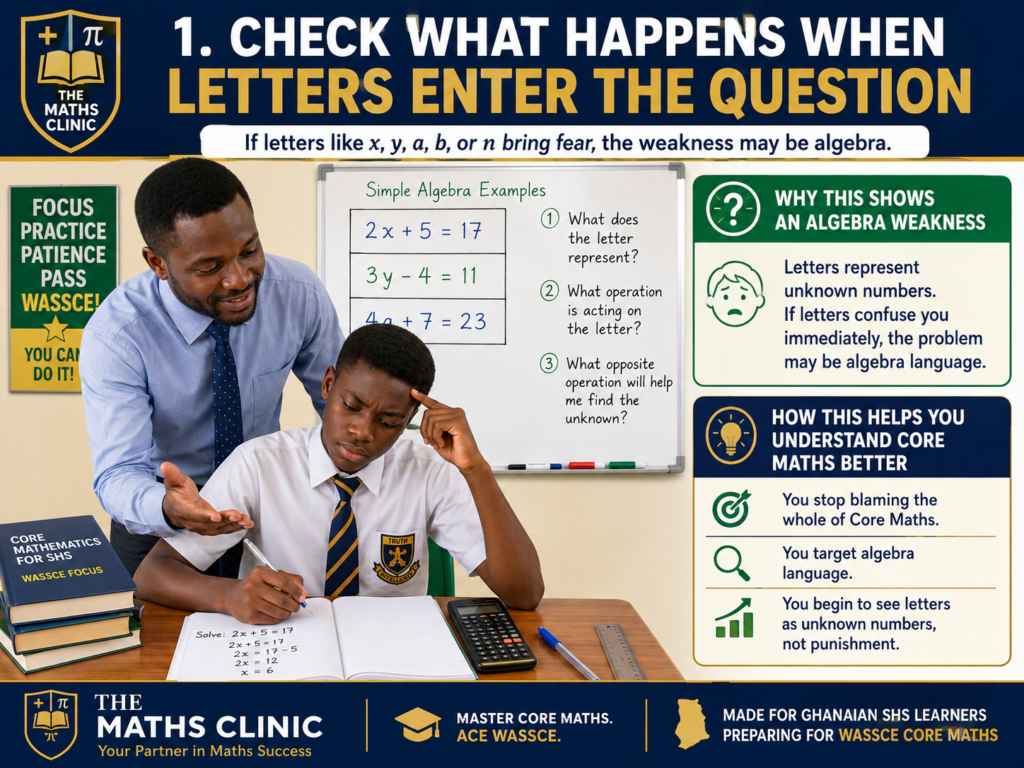
The first way to know whether your problem is algebra is to watch your reaction when letters like x, y, a, b, or n appear in a question.
Some learners are comfortable when the question contains only numbers. But once letters enter the work, fear enters too. They may ask, “Why are there letters in Maths?”
Why This Shows an Algebra Weakness
Algebra is the part of mathematics where letters represent unknown numbers or changing values. If letters confuse you immediately, the problem may not be calculations. The problem may be understanding what the letter stands for.
For example, in the equation 2x + 5 = 17, the letter x is not there to frighten you. It is simply the unknown number you are looking for.
How This Helps You Understand Core Maths Better
When you notice that letters disturb you, you can stop blaming the whole of Core Maths. Your real target is algebraic language.
Start asking, “What does the letter represent?” What operation is acting on the letter? What opposite operation will help me find the unknown?
That one shift gives direct SHS Maths help because it makes algebra feel like a search for an unknown, not a punishment.
2. Check Whether You Struggle When Shapes, Diagrams, and Angles Appear
If your mind becomes blank whenever a diagram appears, your problem may be geometry.
Some learners can solve equations well, but when they see triangles, circles, bearings, angles, or construction diagrams, they lose confidence.
Why This Shows a Geometry Weakness
Geometry is not only about drawing shapes. It is about reading information from shapes. A diagram is like a silent question. It gives you clues through angles, equal sides, parallel lines, radii, diameters, and labels.
A learner who does not know how to read those clues will feel lost even when the calculation is not difficult.
How This Helps You Understand Core Maths Better
Once you know your weakness is geometry, your revision should not start with formulas alone. Start with diagram reading.
Ask: What shape is this? What information is marked? Are there equal sides? Are there parallel lines? Is there a right angle? Is the radius involved?
This helps you see that geometry questions are not empty pictures. They are Core Maths questions carrying clues.
3. Check Whether You Can Calculate but Cannot Translate English into Maths
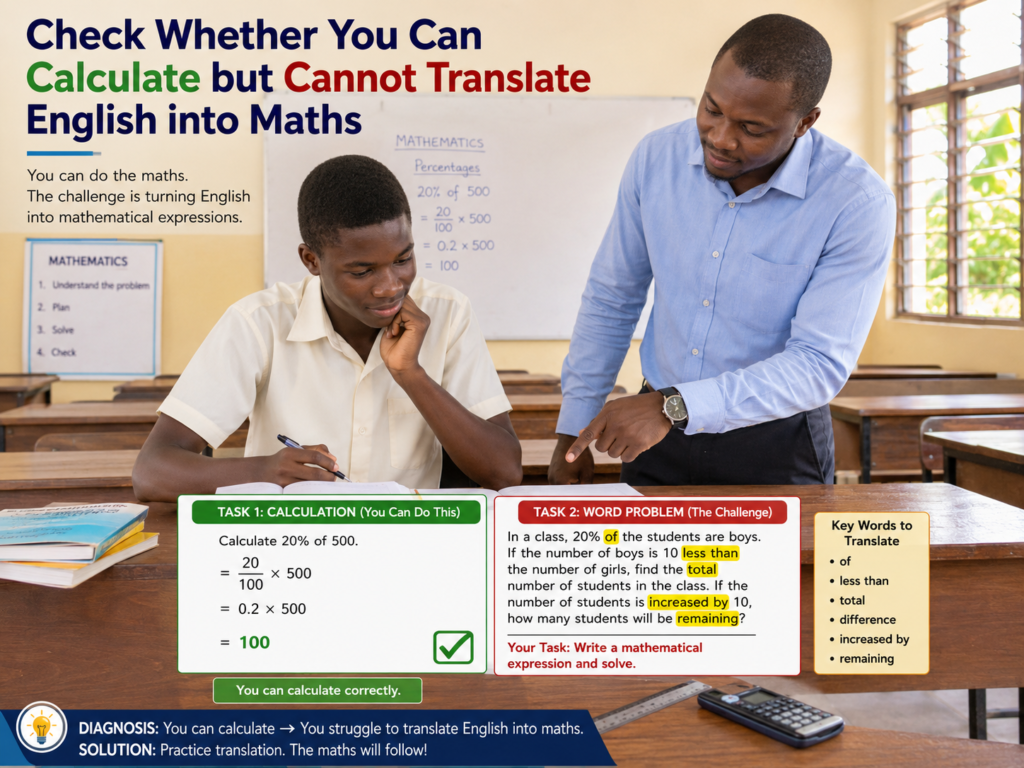
This is one of the strongest signs that your problem is word problems.
A learner may solve 25% of 80 easily but struggle when the same idea is written as a story about discounts, profit, loss, or price.
Why This Shows a Word Problems Weakness
Word problems test two skills at the same time. First, you must understand the English. Second, you must translate the English into mathematics.
Many learners rush to calculate before understanding what the question is asking. That is why they choose the wrong number, wrong operation, or wrong formula.
How This Helps You Understand Core Maths Better
When you identify word problems as your weak area, your practice must include a reading strategy, not only calculation.
Before solving, underline the key words. Identify what is given. Identify what is being asked. Decide the topic hiding inside the question. Then choose the method.
This turns word problems from scary stories into mathematical instructions.
4. Check Where Your Mistake Starts in the Solution
A good diagnosis does not only look at the final answer. It looks at where the mistake started.
If the mistake starts when you move terms, expand brackets, collect like terms, or solve for x, the weakness is likely algebra.
If the mistake starts when you read the diagram, choose an angle rule, identify a shape, or apply a measurement formula, the weakness is likely geometry.
If the mistake starts before you even form the equation or choose the correct topic, the weakness is likely word problems.
Why This Matters
Many learners only say, “I got it wrong.” That is not enough. The important question is, “Where did the wrong thinking begin?”
How This Helps You Understand Core Maths Better
When you locate the first wrong step, you find the real gap.
For example, if your algebra work is correct after the equation is formed, but you formed the wrong equation from the story, then your weakness is not algebra first. It is a word problem translation.
This saves time. You stop treating the wrong topic as the enemy.
5. Check Whether Formulas or Meanings Confuse You
Some learners have a formula problem. Others have a meaning problem.
In algebra, a learner may know how to solve simple equations but not understand what the unknown represents.
In geometry, a learner may memorize area and volume formulas but not know when to use each one.
In word problems, a learner may know many formulas but not know which formula the question is pointing to.
Why This Happens
Learners often memorize formulas without connecting them to meaning. So when WASSCE changes the wording or diagram, the formula becomes hard to use.
How This Helps You Understand Core Maths Better
Ask yourself: Do I know only the formula, or do I understand when and why to use it?
If you know the formula but cannot choose it correctly, your weakness may be interpretation. If you choose the formula but substitute wrongly, your weakness may be algebra or arithmetic. If you choose the wrong formula from a diagram, your weakness may be geometry.
This kind of diagnosis helps learners correct Core Maths mistakes from the root.
6. Check Whether You Struggle More with Symbols, Diagrams, or Sentences
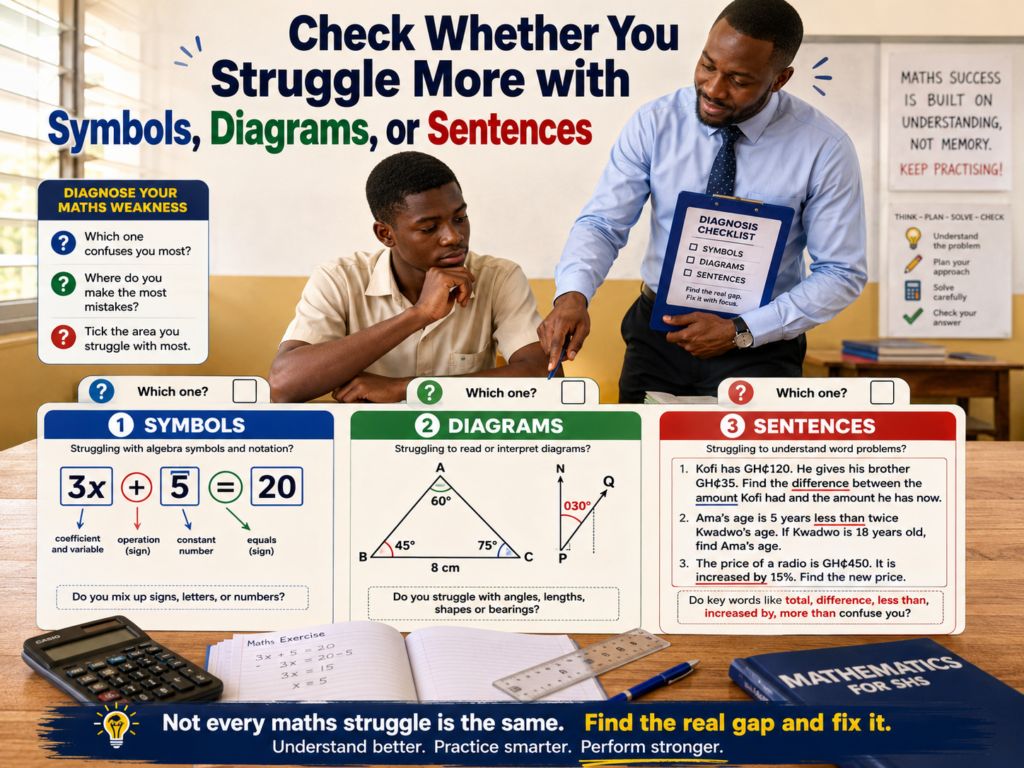
This simple test can help you separate the problem. If symbols like x, y, brackets, fractions, and signs confuse you, suspect algebra. If diagrams, angles, shapes, circles, bearings, or measurements confuse you, suspect geometry. If long sentences, story questions, key words, and hidden information confuse you, suspect word problems.
Why This Works
Every Maths question has a language. Algebra uses symbols. Geometry uses diagrams. Word problems use sentences. A struggling learner must know which language is causing the trouble.
How This Helps You Understand Core Maths Better
Once you know the language that confuses you, you can practice that language directly.
For algebra, practice reading symbols. For geometry, practice reading diagrams. For word problems, practice translating sentences into mathematical statements.
This gives your WASSCE Core Maths revision direction.
7. Check Your Test Papers by Topic, Not Only by Score
After a class test, mock, or WASSCE-style practice, do not only look at your total mark. The total mark can make you sad, but it may not show you what to fix.
Instead, mark the questions under three columns: algebra, geometry, and word problems.
Why This Reveals the Real Problem
A learner may score 20 out of 40 and think the whole Maths is weak. But when the paper is checked carefully, the learner may discover that most lost marks came from word problems, while algebra was fair.
Another learner may think word problems are the issue, but the real problem may be forming and solving equations after reading the question.
How This Helps You Understand Core Maths Better
This method turns your test paper into a diagnosis report.
You can create a simple table in your exercise book: Topic, Question Number, Mistake Made, Real Weakness, What to Practice Next.
When you revise this way, you no longer practice blindly. You practice according to evidence.
Quick Diagnosis Table
| What Confuses You? | Likely Weak Area | What to Practise |
| Letters, brackets, signs, equations | Algebra | Meaning of unknowns, inverse operations, collecting like terms, substitution |
| Shapes, angles, circles, bearings, diagrams | Geometry | Diagram reading, angle rules, properties of shapes, measurement formulas |
| Long questions, stories, hidden information | Word problems | Reading strategy, key words, translation into equations, choosing the correct topic |
| The formula is known, but you choose wrongly | Interpretation gap | Understand what each formula means and when it applies |
| The equation is formed wrongly from a story | Word problem to algebra gap | Translate sentences into mathematical statements before solving |
Worked Example: Finding the Real Weakness
Let us diagnose a learner using one simple question.
Question
Ama is 4 years older than Kojo. The sum of their ages is 30. Find their ages.
Common Wrong Approach
Some learners immediately write 30 – 4 = 26 and then stop. Others divide 30 by 2 and say the ages are 15 and 15, forgetting that Ama is older.
This shows that the learner may not have an arithmetic problem. The learner may have a word problem translation problem.
Correct Method
Let Kojo’s age be x.
Ama’s age is x + 4.
Their total age is 30, so:
x + (x + 4) = 30
2x + 4 = 30
2x = 30 – 4
2x = 26
x = 13
Kojo is 13 years old.
Ama is 13 + 4 = 17 years old.
What Did We Diagnose?
The learner’s main weakness was not algebra alone. The algebra became useful only after the sentence was translated correctly.
So the real gap is this: changing words into an equation.
This is why diagnosis matters. Without diagnosis, the learner may keep revising algebra while the real problem is reading and translation.
Common Wrong Approach Among Struggling Learners
Many struggling SHS learners revise by saying, “I will learn everything again.”
That sounds serious, but it is not always effective.
If your problem is algebra, reading geometry notes for two hours will not fix it. If your problem is word problems, memorizing formulas alone will not solve it. If your problem is geometry, solving only equations will not train you to read diagrams.
The wrong approach is general revision without diagnosis.
Correct Method: Use the Maths Clinic Diagnosis Approach
Use this simple method before WASSCE.
Step 1: Pick three questions
Choose one algebra question, one geometry question, and one word problem.
Step 2: Solve them without help
Do not open your notes. Do not check the answer too early. Let the question show you the truth.
Step 3: Mark the first place where you became confused
Did confusion start with the letters? Did it start with the diagram? Did it start with the English wording?
Step 4: Name the weakness
Write it clearly: algebra weakness, geometry weakness, word problem weakness, or mixed weakness.
Step 5: Practise the exact weakness
If algebra is the issue, practice equations and signs. If geometry is the issue, practice diagrams and angle rules. If word problems are the issue, practice translation and interpretation.
This is how a learner stops guessing and starts repairing the right foundation.
Practice Task: Diagnose Yourself
Try these three questions. After solving, do not only check whether your answer is correct. Check where the difficulty started.
1. Algebra
Solve: 3x + 5 = 20
Diagnosis question: Did the letter x, the sign, or the movement of terms confuse you?
2. Geometry
A triangle has angles of 45° and 65°. Find the third angle.
Diagnosis question: Did you remember and apply the angle sum of a triangle?
3. Word Problem
The sum of two numbers is 40. One number is 6 more than the other. Find the numbers.
Diagnosis question: Did you know how to change the sentence into an equation?
How This Helps a Struggling SHS Learner Understand Core Maths Better
This lesson helps a struggling learner because it separates confusion into clear parts.
Instead of saying, “I am bad at Maths,” the learner can now say, “My problem is algebra signs,” or “My problem is reading geometry diagrams,” or “My problem is translating word problems.”
That kind of statement is powerful because it points to the next action.
A learner who knows the exact weakness can practice better. The teacher can also help better. The learner’s revision becomes focused, not scattered.
This also reduces fear. Many Ghanaian SHS students fear Core Maths because they think the whole subject is against them. But when the weakness is diagnosed, the learner sees that the problem is smaller than it looked.
That is how understanding improves: one gap is found, one gap is corrected, and confidence begins to grow.
Final Advice Before WASSCE
Do not wait until WASSCE is close before you find out whether your weakness is algebra, geometry, or word problems.
Start now. Take your old test papers. Check the questions you missed. Group the mistakes. Look for the pattern.
If most mistakes come from letters and equations, work on algebra. If most mistakes come from diagrams and shapes, work on geometry. If most mistakes come from story questions, work on word problems.
You do not need to fight the whole of Core Maths at once. Start with the exact weakness. Repair it properly. Then move to the next one.
At The Maths Clinic, we believe that weak does not mean finished. “Weak” means the learner needs diagnosis, correction, and guided practice.
Once the real problem is known, Core Maths becomes easier to understand.
Related Posts
Algebra Foundation: 5 Warning Signs Students Must Fix Before WASSCE
Algebra for Beginners: 8 Simple Rules to Stop Guessing in Maths
7 Warning Signs Your Core Maths Foundation Is Weak