Struggling with WASSCE Maths? Stop guessing. Let’s fix the gap step by step.
7 Powerful Tests to Understand a Maths Topic

Many SHS learners say, “Sir, I understand it when you teach, but when I meet the question alone, I get confused.” That statement is very important. It means the learner may not fully understand a Maths topic yet. The learner may only be familiar with the teacher’s example.
There is a difference between seeing a topic before and truly understanding it. A learner may see percentages in class, copy the examples, and even nod while the teacher explains. But when WASSCE Core Maths changes the question into profit, discount, simple interest, depreciation, or a word problem, the same learner begins to struggle.
This is where many Core Maths mistakes begin. The learner thinks the topic is known, but the understanding has not yet been tested properly. That is why SHS Maths help must go beyond more notes. A struggling learner needs a simple way to check whether the idea is really clear.
So before you tell yourself, “I know this topic,” test your understanding properly. The seven checks in this post will help Ghana SHS students diagnose Maths weaknesses early and prepare better for WASSCE without panic.
The main question this post answers
How does this help a struggling SHS learner understand Core Maths better?
It helps the learner move from copying and guessing to checking real understanding. These simple tests show whether a Maths topic is truly clear or whether there is still a hidden Core Maths gap to fix before WASSCE.
Why Understanding a Maths Topic Is More Than Getting One Answer Correct
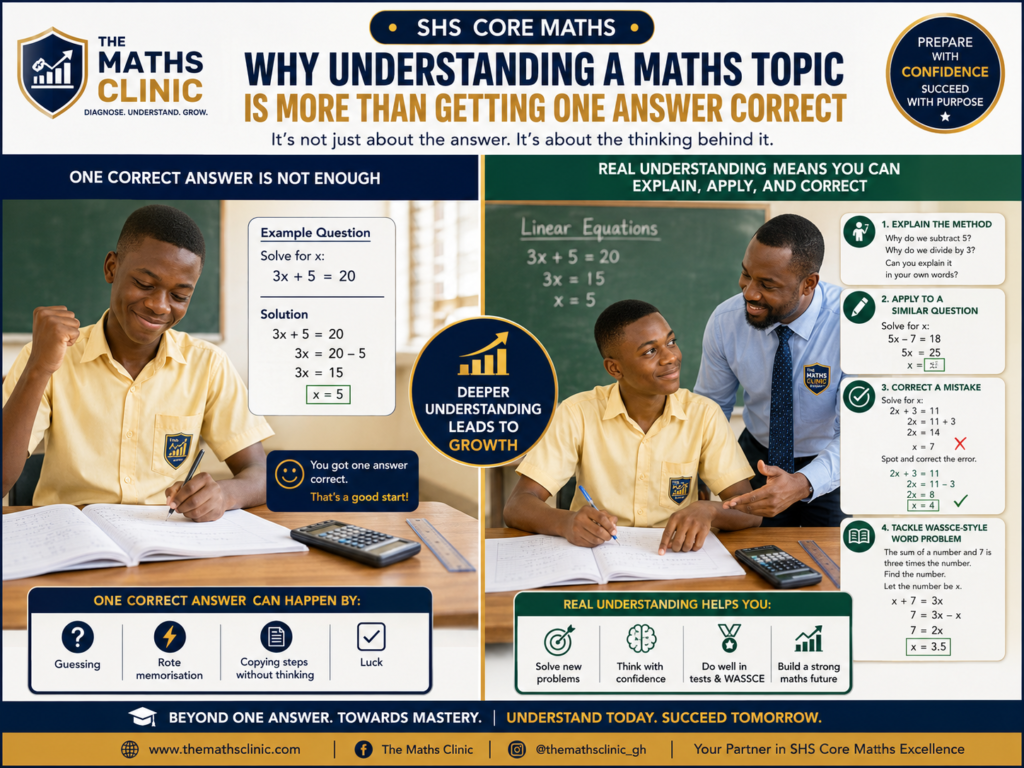
In Core Maths, one correct answer does not always mean the topic is strong. Sometimes a learner gets the answer correct because the numbers were simple, the example was familiar, or a friend helped along the way.
True Core Maths understanding means you can solve the question, explain your thinking, handle a small change, correct your mistake, and apply the idea in a WASSCE-style situation. It also means you can notice when the question is testing the same idea in a different form.
That is why these seven simple tests are useful. They show the real condition of your understanding before the examination exposes the weakness.
1. The Close-the-Book Test
This is the first test every SHS learner should use. After learning a Maths topic, close your notebook and try one question without looking at the worked example.
For example, after learning linear equations, close your book and solve 3x + 5 = 20. Do not look at the teacher’s solution. Do not ask your friend first. Try it alone.
What This Test Reveals
This test shows whether the method is inside your head or only inside your exercise book. If you cannot start without looking at the example, the topic is not yet settled. You may have copied the steps, but the understanding is still weak.
Why Struggling Learners Often Fail This Test
Many learners are used to following the teacher’s hand. When the teacher writes the first line, they feel comfortable. But when they must start alone, they do not know which step should come first.
How This Helps You Understand Core Maths Better
The close-the-book test helps you find the exact point where your mind gets stuck. Maybe you do not know how to start. Maybe you know the first step but get confused with signs. Maybe you know the formula but cannot substitute correctly. Once you know where you are stuck, you can fix that part instead of saying the whole topic is hard.
2. The Explain-It-to-a-Friend Test
If you really understand a Maths topic, you should be able to explain the main idea to a friend in simple words. You do not need to speak big English. You only need clear thinking.
For example, if the topic is percentages, you should be able to say a percentage is a part compared to a whole, written out of 100. If the topic is equations, you should be able to say, “An equation is like a balance, so whatever I do to one side must keep the balance correct.”
What This Test Reveals
This test reveals whether you understand the meaning behind the method. Some learners can write steps, but they cannot explain why the steps work. That is a warning sign.
Why Struggling Learners Often Fail This Test
Many learners memorize procedures. They say things like “transpose” or “cross multiply,” but they do not understand what is really happening. So when WASSCE Core Maths changes the style of the question, the memorized steps fail them.
How This Helps You Understand Core Maths Better
When you explain a topic to a friend, your brain is forced to organize the idea. If your explanation breaks down, that is where the weakness is. A learner who can explain a method is closer to mastering it than a learner who only copies the method.
3. The Change-the-Numbers Test
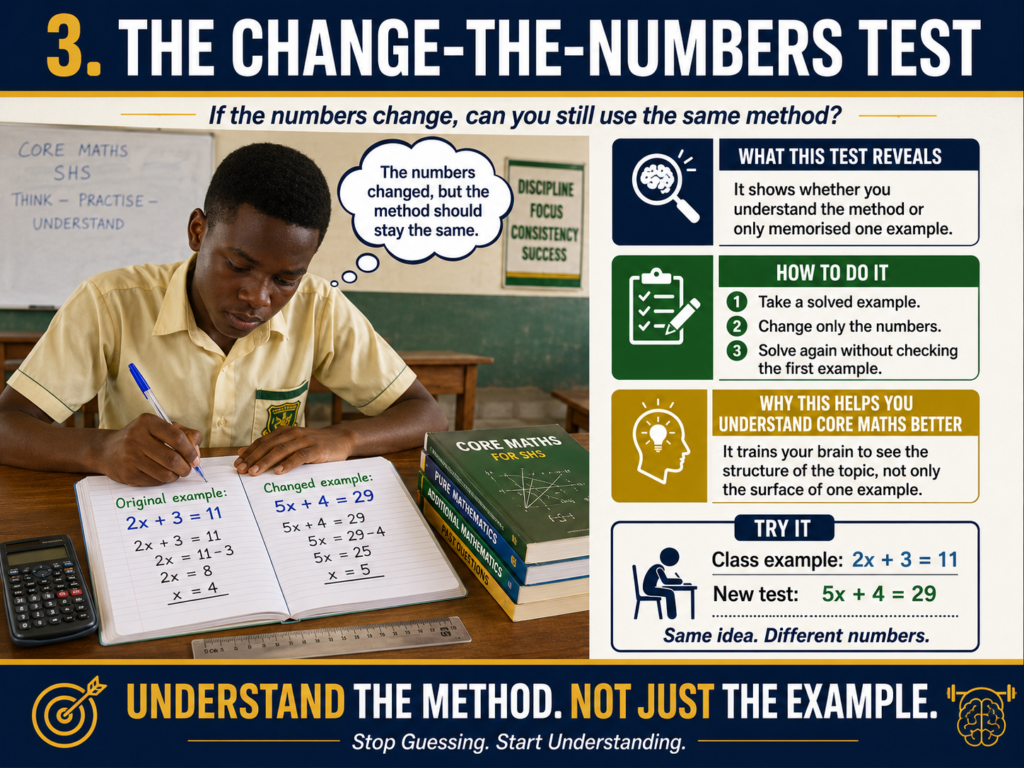
Some learners understand only the exact example the teacher solved. If the numbers change, they become confused.
To test yourself, take a solved example and change only the numbers. Suppose the class example was 2x + 3 = 11. Now change it to 5x + 4 = 29. Then solve it without checking the original example.
What This Test Reveals
This test shows whether you understand the method or only memorized the particular example. If small changes confuse you, then the topic is not yet strong enough for WASSCE preparation.
Why Struggling Learners Often Fail This Test
Some learners prepare by repeating the same question again and again. That can make the question familiar, but it does not always build Core Maths understanding.
How This Helps You Understand Core Maths Better
The change-the-numbers test trains your brain to see the structure of the topic, not only the surface of one example. When WASSCE changes numbers, wording, or arrangement, you will still know what to do because you understand the idea behind the question.
4. The Wrong-Answer Check Test
This test is very powerful, especially for weak and struggling learners. After solving a question, do not only ask, “Is my answer correct?” Ask, “Can I find where I went wrong?”
For example, suppose a learner solves 4x – 7 = 21 and writes 4x = 21 – 7; 4x = 14; x = 3.5. The final answer is wrong. But the important thing is to find the exact wrong step.
What This Test Reveals
This test shows whether you can diagnose your own Core Maths mistakes. A strong learner is not someone who never makes mistakes. A strong learner is someone who can trace the mistake and correct it.
Why Struggling Learners Often Fail This Test
Many learners erase wrong work too quickly. They feel bad, clean the page, and copy the correct answer. But the wrong work contains useful evidence. It shows how the learner was thinking.
How This Helps You Understand Core Maths Better
When you check your wrong answer, you learn from your own thinking. You see whether the mistake came from signs, a formula, substitution, reading, units, or calculation. That is proper Maths diagnosis and a strong part of Maths intervention.
5. The Different-Question Same-Topic Test
A Maths topic is not fully understood if you can only solve one type of question under it.
For example, under percentages, you may be able to find 20% of 500. But can you solve discount, profit, loss, simple interest, and percentage increase questions? Under graphs, you may be able to plot points. But can you find the gradient, read values from a graph, and interpret what the graph means?
What This Test Reveals
This test reveals whether your understanding is wide enough. WASSCE does not always ask the topic in the same way your class exercise presented it.
Why Struggling Learners Often Fail This Test
Many learners practice only the easiest form of a topic. They feel comfortable because the question is direct. But WASSCE may combine the topic with a word problem, diagram, table, or graph.
How This Helps You Understand Core Maths Better
This test helps you see the different faces of one topic. Once you can handle the same idea in different question forms, your understanding becomes stronger and more flexible.
6. The Teach-Back Without Formula Test
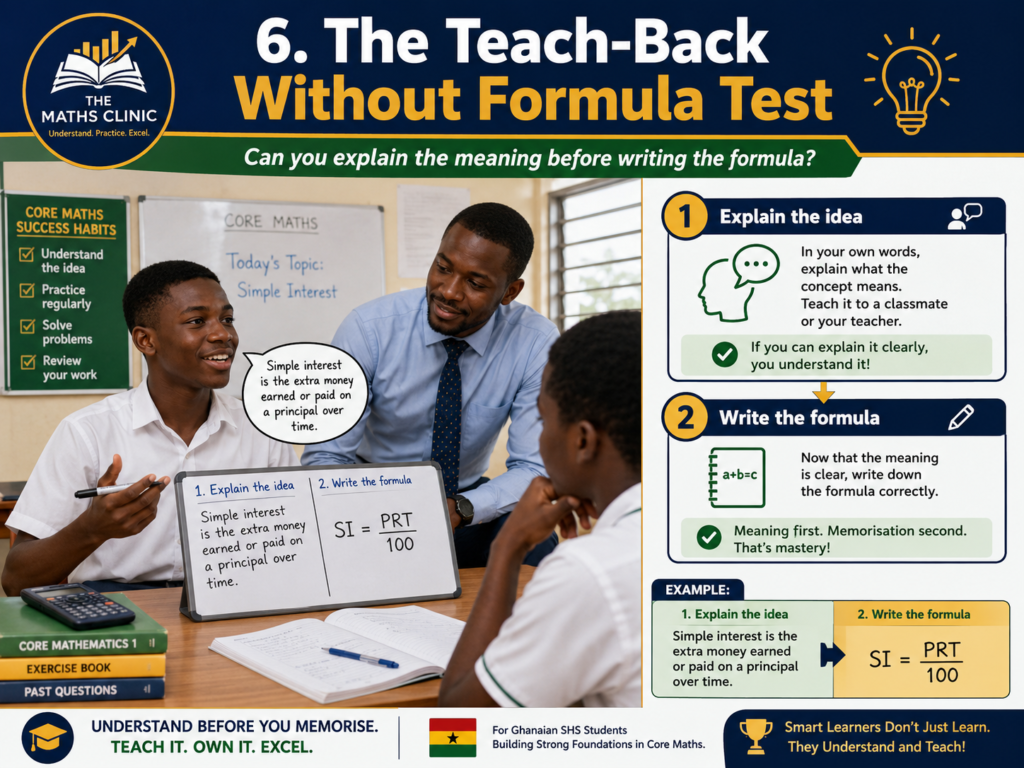
This test checks whether you understand the meaning before the formula. Choose a topic and explain it without first writing the formula.
For example, before writing the simple interest formula, explain what simple interest means. You can say, “Simple interest is the extra money paid or earned on a principal for a given time at a given rate.” After that, you can write SI = PRT/100.
What This Test Reveals
This test reveals whether the formula has meaning in your mind. If you only know the formula but do not know what the letters mean, you can still fail the question.
Why Struggling Learners Often Fail This Test
Some learners cram formulas like songs. They can recite the formula, but when the question gives time in months or asks for the amount instead of interest, they get confused.
How This Helps You Understand Core Maths Better
When you understand the meaning before the formula, substitution becomes easier. You know what each value stands for and what the question is truly asking. This reduces blind formula use and strengthens Core Maths understanding.
7. The WASSCE-Style Practice Test
The final test is to try a WASSCE-style question after learning the topic. A WASSCE-style question may not look like the simple classroom example. It may include a story, a diagram, a table, or two ideas joined together.
For example, after learning linear equations, try a word problem like the following: The sum of two numbers is 45. One number is twice the other. Find the two numbers. This is still connected to equations, but it first requires translation.
What This Test Reveals
This test shows whether you can apply the topic in exam conditions. It is one thing to know a method. It is another thing to recognize when and how to use it.
Why Struggling Learners Often Fail This Test
Many learners practice only direct questions. They do not train themselves to read, interpret, and connect ideas. So when WASSCE hides the topic inside words, they cannot find it.
How This Helps You Understand Core Maths Better
WASSCE-style practice helps you move from classroom familiarity to exam readiness. It teaches you to identify the topic, choose the right method, and apply it even when the question is not written in a simple form.
Worked Example: Using the 7 Tests on One Topic
Topic: Linear Equations
Let us use one simple question: Solve 3x + 6 = 24. A learner who wants to know whether he or she really understands a Maths topic should not stop at getting the answer. The learner should test the understanding in different ways.
- Close-the-Book Test: Can you solve it without looking at your notes?
- Explain-It-to-a-Friend Test: Can you explain that you are removing 6 first because it is added to 3x?
- Change-the-Numbers Test: Can you solve 5x + 7 = 32 using the same idea?
- Wrong-Answer Check Test: If you write 3x = 24 + 6, can you notice that the sign movement is wrong?
- Different-Question Same-Topic Test: Can you solve a word problem that leads to a linear equation?
- Teach-Back Without Formula Test: Can you explain that an equation is a balance before solving it?
- WASSCE-Style Practice Test: Can you solve a question where the equation is hidden inside words?
If you pass all these tests, your understanding of linear equations is becoming stronger. If you fail one or two, do not panic. Those failed tests show you exactly what to revise before WASSCE Core Maths.
Common Wrong Approach
Many SHS learners test their understanding in the wrong way. They say, “I have read the notes, so I know it.” But reading notes is not enough.
Others say, “I got one answer correct, so I understand the topic.” But one correct answer is not enough.
Some also say, “The teacher taught it, so I understand it.” But the teacher’s explanation and your personal understanding are not always the same thing.
This is why some Ghanaian SHS students keep repeating the same Core Maths mistakes even after attending extra classes. The learning activity looks serious, but the hidden weakness has not been diagnosed.
Correct Method: Use a Simple Understanding Checklist
After every Maths topic, use this checklist before moving on:
- Can I solve a question without looking at my notes?
- Can I explain the method in simple words?
- Can I solve the same type of question with different numbers?
- Can I find and correct my own mistake?
- Can I solve different forms of the same topic?
- Can I explain the meaning before using the formula?
- Can I handle a WASSCE-style version of the topic?
If your answer is yes to most of these, the topic is becoming strong. If your answer is no, that does not mean you are finished. It means you have found the part that needs attention.
Practice Task: Test Your Understanding Now
Choose any topic you recently learned. It may be percentages, algebra, graphs, statistics, geometry, or simple interest. Now use these seven tests:
- Close your book and solve one question.
- Explain the method aloud in simple words.
- Change the numbers and solve again.
- Check your wrong step if your answer is wrong.
- Try another question form under the same topic.
- Explain the meaning before using the formula.
- Try one WASSCE-style question.
After doing this, write one sentence: My real weakness in this topic is ___________________________.
That sentence is important. It changes your revision from guessing to diagnosis. It is also the kind of SHS Maths help that makes Maths intervention more useful because the learner now knows what must be corrected.
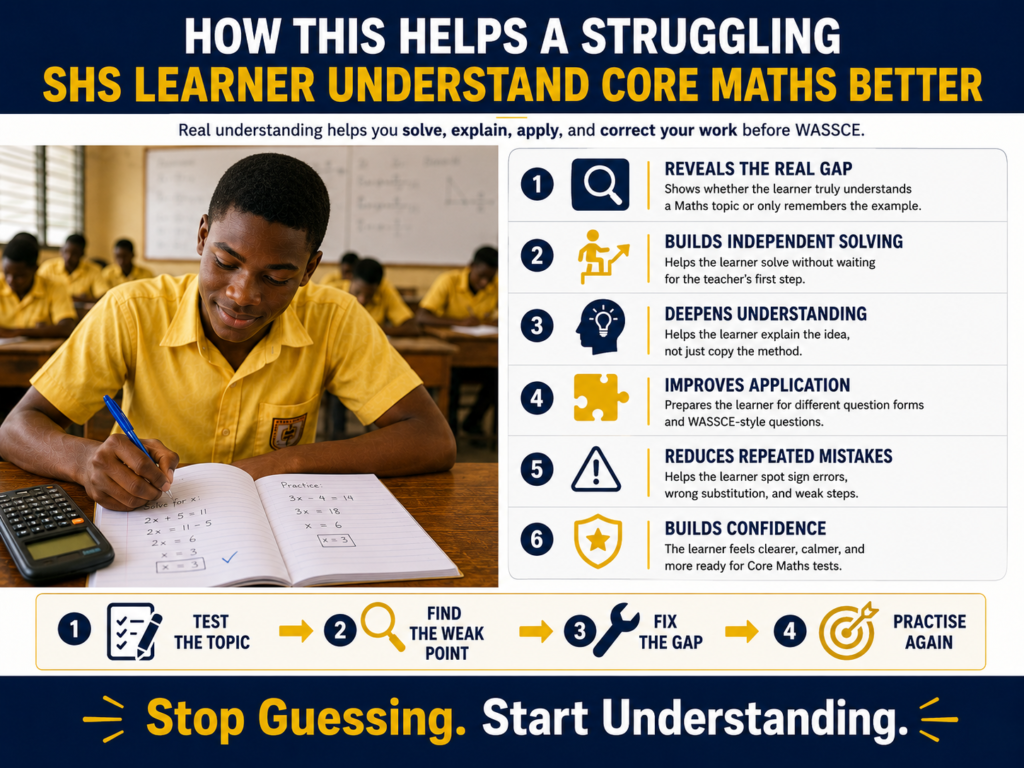
How This Helps a Struggling SHS Learner Understand Core Maths Better
These seven tests help a struggling learner because they reveal the difference between false confidence and real understanding. A learner may feel comfortable when the teacher is solving, but that comfort can disappear during a test.
These checks show whether the learner can stand alone with the topic. They also help the learner locate the hidden gap. Instead of saying, “I do not understand maths,” the learner can say, “I understand the formula, but I cannot apply it in word problems,” or “I can solve direct equations, but I make sign errors.”
That kind of diagnosis is powerful. It revises focus. It reduces panic. It helps the learner correct the exact weakness before WASSCE.
Most importantly, it teaches the learner that understanding Core Maths is not about memorizing many examples. It is about knowing the idea, explaining it, applying it, and correcting mistakes. That is how a learner begins to understand a Maths topic deeply and use it confidently in WASSCE Core Maths.
Final Advice Before WASSCE
Do not wait until the exam is near before checking whether you really understand a Maths topic. After every lesson, test yourself.
Do not fear the test. The test is not there to shame you. It is there to show you the truth.
If you fail one of the seven tests, thank God you have seen the weakness early. Fix it. Practice again. Ask for help where necessary.
At The Maths Clinic, we believe that weak learners can improve when the real gap is found and corrected.
You do not need to guess your way through WASSCE core maths. You need diagnosis, understanding, correction, and steady practice. That is how a Maths topic that once looked difficult can begin to make sense.