Struggling with WASSCE Maths? Stop guessing. Let’s fix the gap step by step.

Word Problems to Equations Quiz: First Line Counts
✏️ Part of the Word Problems Clinic: every word problems lesson, in teaching order.
Quick answer
To turn a word problem into an equation, name the unknown, write each sentence as a maths expression, and find the sentence that says “is”, “equals” or “the result is”: that is where the equals sign goes. Then check your equation by putting the answer back into the story. The quiz below trains exactly that first line.
Many learners can solve 3x − 7 = 20 in seconds, yet freeze when the same equation is hidden in a story. The equation is the first line of your working, and it is where most word problem marks are lost. Train that line here, one story at a time.
Free word problems trainer
First Line Counts
In most word problems, the marks are won or lost on the first line: the equation. Solving it is the easy part.
You will read 12 short stories. For each one, pick the equation that matches the story. The wrong choices are the misreadings WAEC examiners see every year. No writing, no calculator, about 8 minutes.
Why the first line decides your marks
In 2016, the WAEC Chief Examiner wrote that “candidates could not translate word problem into mathematical equation. The phrase “in three years” was not properly factored into their equation.” In 2012: “most of the candidates could not write algebraic equations from the word problem, let alone solve them correctly.”
Translating word problems into equations was named as a weakness in 9 of the 12 Core Mathematics reports we studied (see the evidence). Question 1 of this quiz is built on that exact “in three years” trap.
How to use First Line Counts
- Read the whole story before you look at the choices.
- Say the unknown in words: “x is Ama’s age now.”
- Find the sentence that gives the equals sign.
- Pick your choice, then read the feedback, even when you are right.
- At the end, note your misreadings and learn the fix in the Word Problems Clinic.
- Take the quiz again in 7 days. The choices are shuffled each time.
Questions learners ask
How do I change a word problem into an equation?
Name the unknown with a letter, turn each piece of the story into an expression (for example, “4 years older than Ama” becomes x + 4), and put the equals sign where the story says “is”, “will be” or “the result is”. Then check by putting your answer back into the story.
Why can I solve equations but not word problems?
Because solving and translating are two different skills. Solving follows rules. Translating means reading carefully: who the unknown is, what happens to everyone, and which words mean add, subtract, multiply or equals. This quiz trains the translating skill on its own.
Which words mean which operation?
“More than”, “older than” and “in … years’ time” usually mean add. “Less than”, “younger than” and “… years ago” mean subtract. “Times”, “of” and “twice” mean multiply. “Shared”, “per” and “mean” involve dividing. Be careful with order: “7 subtracted from 3x” is 3x − 7.
Is this quiz free?
Yes. It is free, works on a phone, and nothing is saved or sent anywhere. Your result stays on your screen.
For parents
You do not need to know the maths to help. Sit with your child for one question. Ask them to read the story aloud and say which choice they picked and why, before they tap. If they can explain it, the skill is growing. Their score at the end tells you which misreading to work on first.

Written by
Dickson Sarpong
NTC-certified SHS Mathematics teacher in Ghana with WAEC marking experience, and author of The Bridge Series textbooks. Every lesson here is built around the mistakes WAEC examiners keep reporting.
About DicksonStuck? Ask a question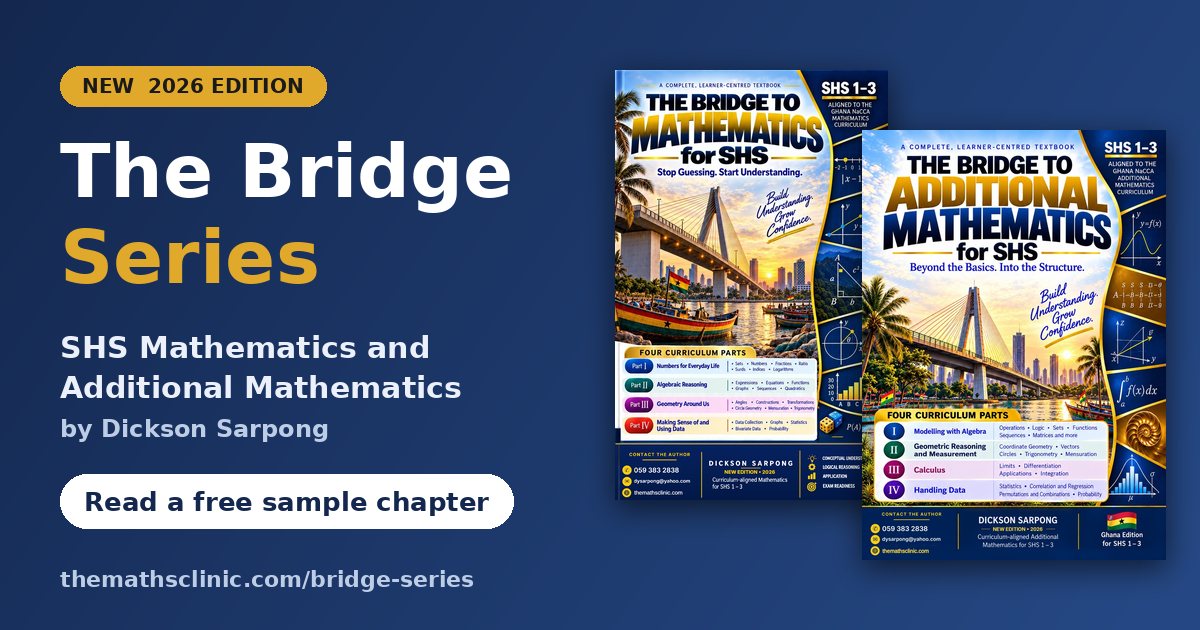
Want the whole topic, step by step? My textbooks, The Bridge to Mathematics and The Bridge to Additional Mathematics for SHS, follow the new curriculum and rebuild the basics as you go.
Read a free chapter →