Struggling with WASSCE Maths? Stop guessing. Let’s fix the gap step by step.

Word Problems Clinic
Stuck turning word problems into equations? Follow the step-by-step route: the 5-step method, then ages, speed, work rate and ratio, with worked WASSCE examples.
You can read the story. You may even be able to solve 3x + 5 = 20. The trouble is the part in between: turning the words into the equation. If that is where you get stuck, you are not alone. WAEC examiners have named “translating word problems into mathematical statements” as a candidate weakness in 9 of the 12 Chief Examiner’s reports we studied (see the evidence).
What this clinic does
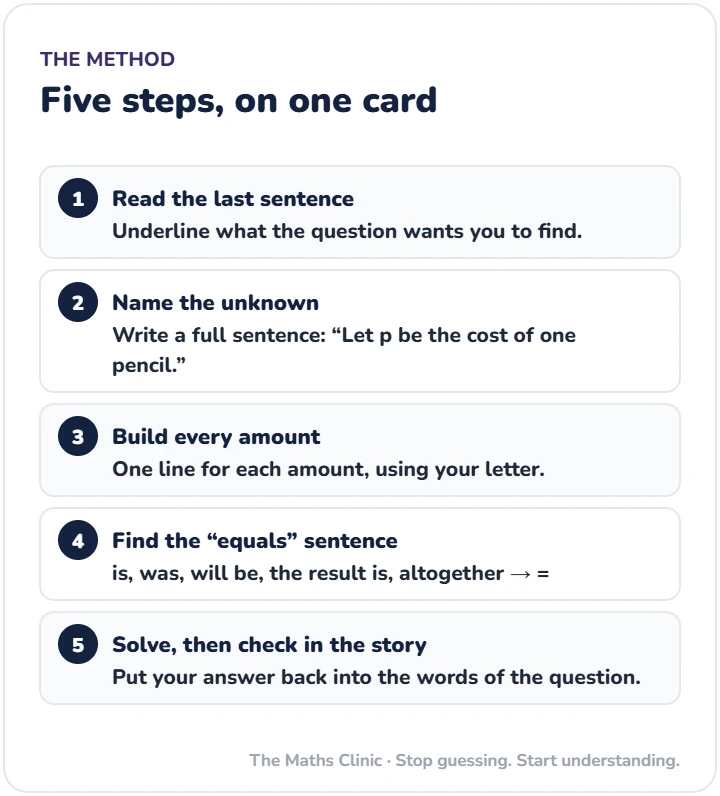
It takes you from “I don’t know what to write first” to a correct equation, one step at a time. Start with Lesson 1, which teaches the method every word problem uses. Then use it on the four question types WASSCE sets most often: ages, speed, work rate and ratio.
🎯 Test your first line in 8 minutes
Not sure which lesson you need? Take First Line Counts: 12 short stories, and for each one you pick the equation that matches. Your result names the exact misreadings to fix, so you know where to start below.
The route, step by step
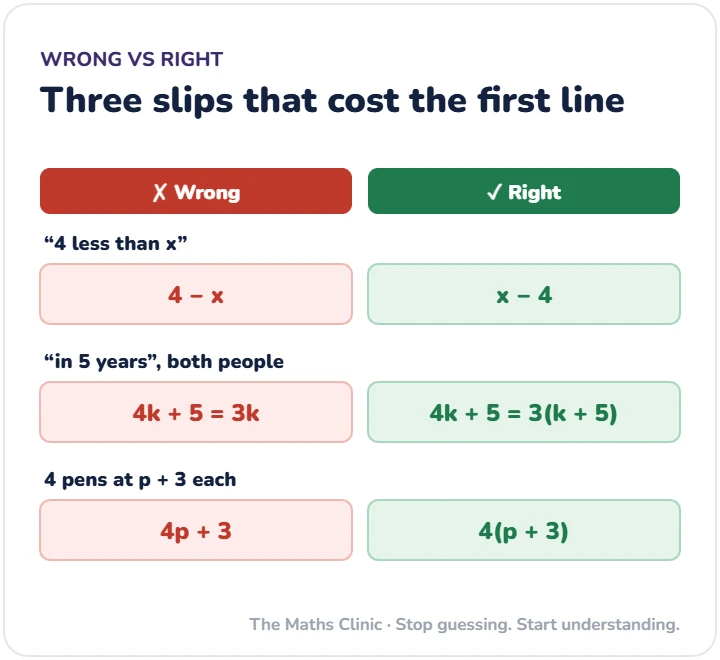
Follow the lessons in this order. Each one writes out every step, shows the wrong way next to the right way, and ends with practice questions and full solutions.
The first lesson, How to Turn Word Problems into Equations, goes live on 14 November at 12:00. The rest follow one by one until 17 November. Bookmark this page: each lesson appears here the moment it goes live.
Which lesson do I need?
| If this sounds like you… | Start with |
|---|---|
| “I understand the story but don’t know what to write first.” | Lesson 1: turning word problems into equations |
| “I forget to add the years to everyone.” | Lesson 2: age word problems (the age table) |
| “Minutes and hours confuse me, and my average speed is wrong.” | Lesson 3: speed, distance and time |
| “I add the times when people work together.” | Lesson 4: work rate problems |
| “I share in a ratio and the answers don’t add up.” | Lesson 5: ratio word problems |
| “I can do each type, but I panic in the exam.” | Word Problems in WASSCE Mathematics: questions and answers |
Practise and check yourself
- Practise word problems in the Practice Zone: questions on this topic only, with feedback on each answer.
- Take the free 18-question check again in a week to see whether your Word Problems score has moved.
More help with word problems
- Key Words in Word Problems: 7 Clues That Show the Operation
- Expression vs Equation: The Difference, With Examples
- How to Solve Linear Equations Step by Step, Without Guessing
- Simultaneous Equations: How to Solve Them, With WASSCE Practice
- Algebra, Geometry or Word Problems? How to Find Your Weak Area
Questions learners often ask
Why are word problems so hard for me?
Usually because the step between the story and the equation was done in someone’s head and never shown to you. The lessons here write out that step every time.
What should I do first in any word problem?
Read the last sentence to see what you are asked to find, then give that unknown a letter in a full sentence, such as “Let k be Kofi’s age now.”
Is this in the new SHS curriculum?
Yes. Year 1 asks you to model and solve linear equations from real-life problems, and Year 2 asks you to model and solve word problems on simultaneous equations involving numbers and ages.
For parents
You do not need to know the maths to help. Ask your child to read one question aloud and tell you two things before writing: “What is the unknown?” and “Which sentence is the equals sign?” If they can, they are using the method.

Written by
Dickson Sarpong
NTC-certified SHS Mathematics teacher in Ghana with WAEC marking experience, and author of The Bridge Series textbooks. Every lesson here is built around the mistakes WAEC examiners keep reporting.
About DicksonStuck? Ask a question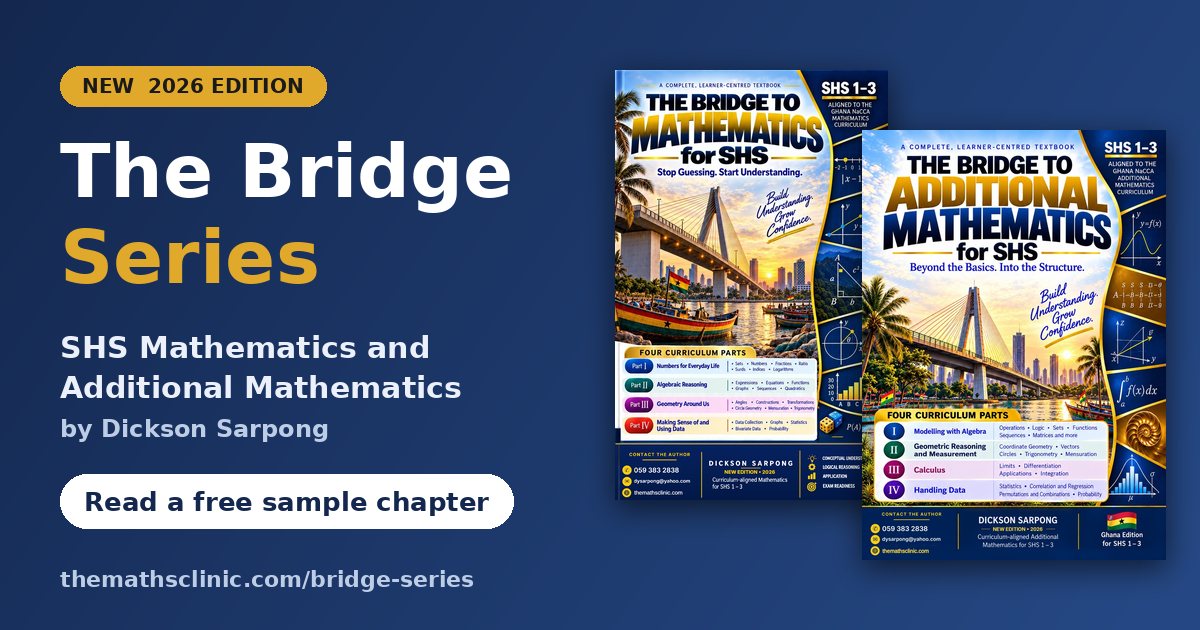
Want the whole topic, step by step? My textbooks, The Bridge to Mathematics and The Bridge to Additional Mathematics for SHS, follow the new curriculum and rebuild the basics as you go.
Read a free chapter →