Struggling with WASSCE Maths? Stop guessing. Let’s fix the gap step by step.

SOHCAHTOA: Meaning, Formula and Examples
What SOHCAHTOA means, how to label the sides from the angle, and how to choose sin, cos or tan without guessing, with worked examples.

📚 Part of the Trigonometry Clinic: every lesson on trigonometry, elevation, depression and bearings, in one place.
Quick answer: what does SOHCAHTOA mean?
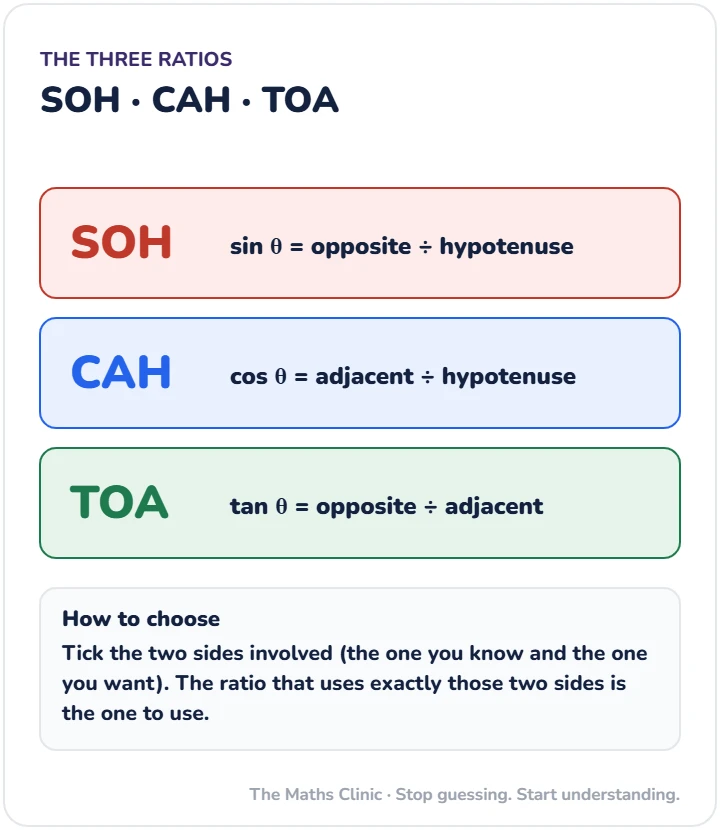
SOHCAHTOA is a memory aid for the three trigonometric ratios in a right-angled triangle: Sin = Opposite ÷ Hypotenuse, Cos = Adjacent ÷ Hypotenuse, Tan = Opposite ÷ Adjacent. The sides are always named from the angle you are using.
Most SHS learners can recite SOHCAHTOA. The marks are lost one step earlier: deciding which side is “opposite” and which is “adjacent”. Get the labels right and the ratio chooses itself.
📋 What the WAEC Chief Examiner reported
- 2023 and 2024: trigonometric ratio work was named as a candidate strength.
- 2017: many candidates “could not analyse and deduce from the given diagram the correct trigonometric ratios”.
- 2011 and 2016: trigonometry was named among the areas of weakness.
How to win these marks back
- Mark the angle you are using before you label anything.
- Label the hypotenuse first, then opposite, then adjacent.
- Write the ratio in words (for example sin = opp ÷ hyp) before you put in numbers.
- Only use SOHCAHTOA in a right-angled triangle.
Source: WAEC Chief Examiners’ Reports, Mathematics (Core), 2011, 2016, 2017, 2023, 2024
What does SOHCAHTOA stand for?
| Letters | Ratio | In words |
|---|---|---|
| SOH | sin θ = opp ÷ hyp | sine is opposite over hypotenuse |
| CAH | cos θ = adj ÷ hyp | cosine is adjacent over hypotenuse |
| TOA | tan θ = opp ÷ adj | tangent is opposite over adjacent |
How to label opposite, adjacent and hypotenuse
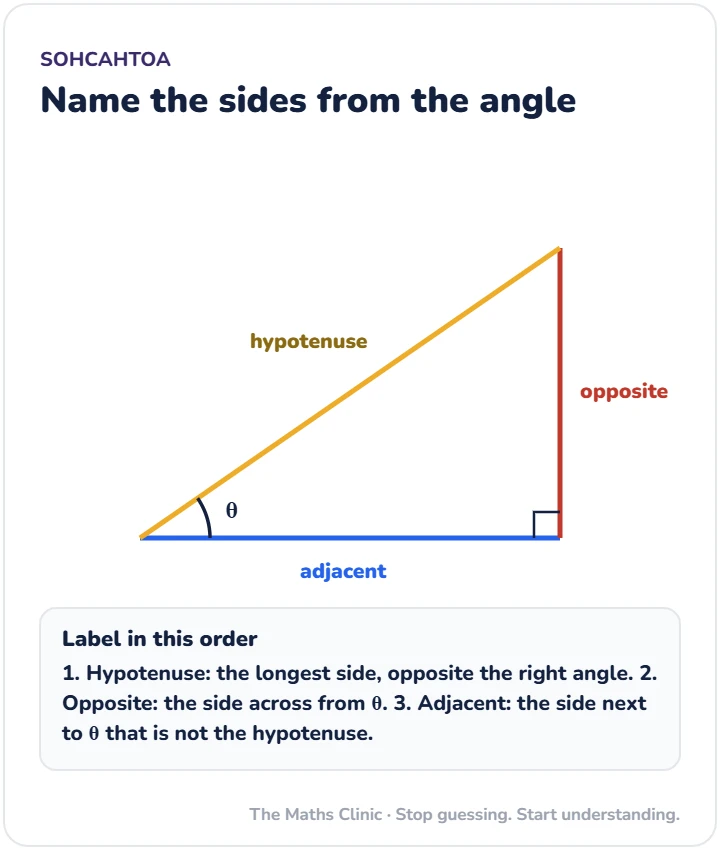
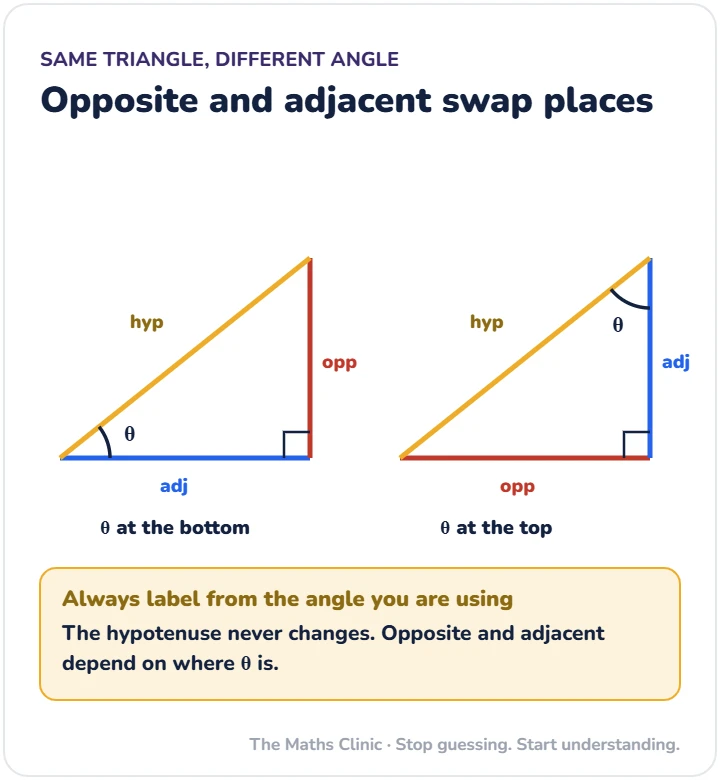
The hypotenuse is the longest side, across from the right angle. It never changes. The opposite is the side across from the angle θ. The adjacent is the side next to θ that is not the hypotenuse.
SOHCAHTOA examples
Example 1: using sin
In a right-angled triangle, the hypotenuse is 10 cm and one angle is 35°. Find the side x opposite the 35°.
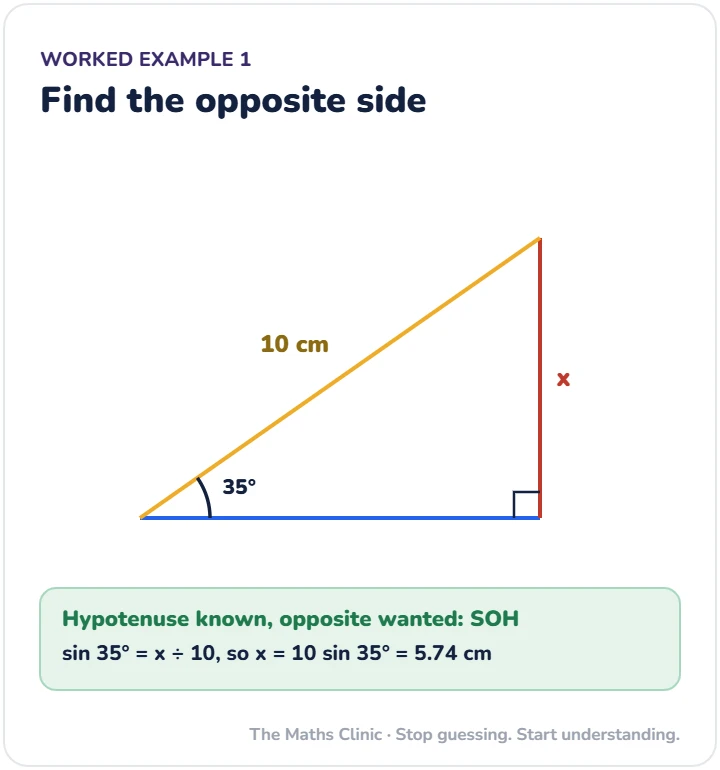
\sin 35^\circ=\dfrac{x}{10}x=10\sin 35^\circ=5.74\text{ cm}Example 2: using tan
The side adjacent to a 50° angle is 12 m. Find the side y opposite the 50°.
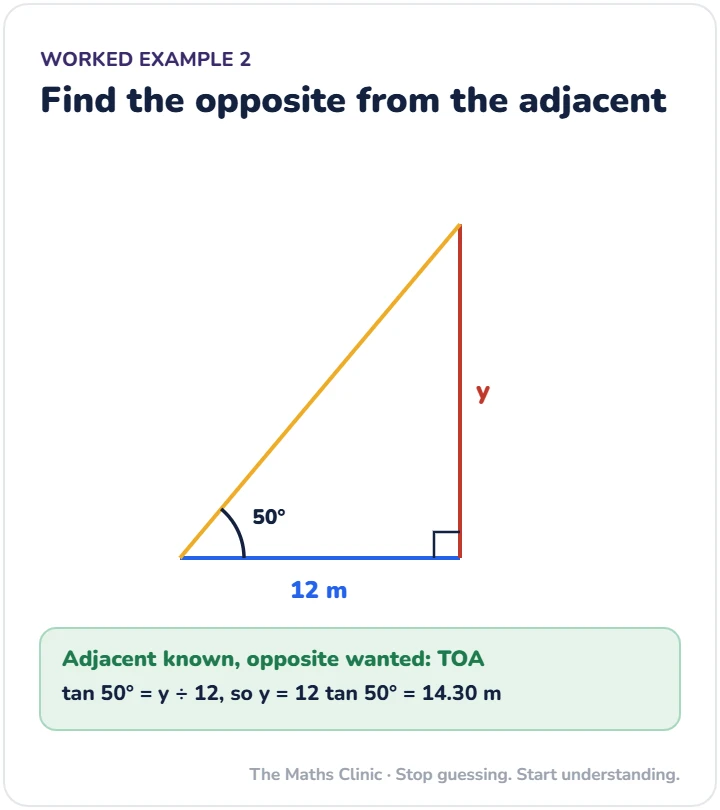
y=12\tan 50^\circ=14.30\text{ m}Example 3: using cos to find the hypotenuse
The side adjacent to a 40° angle is 8 cm. Find the hypotenuse h.
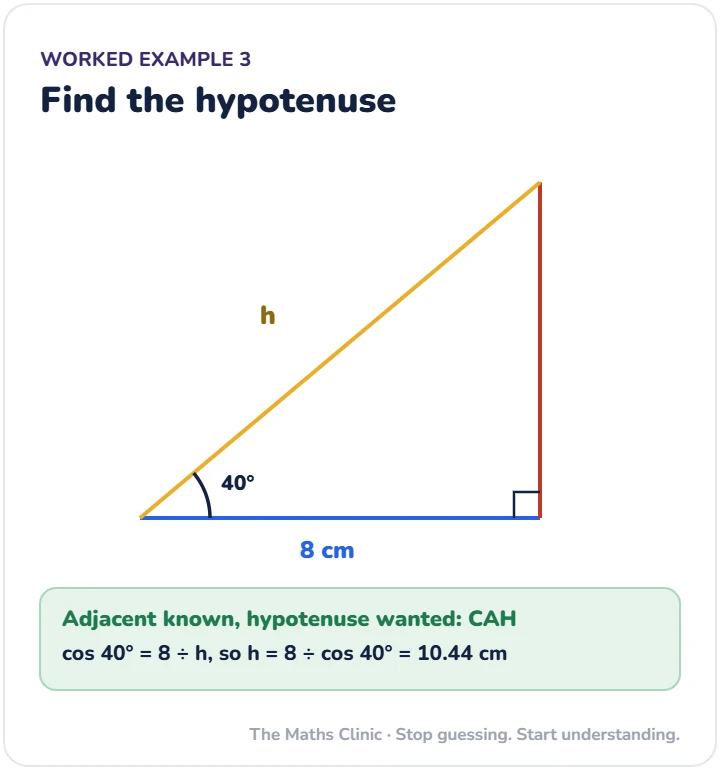
\cos 40^\circ=\dfrac{8}{h}h=\dfrac{8}{\cos 40^\circ}=10.44\text{ cm}The mistake examiners keep seeing
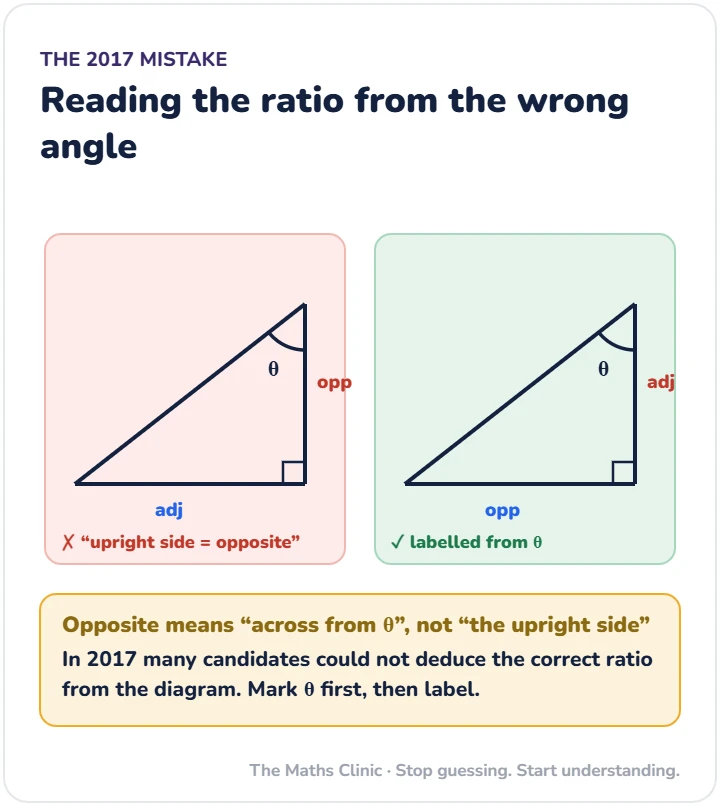
- Labelling the upright side as “opposite” without looking at where θ is.
- Using SOHCAHTOA in a triangle with no right angle.
- Writing x=\dfrac{\sin 35^\circ}{10} instead of x=10\sin 35^\circ. Write the ratio first, then rearrange.
- Calculator in radians. Check that it shows DEG.
SOHCAHTOA practice questions
- In a right-angled triangle, the hypotenuse is 15 cm and one angle is 28°. Find the side adjacent to the 28° angle.
- The side opposite a 33° angle is 9 m. Find the side adjacent to it.
- The side opposite a 25° angle is 6 cm. Find the hypotenuse.
Show the answers
1. CAH: 15\cos 28^\circ = 13.24 cm
2. TOA: \dfrac{9}{\tan 33^\circ} = 13.86 m
3. SOH: \dfrac{6}{\sin 25^\circ} = 14.20 cm
✏️ Try it yourself
A wheelchair ramp rises 1.5 m and makes an angle of 12° with the level ground. How long is the ramp? Label the sides from the 12° angle first.
Tap to see the answer
The rise is opposite and the ramp is the hypotenuse, so SOH: \dfrac{1.5}{\sin 12^\circ} = 7.21 m.
SOHCAHTOA: frequently asked questions
Can I use SOHCAHTOA in any triangle?
No. SOHCAHTOA only works in a right-angled triangle. In a question without a right angle, look for a way to split the shape into right-angled triangles, for example by drawing a perpendicular height.
How do I remember SOHCAHTOA?
Say it as one word, “soh-cah-toa”, and write it at the top of your rough work before every trigonometry question. Many Ghanaian teachers also use a sentence such as “Some Old Horses Can Always Hear Their Owners Approach”.
What is the hypotenuse?
The longest side of a right-angled triangle, always across from the right angle. It is the only side whose name does not depend on θ.
Keep learning
- Angle of Elevation and Depression: Meaning, Diagrams and the Difference
- Angle of Elevation and Depression Questions With Solutions
- Bearings in Mathematics: Questions and Answers With Diagrams
📚 See every lesson in the Trigonometry Clinic
✏️ Practise trigonometry in the Practice Zone

Written by
Dickson Sarpong
NTC-certified SHS Mathematics teacher in Ghana with WAEC marking experience, and author of The Bridge Series textbooks. Every lesson here is built around the mistakes WAEC examiners keep reporting.
About DicksonStuck? Ask a question
Want the whole topic, step by step? My textbooks, The Bridge to Mathematics and The Bridge to Additional Mathematics for SHS, follow the new curriculum and rebuild the basics as you go.
Read a free chapter →