Struggling with WASSCE Maths? Stop guessing. Let’s fix the gap step by step.

Area of a Sector and Arc Length, Step by Step (and the Cone Question)
Find the area of a sector, arc length and perimeter step by step, see why the formulas work, and solve the WASSCE sector-folded-into-a-cone question.

📚 Part of the Mensuration & Geometry Clinic: every lesson on this topic, in one place.
Quick answer: how do you find the area of a sector and the length of an arc?
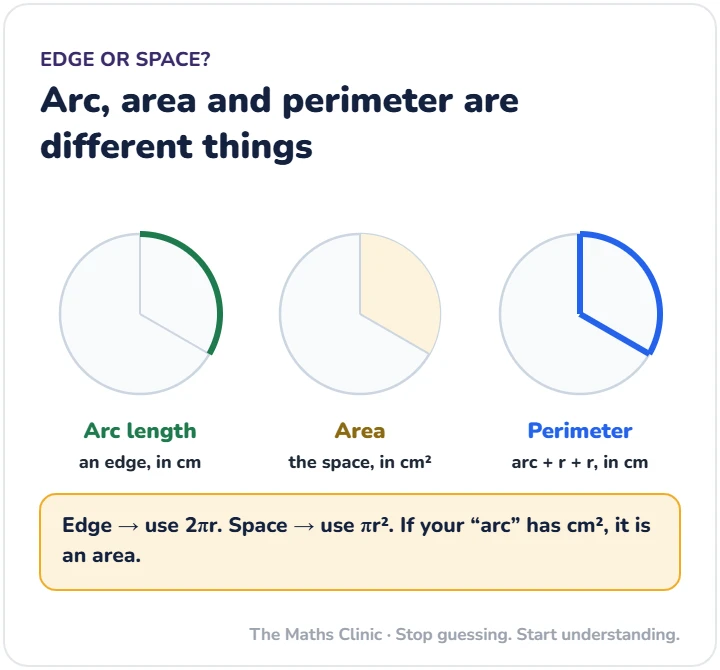
A sector is a fraction of a circle, and the fraction is θ/360, where θ is the angle at the centre. Arc length = θ/360 × 2πr. Area of a sector = θ/360 × πr². Perimeter of a sector = arc length + r + r. Arc and perimeter are lengths (cm); area is in square units (cm²).
You have seen θ/360 × πr² and θ/360 × 2πr in your notes many times. But in the exam, under pressure, you cannot remember which one is the arc and which one is the area. Or you find the arc correctly and forget the two straight edges when the question asks for the perimeter.
The good news: you do not need to memorise either formula. Once you see where they come from, you can rebuild them in ten seconds, every time.
What is a sector? (the idea nobody explains)
A sector is a “slice” of a circle, like a slice of pizza: two straight edges (both radii) and a curved edge (the arc). The angle between the two radii, at the centre of the circle, is θ.
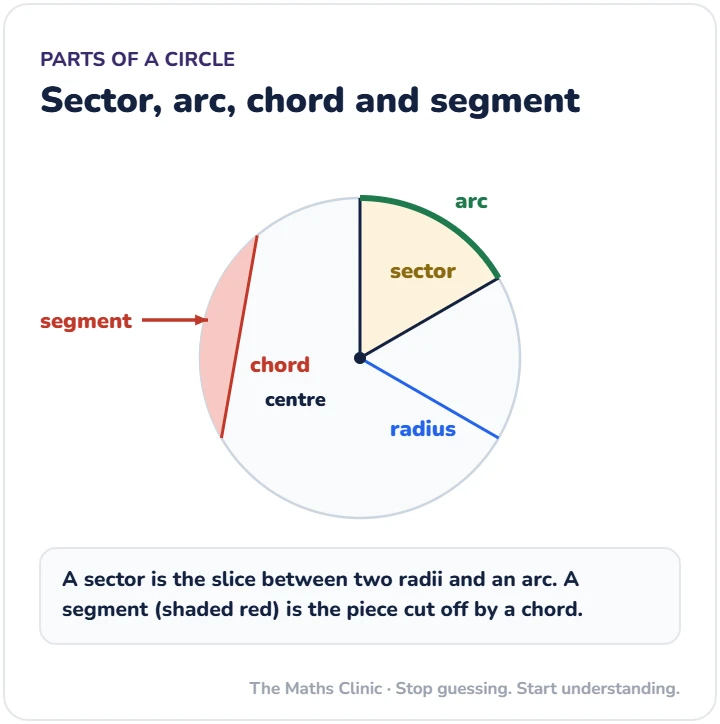
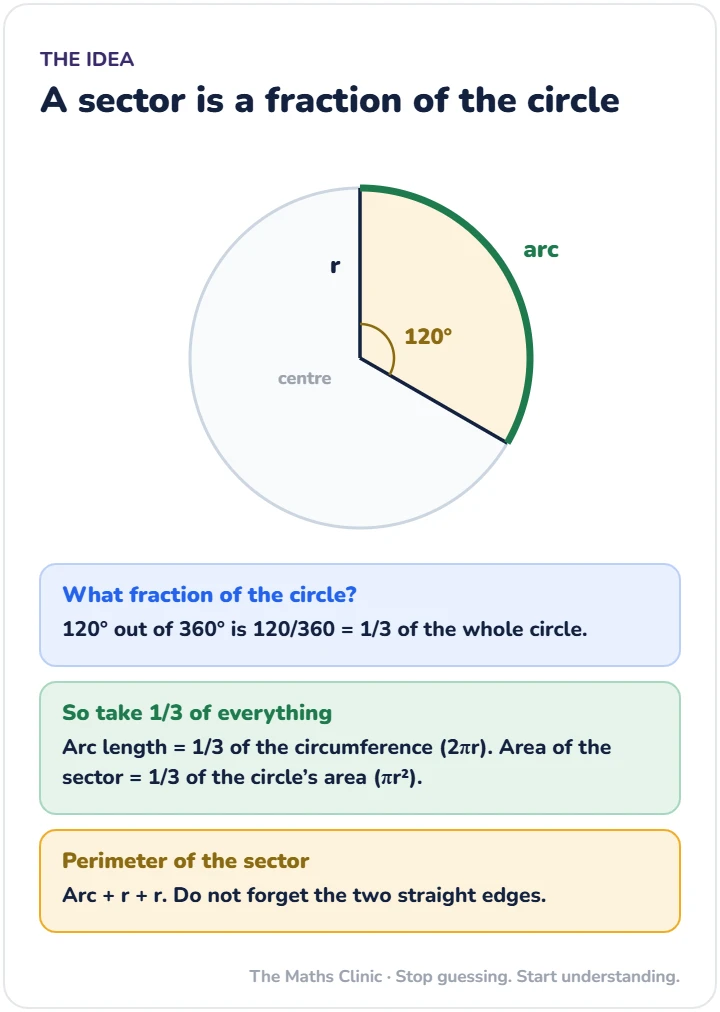
Here is the step that is usually skipped. A full circle has 360° at its centre. So a sector with an angle of 120° is 120 out of 360 parts of the circle:
120/360 = 1/3. The sector is one-third of the circle.
If the slice is one-third of the circle, then its curved edge is one-third of the circle’s edge (the circumference), and its area is one-third of the circle’s area. That is all the formulas say.
| You want | Whole circle | Sector (fraction θ/360) | Unit |
|---|---|---|---|
| the curved edge | circumference = 2πr | arc length = θ/360 × 2πr | cm |
| the space inside | area = πr² | area of sector = θ/360 × πr² | cm² |
| the distance all round | circumference = 2πr | perimeter = arc + r + r | cm |
How to find the area of a sector and arc length: every step
- Write down r and θ. If the question gives the diameter, halve it first to get the radius.
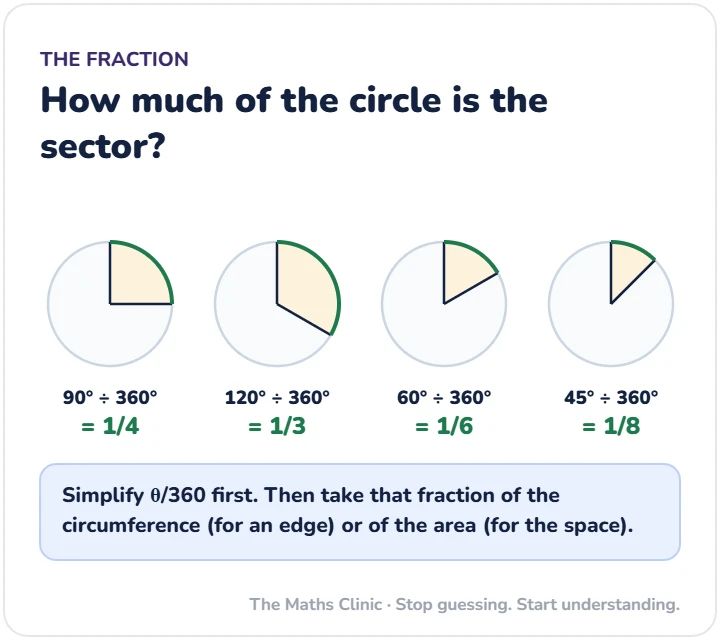
- Find the fraction θ/360 and simplify it. 90/360 = 1/4, 120/360 = 1/3, 60/360 = 1/6, 45/360 = 1/8. Simplifying first makes the arithmetic much easier.
- Decide: edge or space? Arc or perimeter means an edge, so use 2πr. Area means space, so use πr².
- Multiply the fraction by the whole-circle amount.
- For the perimeter, add the two radii.
- Write the unit. cm for arc and perimeter, cm² for area.
Worked example 1: a quarter circle
Question. A sector of a circle has radius 14 cm and angle 90°. Find (a) the arc length, (b) the area, (c) the perimeter of the sector. Take π = 22/7.
Step 1. r = 14 cm, θ = 90°.
Step 2. The fraction. 90/360 = 1/4. The sector is a quarter of the circle.
(a) Arc length. Whole circumference = 2 × 22/7 × 14 = 88 cm. A quarter of it: 88 ÷ 4 = 22 cm.
(b) Area. Whole area = 22/7 × 14 × 14 = 616 cm². A quarter of it: 616 ÷ 4 = 154 cm².
(c) Perimeter. Arc + r + r = 22 + 14 + 14 = 50 cm.
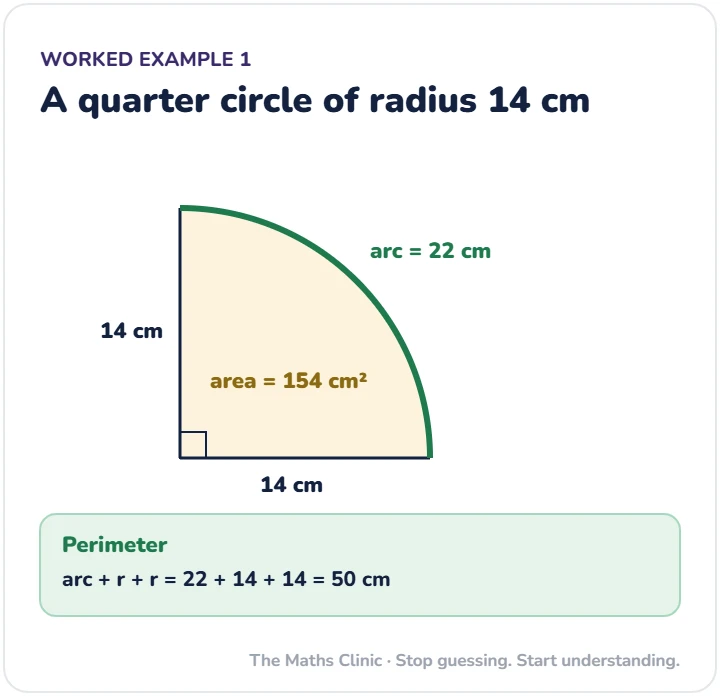
The wrong way. Giving 22 cm as the perimeter. The arc is only the curved edge; the perimeter goes all the way round the slice.
Worked example 2: a 120° sector
Question. Find the arc length, area and perimeter of a sector of radius 21 cm and angle 120°. Take π = 22/7.
Step 1. r = 21 cm, θ = 120°. Step 2. 120/360 = 1/3.
Arc. Circumference = 2 × 22/7 × 21 = 132 cm. One-third: 132 ÷ 3 = 44 cm.
Area. Circle area = 22/7 × 21 × 21 = 1 386 cm². One-third: 1 386 ÷ 3 = 462 cm².
Perimeter. 44 + 21 + 21 = 86 cm.
Worked example 3: finding the angle from the arc
Question. The arc of a sector is 11 cm long and the radius is 7 cm. Find the angle of the sector.
Step 1. Find the whole circumference. 2 × 22/7 × 7 = 44 cm.
Step 2. What fraction of the circumference is the arc? 11/44 = 1/4.
Step 3. The angle is the same fraction of 360°. 1/4 × 360° = 90°.
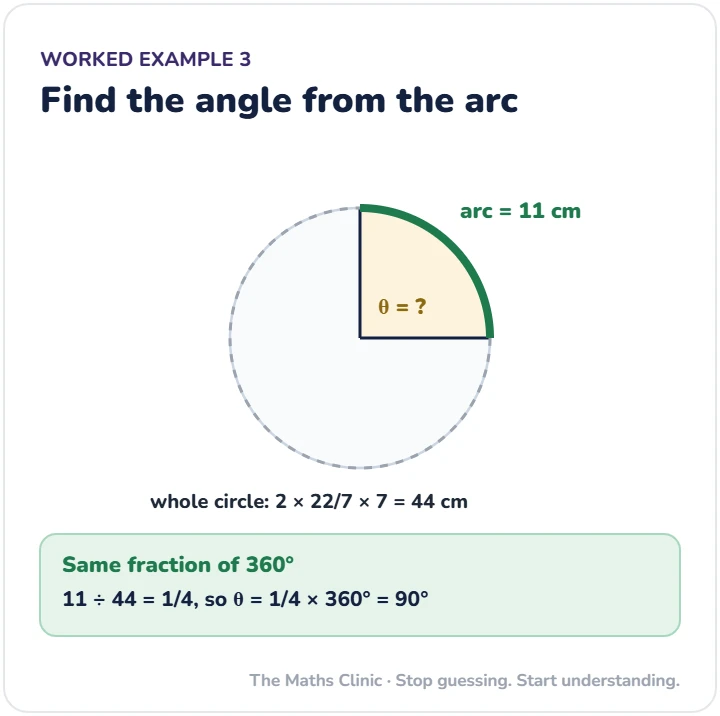
Check. 90/360 × 44 = 11 ✓. Working backwards like this is just the same idea in reverse.
Worked example 4: a sector folded into a cone (WASSCE style)
Question. A sector of a circle of radius 21 cm and angle 120° is folded so that its straight edges meet, forming a cone. Find (a) the base radius of the cone, (b) its height, (c) its volume, correct to one decimal place. Take π = 22/7.
In 2018, a question of exactly this type appeared, and WAEC reported that “most of the candidates did not attempt this question although it was compulsory.” Learners skip it because nobody showed them what happens to each part of the sector when you fold it. Take a sheet of paper, cut out a sector and fold it: you will see it.
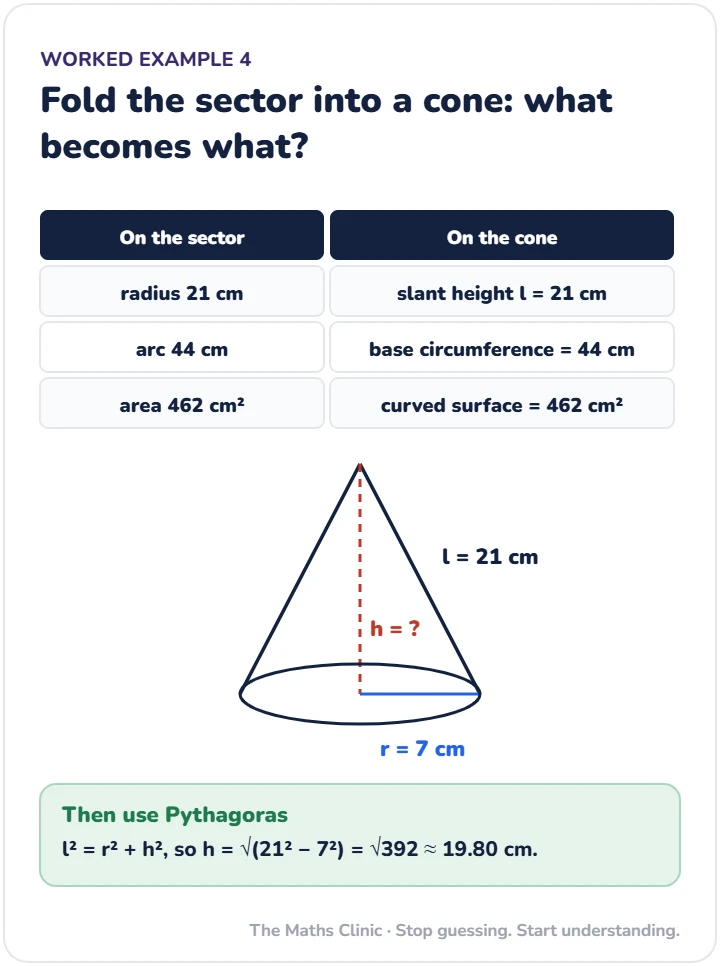
Step 1. What becomes what? The two straight edges (the radius, 21 cm) meet and become the slant height of the cone: l = 21 cm. The arc curls round to become the circumference of the base.
Step 2. Find the arc. From Worked example 2, the arc of this sector is 44 cm.
(a) Base radius. The base circumference is 44 cm, so 2 × 22/7 × r = 44. That is 44/7 × r = 44, so r = 44 × 7/44 = 7 cm.
(b) Height. The height, the base radius and the slant height make a right-angled triangle, with the slant height as the hypotenuse. So h² = l² − r² = 21² − 7² = 441 − 49 = 392. h = √392 = 19.799… ≈ 19.8 cm.
(c) Volume. V = 1/3 × πr²h = 1/3 × 22/7 × 7 × 7 × 19.799… = 1/3 × 154 × 19.799… = 1 016.35… ≈ 1 016.3 cm³.
Keep the full value of h on your calculator. If you round h to 19.8 first, you get 1/3 × 154 × 19.8 = 1 016.4 cm³, which is not the answer to one decimal place. Round only at the very end.
Check. The paper does not stretch, so the sector’s area must equal the cone’s curved surface area: πrl = 22/7 × 7 × 21 = 462 cm², and the sector area from Worked example 2 is 462 cm² ✓.
The wrong ways that cost marks
- Mixing up the formulas. Edge (arc, perimeter) uses 2πr; space (area) uses πr². If your “arc” has cm², it is an area.
- Using the diameter as r. Halve the diameter first.
- Writing 360/θ instead of θ/360. The sector is smaller than the circle, so the fraction must be less than 1 (for θ under 360°).
- Forgetting the two radii when the question asks for the perimeter.
- In the cone question, using 21 cm as the base radius. 21 cm is the slant height; the base radius comes from the arc.
- Using the slant height in the volume formula. Volume needs the vertical height h, found with Pythagoras.
- Rounding too early. Keep full values until the last line.
📋 What WAEC advises, turned into your plan
Mensuration was named as a candidate weakness in 2018 and 2019 (“solving problems involving mensuration”) and in 2024 (“solving problems on mensuration”). In 2018, the sector-folded-into-a-cone question was skipped by most candidates even though it was compulsory. In 2024, a sector area appeared inside a shaded-region question. The encouraging part: in 2012, many candidates could use the arc length formula to find a perimeter. These marks can be won with practice.
Here is how to turn that into your plan:
- Before any formula, write r, θ and the fraction θ/360, simplified.
- Ask “edge or space?” and choose 2πr or πr² from that, not from memory.
- For any cone-from-a-sector question, write “sector radius = slant height” and “arc = base circumference” as your first two lines. They earn method marks.
- Keep full calculator values until the last line.
- Do the six questions below without looking at the solutions.
Source: WAEC Chief Examiner’s Report, WASSCE 2012, Mathematics (Core); WAEC Chief Examiner’s Report, WASSCE 2018, Mathematics (Core); WAEC Chief Examiner’s Report, WASSCE 2019, Mathematics (Core); WAEC Chief Examiner’s Report, WASSCE 2024, Mathematics (Core).
Try it now
Cover the solutions. For each question, write r, θ and the fraction first. Take π = 22/7.
Question 1
Find the length of the arc of a sector of radius 7 cm and angle 90°.
Question 2
Find the area of a sector of radius 14 cm and angle 72°.
Question 3
Find the perimeter of a sector of radius 21 cm and angle 60°.
Question 4
The arc of a sector is 22 cm long and its radius is 21 cm. Find the angle of the sector.
Question 5 (WASSCE style)
A sector of radius 14 cm and angle 270° is folded to form a cone. Find the base radius and the height of the cone, correct to one decimal place.
Question 6 (real life)
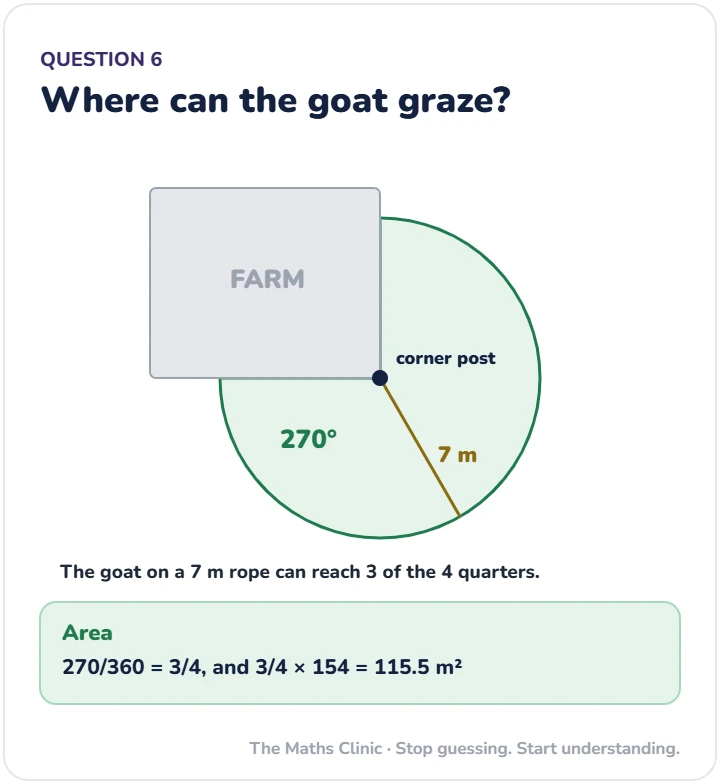
A goat is tied with a 7 m rope to the corner post of a fenced rectangular farm, outside the farm. The corner is a right angle, so the goat can graze a sector of angle 270°. Find the area it can graze, correct to one decimal place.
Solutions
Solution 1
Fraction: 90/360 = 1/4. Circumference: 2 × 22/7 × 7 = 44 cm. Arc = 44 ÷ 4 = 11 cm.
Solution 2
Fraction: 72/360 = 1/5. Circle area: 22/7 × 14 × 14 = 616 cm². Sector = 616 ÷ 5 = 123.2 cm².
Solution 3
Fraction: 60/360 = 1/6. Circumference: 2 × 22/7 × 21 = 132 cm. Arc = 132 ÷ 6 = 22 cm. Perimeter = 22 + 21 + 21 = 64 cm.
Solution 4
Circumference: 2 × 22/7 × 21 = 132 cm. Fraction of the circle: 22/132 = 1/6. Angle = 1/6 × 360° = 60°. Check: 60/360 × 132 = 22 ✓.
Solution 5
Fraction: 270/360 = 3/4. Circumference of the big circle: 2 × 22/7 × 14 = 88 cm, so the arc is 3/4 × 88 = 66 cm. The arc becomes the base circumference: 2 × 22/7 × r = 66, so 44/7 × r = 66 and r = 66 × 7/44 = 10.5 cm. The sector radius becomes the slant height: l = 14 cm. Height: h² = 14² − 10.5² = 196 − 110.25 = 85.75, so h = √85.75 = 9.26… ≈ 9.3 cm.
Solution 6
Fraction: 270/360 = 3/4. Area of a full circle of radius 7 m: 22/7 × 7 × 7 = 154 m². Grazing area = 3/4 × 154 = 115.5 m². Why 270°? The farm takes up the 90° corner, so the goat can swing round the other 360° − 90° = 270°.
Check yourself: did you simplify θ/360 first? Did your arc and perimeter come out in cm, and your areas in cm² or m²? In Question 5, did you use 14 cm as the slant height, not the base radius?
📘 New SHS curriculum link
Sectors and arcs build directly on Year 1 (1.3.2), the perimeter and area of circles, and Year 3 (3.3.1), which asks you to identify the parts of a circle. The cone question also uses Year 2 (2.3.2), surface area and volume. Question 6 is the kind of real-life problem the new curriculum asks you to model.
For parents
Cut a paper plate into a slice and ask your child: “What fraction of the plate is this slice? So what fraction of the edge is the curved part?” If they can answer that, they understand sectors. Then ask them to fold the slice into a cone and tell you which edge became the slant.
Frequently asked questions
What is the formula for the area of a sector?
Area of a sector = θ/360 × πr², where θ is the angle at the centre in degrees and r is the radius. It is the fraction θ/360 of the whole circle’s area.
What is the formula for the length of an arc?
Arc length = θ/360 × 2πr. It is the same fraction of the whole circumference.
How do I find the perimeter of a sector?
Find the arc length, then add the two radii: perimeter = arc + 2r.
How do I find the area of a sector without the angle?
If you know the arc length and the radius, use area = ½ × arc × r. For example, with arc 22 cm and radius 14 cm: ½ × 22 × 14 = 154 cm², the same answer as Worked example 1.
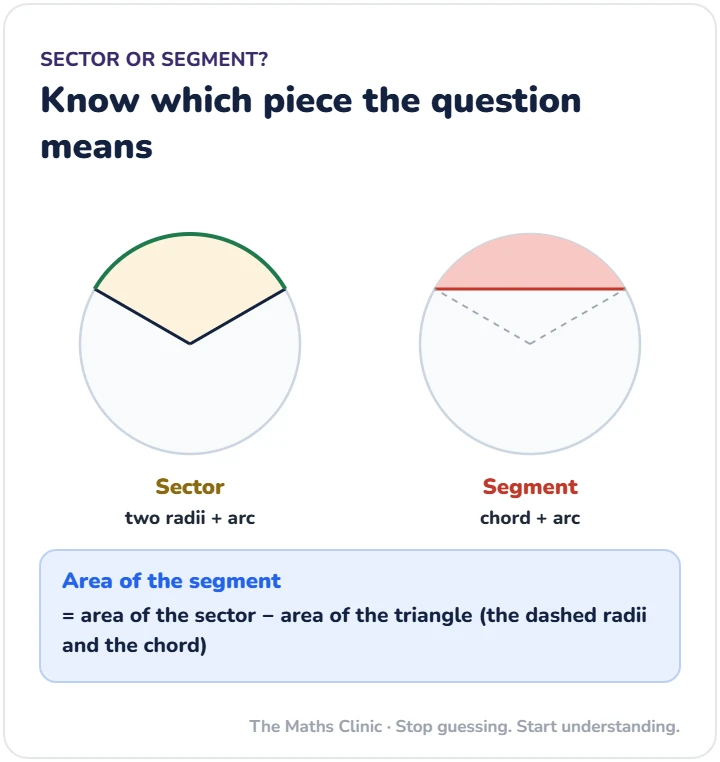
What is the difference between a sector and a segment?
A sector is the slice between two radii and an arc. A segment is the region between a chord and an arc. Area of a minor segment = area of the sector − area of the triangle formed by the two radii and the chord.
How do I find the area of a major sector?
The major sector uses the reflex angle, 360° − θ. For a 90° minor sector, the major sector angle is 270°, so its area is 270/360 = 3/4 of the circle.
Do I need radians for WASSCE Core Mathematics?
No. Core Mathematics uses degrees, so θ/360 is the formula to use. Radians appear in Elective Mathematics.
What to do next
If your areas sometimes come out 100 times too big, read how to convert cm² to m², step by step. To practise choosing the right formula for the question, go to Area, Perimeter or Volume? How to Tell Which One a Question Wants, then try mixed questions in the Practice Zone.
Keep learning
- Why Your Area Answer Is 100 Times Too Big: Converting cm² to m², Step by Step
- Area, Perimeter or Volume? How to Tell Which One a Question Wants
- Area and Volume Formulas: 10 Common Errors and How to Fix Them
📚 See every lesson in the Mensuration & Geometry Clinic
✏️ Practise mensuration and geometry
💬 Stuck on a step? Ask Dickson and send the line where you got lost.

Written by
Dickson Sarpong
NTC-certified SHS Mathematics teacher in Ghana with WAEC marking experience, and author of The Bridge Series textbooks. Every lesson here is built around the mistakes WAEC examiners keep reporting.
About DicksonStuck? Ask a question
Want the whole topic, step by step? My textbooks, The Bridge to Mathematics and The Bridge to Additional Mathematics for SHS, follow the new curriculum and rebuild the basics as you go.
Read a free chapter →

