Struggling with WASSCE Maths? Stop guessing. Let’s fix the gap step by step.

Circle Theorems, Step by Step: The Rules, the Reasons and WASSCE Questions with Answers
The seven circle theorems for WASSCE, one at a time, with the hidden step most candidates miss: two radii make an isosceles triangle. Four worked examples, six practice questions and full solutions.

📚 Part of the Mensuration & Geometry Clinic: every lesson on this topic, in one place.
Quick answer: what are the circle theorems?
There are seven rules you need for WASSCE: (1) the angle at the centre is twice the angle at the circumference; (2) the angle in a semicircle is 90°; (3) angles in the same segment are equal; (4) opposite angles of a cyclic quadrilateral add up to 180°; (5) a tangent meets the radius at 90°; (6) two tangents from one point are equal; (7) the alternate segment theorem. Before using any of them, look for two radii: they always make an isosceles triangle.
You open the question. There is a circle, a centre O, three or four letters on the edge, one angle given, and the words “find ∠OAB”. You stare at it. The angle looks like a right angle, so you write 90° and move on.
That is exactly what WAEC examiners saw in 2020. The Chief Examiner wrote that candidates “failed to apply the appropriate theorems regarding the angle in a semi circle and angles in an isosceles triangle.” In 2021 a circle question was poorly answered, “confirming students’ dislike for circle theorem problems.” This lesson takes the fear out, one rule at a time, with every step written down.
The step nobody tells you: look for the radii first
Before any theorem, find the centre O. Every line from O to the circle is a radius, and every radius in the same circle is the same length.
So when O is joined to two points A and B on the circle, OA = OB. That makes triangle OAB isosceles, and an isosceles triangle has two equal base angles.
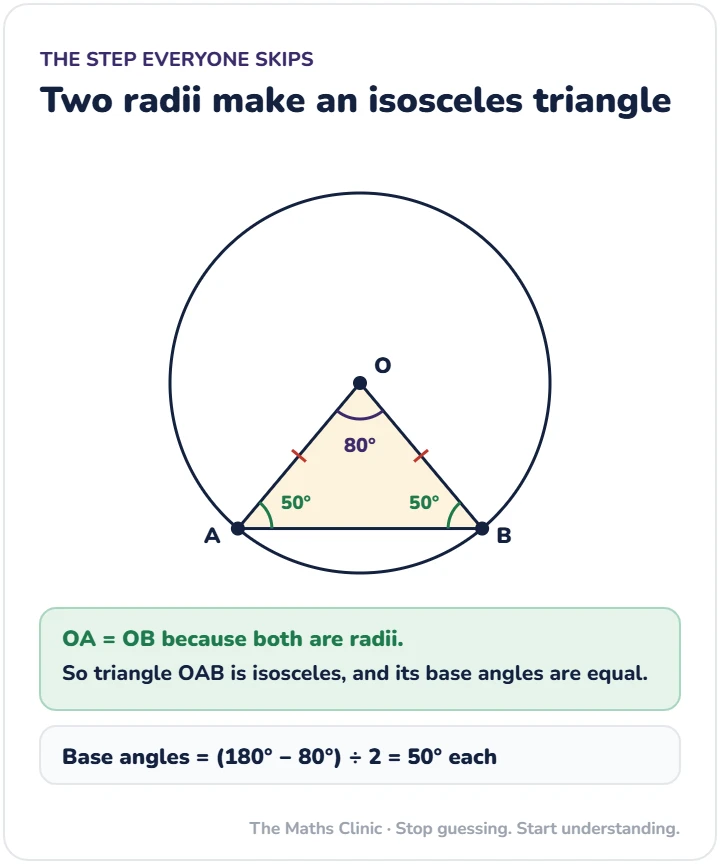
Here is how to use it, step by step. Suppose ∠AOB = 80°.
- The three angles of a triangle add up to 180°.
- Take away the angle at O: 180° − 80° = 100°.
- The two base angles are equal, so share 100° equally: 100° ÷ 2 = 50°.
- So ∠OAB = 50° and ∠OBA = 50°.
This one step unlocks more circle questions than any theorem. Many learners skip it because nobody says it out loud.
The 7 circle theorems, one at a time
For each rule: what it says, how to spot it in a diagram, and the short reason to write beside your working.
Theorem 1: the angle at the centre is twice the angle at the circumference
Take an arc AB. Join A and B to the centre O, and also to a point C on the circle. Both angles “stand on” the same arc AB. The angle at the centre, ∠AOB, is double the angle at the circumference, ∠ACB.

- Going from the edge to the centre: multiply by 2. If ∠ACB = 35°, then ∠AOB = 70°.
- Going from the centre to the edge: divide by 2. If ∠AOB = 100°, then ∠ACB = 50°.
- Reason to write: angle at centre = 2 × angle at circumference.
Theorem 2: the angle in a semicircle is 90°
If AB is a diameter (a straight line through the centre), then any angle made at the circumference by joining A and B to a point C on the circle is exactly 90°.
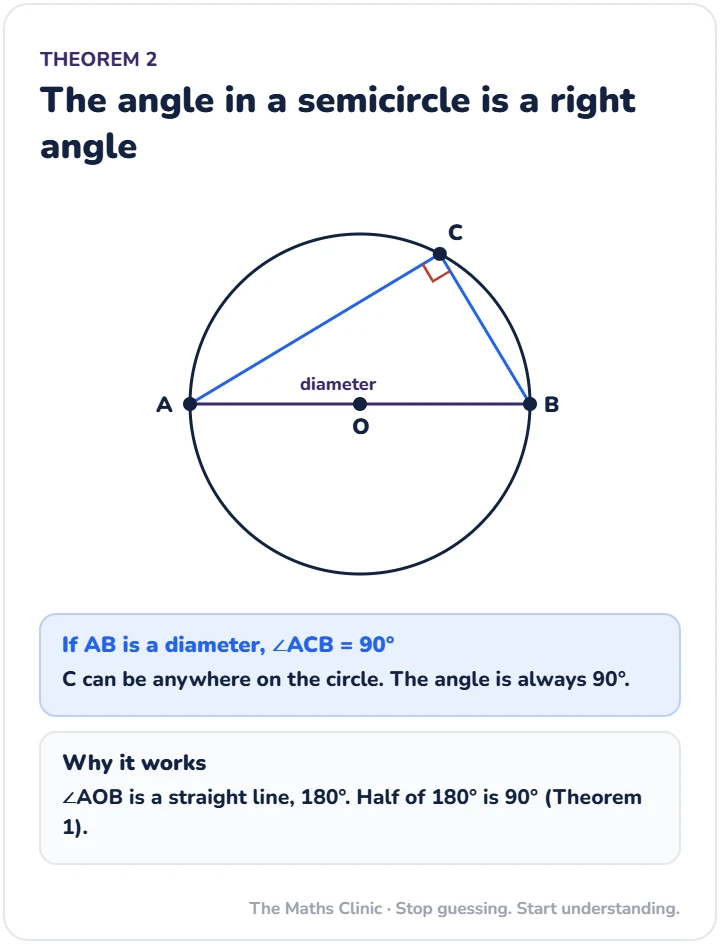
Why? The “angle” at the centre on a diameter is a straight line, 180°. By Theorem 1, the angle at the circumference is half of that: 180° ÷ 2 = 90°. Reason to write: angle in a semicircle.
Theorem 3: angles in the same segment are equal
Join A and B to two different points C and D on the circle, both on the same side of the chord AB. The two angles ∠ACB and ∠ADB are equal. In the diagram this looks like a bow tie.
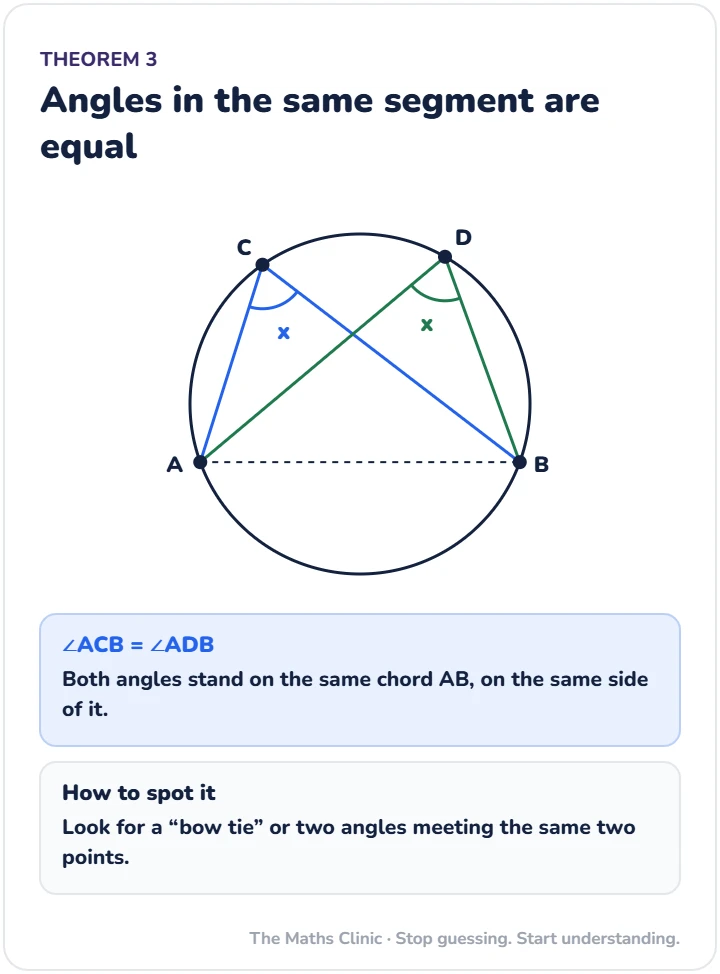
Why? Each one is half of the same angle at the centre (Theorem 1), so they must be equal. Reason to write: angles in the same segment.
Theorem 4: opposite angles of a cyclic quadrilateral add up to 180°
A cyclic quadrilateral is a four-sided shape with all four corners on the circle. Angles opposite each other (across the shape, not next to each other) add up to 180°.
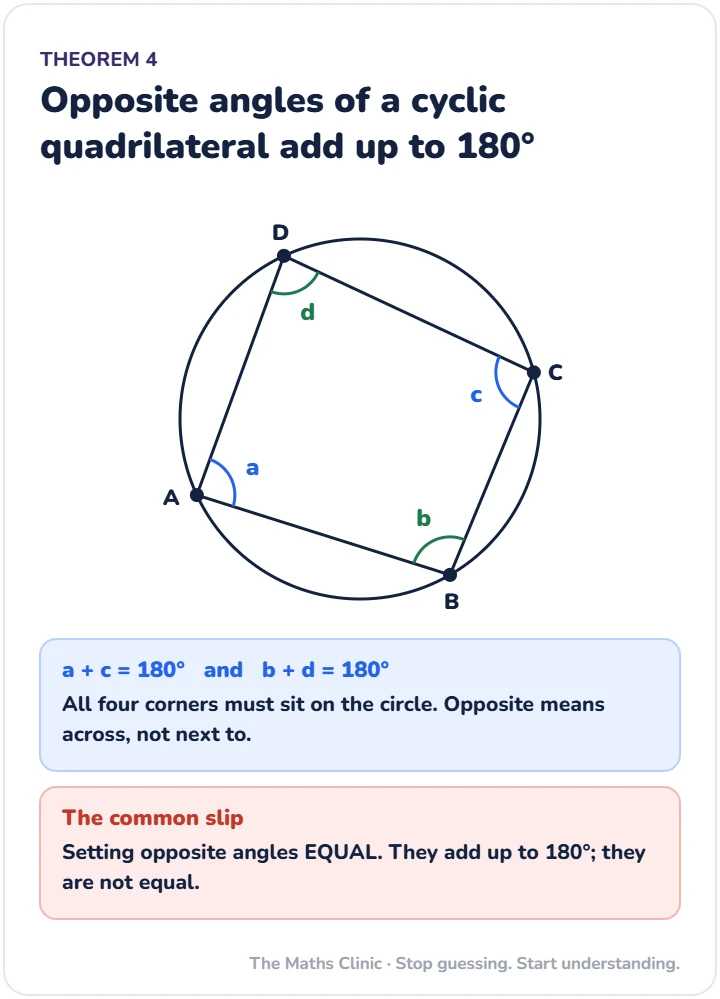
Be careful: opposite angles are not equal. They are supplementary, which means they add up to 180°. Reason to write: opposite angles of a cyclic quadrilateral.
Theorems 5 and 6: tangents
A tangent is a straight line that touches the circle at exactly one point. Two facts:
- The radius drawn to the point of contact meets the tangent at 90°.
- Two tangents drawn from the same outside point P are equal in length: PA = PB.
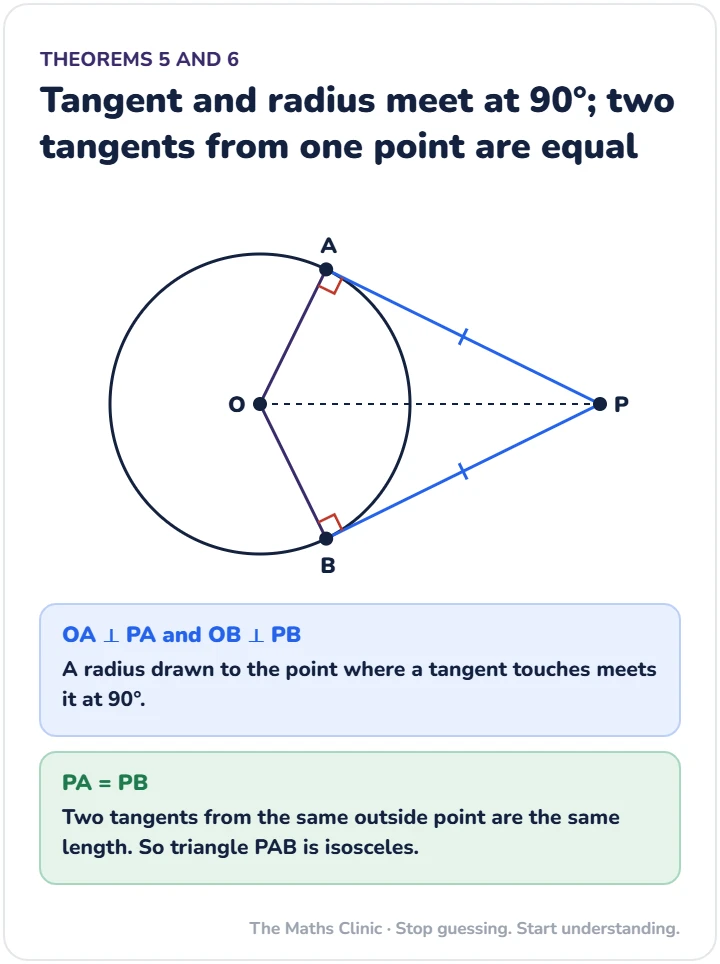
PA = PB means triangle PAB is isosceles. That is the same hidden step as the two radii, used again. Reasons to write: radius ⟂ tangent and tangents from an external point.
Theorem 7: the alternate segment theorem
At the point T where a tangent touches the circle, draw a chord TA. The angle between the tangent and the chord is equal to the angle in the alternate segment: the angle at B, on the other side of the chord.
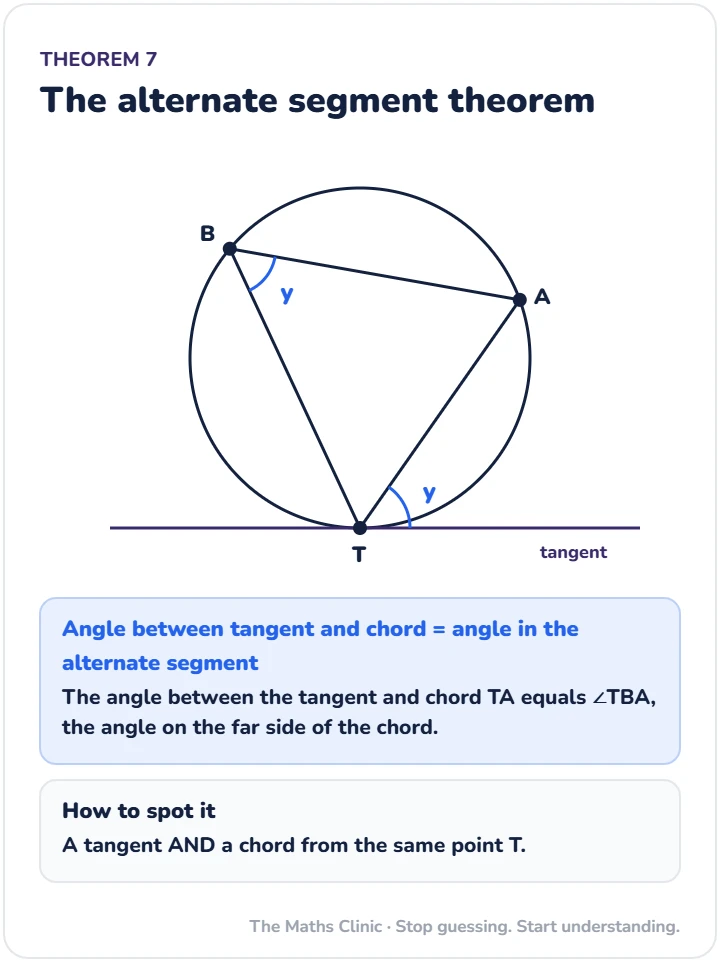
How to spot it: a tangent and a chord starting from the same point. Reason to write: alternate segment theorem.
How to solve circle theorem questions, step by step
- Copy the diagram into your answer booklet and write every given angle on it.
- Mark every radius you can see. Put a small tick on each one, and note any isosceles triangles.
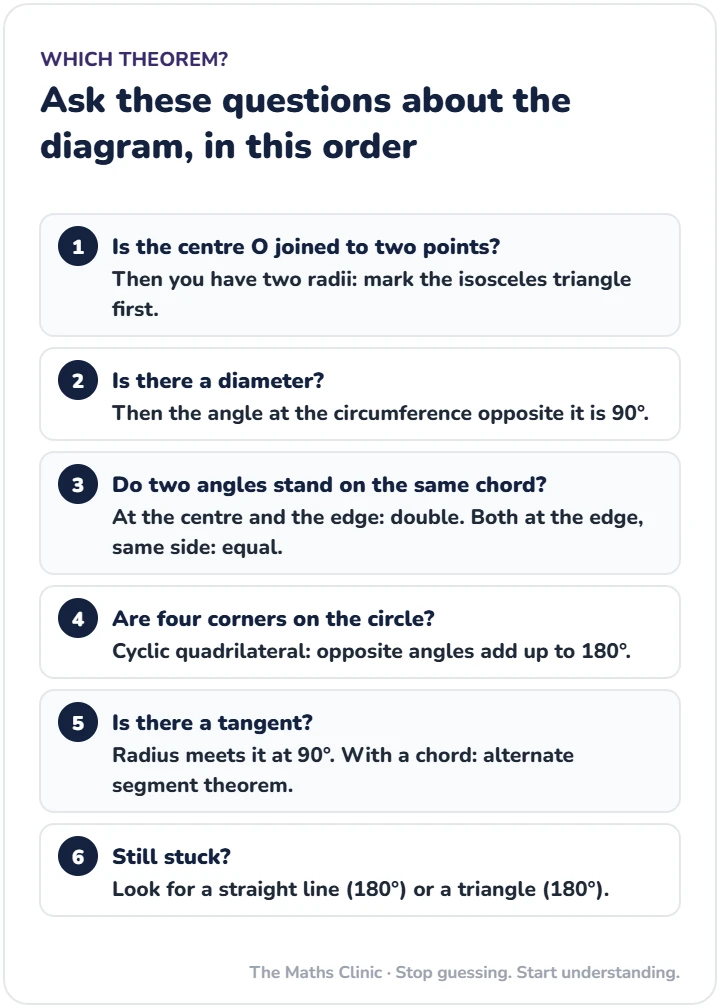
- Ask the six questions on the card below, in order, until you find a rule that fits.
- Find one new angle at a time. Write it on the diagram with its reason.
- Keep going until you reach the angle the question asks for.
- Check: angles in each triangle add up to 180°, and angles on a straight line add up to 180°.
Worked example 1: the angle at the centre and the isosceles triangle
Question. O is the centre of a circle. A, B and C are points on the circle, and ∠ACB = 38°. Find (a) ∠AOB, (b) ∠OAB.
Step 1: what stands on what? ∠ACB (at the circumference) and ∠AOB (at the centre) both stand on the arc AB.
Step 2: use Theorem 1. ∠AOB = 2 × ∠ACB = 2 × 38° = 76°. (angle at centre = 2 × angle at circumference)
Step 3: spot the radii. OA and OB are both radii, so OA = OB and triangle OAB is isosceles. That means ∠OAB = ∠OBA.
Step 4: share what is left. 180° − 76° = 104°. Then 104° ÷ 2 = 52°. So ∠OAB = 52°.
Check in the diagram. 76° + 52° + 52° = 180°. The triangle adds up.
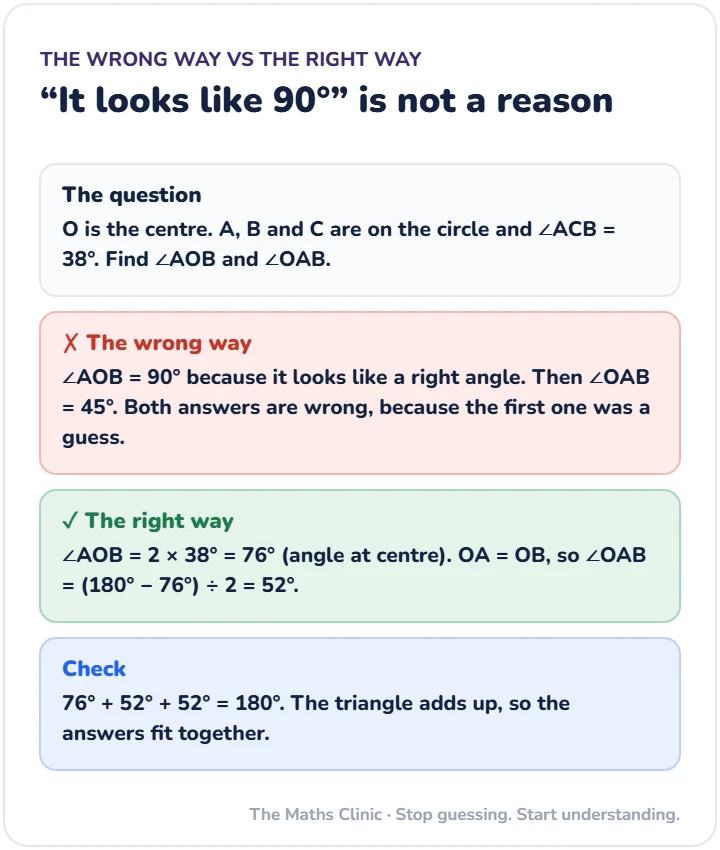
The wrong way. Halving instead of doubling (writing ∠AOB = 19°), or assuming ∠AOB = 90° because it looks square. The centre angle is always the bigger one.
Worked example 2: the angle in a semicircle
Question. AB is a diameter of a circle and C is a point on the circle. ∠CAB = 34°. Find ∠ABC.
Step 1: spot the diameter. AB passes through the centre, so ∠ACB = 90°. (angle in a semicircle)
Step 2: use the triangle. The angles in triangle ABC add up to 180°. So ∠ABC = 180° − 90° − 34° = 56°.
Check in the diagram. 90° + 34° + 56° = 180°. ✔
The wrong way. Writing ∠ABC = 180° − 34° = 146°. That forgets the right angle at C, and a triangle cannot have two angles that add up to more than 180°.
Worked example 3: a cyclic quadrilateral with algebra
Question. PQRS is a cyclic quadrilateral. ∠P = (3x + 10)° and the opposite angle ∠R = (2x + 20)°. Find x, ∠P and ∠R.
Step 1: choose the rule. P and R are opposite corners of a cyclic quadrilateral, so ∠P + ∠R = 180°.
Step 2: write the equation. (3x + 10) + (2x + 20) = 180.
Step 3: collect like terms. 3x + 2x = 5x, and 10 + 20 = 30. So 5x + 30 = 180.
Step 4: solve. 5x = 180 − 30 = 150, so x = 150 ÷ 5 = 30.
Step 5: find the angles. ∠P = 3(30) + 10 = 100°. ∠R = 2(30) + 20 = 80°.
Check in the diagram. 100° + 80° = 180°. ✔
The wrong way. Setting the angles equal: 3x + 10 = 2x + 20 gives x = 10, ∠P = 40° and ∠R = 40°. They add up to 80°, not 180°, so the check catches it straight away.
Worked example 4: a tangent, a chord and the centre (WASSCE style)
Question. TA is a tangent to a circle with centre O, touching it at A. AB is a chord and ∠TAB = 64°. C is a point on the major arc. Find (a) ∠ACB, (b) ∠AOB, (c) ∠OAB.
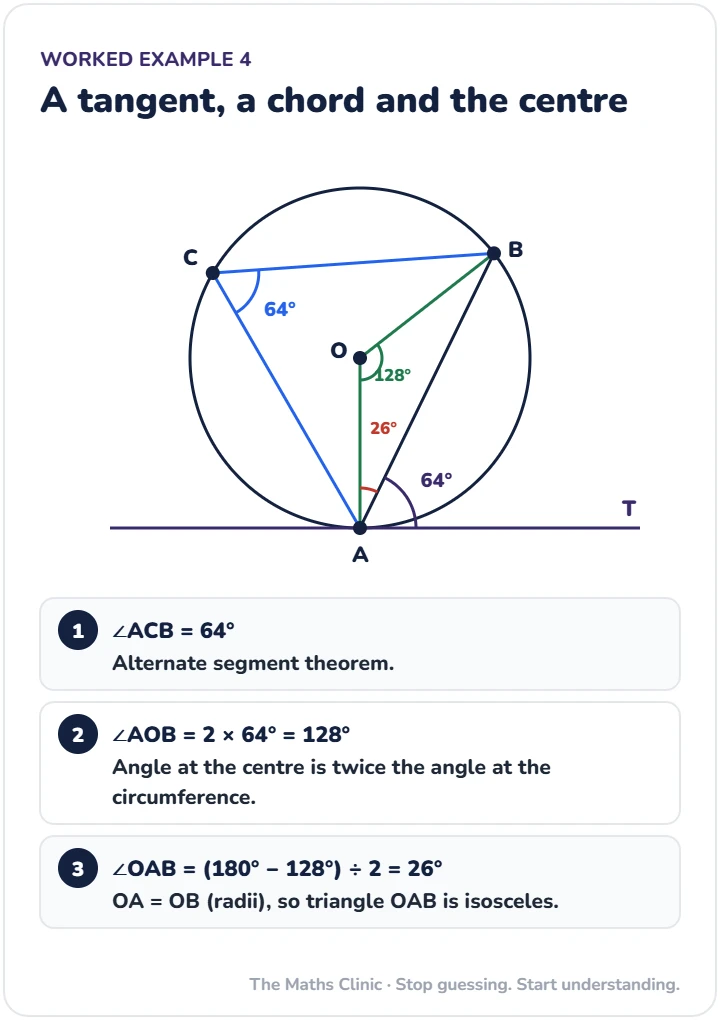
Step 1: tangent and chord from the same point. That is the alternate segment theorem. ∠ACB = ∠TAB = 64°.
Step 2: angle at the centre. ∠AOB stands on the same arc AB as ∠ACB. So ∠AOB = 2 × 64° = 128°.
Step 3: the two radii. OA = OB, so triangle OAB is isosceles. 180° − 128° = 52°, and 52° ÷ 2 = 26°. So ∠OAB = 26°.
Check in the diagram. The radius OA meets the tangent at 90°. And ∠OAB + ∠BAT = 26° + 64° = 90°. ✔ Two different rules give the same answer, so the working is right.
The wrong way. Using 64° as the angle at the centre and halving it to 32°. The 64° is at the circumference (alternate segment), so it doubles.
The wrong ways that cost marks
- Assuming an angle is 90° because it looks like it. Only a diameter or a tangent with a radius gives 90°.
- Halving when you should double (or the other way round). The centre angle is always the bigger one.
- Setting opposite angles of a cyclic quadrilateral equal. They add up to 180°.
- Missing the isosceles triangle made by two radii.
- Using “angles in the same segment” when the two angles are on opposite sides of the chord.
- Writing answers with no reasons, so nobody can follow how you got them.
📋 What the WAEC Chief Examiner reported
- In 2011, WAEC listed “circle theorems and their applications in solving problems in geometry” among candidates’ weaknesses.
- In 2012: “inability to apply circle theorem in finding unknown angles”.
- In 2017, candidates had difficulty “solving problems involving geometry such as, cyclic quadrilaterals, tangent and chord theorem”.
- In 2020 the advice was plain: “The concept of circle theorems must be explained well in schools.”
How to win these marks back
- Mark every radius first and look for isosceles triangles.
- Find one angle at a time and write a short reason beside it.
- Never assume 90°. Check every triangle adds up to 180°.
Source: WAEC Chief Examiner’s Reports, WASSCE (School Candidates) 2011, 2012, 2017, 2020 and 2021, Mathematics (Core).
Try it now
Cover the solutions. Draw each diagram yourself, mark the radii, and write a reason beside every angle you find.
Question 1
O is the centre of a circle and A, B, C are points on it, with C on the major arc. ∠AOB = 140°. Find ∠ACB.
Question 2
AB is a diameter of a circle and C is on the circle. ∠ABC = 47°. Find ∠BAC.
Question 3
A, B, C and D are on a circle, with C and D on the same side of the chord AB. ∠ADB = 52°. Find ∠ACB.
Question 4
ABCD is a cyclic quadrilateral. ∠A = 2y° and ∠C = (y + 30)°. Find y, ∠A and ∠C.
Question 5 (WASSCE style)
O is the centre of a circle. A, B and C are on the circle, with C on the major arc. ∠OAB = 25°. Find (a) ∠AOB, (b) ∠ACB.
Question 6 (tangents)
PA and PB are tangents from a point P to a circle with centre O. ∠APB = 70°. Find (a) ∠AOB, (b) ∠OAB.
Solutions
Solution 1
∠AOB and ∠ACB stand on the same arc AB. The angle at the circumference is half the angle at the centre: ∠ACB = 140° ÷ 2 = 70°. (angle at centre = 2 × angle at circumference)
Solution 2
AB is a diameter, so ∠ACB = 90° (angle in a semicircle). In triangle ABC: ∠BAC = 180° − 90° − 47° = 43°. Check: 90° + 47° + 43° = 180° ✔
Solution 3
∠ACB and ∠ADB stand on the same chord AB, on the same side. So ∠ACB = ∠ADB = 52°. (angles in the same segment)
Solution 4
Opposite angles add up to 180°: 2y + (y + 30) = 180. Collect like terms: 3y + 30 = 180. Subtract 30: 3y = 150. Divide by 3: y = 50. So ∠A = 2(50) = 100° and ∠C = 50 + 30 = 80°. Check: 100° + 80° = 180° ✔
Solution 5
(a) OA = OB (radii), so triangle OAB is isosceles and ∠OBA = ∠OAB = 25°. Then ∠AOB = 180° − 25° − 25° = 130°. (b) ∠ACB is at the circumference on the same arc: ∠ACB = 130° ÷ 2 = 65°.
Solution 6
(a) Each radius meets its tangent at 90°, so ∠OAP = ∠OBP = 90°. The four angles of quadrilateral PAOB add up to 360°: ∠AOB = 360° − 90° − 90° − 70° = 110°. (b) OA = OB, so ∠OAB = (180° − 110°) ÷ 2 = 35°. Check: PA = PB, so ∠PAB = (180° − 70°) ÷ 2 = 55°, and 55° + 35° = 90° = ∠OAP ✔
📘 New SHS curriculum link
Circle theorems are in Year 3 of the new SHS Mathematics curriculum, Strand 3 (Geometry Around Us), learning outcome 3.3.1.LO.1: draw circles, use the circle theorems, show that a tangent is perpendicular to the radius at the point of contact, and show that tangents from an outside point are equal. The curriculum also works through the alternate segment theorem, so every rule in this lesson is on your syllabus.
For parents
You do not need to know the theorems to help. Draw round a plate, mark the middle, and draw two lines from the middle to the edge. Ask your child: “Why are these two lines the same length, and what does that tell you about the triangle?” If they say “they are radii, so the triangle is isosceles”, they have the step most candidates miss.
Frequently asked questions
What are the circle theorems?
They are rules about angles and lengths in a circle: the angle at the centre is twice the angle at the circumference; the angle in a semicircle is 90°; angles in the same segment are equal; opposite angles of a cyclic quadrilateral add up to 180°; a tangent meets the radius at 90°; tangents from one point are equal; and the alternate segment theorem.
How many circle theorems are there?
Books count them differently. For WASSCE Core Mathematics, learn the seven in this lesson, plus the fact that two radii make an isosceles triangle.
Why is the angle in a semicircle 90°?
A diameter makes a straight angle of 180° at the centre. The angle at the circumference is half the angle at the centre, and half of 180° is 90°.
How do I know which circle theorem to use?
Look at what the diagram shows. Centre joined to two points: radii and the angle at the centre. A diameter: 90°. Four points on the circle: cyclic quadrilateral. A tangent: 90° with the radius, or the alternate segment theorem if there is a chord too. Use the six-question card above, in order.
What is the alternate segment theorem?
The angle between a tangent and a chord, at the point where they meet, equals the angle the chord makes at the circumference on the other side (the alternate segment).
How do I remember the circle theorems?
Learn them with the pictures, not just the words: the arrowhead (centre is double), the diameter (90°), the bow tie (equal), the four-cornered shape (180°) and the kite made by two tangents. Draw each one from memory once a day for a week.
Do I need to write the reasons?
Yes, write a short reason beside each angle, such as “angle in a semicircle”. It shows the examiner your method, and it stops you from guessing an angle because it looks right.
What to do next
If arcs and sectors still confuse you, read Area of a Sector and Arc Length, Step by Step. For angles in right-angled triangles, go to how to find an angle in a right-angled triangle. Then try mixed questions in the Practice Zone.
Keep learning
- Area of a Sector and Arc Length, Step by Step (and the Cone Question)
- Angle of Elevation and Depression: Meaning, Diagrams and the Difference
- Area, Perimeter or Volume? How to Tell Which One a Question Wants
📚 See every lesson in the Mensuration & Geometry Clinic
✏️ Practise mensuration and geometry
💬 Stuck on a step? Ask Dickson and send the line where you got lost.

Written by
Dickson Sarpong
NTC-certified SHS Mathematics teacher in Ghana with WAEC marking experience, and author of The Bridge Series textbooks. Every lesson here is built around the mistakes WAEC examiners keep reporting.
About DicksonStuck? Ask a question
Want the whole topic, step by step? My textbooks, The Bridge to Mathematics and The Bridge to Additional Mathematics for SHS, follow the new curriculum and rebuild the basics as you go.
Read a free chapter →