Struggling with WASSCE Maths? Stop guessing. Let’s fix the gap step by step.

8 Powerful Ways to Solve Equations Step by Step

In many Ghanaian SHS classrooms, a learner can copy the teacher’s equation correctly, understand the question at first, and still lose the answer after two or three lines of working. The learner may say, “Sir, I know it, but I get confused when I start moving the numbers.”
That confusion is not a small thing. It is the point where algebra begins to test understanding, not memory. To solve equations step by step, the learner must know what operation is controlling the unknown, what opposite operation will remove it, and how to keep the two sides of the equation balanced.
This post is for the SHS learner, WASSCE candidate, or Nov/Dec student who keeps guessing signs, cancelling wrongly, or jumping steps because the answer looks simple. Today, we are not going to shame the mistake. We are going to diagnose it and fix it.
1. The Learner’s Problem
The common problem is this: the student wants the answer quickly, so the student treats an equation like a puzzle of moving numbers from left to right. But an equation is not about pushing numbers around. An equation is a balance. Whatever you do to one side must also be done to the other side.
For example, in 3x + 5 = 20, the goal is not just to “send 5 across.” The real goal is to remove +5 from the left side by subtracting 5 from both sides. That is why the equation becomes 3x = 15.
| Maths Clinic Diagnosis The learner is not weak because equations are impossible. The learner is weak at seeing the operation attached to the unknown and choosing the correct inverse operation. |
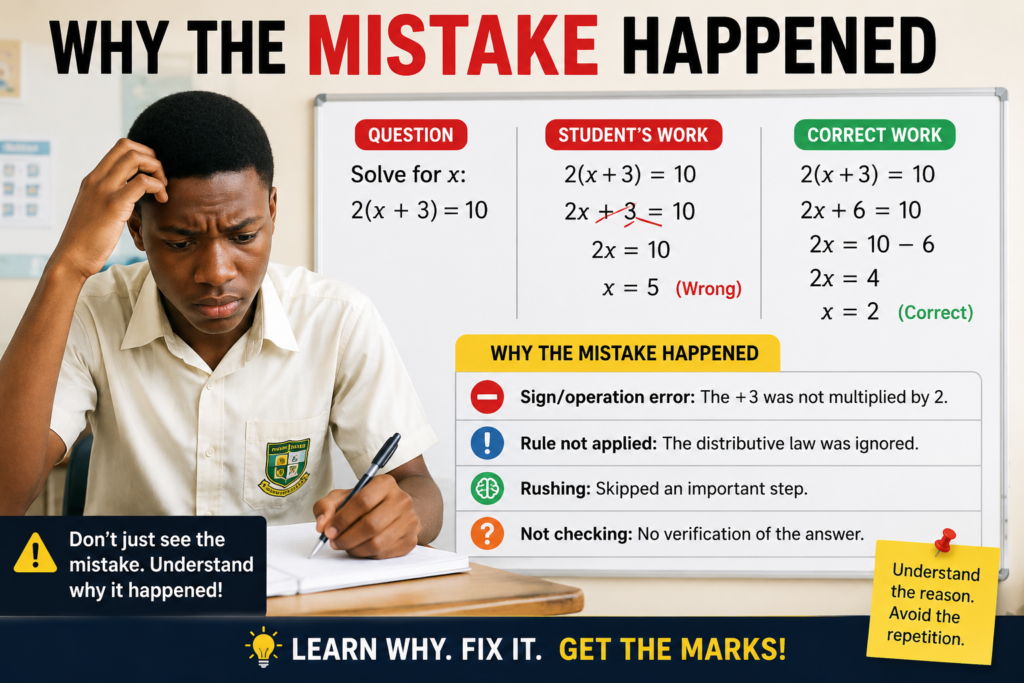
2. Why the Mistake Happened
Many students were taught shortcuts before they understood the reason behind the shortcuts. They heard “when it crosses the equal sign, the sign changes.” That sentence can help a careful learner, but it can also damage a weak learner who does not understand the balance idea.
The hidden gaps are usually these:
- The learner does not know inverse operations well: addition and subtraction, multiplication and division, squaring and square roots.
- The learner does not treat the equal sign as a balance sign.
- The learner changes signs by habit instead of asking which operation is being undone.
- The learner skips lines and loses the reason for each step.
- The learner thinks the answer is more important than correct working, but WASSCE rewards correct mathematical steps.
3. What WAEC or the Curriculum Reveals
WASSCE Core Maths does not only test whether students can get x. It tests whether students can organize working, apply algebraic rules, interpret symbols, and solve problems without breaking mathematical meaning. This is why equations appear inside word problems, mensuration, graphs, inequalities, variations, financial mathematics, and formula work.
So, when a learner cannot solve a simple linear equation well, the problem spreads into many other topics. That is why equation solving must be treated like a foundation skill, not a small topic to rush through.
4. Simple Explanation: What Does It Mean to Solve an Equation?
To solve an equation means to find the value of the unknown that makes the statement true. The unknown may be x, y, a, t, or any letter. The method is to isolate the unknown by undoing the operations around it.
Think of the unknown like a student surrounded by noise. Your job is to remove the noise one by one until the student stands alone. But you must remove the noise fairly from both sides of the equation.
| Simple Rule Do the opposite operation to both sides. Do not just move numbers. Undo the operation that is blocking the unknown. |
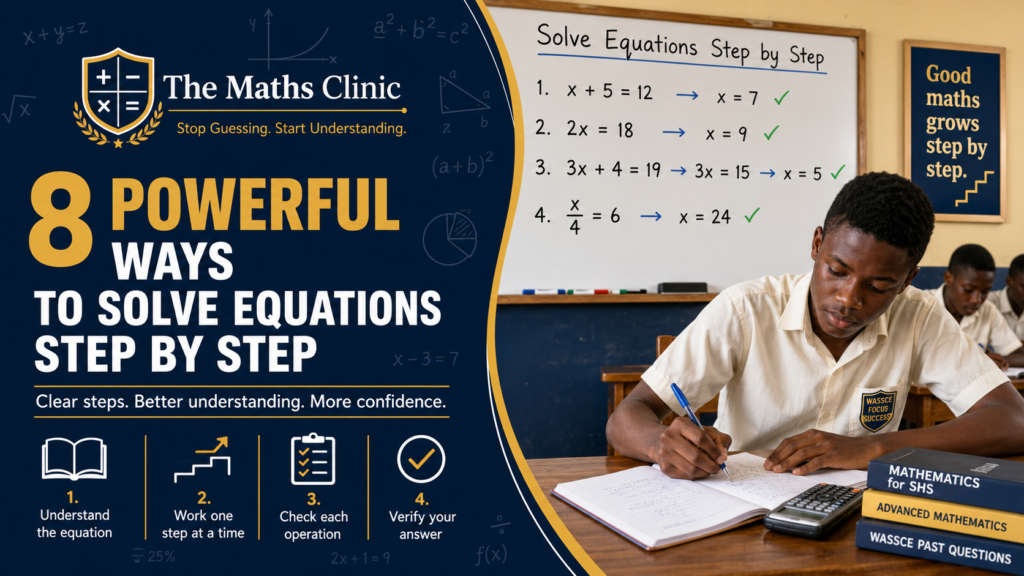
5. Eight Powerful Ways to Solve Equations Step by Step
Way 1: Copy the equation correctly before solving
Many wrong answers start from poor copying. Before solving, check signs, brackets, powers, fractions, and the position of the equal sign. A copied mistake becomes a solved mistake.
Way 2: Identify the unknown clearly
Ask: Which letter am I solving for? In 5x – 7 = 18, the unknown is x. In A = P(1 + rt), the subject may be P, r, or t depending on the question.
Way 3: Look at the operation closest to the unknown
In 3x + 5 = 20, x is first multiplied by 3, then 5 is added. To undo it, remove +5 first, then divide by 3.
Way 4: Use inverse operations, not guesswork
If the equation adds 8, subtract 8 from both sides. If it multiplies by 6, divide both sides by 6. If it divides by 4, multiply both sides by 4.
Way 5: Work from the outside towards the unknown
Remove the outside operation first. In 2x + 9 = 25, remove 9 before dealing with 2x. This prevents wrong division and sign errors.
Way 6: Keep the equal sign aligned
Write the equal sign under the equal sign. This keeps your working neat and helps your eye see that both sides are still balanced.
Way 7: Check by substitution
After finding x, put the value back into the original equation. If the left side equals the right side, your answer is correct.
Way 8: Do not skip the line that explains the change
Weak learners often jump from the question to the answer. Write the middle steps. Those middle steps are where understanding grows and where WASSCE marks are protected.
6. Worked Example 1: Linear Equation
Solve: 4x – 7 = 21
Step 1: Add 7 to both sides because -7 is attached to 4x.
4x – 7 + 7 = 21 + 7
4x = 28
Step 2: Divide both sides by 4 because x is multiplied by 4.
x = 28 / 4
x = 7
Check: 4(7) – 7 = 28 – 7 = 21. The answer works.
7. Worked Example 2: Equation with Brackets
Solve: 3(x + 2) = 24
Method 1: Divide first.
x + 2 = 24 / 3
x + 2 = 8
x = 8 – 2
x = 6
Method 2: Expand first.
3x + 6 = 24
3x = 18
x = 6
| Teacher Note Both methods are correct. The danger is not the method. The danger is doing a method you do not understand. |
8. Common Wrong Approach
Question: Solve 5x + 4 = 29
Wrong working: 5x = 29 + 4, so 5x = 33, x = 33 / 5
Why it is wrong: The learner changed the sign by habit. Since +4 is on the left, we subtract 4 from both sides. The correct step is 5x = 29 – 4 = 25, so x = 5.
9. Correct Method to Remember
1. Copy the equation carefully.
2. Locate the unknown.
3. Remove addition or subtraction first if they are outside the unknown term.
4. Remove multiplication or division next.
5. Simplify carefully.
6. Check your answer in the original equation.
10. Practice Task
Solve the following equations step by step. Do not skip the middle lines.
1. 2x + 6 = 18
2. 5x – 9 = 26
3. 3(x + 4) = 27
4. 7x / 2 = 21
5. 4x + 3 = 2x + 15
Answers: 1) x = 6, 2) x = 7, 3) x = 5, 4) x = 6, 5) x = 6
Conclusion: Stop Moving Numbers, Start Balancing Equations
If you want to solve equations step by step, stop thinking only about changing sides. Start asking, “What operation is blocking the unknown, and what opposite operation will remove it?” That one question can save many marks in WASSCE Core Maths.
You are not bad at algebra because you make sign mistakes. You only need a better method, slower work, and enough practice to make the balance idea natural.