Struggling with WASSCE Maths? Stop guessing. Let’s fix the gap step by step.

Profit and Loss Questions: 8 WASSCE Fixes
Buying and selling makes sense at the market. On paper, students often divide by the wrong price and lose the mark. This lesson shows you why profit and loss are worked out on the cost price, and how to get them right every time.

📚 Part of the Business Maths Clinic: every lesson on this topic, in one place.
Quick answer: how do you solve profit and loss questions?
Profit = selling price − cost price; loss = cost price − selling price. Percentage profit or loss = (profit or loss ÷ cost price) × 100%. To work backwards, use multipliers: a 20% profit means SP = 1.2 × CP, so CP = SP ÷ 1.2. Include extra expenses (transport, repairs) in the cost price.
Buying and selling makes sense at the market. On paper, students often divide by the wrong price and lose the mark. This lesson shows you why profit and loss are worked out on the cost price, and how to get them right every time.
Buying and selling are familiar activities. This can make profit and loss look easy. However, WASSCE-style questions do not test only whether a learner knows the meaning of buying and selling. They also test whether the learner can:
- Identify cost price and selling price
- Decide whether a profit or loss occurred
- Find the correct difference
- Select the correct percentage base
- Work backwards from a given selling price
- State the final answer clearly
Many wrong answers begin when the learner compares the profit or loss with the selling price instead of the cost price.
This cost-price and selling-price lesson identifies the cost-price base gap and repairs it step by step.
Maths Clinic Diagnosis: A Neat Percentage Can Still Be Wrong
Consider this question:
A calculator is bought for GH₵400 and sold for GH₵500. Find the percentage profit.
First find the profit:
Profit = Selling price − Cost price
\text{Profit} = \text{GH₵}500 - \text{GH₵}400\text{Profit} = \text{GH₵}100A learner may then write:
\text{Percentage profit} = (100 \div 500) \times 100\%\text{Percentage profit} = 20\%The arithmetic is neat, but the base is wrong. The learner has used the selling price.
Percentage profit is normally based on cost price:
Percentage profit = (Profit ÷ Cost price) × 100%
\text{Percentage profit} = (100 \div 400) \times 100\%\text{Percentage profit} = 25\%The exact hidden gap is
The learner knows how to calculate a percentage but cannot identify the original amount against which the gain or loss should be compared.
Profit and Loss Questions: The Learner’s Exact Problem
The learner sees a familiar trading story and starts calculating before labelling the values.
This leads to several mistakes:
- Cost price and selling price are swapped.
- Every difference is called profit.
- Selling price is used as the percentage base.
- Profit is confused with selling price.
- Loss is written as a negative amount.
- A reverse question is treated like a direct question.
- Additional buying expenses are ignored.
- The final answer is not checked against the story.
The learner may know a formula but still not know what the figures inside the formula represent.
📋 What the WAEC Chief Examiner reported
- In 2020, solving problems on ratio and proportion was a listed weakness.
- In 2025, a cost-sharing question (ratio 12 : 15 : 5 with percentage increases) was poorly answered in its second part; good solutions were few.
- Business mathematics was named as a weakness in 2013 (“solving business related mathematical problems”), 2017 (“solving problems involving financial mathematics”) and 2024 (“solving problems in business mathematics”).
What WAEC recommends
The Chief Examiner advised in 2024: “Teachers should prepare the candidates very well by giving them more exercise particularly on the above weaknesses and guide them to work,” and “Candidates should read the questions well before answering them and ensure the rubric are followed.” This lesson does both: it shows how to read each money story before calculating, and guides you through every step.
How to win these marks back
- Find each share from the total number of parts before anything else.
- Write a percentage increase as a multiplier: (100 + x)/100 × amount.
- Give money answers with the currency and to the accuracy asked.
Source: WAEC Chief Examiner’s Report, WASSCE 2013, Mathematics (Core); WAEC Chief Examiner’s Report, WASSCE 2017, Mathematics (Core); WAEC Chief Examiner’s Report, WASSCE 2020, Mathematics (Core); WAEC Chief Examiners’ Reports, WASSCE (SC) 2025, Ghana: Mathematics (Core); WAEC Chief Examiner’s Report, WASSCE 2024, Mathematics (Core).
The Four Main Quantities
Cost Price, CP
Cost price is the amount paid to buy or produce an item.
If a trader buys a bag for GH₵200:
\text{CP} = \text{GH₵}200Selling Price, SP
Selling price is the amount received when the item is sold.
If the bag is sold for GH₵250:
\text{SP} = \text{GH₵}250Profit
Profit occurs when selling price is greater than cost price.
If SP > CP:
\text{Profit} = \text{SP} - \text{CP}Loss
Loss occurs when selling price is less than cost price.
If SP < CP:
\text{Loss} = \text{CP} - \text{SP}No Profit, No Loss
If selling price equals cost price:
\text{SP} = \text{CP}There is no profit and no loss.
The Direction Test
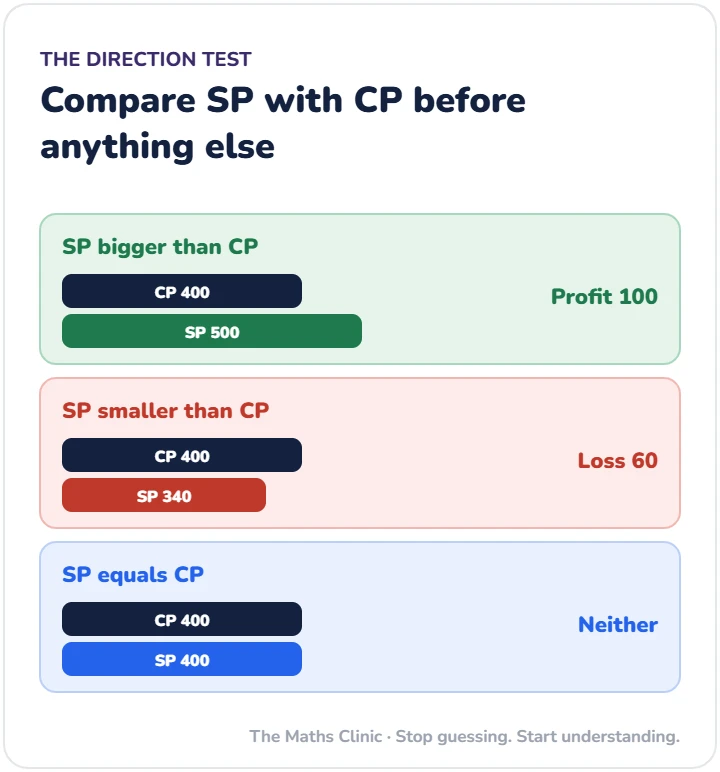
Before calculating the difference, compare CP and SP.
| Comparison | Result | Correct difference |
|---|---|---|
| SP > CP | Profit | \text{SP} – \text{CP} |
| SP < CP | Loss | \text{CP} – \text{SP} |
| \text{SP} = \text{CP} | No profit, no loss | 0 |
This test prevents the learner from calling every difference profit.
Why Cost Price Is the Usual Percentage Base
Profit or loss measures what happened to the amount originally invested in the item.

That original investment is the cost price.
Suppose a trader spends GH₵400 and gains GH₵100.
The question is asking:
The GH₵100 gain is what percentage of the GH₵400 invested?
Therefore:
\text{Percentage profit} = (100 \div 400) \times 100\%\text{Percentage profit} = 25\%The selling price of GH₵500 is the final amount received. It is not the original investment.
The Main Profit and Loss Relationships
Profit
\text{Profit} = \text{SP} - \text{CP}Loss
\text{Loss} = \text{CP} - \text{SP}Percentage profit
\text{Percentage profit} = (\text{Profit} \div \text{CP}) \times 100\%Percentage loss
\text{Percentage loss} = (\text{Loss} \div \text{CP}) \times 100\%Selling price when profit is known
\text{SP} = \text{CP} + \text{Profit}Selling price when loss is known
\text{SP} = \text{CP} - \text{Loss}Cost price when profit amount is known
\text{CP} = \text{SP} - \text{Profit}Cost price when loss amount is known
\text{CP} = \text{SP} + \text{Loss}Percentage Multipliers
Percentage multipliers provide a shorter method after the learner understands the relationship.

Selling at an r% profit
Selling price represents:
100\% + r%
Therefore:
\text{SP} = \text{CP} \times \dfrac{100 + r}{100}Selling at an r% loss
Selling price represents:
100\% – r%
Therefore:
\text{SP} = \text{CP} \times \dfrac{100 - r}{100}Cost price from selling price at an r% profit
\text{CP} = \text{SP} \times \dfrac{100}{100 + r}Cost price from selling price at an r% loss
\text{CP} = \text{SP} \times \dfrac{100}{100 - r}A learner should not memorise these forms blindly. First understand why profit adds to 100% and loss subtracts from 100%.
Important Convention About the Percentage Base
In standard Profit and Loss Questions:
- Percentage profit is based on cost price.
- Percentage loss is based on cost price.
However, if a question clearly says:
The profit is 20% of the selling price,
then the selling price is the stated base.
Do not ignore an explicitly stated base. The cost-price rule applies when the usual profit or loss percentage is intended or stated.
What Counts as Cost Price?
Sometimes the buying price is not the full cost.
A question may include additional expenses such as:
- Transport
- Repairs
- Packaging
- Installation
- Production expenses
If the question treats these as costs incurred before selling, include them in the total cost price.
Example
A trader buys a refrigerator for GH₵2,000 and spends GH₵100 on transport and GH₵200 on repairs.
Total cost price:
\text{CP} = \text{GH₵}2{,}000 + \text{GH₵}100 + \text{GH₵}200\text{CP} = \text{GH₵}2{,}300If the refrigerator is sold for GH₵2,760:
\text{Profit} = \text{GH₵}2{,}760 - \text{GH₵}2{,}300\text{Profit} = \text{GH₵}460\text{Percentage profit} = (460 \div 2{,}300) \times 100\%\text{Percentage profit} = 20\%Ignoring the additional costs would give the wrong profit.

Eight Fixes for Profit and Loss Questions
Fix 1: Label CP and SP Before Calculating
Write:
\begin{gathered}\text{CP} = … \\ \text{SP} = …\end{gathered}Do not leave the values inside the story.
Fix 2: Compare SP with CP
Ask:
- Is SP greater?
- Is SP smaller?
- Are they equal?
This identifies profit, loss or neither.
Fix 3: Find the Difference in the Correct Direction
For profit:
\text{Profit} = \text{SP} - \text{CP}For loss:
\text{Loss} = \text{CP} - \text{SP}The answer should normally be a positive money value.
Fix 4: Use CP as the Usual Percentage Base
Complete:
The profit or loss is being compared with the amount originally invested.
That amount is cost price.
Fix 5: Separate the Change from the Final Value
Profit is only the gain.
Loss is only the reduction.
Selling price is the final amount received.
Fix 6: Translate Percentage Statements into 100% Relationships
A 20% profit means:
\text{SP} = 120\%\ \text{of} \text{CP}A 20% loss means:
\text{SP} = 80\%\ \text{of} \text{CP}This is especially useful in reverse questions.
Fix 7: Include All Stated Costs
If transport, repairs or other expenses form part of the transaction cost, add them before calculating profit.
Fix 8: Check Direction, Base and Unit
After solving, ask:
- Is SP higher for a profit?
- Is SP lower for a loss?
- Did I divide by CP?
- Does a money answer carry GH₵?
- Does a rate answer carry %?
Worked Example 1: Find Profit and Percentage Profit
A calculator is bought for GH₵400 and sold for GH₵500. Find:
- The profit
- The percentage profit
\begin{gathered}\text{CP} = \text{GH₵}400 \\ \text{SP} = \text{GH₵}500\end{gathered}Since SP > CP, there is a profit.
\text{Profit} = \text{SP} - \text{CP}\text{Profit} = \text{GH₵}500 - \text{GH₵}400\text{Profit} = \text{GH₵}100\text{Percentage profit} = (\text{Profit} \div \text{CP}) \times 100\%\text{Percentage profit} = (100 \div 400) \times 100\%\text{Percentage profit} = 25\%\text{Answer}: \text{Profit} = \text{GH₵}100; \text{percentage profit} = 25\%.Common wrong method
Wrong:
(100 \div 500) \times 100\% = 20\%
The learner used selling price instead of cost price.
Worked Example 2: Find Loss and Percentage Loss
A bag is bought for GH₵240 and sold for GH₵210. Find:
- The loss
- The percentage loss
\begin{gathered}\text{CP} = \text{GH₵}240 \\ \text{SP} = \text{GH₵}210\end{gathered}Since SP < CP, there is a loss.
\text{Loss} = \text{CP} - \text{SP}\text{Loss} = \text{GH₵}240 - \text{GH₵}210\text{Loss} = \text{GH₵}30\text{Percentage loss} = (\text{Loss} \div \text{CP}) \times 100\%\text{Percentage loss} = (30 \div 240) \times 100\%\text{Percentage loss} = 12.5\%\text{Answer}: \text{Loss} = \text{GH₵}30; \text{percentage loss} = 12.5\%.Worked Example 3: Find Selling Price from Profit Amount
A trader makes a profit of GH₵60 on an item bought for GH₵300. Find the selling price.
\text{CP} = \text{GH₵}300
Profit = GH₵60
SP = ?
\text{SP} = \text{CP} + \text{Profit}\text{SP} = \text{GH₵}300 + \text{GH₵}60\text{SP} = \text{GH₵}360\text{Answer}: \text{Selling price} = \text{GH₵}360.Hidden trap
GH₵60 is the profit, not the selling price.
Worked Example 4: Find Selling Price from Percentage Loss
An item has a cost price of GH₵500 and is sold at a loss of 20%. Find the selling price.
\begin{gathered}\text{CP} = \text{GH₵}500 \\ \text{Loss rate} = 20\%\end{gathered}Two-step method
\text{Loss} = (20 \div 100) \times \text{GH₵}500\text{Loss} = \text{GH₵}100\text{SP} = \text{CP} - \text{Loss}\text{SP} = \text{GH₵}500 - \text{GH₵}100\text{SP} = \text{GH₵}400Multiplier method
A 20% loss means the item is sold for 80% of cost price.
\text{SP} = (80 \div 100) \times \text{GH₵}500\text{SP} = \text{GH₵}400\text{Answer}: \text{Selling price} = \text{GH₵}400.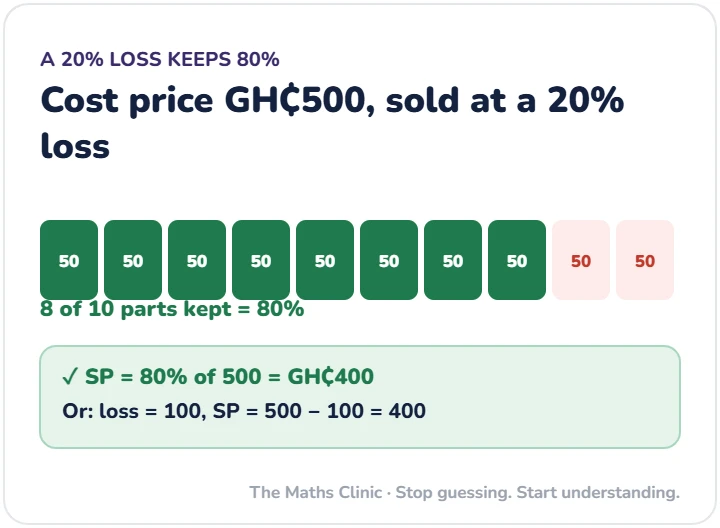
Worked Example 5: Find Cost Price from Selling Price and Percentage Profit
An item is sold for GH₵690 at a profit of 15%. Find the cost price.
A 15% profit means:
\text{SP} = 115\%\ \text{of} \text{CP}Therefore:
115\%\ \text{of} \text{CP} = \text{GH₵}690\text{CP} = \dfrac{690 \times 100}{115}\text{CP} = \text{GH₵}600\text{Answer}: \text{Cost price} = \text{GH₵}600.Check
\text{Profit} = 15\%\ \text{of GH₵}600\text{Profit} = \text{GH₵}90\text{SP} = \text{GH₵}600 + \text{GH₵}90\text{SP} = \text{GH₵}690
Worked Example 6: Find Cost Price from Selling Price and Percentage Loss
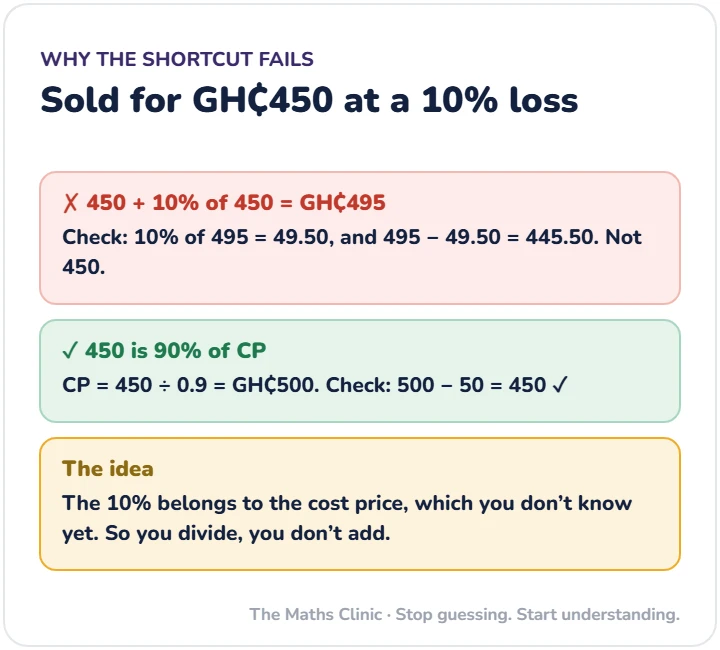
An item is sold for GH₵450 at a loss of 10%. Find the cost price.
A 10% loss means:
\text{SP} = 90\%\ \text{of} \text{CP}Therefore:
90\%\ \text{of} \text{CP} = \text{GH₵}450\text{CP} = \dfrac{450 \times 100}{90}\text{CP} = \text{GH₵}500\text{Answer}: \text{Cost price} = \text{GH₵}500.Common wrong method
Wrong:
\text{Loss} = 10\%\ \text{of GH₵}450The GH₵450 is selling price, but the 10% loss is based on the unknown cost price.
Worked Example 7: Additional Expenses Form Part of Cost
A trader buys a machine for GH₵4,000. She spends GH₵200 on transport and GH₵300 on repairs before selling it for GH₵5,400. Find the percentage profit.
Total cost price:
\text{CP} = \text{GH₵}4{,}000 + \text{GH₵}200 + \text{GH₵}300\text{CP} = \text{GH₵}4{,}500\text{Profit} = \text{SP} - \text{CP}\text{Profit} = \text{GH₵}5{,}400 - \text{GH₵}4{,}500\text{Profit} = \text{GH₵}900\text{Percentage profit} = (900 \div 4{,}500) \times 100\%\text{Percentage profit} = 20\%\text{Answer}: \text{Percentage profit} = 20\%.Worked Example 8: No Profit, No Loss
A trader buys an item for GH₵750 and sells it for GH₵750.
\begin{gathered}\text{CP} = \text{GH₵}750 \\ \text{SP} = \text{GH₵}750\end{gathered}Since \text{SP} = \text{CP}:
\begin{gathered}\text{Profit} = \text{GH₵}0 \\ \text{Loss} = \text{GH₵}0\end{gathered}Answer: There is no profit and no loss.
Common Wrong Approaches
Wrong Approach 1: Using SP as the Percentage Base
Percentage profit and percentage loss are normally compared with CP.
Wrong Approach 2: Calling Every Difference Profit
The larger value determines the situation.
- SP greater → Profit
- SP smaller → Loss
Wrong Approach 3: Writing Loss as a Negative Amount
If \text{CP} = \text{GH₵}200 and \text{SP} = \text{GH₵}170:
\text{Loss} = \text{GH₵}30Do not report the loss as −GH₵30.
The word “loss” already describes the downward direction.
Wrong Approach 4: Treating Profit as Selling Price
If \text{CP} = \text{GH₵}200 and profit = GH₵50:
\text{SP} = \text{GH₵}250The GH₵50 is only the change.
Wrong Approach 5: Subtracting Profit from CP
Profit increases the cost price when finding selling price.
\text{SP} = \text{CP} + \text{Profit}Wrong Approach 6: Adding Loss to CP
Loss reduces the cost price when finding selling price.
\text{SP} = \text{CP} - \text{Loss}Wrong Approach 7: Taking a Reverse Percentage from SP
If an item is sold at a 20% profit, SP is 120% of CP.
Do not find 20% of SP and subtract it. The 20% was based on CP.
Wrong Approach 8: Ignoring Additional Costs
If the question includes transport or repairs as costs, they may form part of CP.
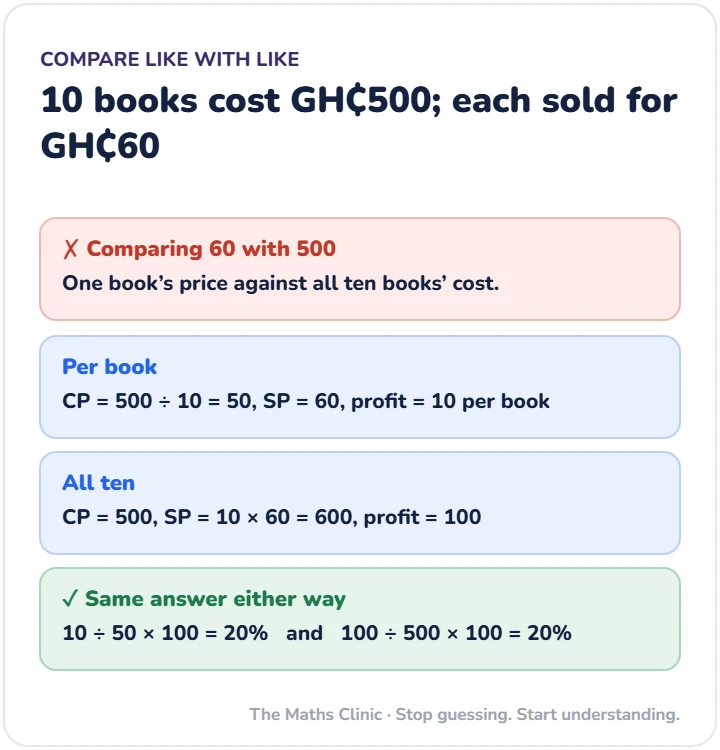
Wrong Approach 9: Mixing Total and Unit Prices
If ten books cost GH₵500 in total, the cost price per book is:
\text{GH₵}500 \div 10 = \text{GH₵}50Compare unit cost with unit selling price, or compare total cost with total selling price. Do not mix a total value with a unit value.
Wrong Approach 10: Rounding Too Early
Keep exact values through the working. Round only the final answer when required.
The Maths Clinic Profit-and-Loss Routine
Step 1: Read
Read the complete transaction without calculating.
Step 2: Label
Write CP and SP beside the correct values.
Step 3: Compare
Determine whether SP is greater than, less than or equal to CP.
Step 4: Find the Difference
Calculate profit or loss.
Step 5: Identify the Base
If a percentage is required, use CP unless another base is clearly stated.
Step 6: Answer the Demand
Check whether the question asks for:
- Profit
- Loss
- Percentage profit
- Percentage loss
- Selling price
- Cost price
Step 7: Check
Test the direction, size and unit.
WASSCE-Style Demand Words
| Wording | Meaning |
|---|---|
| Bought for | Cost price |
| Cost the trader | Cost price |
| Total cost | Cost price including stated expenses |
| Sold for | Selling price |
| Gain | Profit |
| Profit made | Profit |
| Loss incurred | Loss |
| Profit percentage | Profit divided by CP, multiplied by 100% |
| Loss percentage | Loss divided by CP, multiplied by 100% |
| Sold at r% profit | SP is (100 + r)% of CP |
| Sold at r% loss | SP is (100 – r)% of CP |
| Break-even | \text{SP} = \text{CP} |
| No profit, no loss | \text{SP} = \text{CP} |
Profit and Loss Diagnostic Practice
Attempt every question before checking the answers.
Questions
- An item is bought for GH₵150 and sold for GH₵180. Find the profit and percentage profit.
- A bag is bought for GH₵240 and sold for GH₵210. Find the loss and percentage loss.
- A trader makes a profit of GH₵60 on an item bought for GH₵300. Find the selling price.
- An item with a cost price of GH₵500 is sold at a loss of 20%. Find the selling price.
- A pair of shoes is bought for GH₵200 and sold for GH₵260. Explain why percentage profit is not calculated using GH₵260 as the base.
- A radio is sold for GH₵540 after making a profit of GH₵90. Find the cost price.
- An item is sold for GH₵420 after a loss of GH₵80. Find the cost price.
- A phone is sold for GH₵1,008 at a profit of 12%. Find the cost price.
- A table is sold for GH₵680 at a loss of 15%. Find the cost price.
- A trader buys 20 exercise books for GH₵300 and sells each one for GH₵18. Find the total profit and percentage profit.
- A machine is bought for GH₵3,000. Transport costs GH₵200 and repairs cost GH₵300. It is sold for GH₵4,200. Find the percentage profit.
- An item is bought and sold for GH₵850. State the profit or loss.
- A trader sells an item at a profit of 25%. If the cost price is GH₵640, find the profit and selling price.
- An item is sold for GH₵720 at a loss of 10%. Find the cost price and loss.
Answers and Gap Diagnosis
1. Profit = GH₵30; percentage profit = 20%
\text{Profit} = \text{GH₵}180 - \text{GH₵}150\text{Profit} = \text{GH₵}30\text{Percentage profit} = (30 \div 150) \times 100\%\text{Percentage profit} = 20\%If you divided by GH₵180: You used SP as the base.
2. Loss = GH₵30; percentage loss = 12.5%
\text{Loss} = \text{GH₵}240 - \text{GH₵}210\text{Loss} = \text{GH₵}30\text{Percentage loss} = (30 \div 240) \times 100\%\text{Percentage loss} = 12.5\%3. GH₵360
\text{SP} = \text{CP} + \text{Profit}\text{SP} = \text{GH₵}300 + \text{GH₵}60\text{SP} = \text{GH₵}360If you wrote GH₵60: You confused profit with selling price.
4. GH₵400
\text{Loss} = 20\%\ \text{of GH₵}500\text{Loss} = \text{GH₵}100\text{SP} = \text{GH₵}500 - \text{GH₵}100\text{SP} = \text{GH₵}4005. Expected explanation
GH₵260 is the selling price, which is the final amount received. Percentage profit is normally compared with the original amount invested, which is the GH₵200 cost price.
\text{Profit} = \text{GH₵}60\text{Percentage profit} = (60 \div 200) \times 100\%\text{Percentage profit} = 30\%6. GH₵450
\text{CP} = \text{SP} - \text{Profit}\text{CP} = \text{GH₵}540 - \text{GH₵}90\text{CP} = \text{GH₵}4507. GH₵500
\text{CP} = \text{SP} + \text{Loss}\text{CP} = \text{GH₵}420 + \text{GH₵}80\text{CP} = \text{GH₵}5008. GH₵900
A 12% profit means SP is 112% of CP.
\text{CP} = \dfrac{1{,}008 \times 100}{112}\text{CP} = \text{GH₵}9009. GH₵800
A 15% loss means SP is 85% of CP.
\text{CP} = \dfrac{680 \times 100}{85}\text{CP} = \text{GH₵}80010. Total profit = GH₵60; percentage profit = 20%
\text{Total selling price} = 20 \times \text{GH₵}18\text{Total selling price} = \text{GH₵}360\text{Profit} = \text{GH₵}360 - \text{GH₵}300\text{Profit} = \text{GH₵}60\text{Percentage profit} = (60 \div 300) \times 100\%\text{Percentage profit} = 20\%If you compared GH₵18 with GH₵300: You mixed a unit price with a total price.
11. 20%
\text{Total} \text{CP} = \text{GH₵}3{,}000 + \text{GH₵}200 + \text{GH₵}300\text{Total} \text{CP} = \text{GH₵}3{,}500\text{Profit} = \text{GH₵}4{,}200 - \text{GH₵}3{,}500\text{Profit} = \text{GH₵}700\text{Percentage profit} = (700 \div 3{,}500) \times 100\%\text{Percentage profit} = 20\%12. No profit and no loss
\text{CP} = \text{SP} = \text{GH₵}850\text{Profit} or \text{loss} = \text{GH₵}013. Profit = GH₵160; selling price = GH₵800
\text{Profit} = (25 \div 100) \times \text{GH₵}640\text{Profit} = \text{GH₵}160\text{SP} = \text{GH₵}640 + \text{GH₵}160\text{SP} = \text{GH₵}80014. Cost price = GH₵800; loss = GH₵80
A 10% loss means SP is 90% of CP.
\text{CP} = \dfrac{720 \times 100}{90}\text{CP} = \text{GH₵}800\text{Loss} = \text{GH₵}800 - \text{GH₵}720\text{Loss} = \text{GH₵}80DoK Progression
| Depth of Knowledge | Main demand | Questions |
|---|---|---|
| DoK 1 | Identify profit, loss or no change | 1–4 and 12 |
| DoK 2 | Connect amounts, percentages and final values | 5–7, 10, 11 and 13 |
| DoK 3 | Reverse a percentage relationship and justify the base | 8, 9 and 14 |
Use the Results to Locate the Gap
| Score | What it suggests | Next action |
|---|---|---|
| 12–14 correct | The cost-price base is becoming secure | Attempt unfamiliar mixed questions |
| 9–11 correct | One or two relationships remain weak | Correct the missed question types |
| 5–8 correct | CP, SP and change are being confused | Return to the direction and base tests |
| 0–4 correct | Calculation begins before the transaction is labelled | Rebuild CP, SP, profit and loss first |
Check the error pattern:
- Used SP as denominator → Cost-price base gap
- Called every difference profit → Direction gap
- Stopped at profit or loss → Final-value gap
- Failed reverse questions → Percentage-reversal gap
- Ignored transport or repairs → Total-cost gap
- Mixed unit and total prices → Quantity-comparison gap
- Missing GH₵ or % → Unit-control gap
Learner Reflection
Tick each statement only when you can do it without copying.
- I can explain cost price and selling price.
- I can identify profit, loss or no change.
- I can find the correct difference.
- I know why percentage profit uses cost price.
- I know why percentage loss uses cost price.
- I can distinguish profit from selling price.
- I can distinguish loss from selling price.
- I can find SP from a stated profit or loss.
- I can find CP from a stated selling price and percentage.
- I can include stated additional costs.
- I can compare total values with total values and unit values with unit values.
- I can check whether my answer fits the transaction.
📘 New SHS curriculum link
This is Year 1 of the new SHS Mathematics curriculum (1.1.2.LO.2): create strategies for solving problems involving percentages of personal or household finances, such as buying and selling.
For parents
If your household buys and sells anything, ask your child: “We bought it for GH₵80 and sold it for GH₵100. What is the percentage profit?” The answer is 25%, worked on the GH₵80 we paid. If they say 20%, they divided by the selling price: the exact mistake this lesson fixes.
Questions learners ask
What is the formula for percentage profit?
Percentage profit = (profit ÷ cost price) × 100%.
How do I find the cost price from the selling price and percentage profit?
Divide the selling price by the multiplier. For 25% profit: CP = SP ÷ 1.25.
Are transport costs part of the cost price?
Yes. Any money spent to get the goods ready to sell is added to the cost price.
Why is percentage profit worked on the cost price?
Because profit measures how much the money you spent has grown. Unless the question says otherwise, the base is the cost price.
How This Helps Before WASSCE
This lesson helps the learner to:
- Read buying-and-selling situations accurately
- Identify cost price and selling price
- Use cost price as the correct percentage base
- Control profit and loss directions
- Separate a change from the final value
- Solve direct and reverse questions
- Include relevant transaction costs
- Show labelled and orderly working
- Use correct money and percentage units
- Check whether the final answer is reasonable
The official WAEC Ghana Chief Examiner’s Reports may also be consulted when studying reported examination performance and weaknesses.
Continue the Intervention
If several Business Maths values are still being confused, study Business Maths Mistakes.
If percentage direction and commission cause difficulty, study Discount and Commission.
If simple-interest wording is the problem, study Simple Interest Word Problems.
If the difficulty remains wider than profit and loss, visit the Intervention Hub.
When the cost-price base is secure, attempt targeted questions in the WASSCE Maths Practice Zone.
For common examination traps, explore WAEC Maths Traps.
Conclusion: Solve Profit and Loss Questions with Understanding
Profit and Loss Questions become manageable when the learner labels the transaction before calculating.
Remember:
- Cost price is the original amount invested.
- Selling price is the final amount received.
- Profit occurs when SP is greater than CP.
- Loss occurs when SP is less than CP.
- Percentage profit and loss are normally based on CP.
Before submitting an answer, ask:
- Have I identified CP and SP correctly?
- Is the situation profit, loss or neither?
- Did I find the difference in the correct direction?
- Did I use CP as the percentage base?
- Did I answer the exact demand?
- Does my answer carry the correct unit?
- Does the result make sense?
Once the cost-price base becomes clear, the percentage calculation stops being guesswork.
Stop Guessing. Start Understanding.
Practice Zone CTA
Do not guess your way through Mathematics.
Visit the WASSCE Maths Practice Zone and attempt more Profit and Loss Questions.
For every wrong answer, identify whether the mistake came from:
- CP and SP identification
- Profit or loss direction
- Cost-price percentage base
- Final-value interpretation
- Reverse percentage reasoning
- Additional costs
- Unit and total-value comparison
- Answer units
Correct that exact gap before attempting a fresh question.
✏️ Try it yourself
A phone bought for GH₵800 is sold for GH₵920. Find the percentage profit.
Tap to see the answer
Profit = 920 – 800 = \text{GH₵}120. Base = cost price: 120 \div 800 \times 100 = 15%.
Keep learning
- Percentages in Mathematics: 6 Common Mistakes to Avoid
- Financial Maths: 5 Simple Interest Mistakes to Correct
- Simple Interest in Mathematics: What P, R, T, I and A Really Mean
📚 See every lesson in the Mathematics Topic Lessons
✏️ Practise business maths
💬 Stuck on a step? Ask Dickson and send the line where you got lost.

Written by
Dickson Sarpong
NTC-certified SHS Mathematics teacher in Ghana with WAEC marking experience, and author of The Bridge Series textbooks. Every lesson here is built around the mistakes WAEC examiners keep reporting.
About DicksonStuck? Ask a question
Want the whole topic, step by step? My textbooks, The Bridge to Mathematics and The Bridge to Additional Mathematics for SHS, follow the new curriculum and rebuild the basics as you go.
Read a free chapter →