Struggling with WASSCE Maths? Stop guessing. Let’s fix the gap step by step.

Read Business Maths Questions Carefully: 8 WASSCE Fixes
Many students see GH₵, a percentage and a business word, and start calculating straight away. Then they answer a different question from the one WAEC asked. This lesson teaches you to read for meaning first, so every number has a job before you touch the calculator.

📚 Part of the Business Maths Clinic: every lesson on this topic, in one place.
Quick answer: how do you read a business maths question before calculating?
Use four passes. 1: find the target (what must the final answer be?). 2: read the whole story and say what happens to the money. 3: label every number with its meaning (cost price, rate, time). 4: solve, then go back and check your answer matches the target, with GH₵ or % as needed.
Many students see GH₵, a percentage and a business word, and start calculating straight away. Then they answer a different question from the one WAEC asked. This lesson teaches you to read for meaning first, so every number has a job before you touch the calculator.
Some SHS learners lose marks in business maths before they begin the calculation. They see GH₵, a percentage, and a few familiar business words. They immediately start adding, subtracting, or multiplying.
The mistake begins in the reading stage.
Careful reading is not separate from mathematics. In business maths, the eyes must understand the money story before the hand starts writing formulas.
This Business Maths reading skills lesson identifies a financial-word-problem interpretation gap and repairs it step by step.
Maths Clinic Diagnosis: Reading for Numbers but Not Meaning
Consider this question:
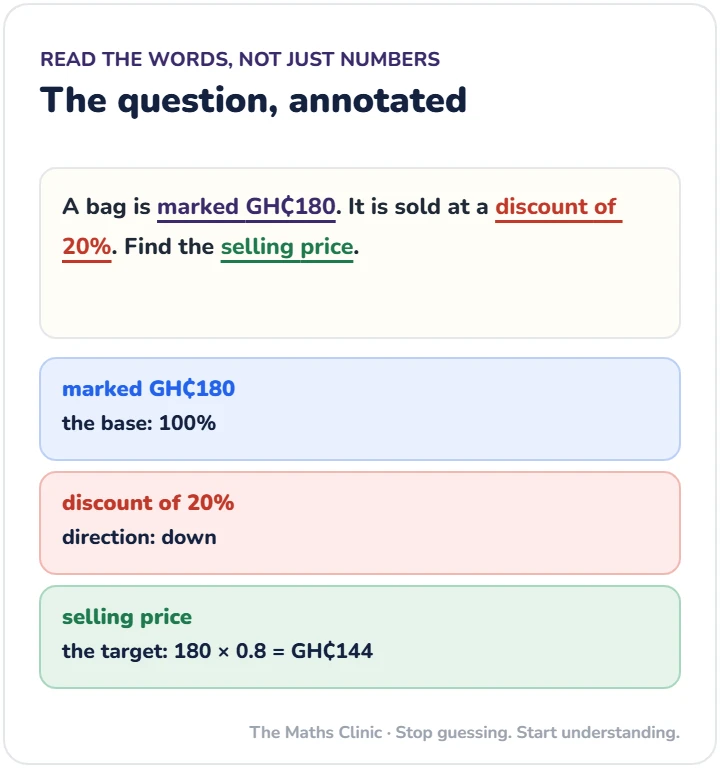
A bag is marked GH₵180 and sold at a discount of 20%. Find the selling price.
A learner may pick out:
GH₵180 and 20%
The learner calculates:
20\%\ \text{of GH₵}180 = \text{GH₵}36The calculation is correct, but GH₵36 is only the discount.
The question requires the selling price:
Selling price = Marked price − Discount
\text{Selling price} = \text{GH₵}180 - \text{GH₵}36\text{Selling price} = \text{GH₵}144The learner’s difficulty was not percentage calculation. The learner failed to read the target of the question.
The exact hidden gap is:
The learner reads to collect figures but does not read to identify the role, direction, base and target attached to those figures.
Read Business Maths Questions Carefully: The Learner’s Exact Problem
Some learners pick numbers from a question as if every number can be used immediately.
They do not ask:
- What does this money value represent?
- Is it an original price or final price?
- Is the percentage an increase or reduction?
- Which value is the percentage based on?
- Does “per month” show repeated payment?
- Does “per annum” control the time unit?
- Does the question require a change or final total?
- Is another step needed after the first calculation?
This leads to correct arithmetic being attached to the wrong business meaning.
📋 What the WAEC Chief Examiner reported
- In 2020, solving problems on ratio and proportion was a listed weakness.
- In 2025, a cost-sharing question (ratio 12 : 15 : 5 with percentage increases) was poorly answered in its second part; good solutions were few.
- Business mathematics was named as a weakness in 2013 (“solving business related mathematical problems”), 2017 (“solving problems involving financial mathematics”) and 2024 (“solving problems in business mathematics”).
What WAEC recommends
The Chief Examiner advised in 2024: “Teachers should prepare the candidates very well by giving them more exercise particularly on the above weaknesses and guide them to work,” and “Candidates should read the questions well before answering them and ensure the rubric are followed.” This lesson does both: it shows how to read each money story before calculating, and guides you through every step.
How to win these marks back
- Find each share from the total number of parts before anything else.
- Write a percentage increase as a multiplier: (100 + x)/100 × amount.
- Give money answers with the currency and to the accuracy asked.
Source: WAEC Chief Examiner’s Report, WASSCE 2013, Mathematics (Core); WAEC Chief Examiner’s Report, WASSCE 2017, Mathematics (Core); WAEC Chief Examiner’s Report, WASSCE 2020, Mathematics (Core); WAEC Chief Examiners’ Reports, WASSCE (SC) 2025, Ghana: Mathematics (Core); WAEC Chief Examiner’s Report, WASSCE 2024, Mathematics (Core).
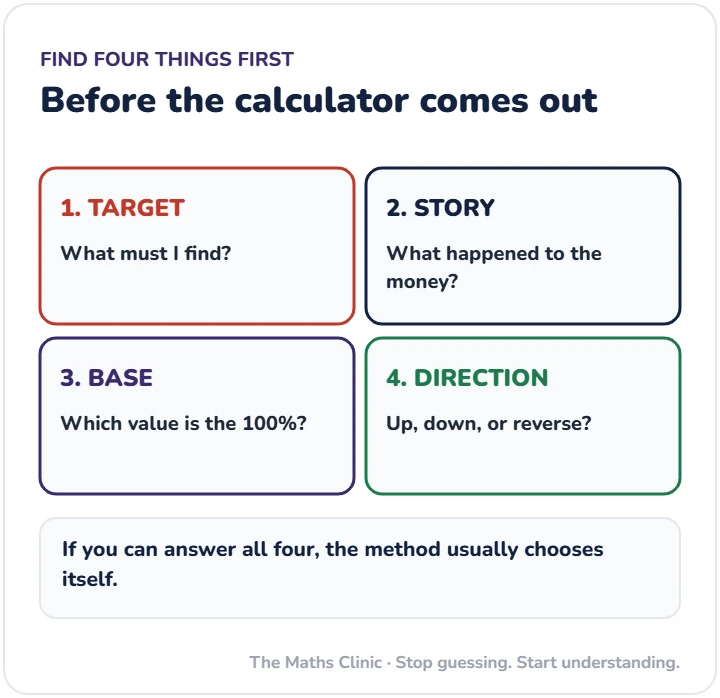
The Four Things to Find Before Calculating
Before choosing a formula, identify these four parts.
1. The starting value
This is the value before a change occurs.
Examples:
- Cost price
- Marked price
- Principal
- Cash price
- Original asset value
2. The change
This is what happens to the starting value.
Examples:
- Profit is added.
- Loss is removed.
- Discount is removed.
- Interest is added.
- Tax is added.
- Depreciation is removed.
- Commission is earned.
3. The final value
This is the value after the change.
Examples:
- Selling price
- Discounted price
- Amount after interest
- Price after tax
- Value after depreciation
4. The target
This is what the question asks you to find.
The target may be:
- Profit
- Selling price
- Percentage loss
- Discount
- Amount
- Rate
- Commission
- Total of repeated payments
- Extra cost
The target controls the final step.
The Business Maths Reading Map
| Words in the question | What they usually identify | What to think |
|---|---|---|
| Bought for | Cost price | Original trading cost |
| Sold for | Selling price | Final amount received |
| Marked at | Marked price | Price before discount |
| Discount of | Reduction | Subtract from marked price if final price is required |
| Profit of | Gain | Add to cost price if selling price is required |
| Loss of | Reduction | Subtract from cost price if selling price is required |
| Invested or deposited | Principal | Starting money |
| Amounts to | Amount | Principal plus interest |
| Interest earned | Interest | Extra money |
| Commission on sales | Commission base | Calculate from stated sales |
| Each month for n months | Repeated payment | Multiply the payment by the number of months |
| Depreciates by | Reduction in value | Subtract from the stated base |
| Per annum | Rate period | Match time in years |
| Per month | Rate or payment period | Match time or count monthly payments |
| Total | Possible final value | Read the full phrase before deciding |
These meanings are guides. The complete sentence must always control the interpretation.
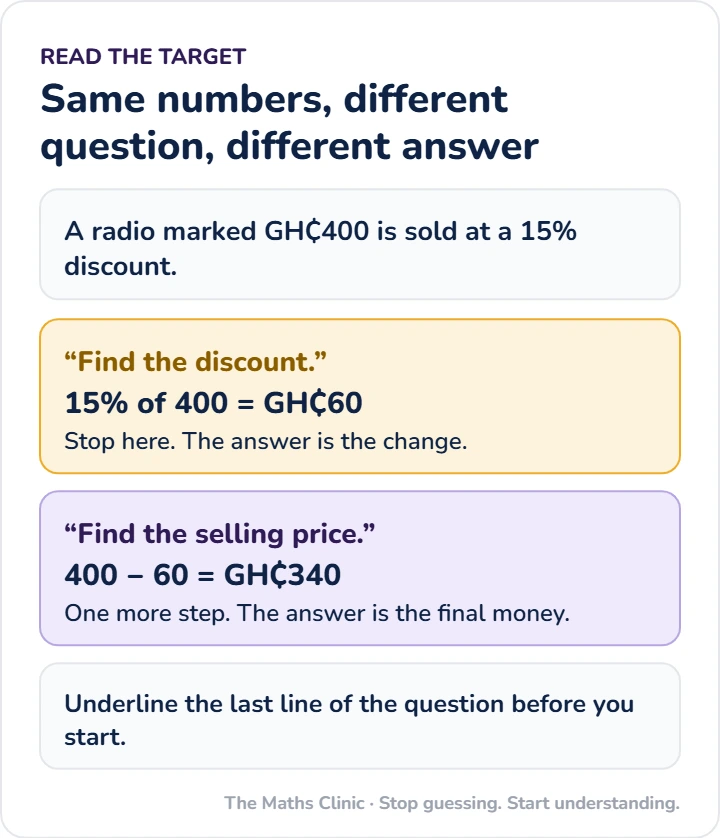
Why One Word Can Change the Calculation
Compare these instructions:
“Find the discount”
The answer is the money removed.
“Find the selling price after discount”
The learner must:
- Find the discount.
- Subtract it from marked price.
“Find the simple interest”
Calculate the extra money and stop.
“Find the amount”
Calculate interest, then add principal.
“Find the profit”
Subtract cost price from selling price.
“Find the percentage profit”
Find profit, then divide by cost price and multiply by 100%.
A learner who ignores the demand words may solve only the first stage.
Eight Reading Fixes
Fix 1: Scan the Demand Before Solving
Look at the final instruction first to discover what must be found.
For example:
Find the selling price.
Write:
Selling price = ?
This is a target scan, not a replacement for reading the full question. After identifying the target, return to the beginning and read the complete story.
Fix 2: Read the Complete Story
Read from beginning to end without calculating.
Ask:
- Who is buying, selling, borrowing or saving?
- What happens to the money?
- Which value comes first?
- Which value comes later?
Fix 3: Underline Business Words, Not Only Numbers
Underline words such as:
- Bought
- Sold
- Marked
- Discount
- Profit
- Loss
- Principal
- Interest
- Amount
- Commission
- Per month
- Altogether
- Per annum
These words give meaning to the figures.
Fix 4: Label Every Relevant Value
Instead of writing:
180 and 20%
write:
\begin{gathered}\text{Marked price} = \text{GH₵}180 \\ \text{Discount rate} = 20\%\end{gathered}A labelled figure is less likely to enter the wrong formula.
Fix 5: Identify the Percentage Base
Complete:
The percentage is calculated from __________.
Examples:
- Profit percentage → Cost price
- Discount → Marked price
- Simple interest → Principal
- Commission → Total sales or stated transaction value
Fix 6: Decide the Direction
Ask whether the percentage:
- Increases the value
- Reduces the value
- Produces an earning
- Measures a comparison
Examples:
- Profit → Increase
- Discount → Reduction
- Interest → Increase in final amount
- Commission → Earning
- Loss → Reduction
Fix 7: Count the Required Steps
Some questions need one step. Others need two or more.
For example:
Discount required → Find discount.
Selling price required → Find discount, then subtract.
Total of repeated payments required → Multiply, then add any one-off amount.
Fix 8: Return to the Question and Check
Before writing the final answer, ask:
- Did I answer the exact demand?
- Does the answer need GH₵, % or time?
- Does the direction make sense?
- Is another step still needed?
- Have I labelled the final quantity?
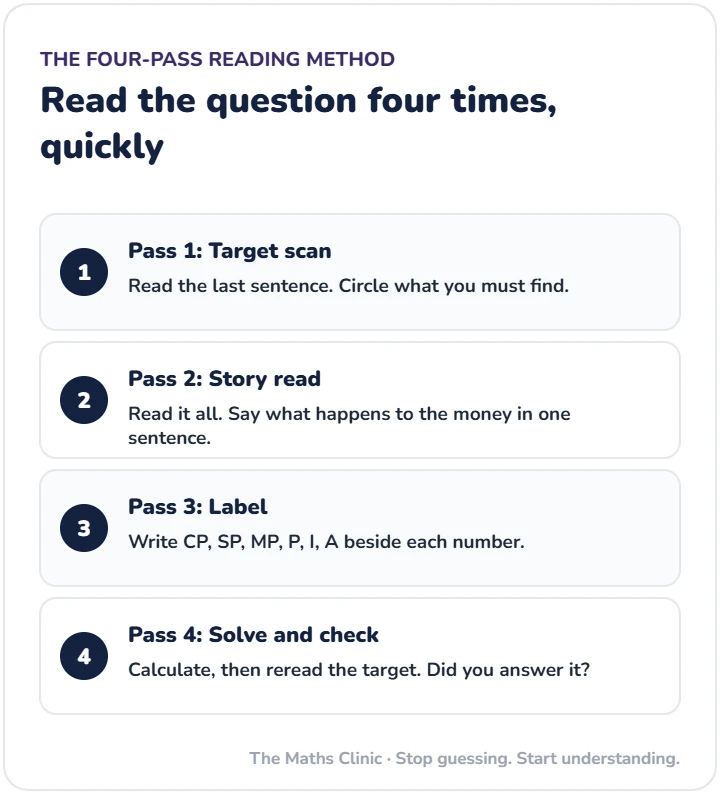
The Maths Clinic Four-Pass Reading Method
Pass 1: Target Scan
Read the final instruction and identify the required quantity.
Write:
Required: __________
Pass 2: Story Read
Read the entire question for meaning.
State the money action in one sentence.
For example:
The shop reduces the marked price.
Pass 3: Value Labelling
Write the meaning beside every relevant number.
| Quantity | Value |
|---|---|
| Marked price | GH₵180 |
| Discount rate | 20% |
| Selling price | ? |
Pass 4: Solve and Check
Choose the relationship, calculate and return to the demand.
This method may feel slower at first. In practice, it saves time because the learner avoids restarting after choosing the wrong method.
Percentage Bases Learners Must Recognise
| Situation | Usual percentage base |
|---|---|
| Percentage profit | Cost price |
| Percentage loss | Cost price |
| Discount | Marked price |
| Commission | Total sales or stated transaction value |
| Simple interest | Principal |
| Tax added | Price before tax |
| Straight-line depreciation | Original value |
| Reducing-balance depreciation | Current value at the beginning of the period |
If the question clearly states another base, use the stated base.
Words That Show an Increase
These words often suggest addition after the percentage amount is found:

- Profit
- Interest added
- Tax added
- Increase
- Appreciation
- Mark-up
- Extra charge
Do not add automatically. First identify whether the question wants the change or the final value.
Words That Show a Reduction
These words often suggest subtraction:
- Discount
- Loss
- Depreciation
- Reduction
- Decrease
- Rebate, when described as money taken off the price
Again, check whether the question wants the reduction itself or the value remaining.
Words That Show Repeated Payments
These phrases normally require multiplication:
- GH₵150 each month for 12 months
- Ten payments of GH₵200
- GH₵300 quarterly for 2 years
- GH₵50 per week for 8 weeks
Do not add the payment amount to the number of payments.
Unit Words That Control the Method
Per annum
Means per year.
If time is in months:
\text{Time} in \text{years} = \text{Months} \div 12Per month
The rate or payment applies each month.
Percentage
The final rate answer needs %.
Currency
Money answers need GH₵.
Number of payments
This is a count. It does not need GH₵.
Worked Example 1: Discount and Selling Price
A bag is marked GH₵180. It is sold at a discount of 20%. Find the selling price.
Pass 1: Identify the target
Required: Selling price
Pass 2: State the story
The marked price is being reduced.
Pass 3: Label the values
Marked price = GH₵180
Discount rate = 20%
Selling price = ?
Pass 4: Solve
\text{Discount} = (20 \div 100) \times \text{GH₵}180\text{Discount} = \text{GH₵}36Selling price = Marked price − Discount
\text{Selling price} = \text{GH₵}180 - \text{GH₵}36\text{Selling price} = \text{GH₵}144\text{Answer}: \text{Selling price} = \text{GH₵}144.Common wrong answer
GH₵36 is the discount. It is not the selling price.
This is mainly a target-reading mistake.
Worked Example 2: Profit or Selling Price?
A trader buys a radio for GH₵400 and sells it at a profit of 25%. Find the selling price.
Target
Selling price
Story
Profit increases cost price.
Labels
\text{CP} = \text{GH₵}400
Profit rate = 25%
SP = ?
Solve
\text{Profit} = (25 \div 100) \times \text{GH₵}400\text{Profit} = \text{GH₵}100\text{SP} = \text{CP} + \text{Profit}\text{SP} = \text{GH₵}400 + \text{GH₵}100\text{SP} = \text{GH₵}500\text{Answer}: \text{Selling price} = \text{GH₵}500.Reading trap
GH₵100 is only the profit. The final target is GH₵500.

Worked Example 3: Interest or Amount?
A loan of GH₵800 attracts GH₵96 simple interest. Find the amount.
Target
Amount
Labels
Principal = GH₵800
Interest = GH₵96
Amount = ?
Solve
\text{Amount} = \text{Principal} + \text{Interest}\text{Amount} = \text{GH₵}800 + \text{GH₵}96\text{Amount} = \text{GH₵}896\text{Answer}: \text{Amount} = \text{GH₵}896.Reading trap
The interest is already given. There is no need to use PRT/100.
Worked Example 4: Reverse Loss Question
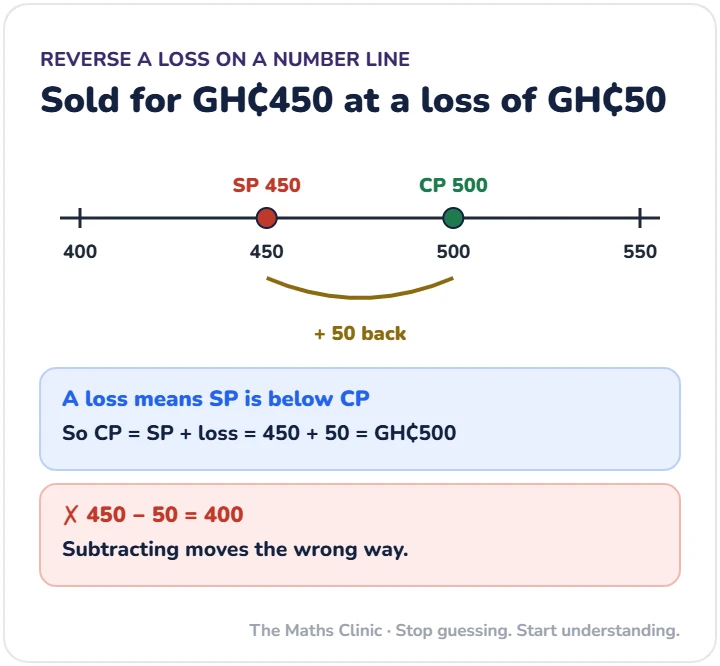
An item is sold for GH₵450 at a loss of GH₵50. Find the cost price.
Target
Cost price
Story
Selling price is lower than cost price by GH₵50.
Labels
\text{SP} = \text{GH₵}450
Loss = GH₵50
CP = ?
Solve
\text{CP} = \text{SP} + \text{Loss}\text{CP} = \text{GH₵}450 + \text{GH₵}50\text{CP} = \text{GH₵}500\text{Answer}: \text{Cost price} = \text{GH₵}500.Reading trap
Subtracting the loss again would move farther away from the original cost price.
Worked Example 5: Monthly Payments
A household pays a water bill of GH₵180 every month for 10 months. It also paid a one-off connection fee of GH₵400. Find the total amount paid.
Target
Total amount paid
Labels
\begin{gathered}\text{One-off fee} = \text{GH₵}400 \\ \text{One monthly payment} = \text{GH₵}180 \\ \text{Number of payments} = 10\end{gathered}Solve
\text{Total of monthly payments} = 10 \times \text{GH₵}180\text{Total of monthly payments} = \text{GH₵}1{,}800\text{Total paid} = \text{One-off fee} + \text{Total of monthly payments}\text{Total paid} = \text{GH₵}400 + \text{GH₵}1{,}800\text{Total paid} = \text{GH₵}2{,}200\text{Answer}: \text{Total paid} = \text{GH₵}2{,}200.Reading trap
“Every month for 10 months” shows a repeated payment, so multiply before you add. The connection fee is paid once, so add it only once.
Common Reading Mistakes
Mistake 1: Reading Only the Numbers
Numbers do not reveal whether they are cost price, amount, commission or interest.
Mistake 2: Reading Only the Final Sentence
The demand is important, but the rest of the story supplies the meaning and values.
Use the final sentence for a target scan, then read the full question.
Mistake 3: Underlining Every Number Without Its Word
Underline:
GH₵180 marked price
not only:
GH₵180
Mistake 4: Assuming Every Percentage Means Addition
Discount and loss reduce values.
Profit and added tax increase final values.
Commission is an earning.
Mistake 5: Stopping After the Percentage Calculation
The percentage amount may be only an intermediate result.
Mistake 6: Using the Largest Number as the Base
The correct base is determined by meaning, not size.
Mistake 7: Treating “Amount” as One Fixed Meaning Everywhere
In simple interest, amount often means principal plus interest.
In ordinary English, “an amount of GH₵500 was invested” may simply mean a sum of money and therefore identify principal.
Read the whole phrase.
Mistake 8: Ignoring “Per”
“Per month” and “per annum” control multiplication or unit matching.
Mistake 9: Ignoring Negative Words
Words such as loss, discount and depreciation show downward movement.
Mistake 10: Failing to Label the Final Answer
Write:
\text{Commission} = \text{GH₵}200not merely:
200
WASSCE-Style Trap Box
Before calculating, complete:
- The question wants me to find __________.
- The starting value is __________.
- The change is __________.
- The percentage base is __________.
- The change increases, reduces or rewards because __________.
- My final answer should be in __________.
If these statements cannot be completed, the money story is not yet clear.
Reading-First Business Maths Practice
For each question:
- State what each figure represents.
- Name the required quantity.
- Then solve.
Questions
- A watch is marked GH₵300 and sold at a discount of 10%. Find the selling price.
- A trader buys an item for GH₵120 and sells it for GH₵150. Find the profit.
- A loan of GH₵800 attracts GH₵96 simple interest. Find the amount.
- A salesperson makes sales worth GH₵5,000 and earns 4% commission. Find the commission.
- An item is sold for GH₵450 at a loss of GH₵50. Find the cost price.
- A table with a cost price of GH₵400 is sold at a profit of 25%. Find the selling price.
- A radio marked GH₵200 is sold for GH₵170. Find the discount.
- A principal of GH₵1,600 earns simple interest at 5% per annum for 2 years. Find the interest.
- A trader puts a starting deposit of GH₵500 into a savings account, then saves GH₵200 every month for 12 months. Find the total saved.
- GH₵2,400 is invested at 10% simple interest per annum for 18 months. Find the amount.
- A bag is sold for GH₵240 after a discount of 20%. Find the marked price.
- A salesperson earns GH₵300 as 5% commission. Find the total sales.
- A machine worth GH₵4,000 depreciates by 10% in one year. Find its value after one year.
- A trader buys 20 books for GH₵300 and sells each book for GH₵18. Find the total profit.
Answers and Gap Diagnosis
1. GH₵270
\begin{gathered}\text{Marked price} = \text{GH₵}300 \\ \text{Discount rate} = 10\% \\ \text{Target} = \text{Selling price}\end{gathered}\text{Discount} = (10 \div 100) \times \text{GH₵}300\text{Discount} = \text{GH₵}30\text{Selling price} = \text{GH₵}300 - \text{GH₵}30\text{Selling price} = \text{GH₵}270If you wrote GH₵30: You found the reduction but not the final price.
2. GH₵30
\begin{gathered}\text{CP} = \text{GH₵}120 \\ \text{SP} = \text{GH₵}150 \\ \text{Target} = \text{Profit}\end{gathered}\text{Profit} = \text{GH₵}150 - \text{GH₵}120\text{Profit} = \text{GH₵}303. GH₵896
\begin{gathered}\text{Principal} = \text{GH₵}800 \\ \text{Interest} = \text{GH₵}96 \\ \text{Target} = \text{Amount}\end{gathered}\text{Amount} = \text{GH₵}800 + \text{GH₵}96\text{Amount} = \text{GH₵}8964. GH₵200
\begin{gathered}\text{Total sales} = \text{GH₵}5{,}000 \\ \text{Commission rate} = 4\% \\ \text{Target} = \text{Commission}\end{gathered}\text{Commission} = (4 \div 100) \times \text{GH₵}5{,}000\text{Commission} = \text{GH₵}2005. GH₵500
\begin{gathered}\text{SP} = \text{GH₵}450 \\ \text{Loss} = \text{GH₵}50 \\ \text{Target} = \text{CP}\end{gathered}\text{CP} = \text{SP} + \text{Loss}\text{CP} = \text{GH₵}450 + \text{GH₵}50\text{CP} = \text{GH₵}5006. GH₵500
\begin{gathered}\text{CP} = \text{GH₵}400 \\ \text{Profit rate} = 25\% \\ \text{Target} = \text{SP}\end{gathered}\text{Profit} = (25 \div 100) \times \text{GH₵}400\text{Profit} = \text{GH₵}100\text{SP} = \text{GH₵}400 + \text{GH₵}100\text{SP} = \text{GH₵}5007. GH₵30
\begin{gathered}\text{Marked price} = \text{GH₵}200 \\ \text{Selling price} = \text{GH₵}170 \\ \text{Target} = \text{Discount}\end{gathered}\text{Discount} = \text{GH₵}200 - \text{GH₵}170\text{Discount} = \text{GH₵}308. GH₵160
\begin{gathered}P = \text{GH₵}1{,}600 \\ R = 5\%\ \text{per annum} \\ T = 2\ \text{years} \\ \text{Target} = \text{Interest}\end{gathered}I = \dfrac{1{,}600 \times 5 \times 2}{100}I = \text{GH₵}1609. GH₵2,900
\begin{gathered}\text{Starting deposit} = \text{GH₵}500 \\ \text{One monthly saving} = \text{GH₵}200 \\ \text{Number} = 12 \\ \text{Target} = \text{Total saved}\end{gathered}\text{Total of monthly savings} = 12 \times \text{GH₵}200\text{Total of monthly savings} = \text{GH₵}2{,}400\text{Total saved} = \text{GH₵}500 + \text{GH₵}2{,}400\text{Total saved} = \text{GH₵}2{,}900If you wrote GH₵700: You added only one month’s saving.
10. GH₵2,760
\begin{gathered}P = \text{GH₵}2{,}400 \\ R = 10\%\ \text{per annum} \\ T = \dfrac{18}{12} = 1.5\ \text{years} \\ \text{Target} = \text{Amount}\end{gathered}I = \dfrac{2{,}400 \times 10 \times 1.5}{100}I = \text{GH₵}360A = \text{GH₵}2{,}400 + \text{GH₵}360A = \text{GH₵}2{,}760If you used T = 18: You ignored the annual rate period.
11. GH₵300
A 20% discount means the buyer pays 80% of the marked price.
80\%\ \text{of marked price} = \text{GH₵}240\text{Marked price} = \dfrac{240 \times 100}{80}\text{Marked price} = \text{GH₵}30012. GH₵6,000
\begin{gathered}\text{Commission} = \text{GH₵}300 \\ \text{Rate} = 5\% \\ \text{Target} = \text{Total sales}\end{gathered}\text{Total sales} = \dfrac{300 \times 100}{5}\text{Total sales} = \text{GH₵}6{,}00013. GH₵3,600
\begin{gathered}\text{Original value} = \text{GH₵}4{,}000 \\ \text{Depreciation rate} = 10\% \\ \text{Target} = \text{Final value}\end{gathered}\text{Depreciation} = (10 \div 100) \times \text{GH₵}4{,}000\text{Depreciation} = \text{GH₵}400\text{Final value} = \text{GH₵}4{,}000 - \text{GH₵}400\text{Final value} = \text{GH₵}3{,}60014. GH₵60
\text{Total} \text{CP} = \text{GH₵}300\text{Total} \text{SP} = 20 \times \text{GH₵}18\text{Total} \text{SP} = \text{GH₵}360\text{Profit} = \text{GH₵}360 - \text{GH₵}300\text{Profit} = \text{GH₵}60If you compared GH₵18 with GH₵300: You mixed a unit selling price with a total cost price.
DoK Progression
| Depth of Knowledge | Main reading demand | Questions |
|---|---|---|
| DoK 1 | Identify familiar quantities and perform a direct operation | 2–4, 7 and 8 |
| DoK 2 | Connect a change to a final value or repeated payment | 1, 5, 6, 9, 10 and 13 |
| DoK 3 | Reverse a relationship or coordinate unit and total values | 11, 12 and 14 |
Use the Results to Locate the Reading Gap
| Score | What it suggests | Next action |
|---|---|---|
| 12–14 correct | Business Maths reading is becoming secure | Attempt unfamiliar mixed questions |
| 9–11 correct | One or two reading traps remain | Correct the missed question types |
| 5–8 correct | Number roles and targets are being confused | Return to the four-pass method |
| 0–4 correct | Calculation begins before the money story is understood | Practise labelling without calculating first |
Check the pattern:
- Found change instead of final value → Target-reading gap
- Used the wrong denominator → Percentage-base gap
- Added instead of subtracting → Direction gap
- Ignored “per annum” → Unit-language gap
- Added only one payment → Repeated-payment gap
- Failed reverse questions → Relationship-reading gap
- Mixed unit and total values → Quantity-scale gap
- Missing GH₵ or % → Answer-unit gap
Learner Reflection
Tick each statement only when you can do it independently.
- I identify the target before calculating.
- I read the complete story after the target scan.
- I underline business words as well as figures.
- I label every relevant money value.
- I identify the percentage base.
- I decide whether the value increases or reduces.
- I recognise repeated-payment language.
- I match time to the rate period.
- I know when a question needs more than one step.
- I return to the demand before writing my final answer.
- I state the meaning and unit of my answer.
- I check whether the result fits the money story.
📘 New SHS curriculum link
This is Year 1 of the new SHS Mathematics curriculum (1.1.2.LO.2): create strategies for solving problems involving percentages of personal or household finances. Reading the money story correctly is the first of those strategies.
For parents
Show your child a price tag or a receipt and ask: “If the question said ‘find the discount’, what number would you give? And if it said ‘find what I paid’?” If they can tell the two apart, they are reading for meaning, not just for numbers.
Questions learners ask
Why do I get business maths wrong when my calculation is right?
Usually because the calculation answered a different question: for example, you found the discount when the question asked for the selling price. Read the target first.
What is the difference between interest and amount?
Interest is the extra money earned or charged. Amount is the principal plus the interest.
What does “per annum” mean?
Per year. If the time is in months, change it to years before using a yearly rate.
Which amount is the base for a percentage?
The amount before the change: cost price for profit or loss, marked price for discount, principal for interest.
How This Helps Before WASSCE
This lesson trains the learner to:
- Read for roles rather than figures alone
- Identify starting, changed and final values
- Recognise business demand words
- Select the correct percentage base
- Control increase and reduction directions
- Interpret repeated payments
- Match units and rate periods
- Complete multi-step questions
- Show meaningful working
- Check the final answer
The official WAEC Ghana Chief Examiner’s Reports may also be consulted when studying reported examination performance and weaknesses.
Continue the Intervention
Use the lesson matching the reading error you discovered:
- For mixed money roles, study Business Maths Mistakes.
- For cost-price percentage errors, study Profit and Loss Questions.
- For simple-interest wording, study Simple Interest Word Problems.
- For interest and final-total confusion, study Interest or Amount.
- For reduction and earnings confusion, study Discount and Commission.
If the reading gap remains broad, visit the Intervention Hub.
When the four-pass method is secure, attempt targeted questions in the WASSCE Maths Practice Zone.
For other examination traps, explore WAEC Maths Traps.
Final Word from The Maths Clinic
A learner who struggles with Business Maths is not necessarily weak in calculation.
Very often, the learner begins calculating before identifying what the figures represent.
Before touching the calculator, ask:
- What does each number mean?
- What is the starting value?
- What change takes place?
- What is the percentage base?
- Does the value increase or reduce?
- What quantity does the question require?
- Does another step remain?
- What unit should the answer carry?
Reading carefully is not wasting time. It prevents the learner from solving the wrong problem correctly.
Stop Guessing. Start Understanding.
Practice Zone CTA
Do not rush into calculation.
Visit the WASSCE Maths Practice Zone and attempt more Business Maths questions.
For every wrong answer, identify whether the mistake came from:
- Demand-word reading
- Money-role identification
- Percentage base
- Direction of change
- Repeated-payment language
- Time and rate units
- Multi-step completion
- Final-answer interpretation
Correct that exact gap and attempt a fresh question without notes.
✏️ Try it yourself
A radio marked GH₵400 is sold at a 15% discount. (a) Find the discount. (b) Find the selling price.
Tap to see the answer
(a) Discount = 15% of 400 = GH₵60. (b) Selling price = 400 – 60 = GH₵340.
Keep learning
- Percentages in Mathematics: 6 Common Mistakes to Avoid
- Financial Maths: 5 Simple Interest Mistakes to Correct
- Simple Interest in Mathematics: What P, R, T, I and A Really Mean
📚 See every lesson in the Mathematics Topic Lessons
✏️ Practise business maths
💬 Stuck on a step? Ask Dickson and send the line where you got lost.

Written by
Dickson Sarpong
NTC-certified SHS Mathematics teacher in Ghana with WAEC marking experience, and author of The Bridge Series textbooks. Every lesson here is built around the mistakes WAEC examiners keep reporting.
About DicksonStuck? Ask a question
Want the whole topic, step by step? My textbooks, The Bridge to Mathematics and The Bridge to Additional Mathematics for SHS, follow the new curriculum and rebuild the basics as you go.
Read a free chapter →