Struggling with WASSCE Maths? Stop guessing. Let’s fix the gap step by step.

Business Maths Percentage Understanding: 9 Fixes
You can work out 20% of GH₵500. The trouble starts when the question doesn’t tell you which amount the 20% belongs to. This lesson is about finding the right base: the amount that counts as 100%.

📚 Part of the Business Maths Clinic: every lesson on this topic, in one place.
Quick answer: how do you find the right base in a business maths percentage question?
Ask “percentage of what?” before you calculate. Profit and loss are percentages of the cost price; discount is a percentage of the marked price; commission is a percentage of sales; interest is a percentage of the principal. Find that base (100%), calculate the part, then decide whether to add it, subtract it or report it, as the story says.
You can work out 20% of GH₵500. The trouble starts when the question doesn’t tell you which amount the 20% belongs to. This lesson is about finding the right base: the amount that counts as 100%.
A learner may correctly calculate:
20\%\ \text{of GH₵}500 = \text{GH₵}100However, the learner may still become confused when the same figures appear in questions about:
- Profit
- Loss
- Discount
- Tax
- Commission
- Simple interest
- Percentage increase
- Percentage decrease
- Depreciation
The multiplication may be the same, but the meaning and next step can change.
In a profit question, GH₵100 may be added to the cost price. In a discount question, it may be subtracted from the marked price. In a commission question, it may be the salesperson’s reward rather than the price of the goods.
This percentage in Business Maths lesson diagnoses the part-whole interpretation gap and repairs it step by step. It helps the learner move from multiplying numbers blindly to identifying the base, explaining the relationship, choosing the correct direction and checking the final answer under WASSCE conditions.
📋 What the WAEC Chief Examiner reported
- In 2020, solving problems on ratio and proportion was a listed weakness.
- In 2025, a cost-sharing question (ratio 12 : 15 : 5 with percentage increases) was poorly answered in its second part; good solutions were few.
- Business mathematics was named as a weakness in 2013 (“solving business related mathematical problems”), 2017 (“solving problems involving financial mathematics”) and 2024 (“solving problems in business mathematics”).
What WAEC recommends
The Chief Examiner advised in 2024: “Teachers should prepare the candidates very well by giving them more exercise particularly on the above weaknesses and guide them to work,” and “Candidates should read the questions well before answering them and ensure the rubric are followed.” This lesson does both: it shows how to read each money story before calculating, and guides you through every step.
How to win these marks back
- Find each share from the total number of parts before anything else.
- Write a percentage increase as a multiplier: (100 + x)/100 × amount.
- Give money answers with the currency and to the accuracy asked.
Source: WAEC Chief Examiner’s Report, WASSCE 2013, Mathematics (Core); WAEC Chief Examiner’s Report, WASSCE 2017, Mathematics (Core); WAEC Chief Examiner’s Report, WASSCE 2020, Mathematics (Core); WAEC Chief Examiners’ Reports, WASSCE (SC) 2025, Ghana: Mathematics (Core); WAEC Chief Examiner’s Report, WASSCE 2024, Mathematics (Core).
Maths Clinic Diagnosis: The Learner Can Calculate but Cannot Interpret
The hidden gap is:
The learner can calculate a direct percentage but cannot answer the decisive question: “Percentage of what?”
Consider these three statements:
- A trader makes 20% profit on goods costing GH₵500.
- A shop gives 20% discount on goods marked GH₵500.
- A salesperson earns 20% commission on sales of GH₵500.
In all three cases:
20\%\ \text{of GH₵}500 = \text{GH₵}100However, GH₵100 has a different meaning in each situation.
| Situation | GH₵500 represents | GH₵100 represents | What happens next? |
|---|---|---|---|
| Profit | Cost price | Profit | Add to cost price |
| Discount | Marked price | Discount | Subtract from marked price |
| Commission | Total sales | Commission earned | Report as the salesperson’s reward |
A learner who sees only the numbers may perform the multiplication correctly but answer the wrong question.
The deeper skill is not only finding a percentage. It is identifying:
- The whole or base
- The part being calculated
- The meaning of the part
- The direction of change
- The final quantity required
Business Maths Percentage Understanding: The Learner’s Exact Problem
Many SHS learners are comfortable when a question says:
Find 20% of GH₵300.
The whole is already clear. It is GH₵300.
However, Business Maths places the percentage inside a money story. The learner must decide which quantity acts as the whole.
For example:
A radio costing GH₵300 is sold at a profit of 20%.
The learner must understand:
- \text{Cost price} = \text{GH₵}300
- \text{Profit rate} = 20\%
- Profit is based on cost price
- \text{Profit} = 20\%\ \text{of GH₵}300
- Selling price = cost price + profit
The calculation is no longer only:
\dfrac{20}{100} \times 300The learner must also know why GH₵300 is the base and what to do with the answer.
What a Percentage Really Means
Percentage means “out of 100.”
For example:
25\% = \dfrac{25}{100} = 0.25The statement:
25% of GH₵400
means:
25 out of every 100 parts of GH₵400
Therefore:
25\%\ \text{of GH₵}400 = \dfrac{25}{100} \times \text{GH₵}400= \text{GH₵}100In every percentage calculation, three quantities are connected:
| Quantity | Meaning |
|---|---|
| Whole or base | The complete quantity being compared with 100% |
| Part or change | The portion of the whole |
| Rate | The percentage relationship between the part and whole |
The basic relationship is:
\text{Percentage part} = \dfrac{\text{Rate}}{100} \times \text{Base}This can be written as:
\text{Part} = \text{Rate} \times \dfrac{\text{Base}}{100}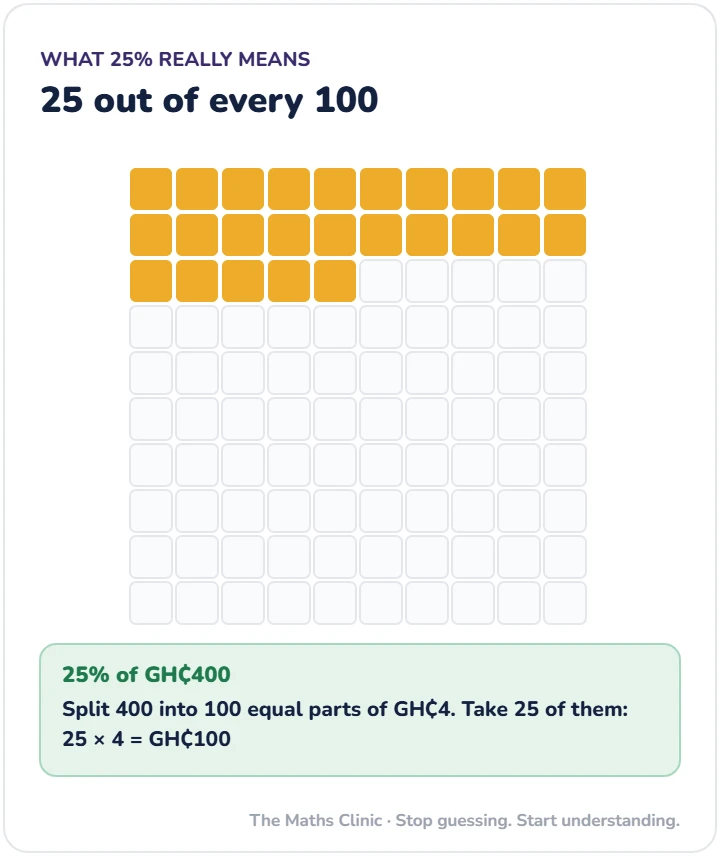
The Percentage Triangle Learners Must Understand
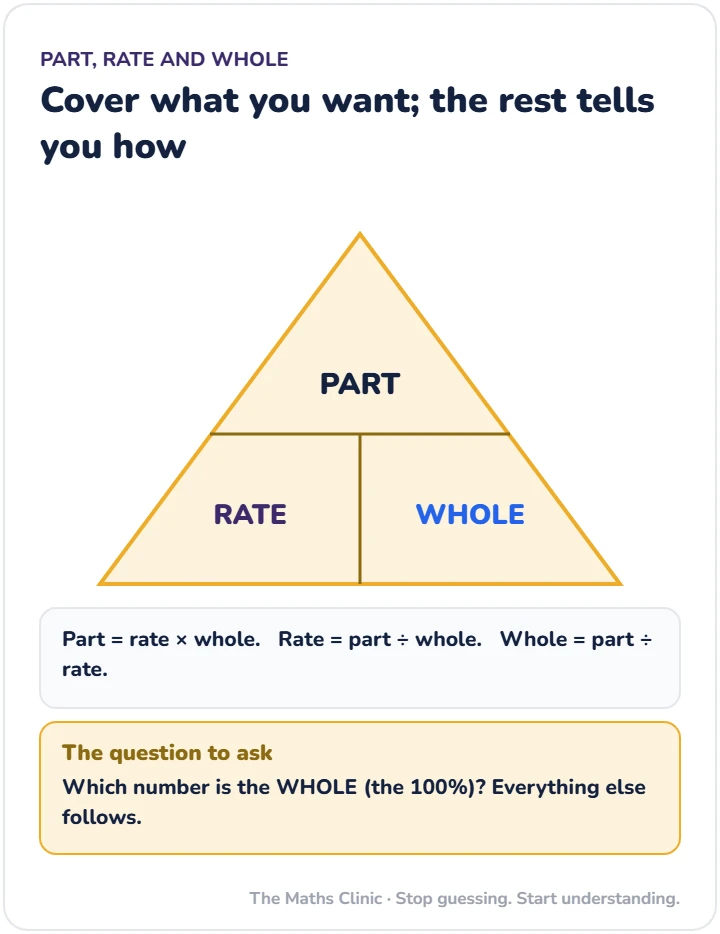
The three main relationships are:
To find the part
\text{Part} = \dfrac{\text{Rate}}{100} \times \text{Whole}To find the rate
\text{Rate} = \dfrac{\text{Part}}{\text{Whole}} \times 100\%To find the whole
\text{Whole} = \text{Part} \times \dfrac{100}{\text{Rate}}These formulas become useful only after the learner correctly identifies the part and the whole.
A wrong base produces a wrong answer even when the formula and arithmetic are correct.
The Four Types of Percentage Questions
Many Business Maths mistakes happen because learners treat all percentage questions as one type.
Type 1: Find the percentage part
Example:
Find 15% of GH₵400.
\text{Part} = \dfrac{15}{100} \times \text{GH₵}400\text{Part} = \text{GH₵}60Type 2: Find the final value after an increase
Example:
Increase GH₵400 by 15%.
\text{Increase} = \dfrac{15}{100} \times \text{GH₵}400\text{Increase} = \text{GH₵}60\text{New value} = \text{GH₵}400 + \text{GH₵}60\text{New value} = \text{GH₵}460The GH₵60 is the increase, not the new value.
Type 3: Find the final value after a decrease
Example:
Reduce GH₵400 by 15%.
\text{Decrease} = \dfrac{15}{100} \times \text{GH₵}400\text{Decrease} = \text{GH₵}60\text{New value} = \text{GH₵}400 - \text{GH₵}60\text{New value} = \text{GH₵}340The GH₵60 is the reduction, not the final value.
Type 4: Find the original whole
Example:
GH₵460 is the final price after a 15% increase. Find the original price.
After a 15% increase:
\text{Final value} = 115\%\ \text{of original value}1.15 \times \text{Original value} = \text{GH₵}460\text{Original value} = \text{GH₵}\dfrac{460}{1.15}\text{Original value} = \text{GH₵}400This is a reverse-percentage question. Subtracting 15% of GH₵460 would use the wrong base.
The Base Amount in Common Business Maths Situations

| Situation | Percentage part | Usual base |
|---|---|---|
| Profit | Profit | Cost price |
| Loss | Loss | Cost price |
| Discount | Discount | Marked price |
| Commission | Commission earned | Total sales or stated transaction value |
| Tax | Tax charged | Taxable price stated in the question |
| Simple interest | Interest | Principal |
| Percentage increase | Increase | Original value |
| Percentage decrease | Decrease | Original value |
| Depreciation | Reduction in value | Value specified by the depreciation method |
| Hire-purchase extra percentage | Extra amount paid | Usually cash price |
| Percentage change | Difference between values | Original value |
These are standard school-mathematics conventions. If a question explicitly states a different base, use the base stated in the question.
For example, profit percentage is normally calculated on cost price unless the question says that it is based on selling price.
Nine Fixes for Business Maths Percentage Understanding
Fix 1: Ask “Percentage of what?”
Do not calculate immediately after seeing a percentage.
Write:
The percentage is based on __________.
For example:
- Profit is 20% of cost price.
- Discount is 10% of marked price.
- Commission is 6% of total sales.
- Interest is 8% of principal for each stated period.
If the blank cannot be completed, the learner is not ready to calculate.
Fix 2: Identify the 100% quantity
The base represents 100%.
If cost price is GH₵400:
\text{Cost price} = 100\%If profit is 15% of cost price:
\text{Profit} = 15\%\ \text{of cost price}\text{Selling price} = 115\%\ \text{of cost price}This 100% view makes both forward and reverse questions easier.
Fix 3: Separate the percentage part from the final value
The percentage calculation usually finds a part or change first.
For example:
\text{Discount} = \text{GH₵}45does not automatically mean:
\text{Selling price} = \text{GH₵}45Selling price must be calculated:
Selling price = Marked price − Discount
The learner must know whether the question wants:
- The change
- The final value
- Both quantities
Fix 4: Decide whether the story increases or decreases money
| Business action | Usual direction |
|---|---|
| Profit | Increase |
| Tax added | Increase |
| Simple interest added to principal | Increase |
| Mark-up | Increase |
| Discount | Decrease |
| Loss | Decrease |
| Depreciation | Decrease |
Commission is different. It is usually a reward calculated from sales. It is not normally added to the sales figure.
If a fixed salary and commission are given and total earnings are required, then:
\text{Total earnings} = \text{Salary} + \text{Commission}Fix 5: Read the demand word
Underline what must be found:
- Profit
- Percentage profit
- Selling price
- Discount
- Discount rate
- Marked price
- Commission
- Total earnings
- Tax
- Final price
- Original price
- Interest
- Amount
A correct percentage part may still be an incomplete final answer.
Watch the small words: by, to, of, out of
| Phrase | What it means |
|---|---|
| increase by 20% | add 20% of the original: final = 120% |
| increase to GH₵240 | GH₵240 is the new total, not the change |
| reduced by 15% | take away 15%: final = 85% |
| reduced to 85% | 85% is what is left |
| 15% of the students | multiply: a share of the whole class |
| 15 out of 60 | a fraction: 15/60 |
Read the question twice: once for the story, once for the mathematics. In a class of 50 with 18 boys, “what percentage are girls?” needs 32 ÷ 50 × 100% = 64%. A learner who answers 36% has done correct arithmetic on the wrong group.

And never add percentages that come from different bases: 10% of GH₵500 and 10% of GH₵800 are GH₵50 and GH₵80, not “20% of something”.
Fix 6: Use a meaning sentence
Before calculating, write a sentence such as:
The profit is 15% of the cost price.
Then translate it:
\text{Profit} = \dfrac{15}{100} \times \text{Cost price}This simple sentence prevents blind substitution.
Fix 7: Use the original value for percentage change
The formula is:
Percentage change = Change/Original value × 100%
For an increase:
Change = New value − Original value
For a decrease:
Change = Original value − New value
The denominator is the original value, not the new value.
Fix 8: Recognise reverse-percentage questions
If the final value is given, work backwards from the percentage that remains or results.
After a 20% increase:
\text{Final value} = 120\%\ \text{of original value}After a 20% decrease:
\text{Final value} = 80\%\ \text{of original value}Do not simply subtract or add the same percentage of the final value. The original and final values are different bases.
Fix 9: Check the direction and size
Ask:
- Should the final value be greater or smaller than the base?
- Did I find the change or the final value?
- Did I use the original value as the base?
- Does my answer need GH₵ or %?
- Did the base change before the next percentage was applied?
A discount should not make the selling price greater than the marked price. A positive profit should not make the selling price lower than the cost price.
Worked Examples: Same Percentage, Different Meaning
Suppose the rate is 20% and the base is GH₵500.
Example A: Profit
A trader makes 20% profit on goods costing GH₵500. Find the profit and selling price.
Meaning sentence:
Profit is 20% of cost price.
\text{Profit} = \dfrac{20}{100} \times \text{GH₵}500\text{Profit} = \text{GH₵}100Selling price = Cost price + Profit
\text{Selling price} = \text{GH₵}500 + \text{GH₵}100\text{Selling price} = \text{GH₵}600\text{Answer}: \text{Profit} = \text{GH₵}100; \text{selling price} = \text{GH₵}600.Example B: Discount
A shop gives a 20% discount on goods marked GH₵500. Find the discount and selling price.
Meaning sentence:
Discount is 20% of marked price.
\text{Discount} = \dfrac{20}{100} \times \text{GH₵}500\text{Discount} = \text{GH₵}100Selling price = Marked price − Discount
\text{Selling price} = \text{GH₵}500 - \text{GH₵}100\text{Selling price} = \text{GH₵}400\text{Answer}: \text{Discount} = \text{GH₵}100; \text{selling price} = \text{GH₵}400.Example C: Commission
A salesperson earns 20% commission on sales of GH₵500. Find the commission.
Meaning sentence:
Commission is 20% of total sales.
\text{Commission} = \dfrac{20}{100} \times \text{GH₵}500\text{Commission} = \text{GH₵}100\text{Answer}: \text{Commission} = \text{GH₵}100.Do not write GH₵600 as total sales. The sales figure was already GH₵500, and commission is the salesperson’s reward.
Central lesson
The rate and base are the same in all three questions.
However:
- Profit is added to cost price.
- Discount is subtracted from marked price.
- Commission is reported as a reward.
This is why meaning must come before calculation.

Worked Example: Percentage Profit
A phone is bought for GH₵900 and sold for GH₵1,080. Find the percentage profit.
Step 1: Find the profit
Profit = Selling price − Cost price
\text{Profit} = \text{GH₵}1{,}080 - \text{GH₵}900\text{Profit} = \text{GH₵}180Step 2: Identify the base
Percentage profit is normally based on cost price.
\text{Base} = \text{GH₵}900Step 3: Calculate the rate
Percentage profit = Profit/Cost price × 100%
\text{Percentage profit} = \dfrac{180}{900} \times 100\%\text{Percentage profit} = 20\%\text{Answer}: \text{Percentage profit} = 20\%.Common trap
Using GH₵1,080 as the denominator calculates profit as a percentage of selling price. That is not the standard percentage-profit calculation unless the question specifically requests it.
Worked Example: Percentage Discount
A radio marked GH₵250 is sold for GH₵210. Find the percentage discount.
Step 1: Find the discount
Discount = Marked price − Selling price
\text{Discount} = \text{GH₵}250 - \text{GH₵}210\text{Discount} = \text{GH₵}40Step 2: Identify the base
Discount is based on marked price.
Step 3: Calculate
Percentage discount = Discount/Marked price × 100%
\text{Percentage discount} = \dfrac{40}{250} \times 100\%\text{Percentage discount} = 16\%\text{Answer}: \text{Percentage discount} = 16\%.Worked Example: Tax After Discount
A shoe is marked GH₵800. A discount of 10% is given. A tax of 12.5% is then charged on the discounted price. Find the final amount paid.
Step 1: Find the discount
\text{Discount} = \dfrac{10}{100} \times \text{GH₵}800\text{Discount} = \text{GH₵}80Step 2: Find the discounted price
\text{Discounted price} = \text{GH₵}800 - \text{GH₵}80\text{Discounted price} = \text{GH₵}720Step 3: Identify the new tax base
The question says tax is charged on the discounted price.
\text{Tax base} = \text{GH₵}720Step 4: Find the tax
\text{Tax} = \dfrac{12.5}{100} \times \text{GH₵}720\text{Tax} = \text{GH₵}90Step 5: Find the final amount
\text{Final amount} = \text{GH₵}720 + \text{GH₵}90\text{Final amount} = \text{GH₵}810\text{Answer}: \text{Final amount paid} = \text{GH₵}810.Important lesson
The base changed after the discount.
The discount used GH₵800 as its base. The tax used GH₵720 as its base.

When the Tax Is Already Included
The word inclusive changes the meaning of a tax question.
Suppose a tax-inclusive price is GH₵1,125 and the tax rate is 12.5%.
The GH₵1,125 represents:
100% original taxable price + 12.5% tax
Therefore:
\text{GH₵}1{,}125 = 112.5\%\ \text{of the original taxable price}\text{Original price} = \dfrac{1{,}125}{1.125}\text{Original price} = \text{GH₵}1{,}000\text{Tax} = \text{GH₵}1{,}125 - \text{GH₵}1{,}000\text{Tax} = \text{GH₵}125Do not calculate 12.5% of GH₵1,125 as the tax. The inclusive amount already contains the tax.

Worked Example: Reverse Discount
An item is sold for GH₵450 after a 10% discount. Find the marked price.
After a 10% discount, 90% of the marked price remains.
Let the marked price be M.
90\%\ \text{of} M = \text{GH₵}4500.9M = 450
M = \dfrac{450}{0.9}M = \text{GH₵}500\text{Answer}: \text{Marked price} = \text{GH₵}500.Why adding 10% fails
A learner may find:
10\%\ \text{of GH₵}450 = \text{GH₵}45and then write:
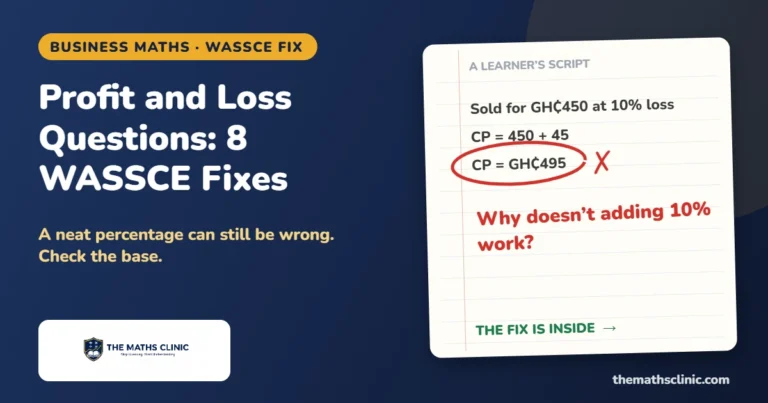
\text{Marked price} = \text{GH₵}450 + \text{GH₵}45 = \text{GH₵}495This is wrong because the 10% discount was based on the unknown marked price, not the GH₵450 selling price.
Worked Example: Reverse Commission
A salesperson earns GH₵360 commission at a rate of 6% of total sales. Find the total sales.
Meaning sentence:
GH₵360 is 6% of total sales.
Let total sales be S.
\dfrac{6}{100} \times S = 3600.06S = 360
S = \dfrac{360}{0.06}S = \text{GH₵}6{,}000\text{Answer}: \text{Total sales} = \text{GH₵}6{,}000.The GH₵360 is the part. GH₵6,000 is the whole.
Worked Example: Simple Interest as a Percentage Situation
GH₵1,800 is invested at 10% simple interest per annum for nine months. Find the interest and amount.
Identify the base
\text{Principal} = \text{GH₵}1{,}800Interest is calculated on the principal.
Match the time unit
\text{Rate} = 10\%\ \text{per annum}\text{Time} = \dfrac{9}{12}\ \text{year} = \dfrac{3}{4}\ \text{year}Find the interest
I = \dfrac{PRT}{100}I = \dfrac{1{,}800 \times 10 \times \dfrac{3}{4}}{100}I = \text{GH₵}135Find the amount
A = P + I
A = \text{GH₵}1{,}800 + \text{GH₵}135A = \text{GH₵}1{,}935\text{Answer}: \text{Interest} = \text{GH₵}135; \text{amount} = \text{GH₵}1{,}935.The principal remains the base throughout a simple-interest calculation.
Successive Percentages Do Not Always Use the Same Base
Suppose a price of GH₵1,000 is increased by 20% and then reduced by 20%.

First change
\text{Increase} = 20\%\ \text{of GH₵}1{,}000\text{Increase} = \text{GH₵}200\text{New price} = \text{GH₵}1{,}200Second change
The 20% reduction is now based on GH₵1,200.
\text{Reduction} = 20\%\ \text{of GH₵}1{,}200\text{Reduction} = \text{GH₵}240\text{Final price} = \text{GH₵}1{,}200 - \text{GH₵}240\text{Final price} = \text{GH₵}960The final price is not GH₵1,000.
The increase and decrease have the same rate, but they use different bases.

Common Wrong Approaches
Wrong Approach 1: Treating every percentage part as an increase
The learner adds the percentage part in profit, discount, loss and depreciation questions.
Correction: Identify whether the money story increases or decreases the base.
Wrong Approach 2: Treating the percentage part as the final value
A learner finds a GH₵60 profit and writes GH₵60 as the selling price.
Correction: Distinguish between the change and the final amount.
Wrong Approach 3: Using selling price as the profit base
Profit percentage is normally based on cost price.
Correction: Write the meaning sentence before calculating.
Wrong Approach 4: Using selling price as the discount base
Discount is normally based on marked price.
Correction: Identify the original listed price before the reduction.
Wrong Approach 5: Adding commission to total sales
Commission is calculated from sales but is not usually part of the sales value.
Correction: Report commission separately unless salary and total earnings are required.
Wrong Approach 6: Using the new value for percentage change
Percentage change is based on the original value.
Correction: Put the original value in the denominator.
Wrong Approach 7: Reversing a percentage by adding or subtracting the same rate
After a 10% discount, the final value is 90% of the original.
Correction: Divide the final value by 0.9 to recover the original.
Wrong Approach 8: Applying two percentages to the first base
In a discount-then-tax question, the tax may be based on the discounted price.
Correction: Check whether the base changes after each step.
Wrong Approach 9: Ignoring “inclusive” and “exclusive”
A tax-inclusive price already contains tax. A tax-exclusive price does not.
Correction: Translate the wording before calculating.
The Maths Clinic Base-Amount Routine
Use this routine for every Business Maths percentage question.
Step 1: Name the business action
Is the money:
- Increasing?
- Decreasing?
- Being compared?
- Producing a reward?
- Earning interest?
- Attracting tax?
Step 2: Underline the target
Write what must be found.
Step 3: Identify the whole
Ask:
Percentage of what?
Write:
Base = __________
Step 4: Write the meaning sentence
For example:
Discount is 15% of marked price.
Step 5: Find the percentage part
\text{Part} = \dfrac{\text{Rate}}{100} \times \text{Base}Step 6: Decide the direction
- Add for an increase.
- Subtract for a decrease.
- Report a reward such as commission separately.
- Divide by the remaining or resulting percentage in a reverse question.
Step 7: Complete the required final step
Do not stop after finding the percentage part if the final value is required.
Step 8: Check the answer
Ask:
- Did I use the correct base?
- Did I calculate the part or final value?
- Should the answer increase or decrease?
- Does the unit match the demand?
- Is the result reasonable?
WASSCE-Style Base Test
Before submitting your answer, complete these statements:
- The business action is __________.
- The original whole is __________.
- The whole represents 100% of __________.
- The percentage part is __________.
- The question requires __________.
- The direction is increase/decrease/comparison/reward.
- My final answer represents __________.
If statement 3 cannot be completed, do not calculate yet.
Business Maths Percentage Understanding Diagnostic Practice
Attempt every question before checking the answers.
Questions
- A trader buys goods for GH₵400 and makes a profit of 15% on the cost price. Find the profit and selling price.
- A dress marked GH₵300 is sold at a discount of 15%. Find the discount and selling price.
- A salesperson sells goods worth GH₵2,000 and earns 6% commission. Find the commission.
- A price of GH₵900 is increased by 12%. Find the increase and new price.
- A price of GH₵900 is reduced by 12%. Find the reduction and new price. Compare the result with Question 4.
- A phone is bought for GH₵800 and sold for GH₵920. Find the profit and percentage profit.
- An item is sold for GH₵450 after a discount of 10%. Find the marked price.
- A salesperson receives GH₵360 commission at 6% of total sales. Find the total sales.
- A shoe marked GH₵800 receives a 10% discount. A tax of 12.5% is then charged on the discounted price. Find the final amount paid.
- A machine worth GH₵2,500 depreciates by 8% of its original value. Find the depreciation and new value.
- GH₵1,800 is invested at 10% simple interest per annum for nine months. Find the interest and amount.
- A price becomes GH₵1,440 after a 20% increase. Find the original price.
Answers and Gap Diagnosis
1. Profit = GH₵60; selling price = GH₵460
\text{Profit} = \dfrac{15}{100} \times \text{GH₵}400\text{Profit} = \text{GH₵}60\text{Selling price} = \text{GH₵}400 + \text{GH₵}60\text{Selling price} = \text{GH₵}460If you wrote GH₵60 as the selling price: You confused the percentage part with the final value.
2. Discount = GH₵45; selling price = GH₵255
\text{Discount} = \dfrac{15}{100} \times \text{GH₵}300\text{Discount} = \text{GH₵}45\text{Selling price} = \text{GH₵}300 - \text{GH₵}45\text{Selling price} = \text{GH₵}255If you wrote GH₵345: You added a discount instead of subtracting it.
3. Commission = GH₵120
\text{Commission} = \dfrac{6}{100} \times \text{GH₵}2{,}000\text{Commission} = \text{GH₵}120If you wrote GH₵2,120: You added commission to the sales value unnecessarily.
4. Increase = GH₵108; new price = GH₵1,008
\text{Increase} = \dfrac{12}{100} \times \text{GH₵}900\text{Increase} = \text{GH₵}108\text{New price} = \text{GH₵}900 + \text{GH₵}108\text{New price} = \text{GH₵}1{,}0085. Reduction = GH₵108; new price = GH₵792
\text{Reduction} = \dfrac{12}{100} \times \text{GH₵}900\text{Reduction} = \text{GH₵}108\text{New price} = \text{GH₵}900 - \text{GH₵}108\text{New price} = \text{GH₵}792Comparison with Question 4
Both questions use:
12\%\ \text{of GH₵}900 = \text{GH₵}108However:
- Question 4 adds GH₵108.
- Question 5 subtracts GH₵108.
- The two final prices differ by GH₵216.
If both final answers were the same: You ignored the direction of change.
6. Profit = GH₵120; percentage profit = 15%
\text{Profit} = \text{GH₵}920 - \text{GH₵}800\text{Profit} = \text{GH₵}120\text{Percentage profit} = \dfrac{120}{800} \times 100\%\text{Percentage profit} = 15\%If you divided by GH₵920: You used selling price instead of cost price as the base.
7. Marked price = GH₵500
After a 10% discount, 90% remains.
0.9 \times \text{Marked price} = \text{GH₵}450\text{Marked price} = \dfrac{450}{0.9}\text{Marked price} = \text{GH₵}500If you wrote GH₵495: You calculated 10% of the final price instead of working backwards from 90%.
8. Total sales = GH₵6,000
6\%\ \text{of total sales} = \text{GH₵}3600.06 \times \text{Total sales} = \text{GH₵}360\text{Total sales} = \dfrac{360}{0.06}\text{Total sales} = \text{GH₵}6{,}000If you multiplied GH₵360 by 6%: You treated the percentage part as the whole.
9. Final amount = GH₵810
\text{Discount} = \dfrac{10}{100} \times \text{GH₵}800\text{Discount} = \text{GH₵}80\text{Discounted price} = \text{GH₵}720\text{Tax} = \dfrac{12.5}{100} \times \text{GH₵}720\text{Tax} = \text{GH₵}90\text{Final amount} = \text{GH₵}720 + \text{GH₵}90\text{Final amount} = \text{GH₵}810If you calculated tax on GH₵800: You failed to notice that the base changed after the discount.
10. Depreciation = GH₵200; new value = GH₵2,300
\text{Depreciation} = \dfrac{8}{100} \times \text{GH₵}2{,}500\text{Depreciation} = \text{GH₵}200\text{New value} = \text{GH₵}2{,}500 - \text{GH₵}200\text{New value} = \text{GH₵}2{,}300The question states that depreciation is based on the original value.
11. Interest = GH₵135; amount = GH₵1,935
T = \dfrac{9}{12}\ \text{year} = \dfrac{3}{4}\ \text{year}I = \dfrac{1{,}800 \times 10 \times \dfrac{3}{4}}{100}I = \text{GH₵}135A = \text{GH₵}1{,}800 + \text{GH₵}135A = \text{GH₵}1{,}935If you used GH₵1,935 as the interest base: You confused amount with principal.
12. Original price = GH₵1,200
After a 20% increase:
\text{Final price} = 120\%\ \text{of original price}1.2 \times \text{Original price} = \text{GH₵}1{,}440\text{Original price} = \dfrac{1{,}440}{1.2}\text{Original price} = \text{GH₵}1{,}200If you subtracted 20% of GH₵1,440: You used the final value as the base.
Use the Results to Locate the Gap
| Error pattern | Likely gap | Repair action |
|---|---|---|
| Correct percentage but wrong final value | Part–final-value gap | Separate the change from the final amount |
| Profit based on selling price | Base-selection gap | Use cost price unless otherwise stated |
| Discount added | Direction gap | Subtract discount from marked price |
| Commission added to sales | Meaning gap | Treat commission as the agent’s reward |
| New value used in percentage change | Original-value gap | Use the original value as denominator |
| Reverse question solved forward | Reverse-percentage gap | Use the resulting or remaining percentage |
| Same base used after a price change | Changing-base gap | Identify the new base before each percentage |
| Inclusive price treated as exclusive | Language gap | Decide whether tax is already included |
| Money answer given as a percentage | Unit gap | Match the answer unit to the demand |
Score Guide
| Score | What it suggests | Next action |
|---|---|---|
| 10–12 correct | Part-whole understanding is becoming secure | Attempt unfamiliar mixed questions |
| 7–9 correct | One or two base or direction traps remain | Correct those question types and retest |
| 4–6 correct | Percentage parts and final values are being confused | Return to the four percentage-question types |
| 0–3 correct | Calculation is beginning before the whole is identified | Rebuild part, whole and rate first |
The total score does not identify the whole problem. Study the pattern of errors.
Correction and Retest Record
Complete one row for every wrong answer.
| Question | Percentage part | Base used | Correct base | Direction | Retest |
|---|---|---|---|---|---|
Use this correction cycle:
- Find the first wrong decision.
- Identify the part.
- Identify the whole.
- Explain why that whole represents 100%.
- Decide the direction.
- Correct the calculation.
- Attempt a similar question without help.
- Record the retest result.
Depth of Knowledge Progression
| Depth of Knowledge | Main demand | Questions |
|---|---|---|
| DoK 1 | Calculate a percentage part from a clearly stated base | 1–3 |
| DoK 2 | Connect the percentage part to final value or percentage comparison | 4–6 and 10–11 |
| DoK 3 | Work backwards, manage changing bases and justify base selection | 7–9 and 12 |
The depth comes from the reasoning required, not merely the number of steps.
Learner Reflection
Tick each statement only when you can do it without copying.
- I can explain percentage as a comparison with a whole.
- I ask “percentage of what?” before calculating.
- I can identify the quantity that represents 100%.
- I can separate a percentage part from a final value.
- I know that profit percentage is normally based on cost price.
- I know that discount is normally based on marked price.
- I know that commission is normally based on total sales.
- I can identify the taxable amount in a tax question.
- I can calculate percentage change using the original value.
- I can solve a reverse-percentage question.
- I can notice when the base changes between two calculations.
- I can distinguish an increase from a decrease.
- I check whether my final answer should be money or a percentage.
- I use each wrong answer to identify the exact gap.
📘 New SHS curriculum link
This is Year 1 of the new SHS Mathematics curriculum (1.1.2.LO.2): create strategies for solving problems involving percentages of personal or household finances.
For parents
Next time you shop, ask your child: “This GH₵200 item has 15% off. Is the 15% taken from GH₵200, or from the price after the discount?” If they say GH₵200 and can explain why, they have the key skill of this lesson.
Questions learners ask
How do I know which amount is 100%?
It is the amount before the change: the cost price for profit or loss, the marked price for discount, the sales for commission, the principal for interest.
How do I find the original price after a percentage increase?
Divide the new price by the multiplier. After a 20% increase the new price is 120% of the original, so divide by 1.2.
Is percentage profit worked out on the selling price?
No. Unless the question says otherwise, percentage profit is profit ÷ cost price × 100%.
Does a 20% increase followed by a 20% decrease cancel out?
No. The decrease is worked on the new, larger amount, so you end lower than you started.
How This Helps Before WASSCE
This lesson helps the learner to:
- Interpret percentages as part-whole relationships
- Identify the correct base amount
- Separate a change from a final value
- Distinguish increases from decreases
- Calculate profit and percentage profit correctly
- Calculate discount and selling price correctly
- Calculate commission without confusing it with sales
- Handle tax before or after a discount
- Interpret tax-inclusive wording
- Calculate percentage change from the original value
- Solve reverse-percentage questions
- Manage successive percentages with changing bases
- Explain why a method works
- Check whether an answer fits the money story
The official WAEC Ghana Chief Examiner’s Reports may also be consulted when studying reported examination performance and weaknesses.
Continue the Intervention
If the learner still struggles to interpret complete financial stories, visit the Maths Intervention Hub and repair the specific reading or percentage gap.
When the base amount is becoming clear, attempt mixed questions in the WASSCE Maths Practice Zone.
For other examination mistakes involving percentage, units or question demands, explore WAEC Maths Traps.
Conclusion: Understand the Whole Before Finding the Part
Business Maths Percentage Understanding becomes stronger when the learner can explain the money relationship before calculating.
A percentage does not stand alone. It is always a percentage of a base.
Before multiplying, ask:
- Percentage of what?
- Which amount represents 100%?
- What part am I calculating?
- Does the money increase or decrease?
- Does the question want the change or the final value?
- Is this a forward or reverse-percentage question?
- Has the base changed after the first step?
- Does my answer require GH₵ or %?
It is not enough to know that:
20\%\ \text{of GH₵}500 = \text{GH₵}100The learner must also know whether GH₵100 represents:
- Profit
- Discount
- Commission
- Tax
- Interest
- Depreciation
- An increase
- A decrease
That meaning decides what happens next.
The learner who can answer “percentage of what?” is no longer guessing with percentages. The learner is beginning to understand Business Maths.
Stop Guessing. Start Understanding.
Practice Zone CTA
Do not guess your way through Mathematics.
Visit the WASSCE Maths Practice Zone and attempt more Business Maths questions with purpose.
For every wrong answer, record:
- The percentage rate
- The percentage part
- The whole or base
- Why the base represents 100%
- Whether the money increases or decreases
- What the final answer represents
Correct that exact gap before attempting another mixed question.
✏️ Try it yourself
A price of GH₵250 is increased by 12%. Find the new price.
Tap to see the answer
\text{Increase means} \times 1.12: 250 \times 1.12 = \text{GH₵}280.Keep learning
- Percentages in Mathematics: 6 Common Mistakes to Avoid
- Financial Maths: 5 Simple Interest Mistakes to Correct
- Simple Interest in Mathematics: What P, R, T, I and A Really Mean
📚 See every lesson in the Mathematics Topic Lessons
✏️ Practise business maths
💬 Stuck on a step? Ask Dickson and send the line where you got lost.

Written by
Dickson Sarpong
NTC-certified SHS Mathematics teacher in Ghana with WAEC marking experience, and author of The Bridge Series textbooks. Every lesson here is built around the mistakes WAEC examiners keep reporting.
About DicksonStuck? Ask a question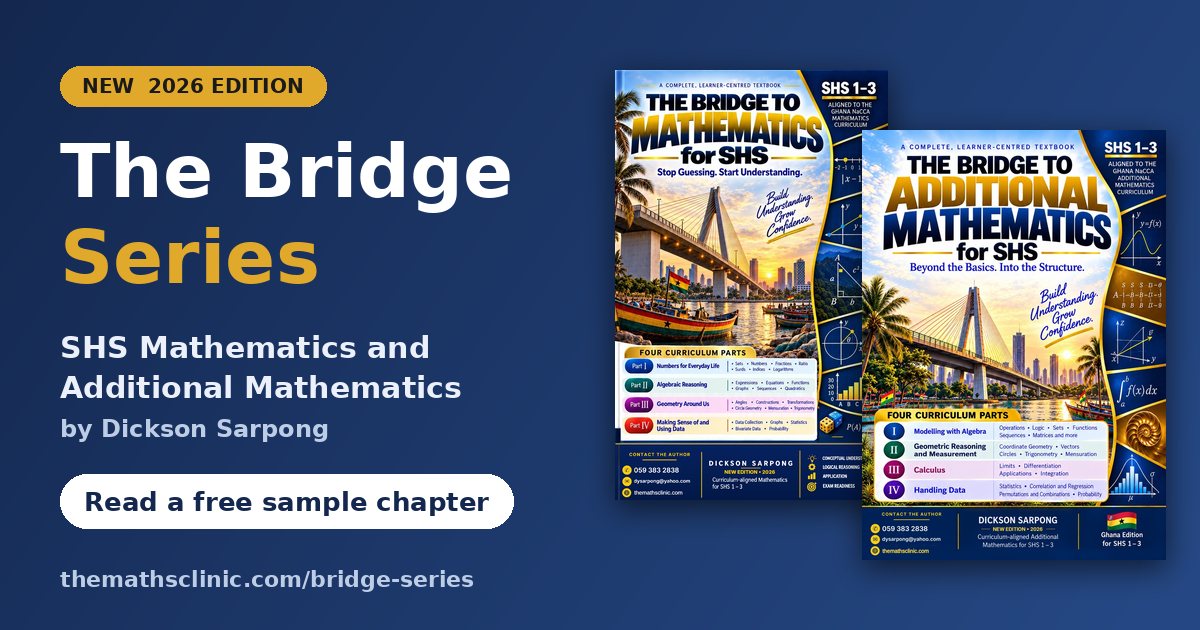
Want the whole topic, step by step? My textbooks, The Bridge to Mathematics and The Bridge to Additional Mathematics for SHS, follow the new curriculum and rebuild the basics as you go.
Read a free chapter →