Struggling with WASSCE Maths? Stop guessing. Let’s fix the gap step by step.

Business Maths Clinic
Percentages, profit and loss, discount, commission, tax and hire purchase for WASSCE and NOVDEC Core Maths, with the mistakes examiners see most.
Business maths is the part of the paper that feels most like real life: buying, selling, saving and paying. Yet it is where many candidates lose easy marks, not because the arithmetic is hard, but because they take a percentage of the wrong amount or answer a different question from the one asked.
This clinic brings all the business maths you need for WASSCE and NOVDEC Core Maths into one place: percentages, profit and loss, discount, commission, tax, hire purchase and depreciation. Each section explains the idea in one picture, then points you to the lesson that fixes it properly.
The question behind every business maths answer: percentage of WHAT? Find the base, the 100%, and the method usually chooses itself.
1. Percentages: the base decides everything
A percentage is a number of parts out of every 100. The hard part is never the multiplication; it is knowing which amount is the 100%.
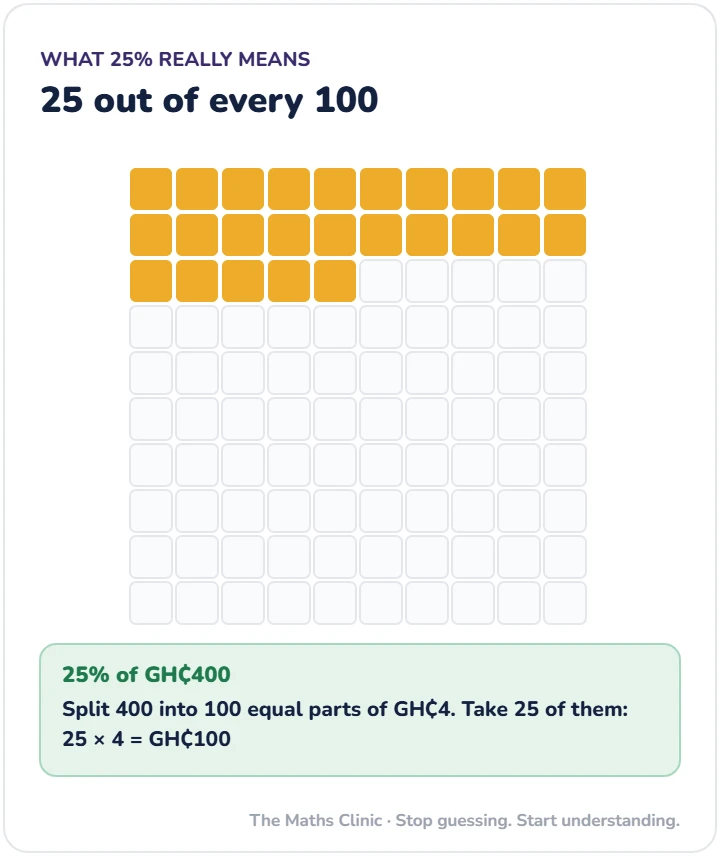
- Profit and loss percentages use the cost price.
- Discount percentages use the marked price.
- Commission uses the total sales.
- Simple interest uses the principal.
Read more: Percentages in Mathematics: 6 Common Mistakes to Avoid.
Worked example
A trader buys goods for GH₵500 and wants a 20% profit. Find the selling price.
\text{Profit} = 20\% \text{ of } 500 = \text{GH₵}100\text{SP} = 500 + 100 = \text{GH₵}600The 20% is taken from GH₵500 because the cost price is the base.
2. Profit and loss
Compare the selling price (SP) with the cost price (CP) first. SP above CP is a profit; SP below CP is a loss. Then express the profit or loss as a percentage of the cost price, because that is the money the trader put in.
\text{Profit \%} = \frac{\text{Profit}}{\text{CP}} \times 100\%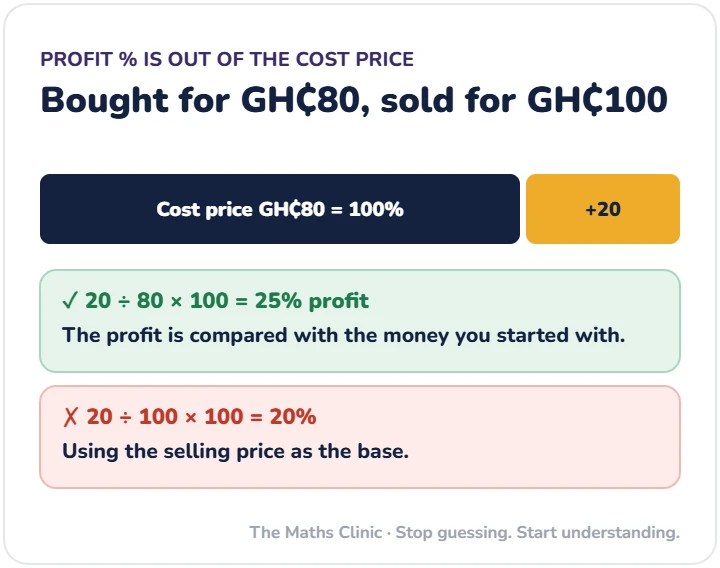
Remember that every cost of getting the item ready to sell, such as transport and repairs, belongs in the cost price.
Worked example
A phone is bought for GH₵1,500 and sold for GH₵1,350. Find the percentage loss.
\text{Loss} = 1{,}500 - 1{,}350 = \text{GH₵}150\text{Loss \%} = \frac{150}{1{,}500} \times 100\% = 10\%3. Discount and commission
Both use a percentage, but the money moves in opposite directions. A discount comes off the price, so the buyer pays less. Commission is paid to the seller, and the sales figure does not change.
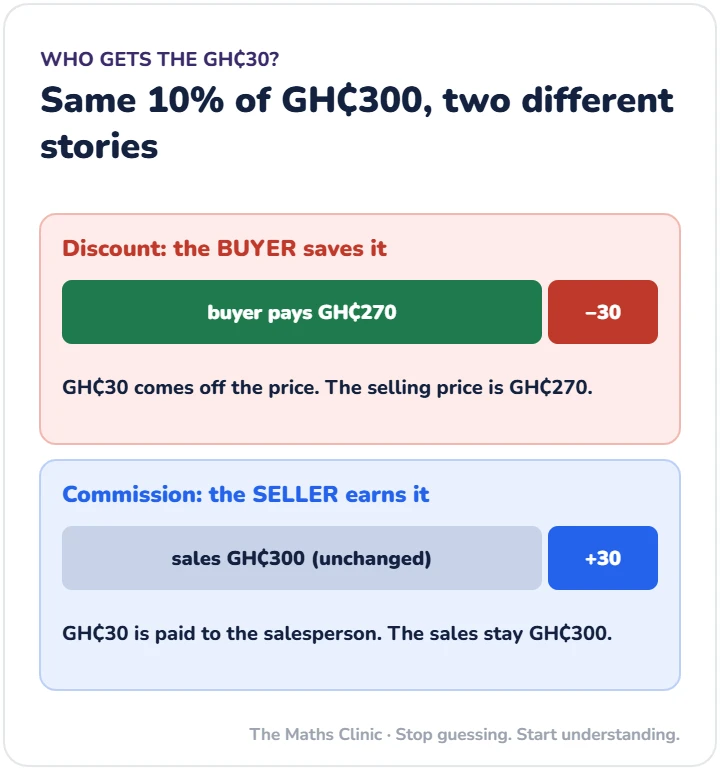
Worked example
A radio marked GH₵250 is sold for GH₵210. Find the percentage discount.
\text{Discount} = 250 - 210 = \text{GH₵}40\text{Discount \%} = \frac{40}{250} \times 100\% = 16\%Divide by the marked price, GH₵250, not the price paid.
4. Tax: inclusive or exclusive?
One word decides the method. If a price is before tax, multiply to add the tax. If a price already includes the tax, divide to remove it.
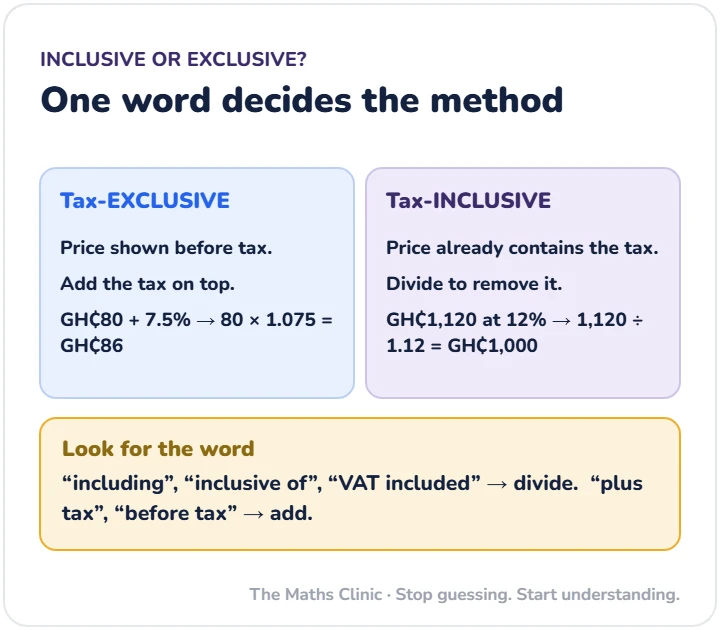
Worked example
A price of GH₵1,120 includes 12% tax. Find the price before tax.
\text{Price before tax} = \frac{1{,}120}{1.12} = \text{GH₵}1{,}000The tax is GH₵120, which is 12% of GH₵1,000, not 12% of GH₵1,120.
5. Successive percentages and reverse questions
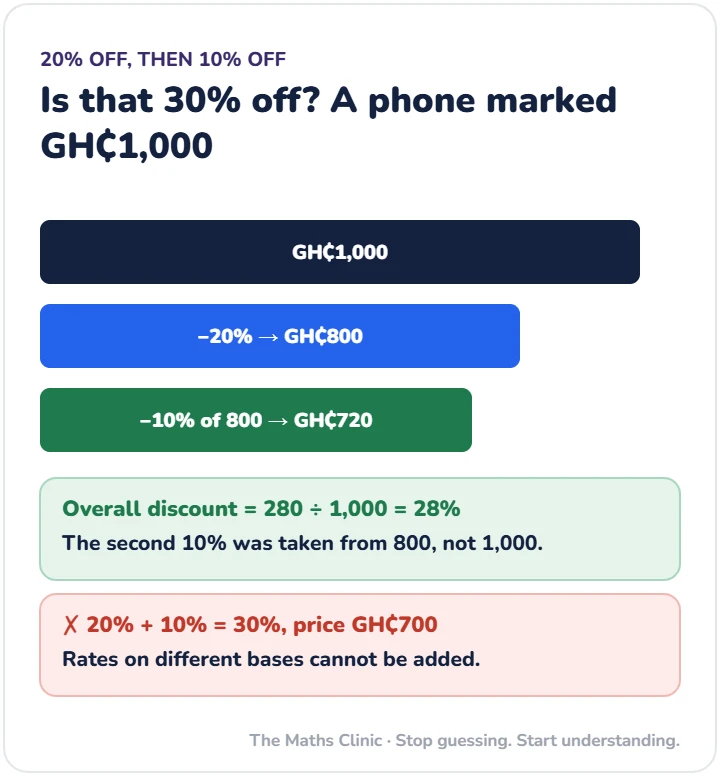
When two percentages follow each other, the second one uses the new value as its base. That is why 20% off and then 10% off is 28% off, not 30%.
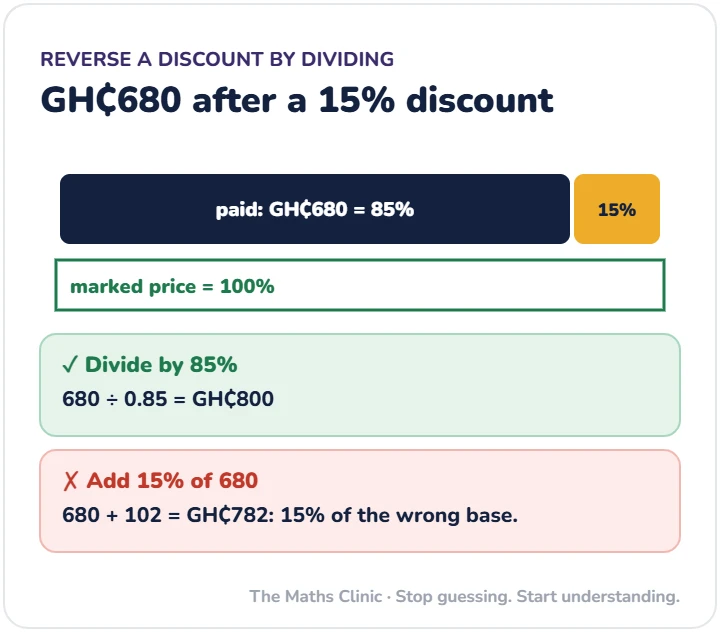
Reverse questions give you the final value and ask for the original. Never “add the percentage back”. Instead, work out what percentage the final value represents, then divide.
6. Hire purchase
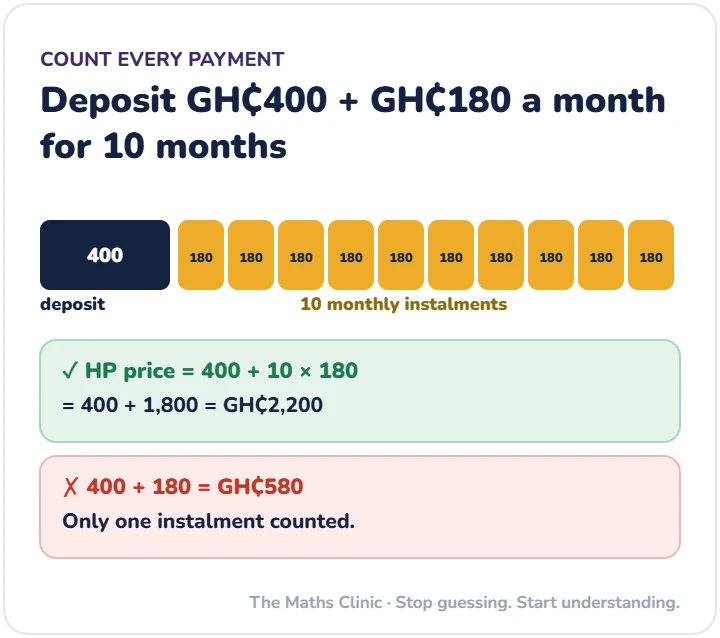
Hire purchase price = deposit + (number of instalments × instalment). Count every payment, and compare the hire purchase price with the cash price to find the extra cost.
Worked example
A fridge costs GH₵3,200 cash. On hire purchase you pay a deposit of GH₵800 and 12 monthly instalments of GH₵250.
\text{HP price} = 800 + 12 \times 250 = \text{GH₵}3{,}800\text{Extra cost} = 3{,}800 - 3{,}200 = \text{GH₵}6007. Depreciation
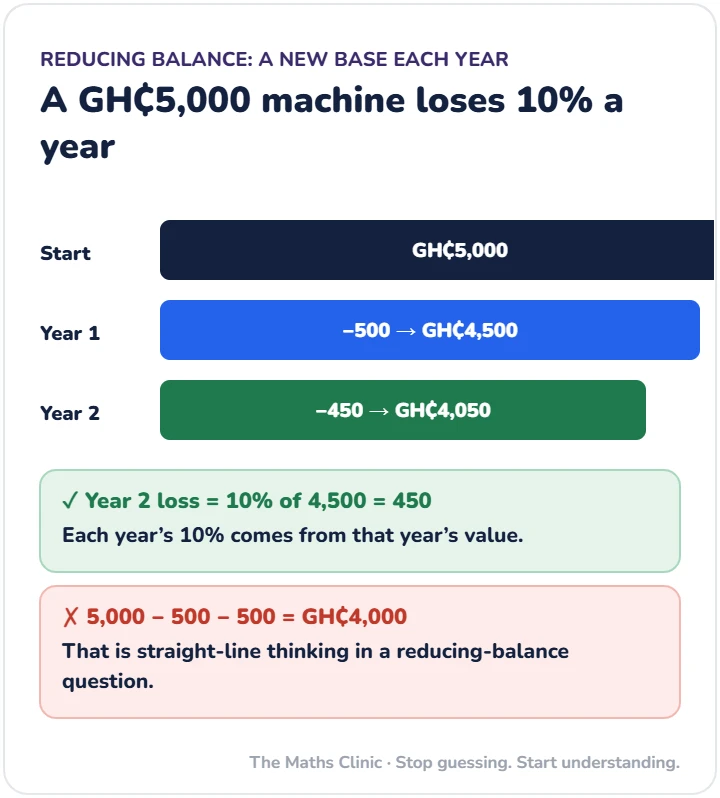
With the reducing-balance method, each year’s percentage is taken from that year’s value, so the value falls by a smaller amount every year.
Worked example
A machine worth GH₵5,000 loses 10% of its value each year on a reducing balance.
\text{Year 1: } 5{,}000 - 500 = \text{GH₵}4{,}500\text{Year 2: } 4{,}500 - 450 = \text{GH₵}4{,}050The mistakes examiners see most often
| Mistake | Fix |
|---|---|
| Profit % taken out of the selling price | Use the cost price as the base |
| Discount written as the selling price | Subtract the discount from the marked price |
| Commission added to total sales | Commission is the seller’s earnings only |
| Tax taken from a tax-inclusive price | Divide by (100 + rate)% |
| Only one instalment counted | Multiply the instalment by the number of payments |
| Percentages added across different bases | Apply each percentage to the value at that stage |
All Business Maths lessons
-
Financial Maths: 5 Simple Interest Mistakes to Correct
📚 Part of the Business Maths Clinic: every lesson on this topic, in one place. Simple interest mistakes are common in many Ghanaian SHS classrooms, even though it seems like one of the friendliest topics in Mathematics. The formula is short. The numbers are usually clear. The question may even mention bank, loan, savings, principal,… Start this lesson →
-
Percentages in Mathematics: 6 Common Mistakes to Avoid
📚 Part of the Business Maths Clinic: every lesson on this topic, in one place. Percentages in Mathematics are treated like one of the “easy” topics in many Ghanaian SHS classrooms. The teacher writes a few examples on the board, the class follows, and many learners feel comfortable. But when WASSCE brings percentages inside profit… Start this lesson →
New lessons are added here as they go live. Work through them in order, or jump to the one that matches your gap.
Questions learners often ask
Which price is the base for percentage profit?
The cost price, unless the question clearly says otherwise.
How do I find the original price after a discount?
Work out what percentage was paid (for 15% off, 85%), then divide the selling price by that percentage.
Is hire purchase extra cost the same as interest?
Not always. It is the difference between the hire purchase price and the cash price. Call it interest only if the question does.
Keep going
Simple interest has its own clinic: Simple Interest Clinic. For the full exam plan, read How to Pass WASSCE and NOVDEC Core Maths. Practise topic by topic in the Practice Zone.

Written by
Dickson Sarpong
NTC-certified SHS Mathematics teacher in Ghana with WAEC marking experience, and author of The Bridge Series textbooks. Every lesson here is built around the mistakes WAEC examiners keep reporting.
About DicksonStuck? Ask a question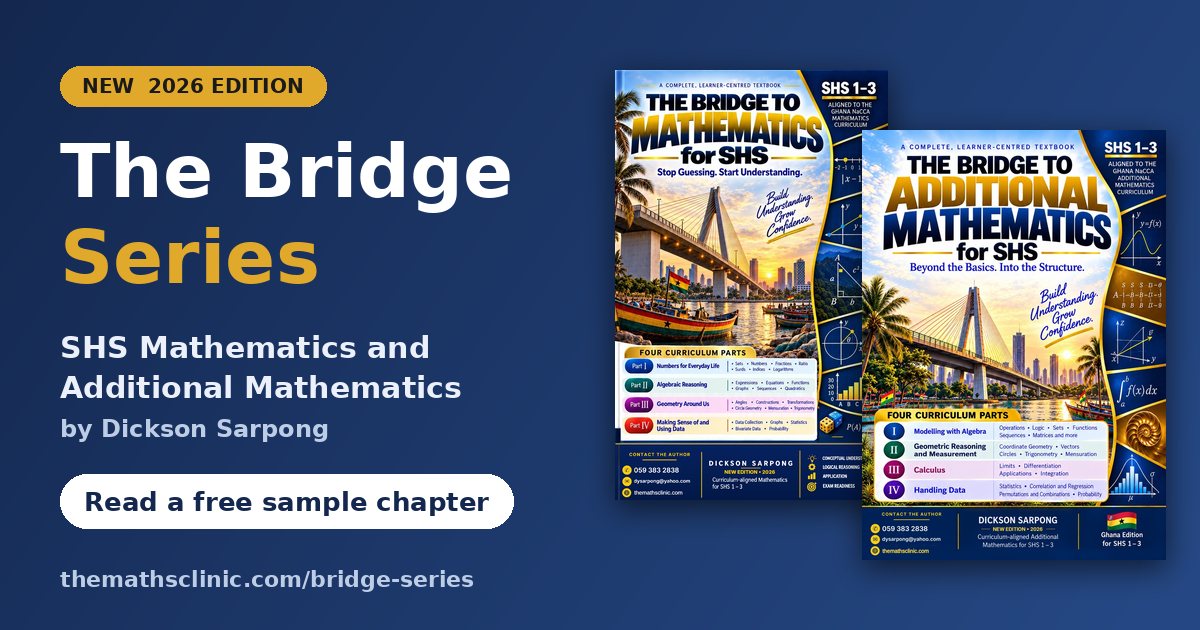
Want the whole topic, step by step? My textbooks, The Bridge to Mathematics and The Bridge to Additional Mathematics for SHS, follow the new curriculum and rebuild the basics as you go.
Read a free chapter →