Struggling with WASSCE Maths? Stop guessing. Let’s fix the gap step by step.

Mensuration & Geometry Clinic
Area, volume, surface area, circles, cyclic quadrilaterals and bearings for WASSCE and NOVDEC Core Maths, with the formula mistakes examiners report.
Mensuration and geometry questions punish formula hunting. The learner sees a cylinder, grabs the first formula they remember, and loses the marks because the question wanted the curved surface, not the volume, or gave the diameter instead of the radius.
This clinic gathers the mensuration and geometry you need for WASSCE and NOVDEC Core Maths: length, area, surface area, volume, capacity and cost, the circle formulas, cyclic quadrilaterals and bearings. Each section gives you the key idea in one picture and points you to the full lesson.
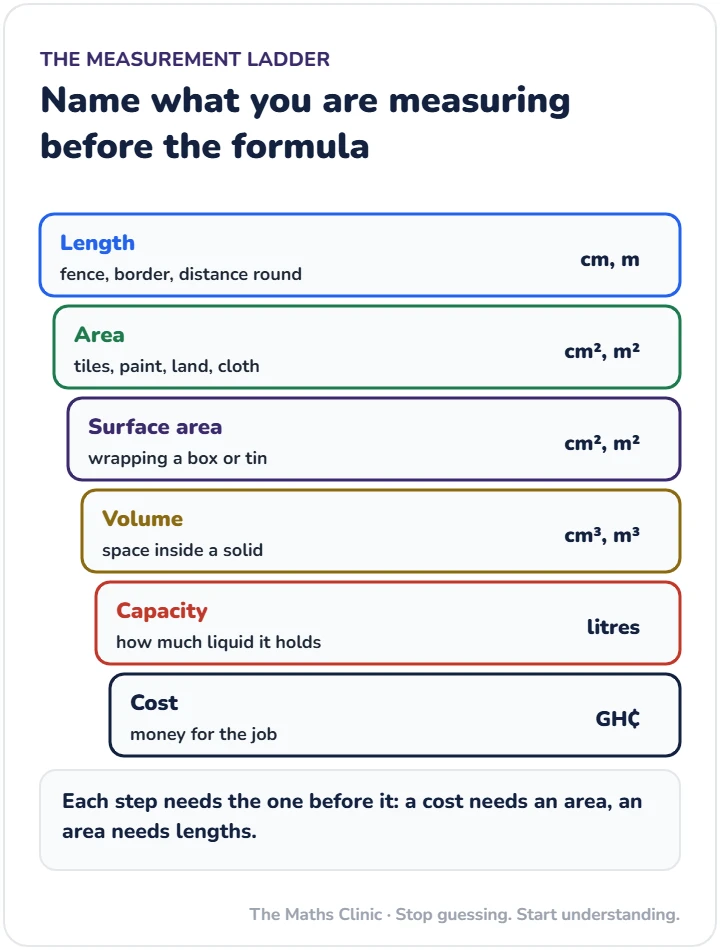
Before any formula, ask: what am I measuring? A length, an area, a volume, or a cost?
1. Name the measurement first
Fence, border and distance round are lengths. Tiles, paint and land are areas. Wrapping a tin is a surface area. The space inside is a volume, and the liquid it holds is a capacity. Cost comes last, from one of these.
2. Units tell you if your answer is possible
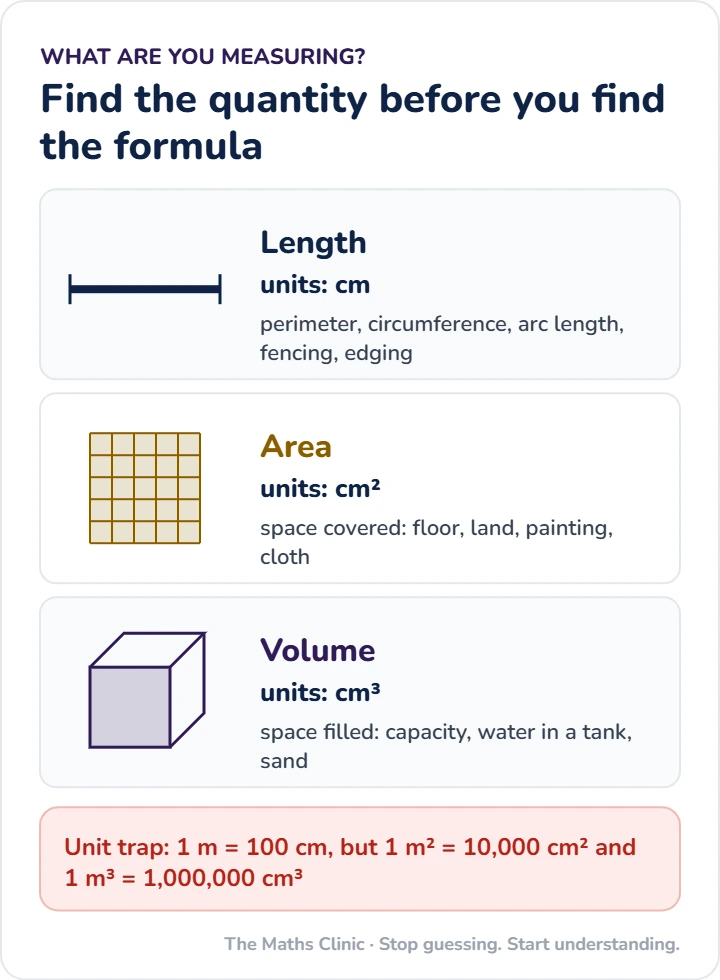
Lengths are in cm or m, areas in cm² or m², volumes in cm³ or m³. If your area answer is in cm³, a wrong formula was used.
Read more: Area, Perimeter or Volume? A Teacher’s Quick Diagnostic Checklist.
3. Radius, not diameter
Circle, cylinder, cone and sphere formulas use the radius. If the question gives the diameter, halve it first. Using the diameter in πr² makes the answer four times too big.
A = \pi r^2 = \frac{22}{7} \times 7 \times 7 = 154 \text{ cm}^2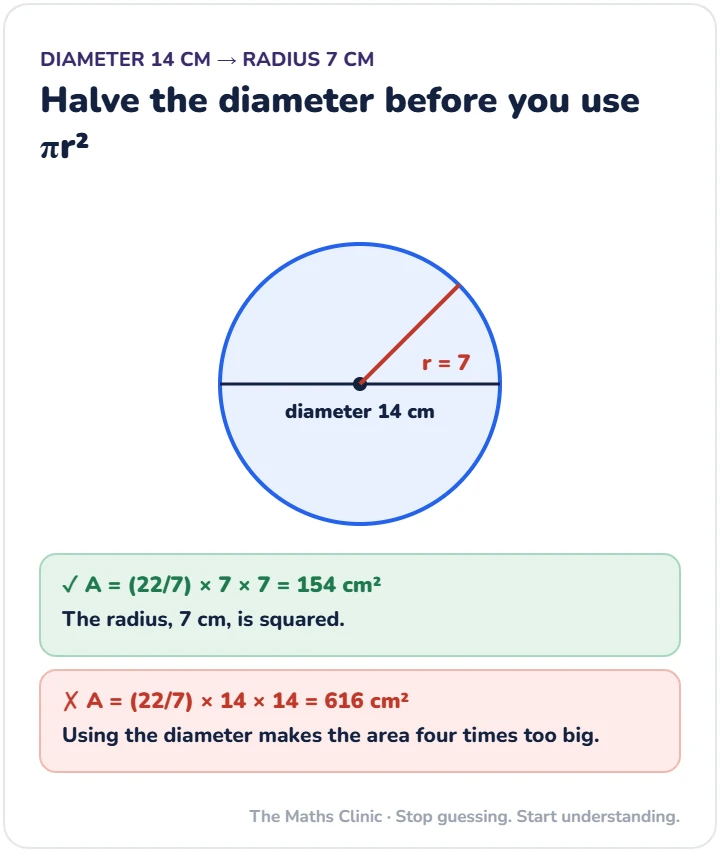
4. Sectors: arc, area and perimeter are three different answers
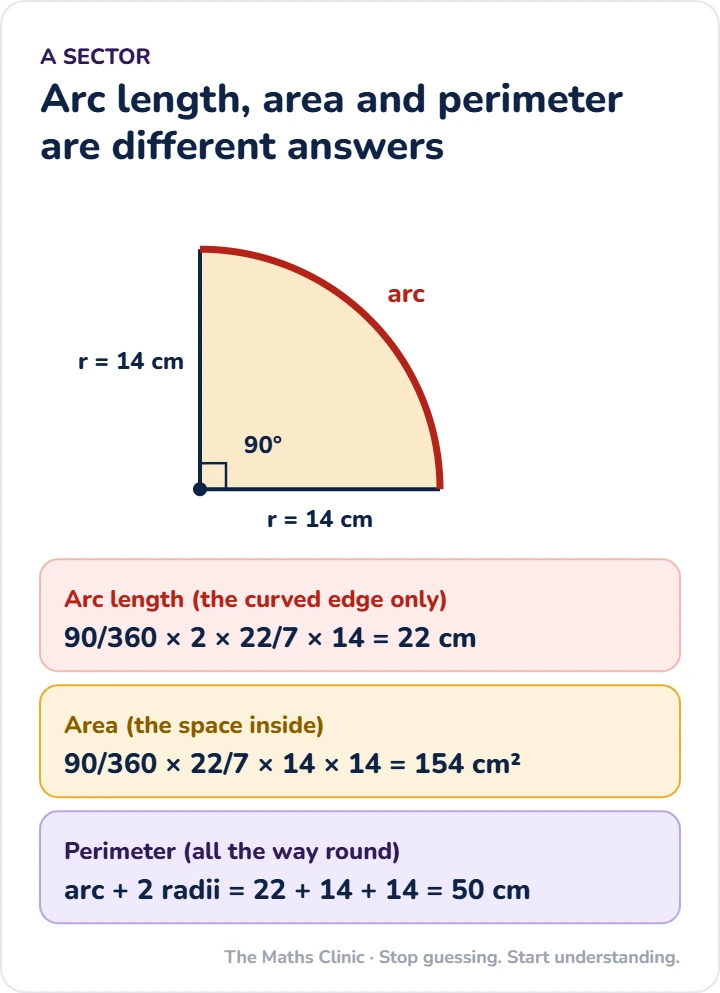
\text{Arc length} = \frac{\theta}{360^\circ} \times 2\pi r \qquad \text{Sector area} = \frac{\theta}{360^\circ} \times \pi r^25. Surface area: open or closed?
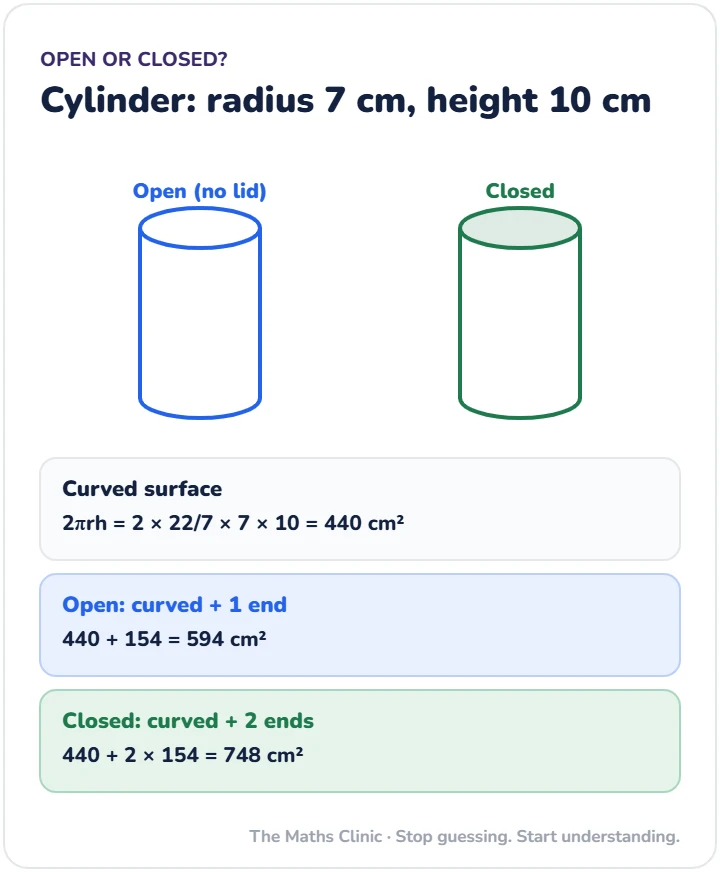
A cylinder’s curved surface is 2πrh. Add one end for an open tank and two ends for a closed one.
6. Area first, then cost
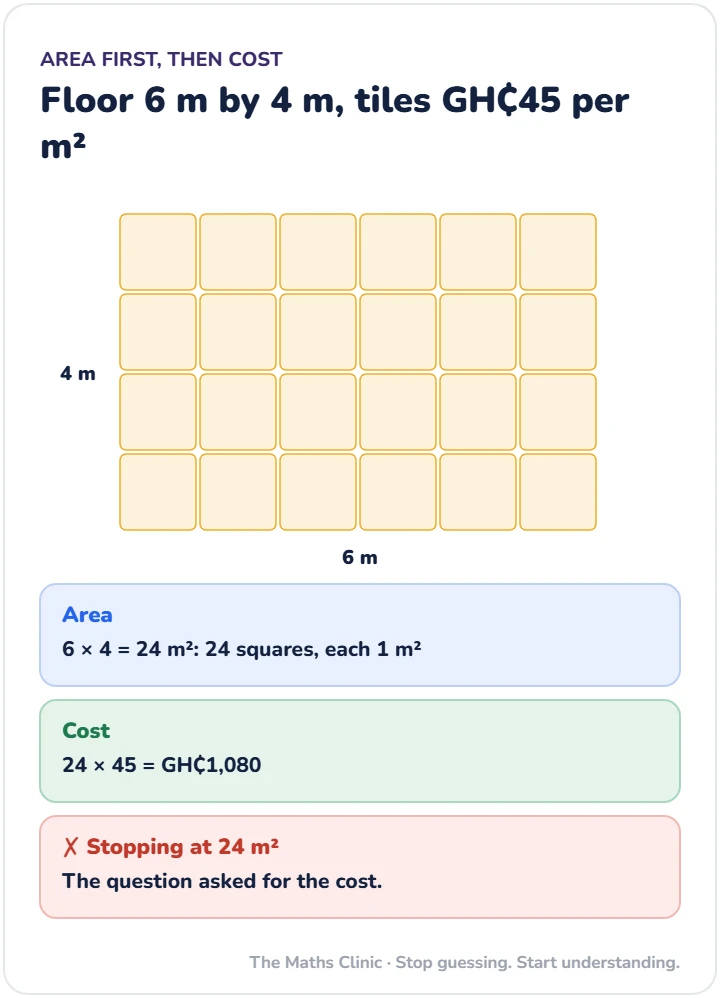
Cost questions need two steps. Find the area (or volume) first, then multiply by the price per unit.
More practice: Area and Volume in WASSCE: 10 Formula Errors and How to Fix Them.
7. Cyclic quadrilaterals
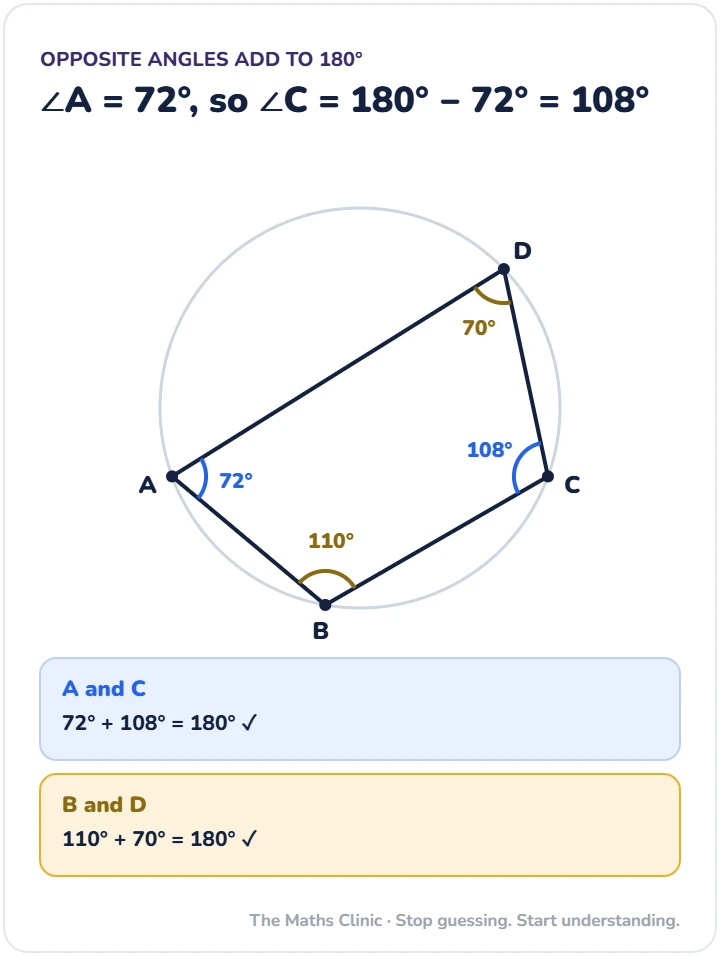
When all four corners of a quadrilateral lie on a circle, each pair of opposite angles adds up to 180°. Read the letters in order to find the opposite pairs, and always write the reason.
8. Bearings
Bearings are measured clockwise from north and written with three figures, such as 045° or 230°. Draw the north line at every point before measuring.
Read more: Bearings in Mathematics: 7 Tips to Read Directions Correctly.
The mistakes examiners see most often
| Mistake | Fix |
|---|---|
| Formula chosen before naming the measurement | Ask: length, area, volume or cost? |
| Diameter used as radius | Halve the diameter first |
| Slant height used in a cone’s volume | Volume uses the perpendicular height |
| Total surface area given when curved was asked | Read “curved”, “open” and “closed” carefully |
| Stopped at the area in a cost question | Multiply by the price per unit |
| Opposite angles of a cyclic quadrilateral made equal | They add up to 180° |
All Mensuration & Geometry lessons
-
Bearings in Mathematics: 7 Tips to Read Directions Correctly
📚 Part of the Mensuration & Geometry Clinic: every lesson on this topic, in one place. In many Ghanaian SHS classrooms, the moment some students hear “bearing,” their confidence drops. You will hear somebody say, “Sir, this one is for pilots and sailors.” Another learner will draw many lines on the paper, turn the protractor… Start this lesson →
-
Area and Volume in WASSCE: 10 Formula Errors and How to Fix Them
📚 Part of the Mensuration & Geometry Clinic: every lesson on this topic, in one place. Formula Errors in Area and Volume is meant for a struggling Ghanaian SHS learner who remembers several mensuration formulas but misidentifies the dimensions, radius, height, or required unit. This mensuration formulas clinic diagnoses the dimension-and-formula gap, corrects it visibly,… Start this lesson →
-
Area, Perimeter or Volume? A Teacher’s Quick Diagnostic Checklist
📚 Part of the Mensuration & Geometry Clinic: every lesson on this topic, in one place. Area, perimeter, or volume is meant for a struggling Ghanaian SHS learner who knows several mensuration formulas but cannot decide whether a practical situation requires distance around, flat covering, outside covering, or space inside. A learner may know: A=lb,… Start this lesson →
New lessons are added here as they go live.
Questions learners often ask
Which value of π should I use?
Use the value the question gives, often 22/7 or 3.142. If none is given, use the π key on your calculator and round at the end.
How do I convert cm³ to litres?
1 litre = 1,000 cm³, so divide the volume in cm³ by 1,000.
How do I know a quadrilateral is cyclic?
If one pair of opposite angles adds up to 180°, the quadrilateral is cyclic.
Keep going
For the full exam plan, read How to Pass WASSCE and NOVDEC Core Maths. Practise in the Practice Zone.

Written by
Dickson Sarpong
NTC-certified SHS Mathematics teacher in Ghana with WAEC marking experience, and author of The Bridge Series textbooks. Every lesson here is built around the mistakes WAEC examiners keep reporting.
About DicksonStuck? Ask a question
Want the whole topic, step by step? My textbooks, The Bridge to Mathematics and The Bridge to Additional Mathematics for SHS, follow the new curriculum and rebuild the basics as you go.
Read a free chapter →