Struggling with WASSCE Maths? Stop guessing. Let’s fix the gap step by step.
8 Silent Mistakes That Follow Weak Students from JHS to SHS

Weak students from JHS to SHS do not usually begin struggling with mathematics on the first day of SHS. In many cases, the difficulty starts quietly in JHS through small errors in basic operations, fractions, negative numbers, mathematical language, and word problems. Because the learner can still answer a few direct questions, the hidden gap may remain unnoticed.
By the time the learner reaches SHS, those same JHS Maths gaps begin to affect algebra, graphs, percentages, geometry, statistics, financial maths, and other WASSCE Core Maths topics. The learner may then conclude, “I am bad at Maths,” when the real problem is a weak Core Maths foundation that was never diagnosed and repaired.
That is why this lesson matters. A weak learner is not automatically lazy or incapable. Many Ghanaian SHS students need focused Maths intervention, patient explanation, and guided practice that shows exactly where understanding breaks down.
This post answers one important learner question: How does identifying these silent mistakes help weak students from JHS to SHS understand Core Maths better before WASSCE?
It helps the learner stop blaming the whole of mathematics and start locating the exact foundation gap. Once the hidden mistake is exposed, SHS Maths help becomes more focused, practice becomes more useful, and WASSCE Core Maths begins to make better sense.
How This Connects to Ghana’s New SHS Mathematics Curriculum
Ghana’s new secondary education mathematics curriculum does not treat mathematics as a subject where learners only memorize formulas and copy procedures. It places greater emphasis on conceptual understanding, critical thinking, problem-solving, communication, reasoning, collaboration, and the application of mathematics to real-life situations. This means a learner must understand why a method works, explain steps clearly, connect ideas, and use earlier knowledge in unfamiliar problems.
The curriculum also expects teaching to respond to differences among learners transitioning from JHS. That makes the diagnosis of JHS Maths gaps important. A learner who has not mastered fractions, integers, operations, reading, or mathematical language will struggle to demonstrate the higher-level competencies expected in SHS, even when the new topic has been taught well.
Maths clinic curriculum connection: Diagnose the missing foundation skill first; rebuild it through examples and guided practice; then return the learner to the SHS task so the learner can reason, explain, apply, and solve independently.
What the WAEC Chief Examiners’ Reports Reveal
WAEC Chief Examiners’ Reports are useful because they do more than show which topics candidates found difficult. They repeatedly draw attention to weaknesses in understanding instructions, applying basic principles, showing logical working, handling signs and operations, interpreting word problems, using correct units, drawing or reading graphs, approximating appropriately, and checking whether an answer is reasonable.
These concerns support the main diagnosis in this post: many examination errors are not caused only by the final SHS topic. They often grow from small foundation weaknesses and poor mathematical habits. When such weaknesses follow weak students from JHS to SHS, they appear later as lost marks in WASSCE core maths.
Chief Examiner connection: The examiner marks the work shown on the script, not the learner’s intention. Clear reasoning, correct mathematical language, accurate operations, proper units, and complete working are therefore part of understanding—not optional finishing touches.
1. Weak Understanding of Basic Operations
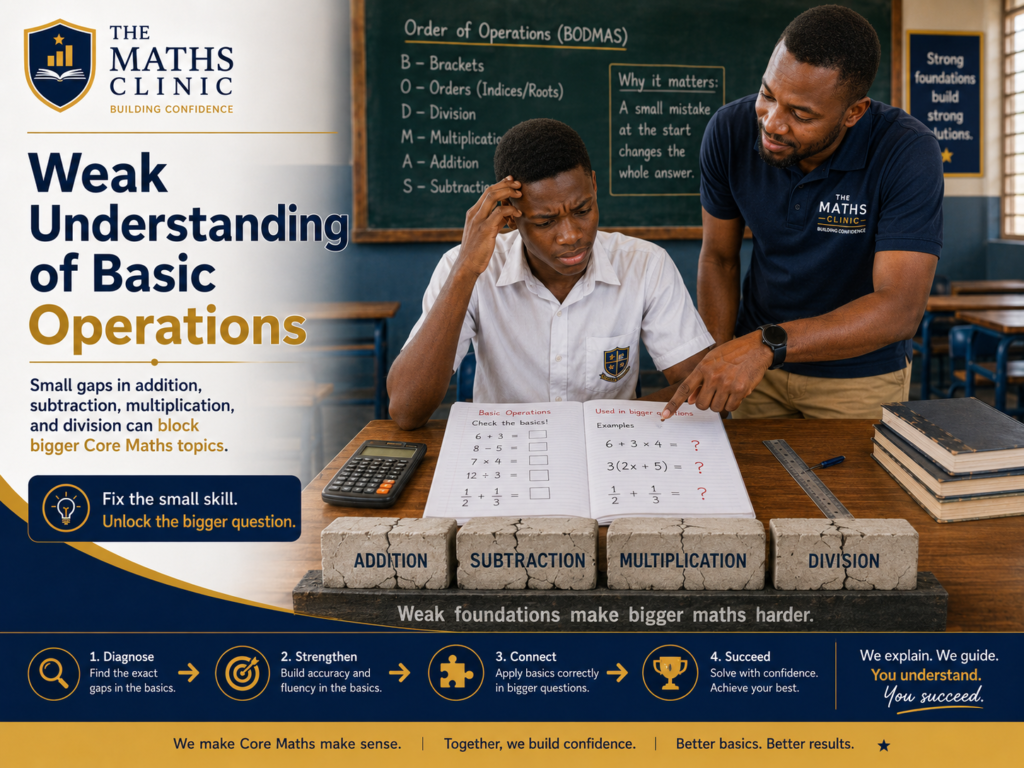
The first silent mistake is a weak understanding of addition, subtraction, multiplication, and division. Some learners can perform these operations in short exercises, but confusion starts when the same operations appear inside fractions, algebra, percentages, ratios, geometry, or a word problem.
For example, a learner may know that 6 × 7 = 42 but struggle to recognize the multiplication required in 3(2x + 5), ratio sharing, the area of a shape, or simple interest.
Why This Mistake Follows Students
In JHS, some learners depend heavily on counting, guessing, or pressing a calculator without understanding what each operation represents. When the operation is hidden inside a longer SHS question, the learner cannot decide which operation to use or why.
Connection to the New Curriculum and WAEC Reports
The new curriculum expects learners to use number sense, reason about operations, and solve real-life problems rather than press buttons without meaning. WAEC reports also reward correct procedures and logical working. Rebuilding basic operations therefore strengthens both curriculum competence and WASSCE performance.
How This Helps the Learner Understand Core Maths Better
When the learner notices this gap, the learner can stop saying, “I do not understand algebra.” The exact problem may be, “I do not understand how multiplication works inside brackets.” Correcting that small gap can unlock several Core Maths topics.
2. Poor Handling of Fractions
Fractions are among the biggest silent problems that follow weak students from JHS to SHS. In SHS, fractions appear in algebra, indices, probability, statistics, gradients, trigonometry, ratios, percentages, and financial maths.
For example, a learner who cannot simplify fractions confidently may struggle with an equation such as x/3 + 2 = 7, even when the equation method has been explained correctly.
Why This Mistake Follows Students
Many learners memorize phrases such as “find the LCM” or “cross multiply” without understanding when each procedure applies. The learner remembers a rule but cannot connect it to the structure of a new question.
Connection to the New Curriculum and WAEC Reports
The new SHS Mathematics curriculum requires connections between number concepts and problem-solving. WAEC Chief Examiners’ comments on weak manipulation and incorrect procedures show why fraction understanding matters. A learner who understands equivalence, common denominators, and fraction operations is better prepared to reason through unfamiliar questions.
How This Helps the Learner Understand Core Maths Better
Once fractions are identified as the hidden gap, revision becomes focused. The learner can rebuild the fraction skill before returning to algebra, probability, percentages, or ratio. That is targeted Maths intervention, not blind repetition.
3. Confusion with Negative Numbers
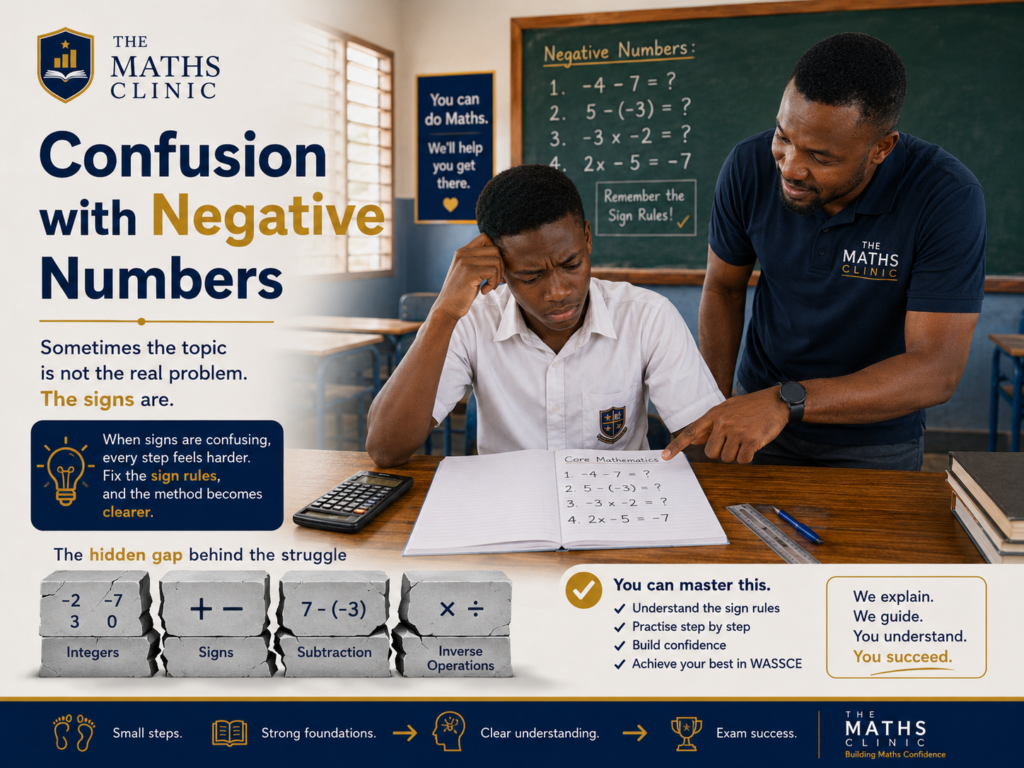
Negative numbers are quite troublemakers in core maths. A learner may understand the main topic but lose marks because of one incorrect sign.
This weakness appears in algebra, graphs, vectors, gradients, transformations, simultaneous equations, coordinate geometry, and substitutions.
Why This Mistake Follows Students
In JHS, some learners memorize sign rules but do not practice them in enough different situations. They may know that a negative multiplied by a negative gives a positive yet lose control when several signs appear in a longer solution.
Connection to the New Curriculum and WAEC Reports
The curriculum expects learners to reason, explain, and apply operations accurately. WAEC reports frequently identify careless manipulation, incorrect substitution, and sign errors as causes of lost marks. Sign control is therefore both a foundation skill and an examination skill.
How This Helps the Learner Understand Core Maths Better
When the learner diagnoses sign control as the real problem, the learner no longer needs to relearn the whole topic. Focused practice with integers, directed numbers, substitution, and inverse operations can repair many SHS Maths errors.
4. Copying Steps Without Understanding the Reason
Some weak learners survive JHS by copying the teacher’s steps neatly. Their notes look complete, but the reasoning behind the steps is missing.
This habit becomes dangerous in SHS because WASSCE Core Maths questions may test the same concept in a different form. The learner then waits for the question to look exactly like the classroom example.
Why This Mistake Follows Students
The learner may believe mathematics is about remembering the arrangement of steps. During a worked example, the learner copies what the teacher writes but does not ask why a sign changed, why a value was substituted, or why a particular formula was selected.
Connection to the New Curriculum and WAEC Reports
The new curriculum moves away from rote learning towards conceptual understanding, problem-solving, communication, and application. WAEC also expects candidates to show meaningful working, not disconnected answers. Understanding the reason behind each step prepares learners for questions that look different but use the same idea.
How This Helps the Learner Understand Core Maths Better
This diagnosis trains the learner to ask better questions: Why did we divide by 100? Why did we use the original price? Why did we multiply every term in the bracket? Why does this formula apply? Once the reason is clear, the method can be transferred.
5. Weak Reading and Translation of Word Problems
Many Ghanaian SHS students can solve a direct calculation but struggle when the same mathematics is written as a story. This weakness often begins in JHS and later affects percentages, ratios, financial maths, mensuration, probability, statistics, and algebra.
A learner may know how to calculate a percentage, but words such as “discount,” “profit,” “loss,” “original price,” “selling price,” “remaining amount,” or “percentage increase” can create confusion.
Why This Mistake Follows Students
Some learners were trained to calculate quickly but not to read slowly. They see numbers and begin operating on them before identifying the unknown, the relationship, and the question being asked.
Connection to the New Curriculum and WAEC Reports
Real-life application and mathematical communication are central to the new curriculum. WAEC Chief Examiners’ Reports also point to candidates misreading questions, failing to interpret information, or answering something different from what was required. Reading and translation are therefore part of mathematics, not separate English work.
How This Helps the Learner Understand Core Maths Better
The learner must practice underlining important information, identifying the topic, defining the unknown, translating words into symbols or equations, and checking that the final answer fits the story. This makes WASSCE word problems less frightening and more structured.
6. Poor Use of Mathematical Language
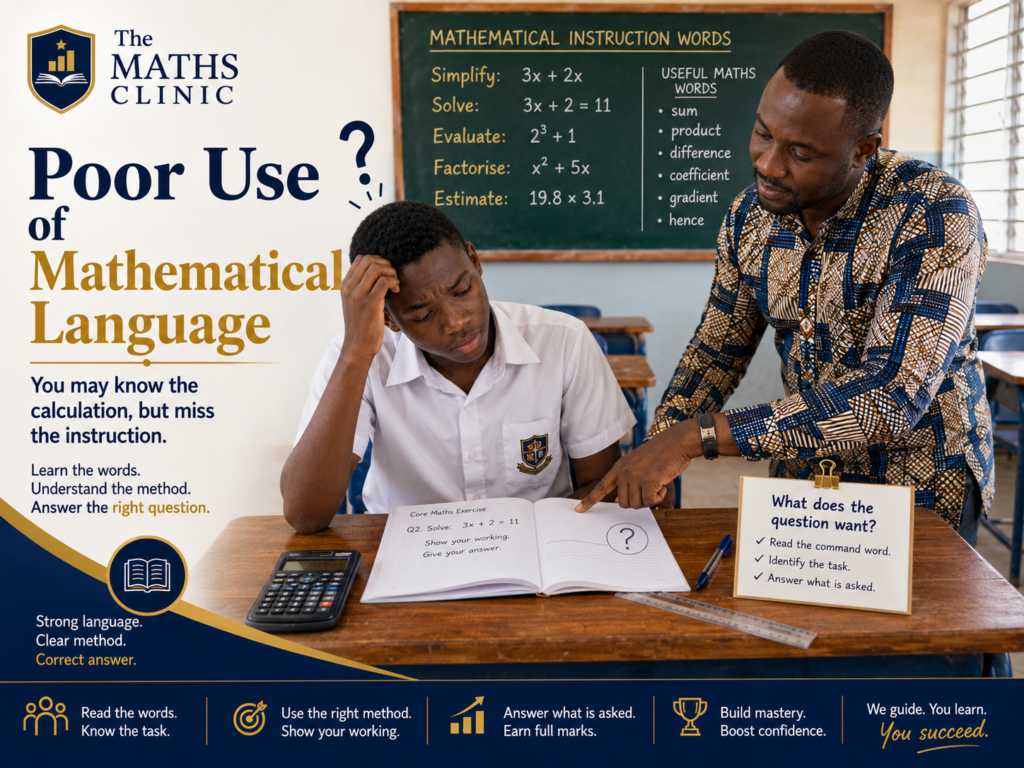
Mathematics has a precise language. Words such as “sum,” “product,” “difference,” “factor,” “multiple,” “coefficient,” “gradient,” “estimate,” “simplify,” “evaluate,” “solve,” and “prove” hence tell the learner what kind of response is required.
A learner may know a calculation but still choose the wrong method because the instruction word was misunderstood.
Why This Mistake Follows Students
In JHS, some learners focus only on obtaining an answer and ignore the meaning of command words. In SHS, they may simplify when the question asks them to solve, calculate when they are expected to explain, or give a decimal when an exact value is required.
Connection to the New Curriculum and WAEC Reports
The new curriculum values mathematical communication and correct use of representations. WAEC examiners also assess whether candidates respond to the command, use acceptable notation, and present working clearly. Learning mathematical language improves both understanding and answer quality.
How This Helps the Learner Understand Core Maths Better
Once the instruction is understood, the learner can select the correct method, organize the solution properly, and avoid wasting time on work that does not answer the question.
7. Poor Checking Habit
Some learners finish a question and move on immediately. They do not check the copied numbers, operation, sign, substitution, unit, degree of accuracy, graph scale, or whether the final statement answers the exact question.
This habit follows weak students from JHS to SHS and turns correct understanding into lost WASSCE marks.
Why This Mistake Follows Students
Many learners think checking is only for very strong students or for candidates who finish early. However, checking is part of mathematical reasoning because it tests whether the result is sensible and consistent with the question.
Connection to the New Curriculum and WAEC Reports
The new curriculum encourages reflection, reasoning, and verification. WAEC Chief Examiners’ Reports repeatedly show the cost of omitted units, inaccurate approximations, poor scales, incomplete answers, and careless arithmetic. A checking routine directly addresses these weaknesses.
How This Helps the Learner Understand Core Maths Better
The learner should ask, “Did I copy the question correctly?” Is the sign reasonable? Did I use the correct unit? Did I answer what was asked? Can I substitute my answer back in? This habit reduces avoidable errors and gradually builds maths confidence.
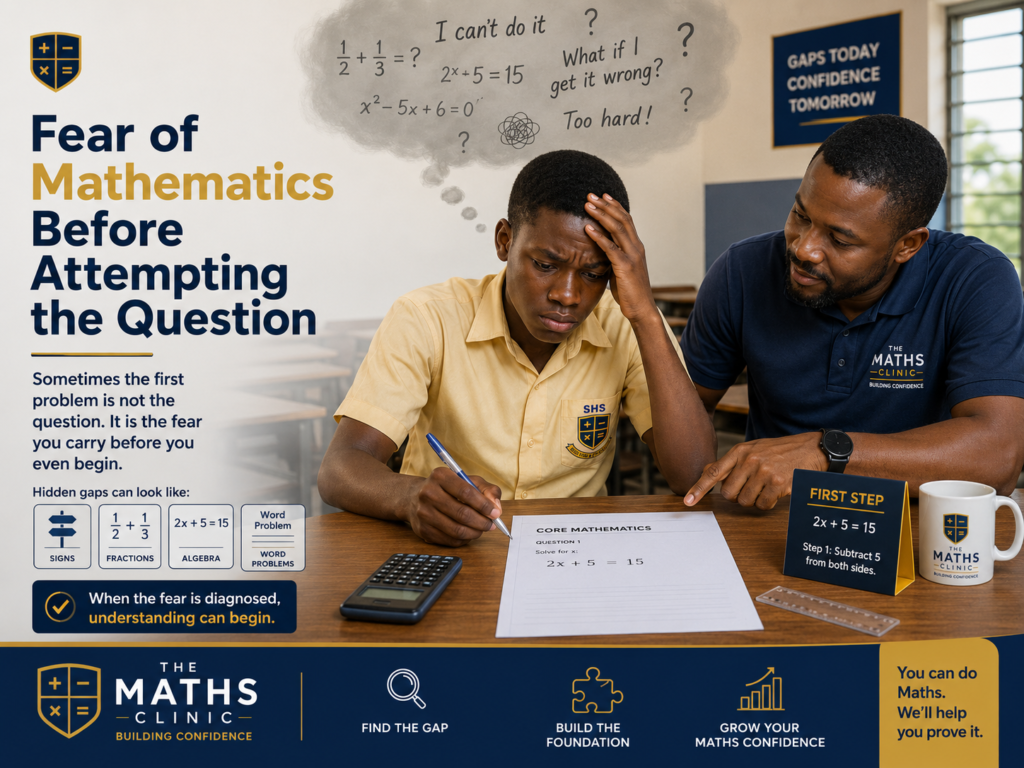
8. Fear of Mathematics Before Attempting the Question
Some learners carry fear from JHS into SHS. Before reading the question properly, they have already concluded, “I cannot do this.” Fear then blocks attention, working memory, and willingness to try.
The learner may rush, guess, copy another person’s method, or leave a question blank without identifying the first manageable step.
Why This Mistake Follows Students
This fear may grow from repeated failure, harsh correction, embarrassment, weak foundations, or years of hearing that mathematics is only for brilliant learners. The emotion becomes stronger than the learner’s actual ability.
Connection to the New Curriculum and WAEC Reports
The new curriculum aims to develop confident, engaged problem-solvers and provides room for differentiated learning. A diagnostic, non-shaming approach supports that aim. WAEC cannot award marks for work that is never attempted, so helping the learner begin, show steps, and use known information has direct examination value.
How This Helps the Learner Understand Core Maths Better
The learner can replace “I cannot do Maths” with a more accurate statement: “I am afraid because this type of question exposed a gap before, but I can identify the topic and attempt the first step.” Confidence grows from corrected understanding and repeated evidence of progress.
Worked Example: How a JHS Mistake Can Affect SHS Algebra
Solve: 3(x − 2) = 15
Common Wrong Approach
Some learners write 3x − 2 = 15 and continue solving. The learner multiplied 3 by x but forgot that the 3 must multiply every term inside the bracket.
Correct Method
3(x − 2) = 15
3x − 6 = 15
3x = 15 + 6
3x = 21
x = 7
What This Reveals
The learner may call this an algebra problem, but the hidden weakness may be multiplication across a bracket and control of a negative sign. This is why diagnosis matters. It identifies the small Core Maths foundation skill that must be corrected before the learner practices more complicated equations.
Curriculum and WAEC lesson: The learner should explain why every term is multiplied, show the logical steps, and check the solution by substituting x = 7 into the original equation. This combines conceptual understanding, communication, reasoning, and verification.
Common Wrong Approach Among Weak Learners
Many weak learners revise by reading everything again from the beginning. That may look serious, but it is not always effective. If the problem is fractions, reading the whole textbook will not repair the gap quickly. If the problem is signs, watching a long lesson on every algebra topic may not solve it. If the problem is reading and translation, doing only direct calculations will not prepare the learner for WASSCE word problems.
The wrong approach is blind revision. The better approach is diagnosis first, correction second, targeted practice third, and independent application last.
Correct Method: A Six-Step Maths Intervention for Hidden Gaps
- Choose one SHS Core Maths topic that gives you trouble.
- Solve five carefully selected questions without copying a worked example.
- Mark the work honestly and separate wrong answers from lucky guesses.
- Write the exact error: operation, fraction, sign, reading, language, formula choice, unit, or checking.
- Identify the JHS foundation skill hiding beneath the SHS topic and practice that small skill.
- Return to the original SHS question, explain the method, solve independently, and check the answer.
This method supports the new curriculum because it develops understanding, problem-solving, communication, reflection, and independent application. It also addresses the recurring examination weaknesses highlighted in WAEC Chief Examiners’ Reports.
Practice Task: Check Whether These Mistakes Are Following You
1. Basic operations
Simplify: 6 + 3 × 4
Diagnosis question: Did you multiply before adding, and can you explain why?
2. Fractions
Simplify: 1/2 + 1/3
Diagnosis question: Did you use equivalent fractions with a common denominator?
3. Negative numbers
Simplify: −4 − 7
Diagnosis question: Did you understand the direction and meaning of the signs?
4. Brackets
Expand: 5(x − 3)
Diagnosis question: Did you multiply every term inside the bracket?
5. Word problem
Ama has GH₵20 more than Kofi. Together they have GH₵100. Find how much each person has.
Diagnosis question: Did you define the unknown and translate the statement into an equation?
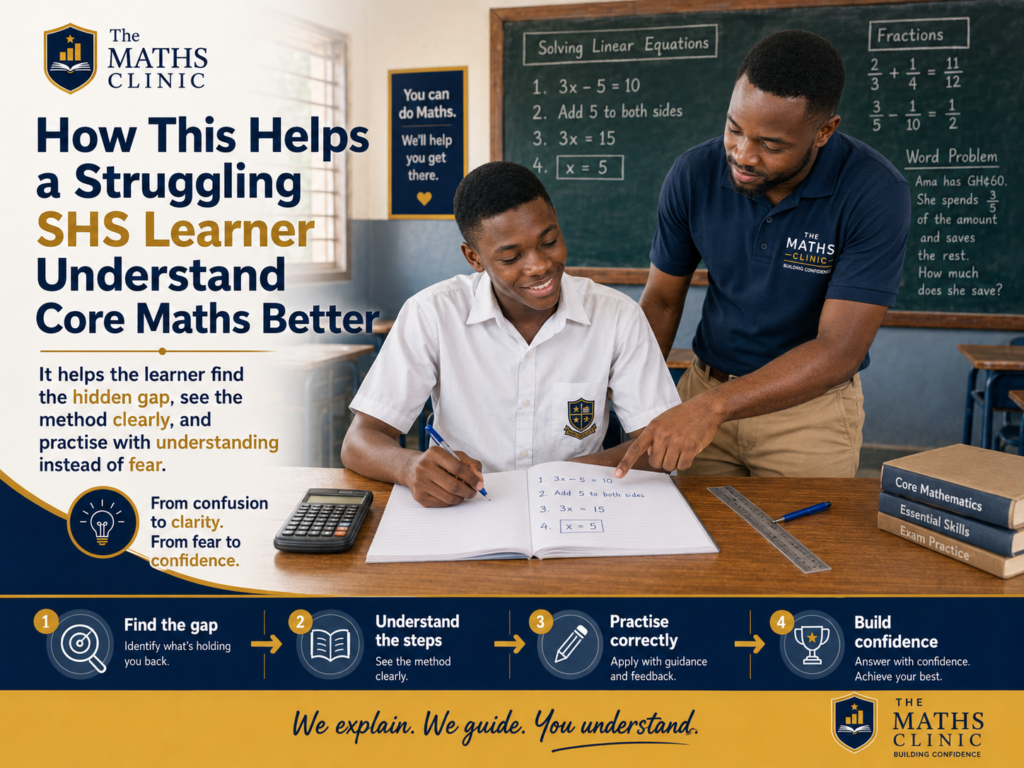
How This Helps a Struggling SHS Learner Understand Core Maths Better
This lesson helps a struggling learner understand Core Maths better because it shows that many SHS difficulties have roots in JHS Maths gaps. When the learner sees the root, the learner stops fighting only the visible leaves.
A learner struggling with percentages may need to repair fractions. A learner struggling with algebra may need to repair signs, operations, and brackets. A learner struggling with word problems may need to repair reading and translation. A learner who understands the topic but keeps losing marks may need a better checking habit.
This approach also fits Ghana’s new SHS mathematics curriculum. It moves the learner from memorising steps to understanding concepts, explaining reasoning, solving real-life problems, applying knowledge in unfamiliar situations, and reflecting on whether an answer is sensible.
It also responds to the WAEC Chief Examiners’ Reports. Instead of waiting until the examination to discover errors in interpretation, signs, operations, units, working, graphs, or approximation, the learner practices correcting those habits during normal lessons and revision.
The learner no longer says, “Maths is hard.” The learner says, “This is the exact silent mistake following me from JHS to SHS, and this is the correction I need.” That is how targeted SHS math helps turn confusion into diagnosis and diagnosis into progress.
Final Advice Before WASSCE
When WASSCE Core Maths feels difficult, do not blame only the SHS topic in front of you. Look beneath it. Ask which JHS foundation skill the question is demanding.
Is the gap in fractions, signs, multiplication, reading, mathematical language, formula choice, units, graph work, or checking? Once you identify it, do not hide it or feel ashamed. Repair it through short, focused, guided practice.
At The Maths Clinic, weak students from JHS to SHS are not treated as finished learners. Many need proper diagnosis, patient correction, and practice designed around the exact point of breakdown. The earlier those silent mistakes are corrected, the stronger the learner’s Core Maths foundation becomes. With a stronger foundation, the learner can participate more fully in the new curriculum and approach WASSCE