Struggling with WASSCE Maths? Stop guessing. Let’s fix the gap step by step.

Trigonometry Word Problems: Due North, Due South and Due East Questions
“P is due south of the tower and Q is due east of it.” How to find the hidden right angle and solve positional trigonometry word problems.

📚 Part of the Trigonometry Clinic: every lesson on trigonometry, elevation, depression and bearings, in one place.
Quick answer: how do you solve trigonometry word problems with due north, south, east or west?
Draw a plan view from above. “Due” means exactly, so any due-north or due-south line meets any due-east or due-west line at 90°. Mark that right angle first, then use Pythagoras or SOHCAHTOA. If a height is involved, draw a separate side view for the angle of elevation or depression.
Many WASSCE trigonometry questions hide a right angle inside compass words: “P is due south of the tower”, “Q is 35 m due east of it”, “a ship sails due east while another sails due south”. Once you see that “due” directions meet at 90°, these questions become Pythagoras plus one ratio.
The question never says “right angle”. It says “due south” and “due east”, and expects you to know what that means. Once the right angle is marked, the rest is Pythagoras or SOHCAHTOA. Every step is written out below.
Why “due” directions give right angles
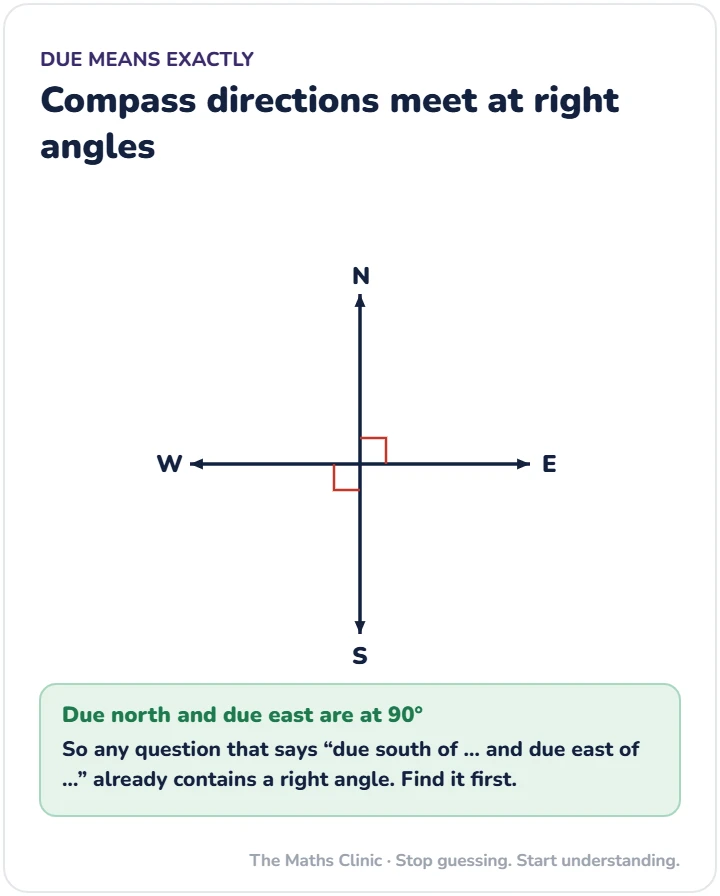
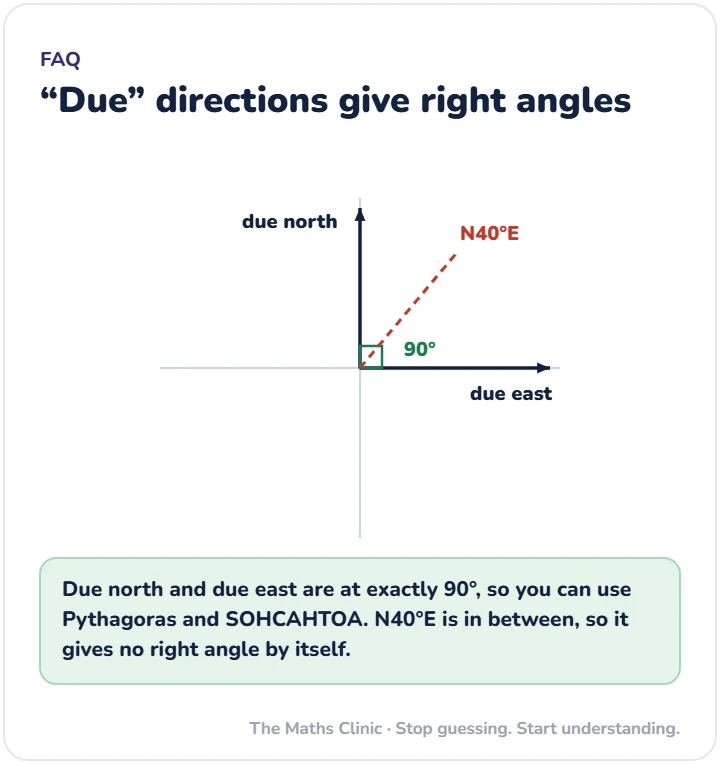
North–south and east–west are perpendicular: they cross at exactly 90°. So a line due south of a point and a line due east of the same point meet at a right angle. “North-east” or “N40°E” are not exactly on those lines, so they do not give a right angle.
Example 1: due south of a tower, due east of it
A vertical tower is 40 m high. A point P is due south of the foot F of the tower, and the angle of elevation of the top from P is 30°. A point Q is 35 m due east of F. Find the distance PQ, and the angle of elevation of the top of the tower from Q.

Step 1: the side view at P. The tower FT is vertical, so the angle at F is 90°. tan 30° = opposite ÷ adjacent = 40 ÷ PF. So PF = 40 ÷ tan 30° = 40 ÷ 0.5774:
PF=\dfrac{40}{\tan 30^\circ}=69.28\text{ m}Step 2: the plan view. P is due south of F and Q is due east of F, so the angle PFQ is 90°. Pythagoras: PQ² = PF² + FQ² = 69.28² + 35² = 4800 + 1225 = 6025.
PQ=\sqrt{69.28^2+35^2}=77.6\text{ m}Step 3: the side view at Q. tan(angle at Q) = 40 ÷ 35 = 1.1429, so the angle of elevation from Q is:
\tan^{-1}\tfrac{40}{35}=48.8^\circCheck. Q is nearer the tower than P (35 m against 69.28 m), so its angle of elevation should be bigger than 30°. 48.8° is bigger. ✔
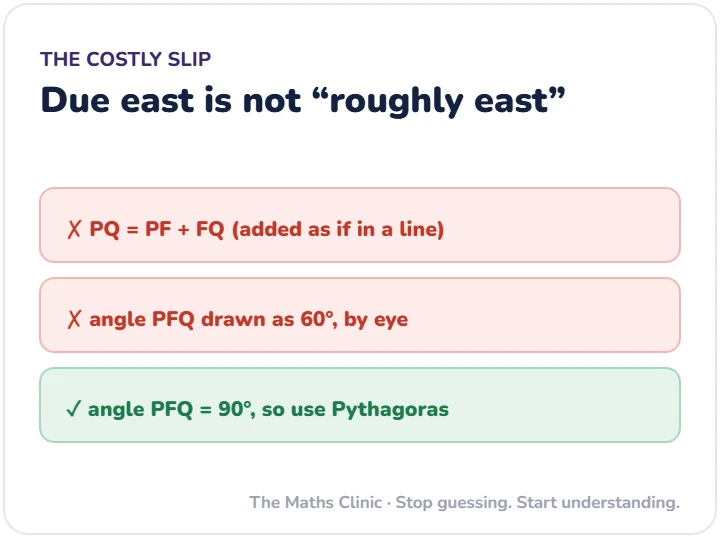
The wrong way. Drawing P, F and Q in one straight line. P is south and Q is east of F: the angle at F is 90°.
Example 2: due north, then due west
A man walks 8 km due north from X to Y, then 6 km due west to Z. Find the distance XZ and the bearing of Z from X.
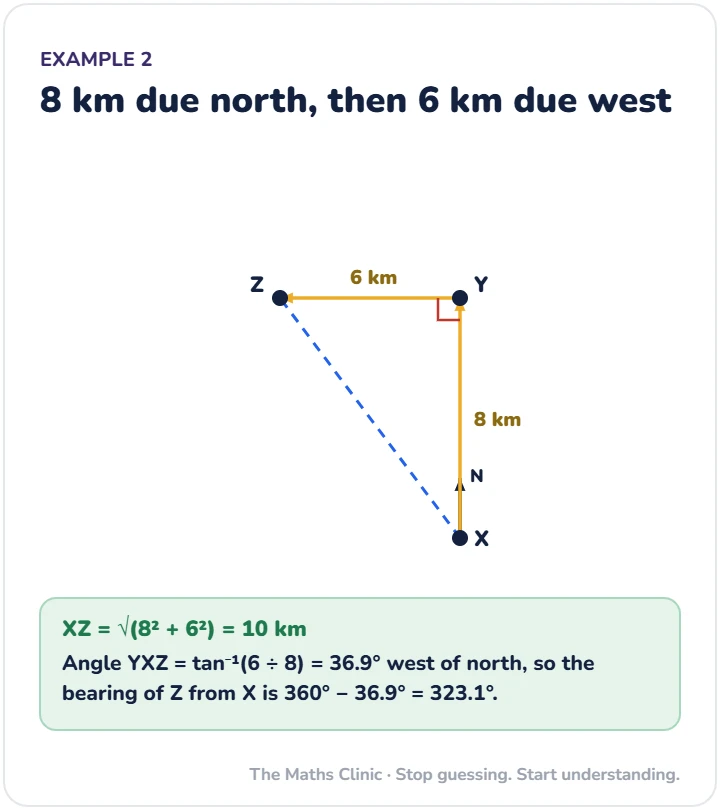
Step 1: right angle. North then west: the turn at Y is 90°.
Step 2: distance. XZ² = 8² + 6² = 64 + 36 = 100.
XZ=\sqrt{8^2+6^2}=10\text{ km}Step 3: the angle at X. tan(∠YXZ) = 6 ÷ 8 = 0.75, so ∠YXZ = 36.9°. Z is west of north from X, so measure clockwise from north all the way round: 360° − 36.9°.
\text{bearing}=360^\circ-\tan^{-1}\tfrac{6}{8}=323.1^\circCheck. Z is north-west of X, and 323.1° is between 270° (west) and 360° (north). ✔
Example 3: two ships leave a port
Two ships leave a port at the same time. One sails due east at 12 km/h and the other due south at 9 km/h. How far apart are they after 2 hours?
Step 1: distance = speed × time. East ship: 12 × 2 = 24 km. South ship: 9 × 2 = 18 km.
Step 2: right angle. East and south meet at 90° at the port.

Step 3: Pythagoras. 24² + 18² = 576 + 324 = 900, and √900 = 30 km.
\sqrt{24^2+18^2}=30\text{ km}If the question also asks for the bearing of the second ship from the first, measure it at the first ship: south-west of it, 180^\circ+\tan^{-1}\tfrac{24}{18} = 233.1°.
The wrong way. Using the speeds (12 and 9) in Pythagoras. Those are not distances: multiply by the time first.
The method
The mistakes that cost marks
📋 What the WAEC Chief Examiner reported
- Drawing the diagram from words is named as a weakness every year from 2023 to 2025. 2023: “illustrating a given information correctly on a diagram”. 2024: “representing mathematical illustrations in a diagram”. 2025: “representing mathematical information in a diagram”.
- In 2025, WAEC also listed “making deductions from real life problems” and “translating word problems into mathematical expressions”.
- In 2011, 2016 and 2021, bearings and position questions went wrong when the diagram of directions was built incorrectly.
What WAEC recommends
The Chief Examiner advised in 2024: “Candidates should read the questions well before answering them and ensure the rubric are followed.” In these questions, the words “due north” and “due east” carry the right angle. Read them, mark the right angle, and only then calculate.
How to win these marks back
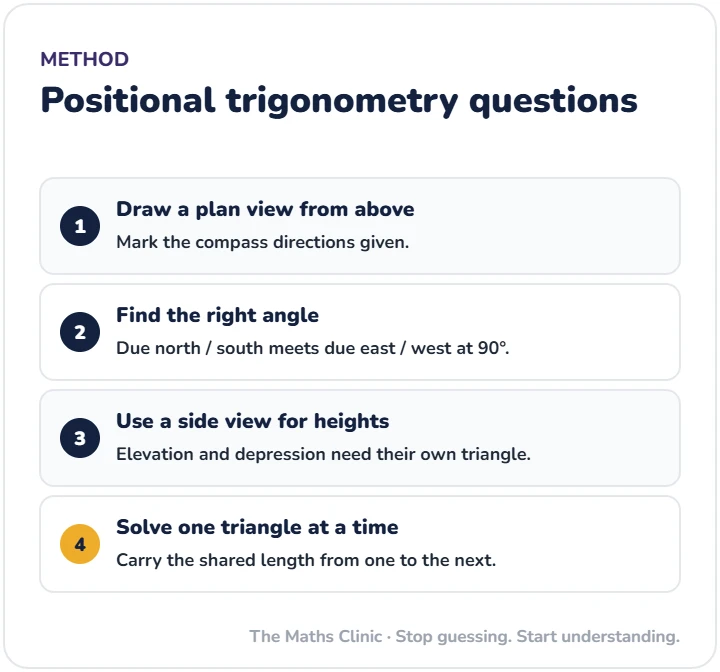
- Draw a plan view and mark the compass directions given.
- Mark the right angle where a due-north/south line meets a due-east/west line.
- Use a separate side view for any height. Work out distances from speed × time before using the triangle.
Source: WAEC Chief Examiner’s Reports, WASSCE (School Candidates) 2011, 2016, 2021, 2023, 2024 and 2025, Mathematics (Core).
Try it now
Cover the solutions. Draw a plan view first and mark every right angle given by “due”.
Question 1
A is 5 km due north of B, and C is 12 km due east of B. Find AC and the bearing of C from A.
Question 2
Two cyclists leave a junction at the same time, one due north at 10 km/h and one due east at 24 km/h. How far apart are they after 1½ hours?
Question 3
From a point 20 m due west of a vertical pole, the angle of elevation of the top of the pole is 50°. Find the height of the pole.
Question 4
A point P is 30 m due south of a tree and a point Q is 40 m due east of the same tree. How far apart are P and Q?
Question 5 (WASSCE style)
A vertical mast is 25 m high. A point A is due north of its foot, and the angle of elevation of the top from A is 40°. A point B is 18 m due west of the foot. Find (a) the distance from A to the foot, (b) |AB|.
Question 6 (real life)
A girl walks 300 m due east from her house to a shop, then 400 m due north to her school. How far is the school from her house in a straight line?
Solutions
Solution 1
Right angle at B. AC² = 5² + 12² = 25 + 144 = 169, so AC = 13 km. From A, C is south and east. The angle from south at A: tan⁻¹(12 ÷ 5) = 67.4°. Bearing = 180° − 67.4° = 112.6°.
Solution 2
Distances: 10 × 1.5 = 15 km and 24 × 1.5 = 36 km, at right angles. Distance² = 15² + 36² = 225 + 1296 = 1521, so 39 km.
Solution 3
Side view with a right angle at the foot. tan 50° = height ÷ 20, so height = 20 × tan 50° = 20 × 1.1918 = 23.84 m.
Solution 4
Right angle at the tree. PQ² = 30² + 40² = 900 + 1600 = 2500, so PQ = 50 m.
Solution 5
(a) tan 40° = 25 ÷ (distance), so distance = 25 ÷ tan 40° = 25 ÷ 0.8391 = 29.79 m. (b) North and west meet at 90° at the foot. AB² = 29.79² + 18² = 887.6 + 324 = 1211.6, so AB = 34.81 m.
Solution 6
East then north: right angle at the shop. Distance² = 300² + 400² = 90000 + 160000 = 250000, so 500 m.
📘 New SHS curriculum link
These questions combine Year 1 of the new SHS Mathematics curriculum (1.3.1.LO.1: Pythagoras’ theorem and perpendicular lines) with Year 2 (2.3.2.LO.2: angles of elevation used to calculate distances and heights).
For parents
Ask your child: “If our house is due south of the church and the market is due east of it, what angle is at the church?” If they say 90° and can draw it, they will find the hidden right angle in these questions.
Frequently asked questions
What is the difference between “north” and “due north”?
“Due north” means exactly north, along the north line. “North-east” or “N40°E” are in between, so they do not automatically give a right angle.
Do I need a 3D diagram?
Rarely. Draw a flat plan view for the ground and a separate side view for each height. Two simple diagrams are clearer than one complicated one.
What to do next
For journeys that do not turn at a right angle, go to Bearings and Distance Questions: Two-Leg Journeys, then practise in the Practice Zone.
Keep learning
- Bearings and Distance Questions: Two-Leg Journeys
- Back Bearing: How to Find the Bearing of A From B
- Angle of Elevation and Depression Questions With Solutions
📚 See every lesson in the Trigonometry Clinic
✏️ Practise trigonometry in the Practice Zone

Written by
Dickson Sarpong
NTC-certified SHS Mathematics teacher in Ghana with WAEC marking experience, and author of The Bridge Series textbooks. Every lesson here is built around the mistakes WAEC examiners keep reporting.
About DicksonStuck? Ask a question
Want the whole topic, step by step? My textbooks, The Bridge to Mathematics and The Bridge to Additional Mathematics for SHS, follow the new curriculum and rebuild the basics as you go.
Read a free chapter →