Struggling with WASSCE Maths? Stop guessing. Let’s fix the gap step by step.

Making a Subject: 7 Costly Reasons Students Lose Marks

In Core Maths, some learners can use a formula when the subject is already given. But immediately the question says “make r the subject” or “express h in terms of the other variables,” the same learner freezes. This is a very common SHS algebra struggle.
The painful part is that the learner may understand the topic, such as area, volume, speed, simple interest, or variation, but still lose marks because the formula must be rearranged first. So the hidden gap is not always in the main topic. Sometimes the gap is in making a subject.
This post will help a struggling WASSCE or Nov/Dec learner see where the marks are lost and how to correct the method step by step.
1. The Learner’s Problem
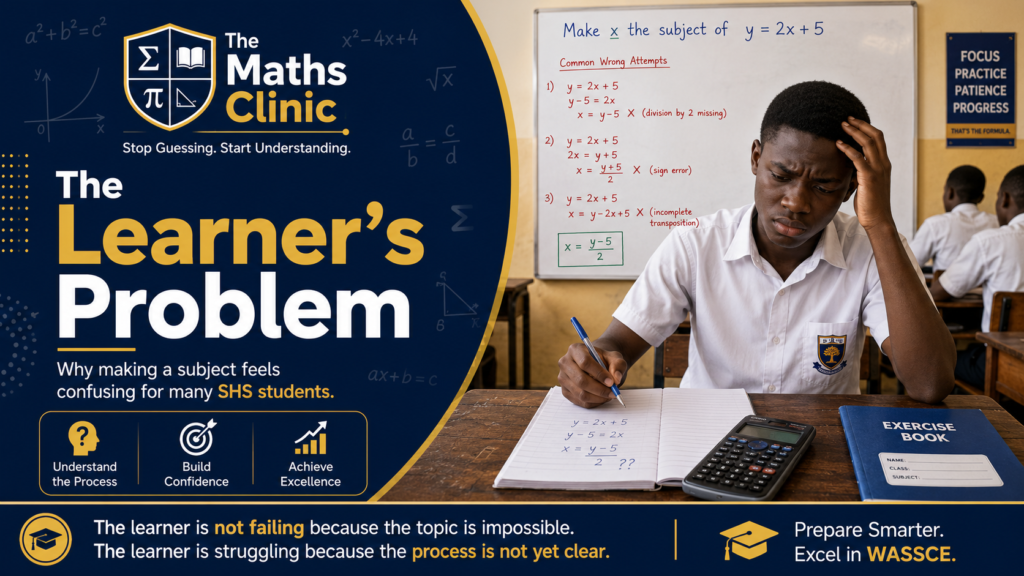
The learner sees letters everywhere and treats the formula like an ordinary equation without a clear target. Instead of asking, “Which letter must stand alone?” the learner starts moving letters across the equal sign. Soon, multiplication, division, brackets, powers, and fractions begin to mix.
| Maths Clinic Diagnosis: When students lose marks in making a subject, the main weakness is often not the formula itself. The weakness is rearranging operations in the correct order while keeping the formula balanced. |
2. Why the Mistake Happened
Making a subject is harder than solving simple equations because the final answer may still contain letters. Many learners expect a number at the end, so they feel uncomfortable when the answer is something like r = A /h or t = (A – P) / Pr.
Another reason is that students memorize many formulas but do not practice changing them. In WASSCE Core Maths, formula work can appear quietly inside mensuration, financial mathematics, variation, physics-like contexts, and word problems. If the learner cannot rearrange, the topic becomes heavier than it should be.
3. What WAEC or the Curriculum Reveals
The Core Maths curriculum expects learners to manipulate algebraic expressions and formulas, not only substitute values. WASSCE questions often reward correct method, logical arrangement, and accurate use of inverse operations. This means a learner may lose marks even when the final formula looks close if important steps are missing or wrong.
So making a subject must be taught as a survival skill for WASSCE, not as a small algebra corner.
4. Simple Explanation: What Does It Mean to Make a Subject?
To make a letter the subject means to rearrange the formula so that the chosen letter stands alone on one side of the equal sign. The chosen letter becomes the main focus of the formula.
For example, in A = bh, b is already the subject. A is the subject because A stands alone. To make b the subject, divide both sides by h: b = A / h.
| Simple Rule: Ask, “Which letter must stand alone? Then remove every operation around that letter by using the opposite operation on both sides. |
5. Seven Reasons Students Lose Marks When Making a Subject
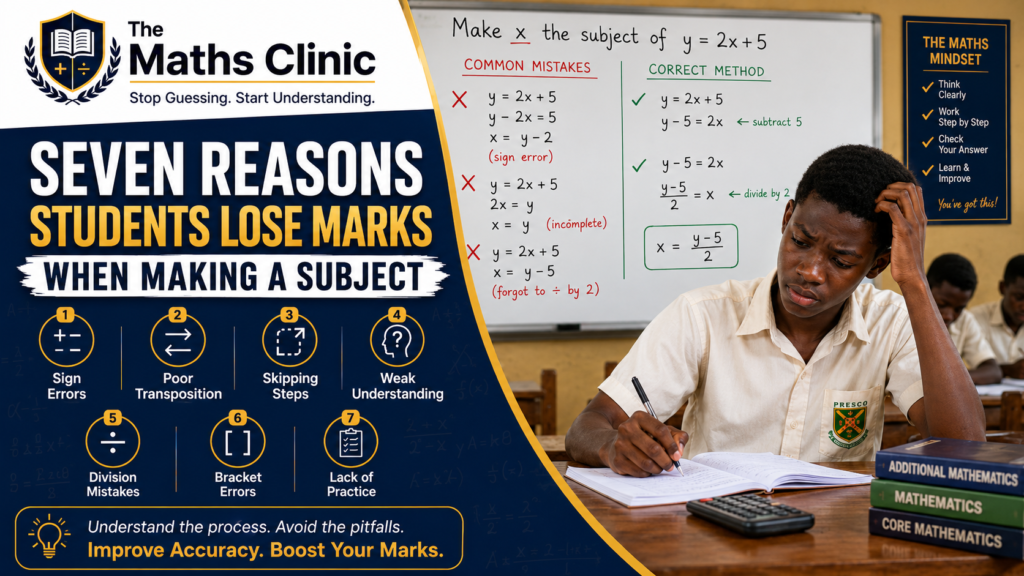
Reason 1: They do not identify the target letter first
Before touching the formula, circle or mentally mark the letter you are making the subject. If the target is h, every step must move towards leaving h alone.
Reason 2: They change signs without checking the operation
Students often say, “Cross it and change the sign.” But in formula work, the issue may be multiplication, division, square root, or brackets, not only addition and subtraction.
Reason 3: They divide only one term instead of the whole side
If A = 1/2 bh and you multiply both sides by 2, you get 2A = bh. If you later divide by b, the whole left side becomes 2A / b, not only A / b.
Reason 4: They remove brackets wrongly
In formulas like P = 2(l + b), the 2 multiplies the whole bracket. You must divide by 2 first before separating l and b or expand carefully.
Reason 5: They mishandle fractions
A formula with a fraction needs careful clearing of denominators. Weak learners often multiply one part and forget the other side.
Reason 6: They do not reverse operations in the correct order
If the target letter is inside a bracket, remove outside operations before dealing with what is inside the bracket. This is like opening layers one by one.
Reason 7: They stop before the target is fully alone
Sometimes a learner reaches bh = 2A and stops, but if the question says make h the subject, h must stand alone: h = 2A / b.
6. Worked Example 1: Simple Formula
Make b the subject of A = bh.
A = bh
Divide both sides by h because b is multiplied by h.
A/h = b
Therefore, b = A/h
7. Worked Example 2: Formula with a Fraction
Make h the subject of A = 1/2 bh.
A = 1/2 bh
Multiply both sides by 2 to remove 1/2.
2A = bh
Divide both sides by b.
2A / b = h
Therefore, h = 2A/b
8. Worked Example 3: Simple Interest Formula
Make r the subject of I = Prt / 100.
I = Prt / 100
Multiply both sides by 100.
100I = Prt
Divide both sides by Pt.
r = 100I / Pt
| WAEC Trap Box: Do not divide by P alone and leave t attached to r. If the target is r, both P and t must be removed because they are multiplying r. |
9. Common Wrong Approach
Question: Make h the subject of A = 1/2 bh
Wrong answer: h = A/2b
Why it is wrong: The learner divided by 2 instead of removing the fraction 1/2 properly. Since A = bh / 2, multiplying by 2 gives 2A = bh. Therefore, h = 2A/b.
10. Correct Method to Remember
1. Name the target letter.
2. Locate every operation attached to the target letter.
3. Remove outside operations first.
4. Use inverse operations on both sides.
5. Keep the whole expression together when dividing or multiplying.
6. Stop only when the target letter is alone.
7. Read the final answer to confirm that the requested letter is the subject.
11. Practice Task
Make the indicated letter the subject.
1. A = bh; make h the subject.
2. P = 2(l + b); make l the subject.
3. V = lwh; make w the subject.
4. I = Prt / 100; make t the subject.
5. C = 2πr; make r the subject.
Answers:
1) h = A / b,
2) l = P / 2 – b,
3) w = V / lh,
4) t = 100 I / PR
5) r = C / 2π
Conclusion: Making a Subject Is Not Guessing Letters Around
Making a subject becomes easier when the learner stops moving letters blindly and starts removing operations carefully. The question is always simple: which letter must stand alone, and what is stopping it from standing alone?
For a weak Core Maths learner, this skill can protect marks in many topics. Once the learner can rearrange formulas calmly, substitution, mensuration, simple interest, speed, and variation become easier to handle before WASSCE.