Struggling with WASSCE Maths? Stop guessing. Let’s fix the gap step by step.

Interest or Amount? How to Tell What the Question Wants
You worked out the interest perfectly and still lost the mark, because the question wanted the amount. Or you added the principal when it only asked for the interest. This part is about reading the question’s target before you calculate anything.

📚 Part of the Simple Interest Clinic: every lesson on this topic, in one place.
You worked out the interest perfectly and still lost the mark, because the question wanted the amount. Or you added the principal when it only asked for the interest. This part is about reading the question’s target before you calculate anything.
📘 This lesson is part of the Simple Interest Clinic
Work through the parts in order. Each one fixes a different gap. See the whole series
-
Simple Interest Questions With Answers: P, R, T, I and A Explained
-
Simple Interest Formula (I = PRT/100): How to Use It Correctly
-
Interest or Amount? How to Tell What the Question Wants
-
Simple Interest Examples: 8 WASSCE Fixes, Step by Step
-
Simple Interest Word Problems: 7 Hidden WASSCE Traps
-
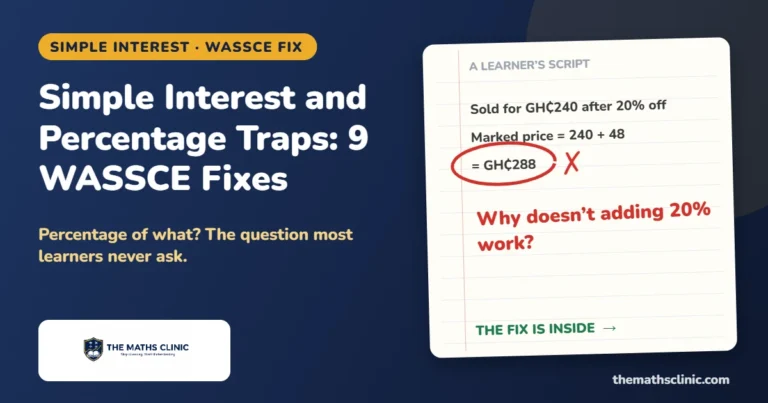
Simple Interest and Percentage Traps: 9 WASSCE Fixes
-
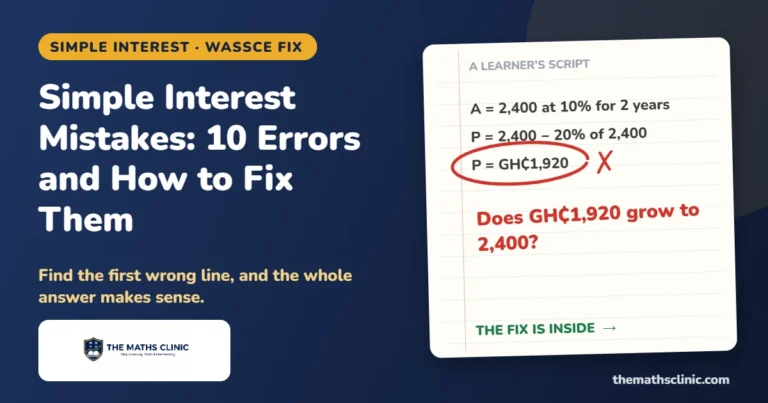
Simple Interest Mistakes: 10 Errors and How to Fix Them
-
Wrong Simple Interest Answer? Find Where It First Went Wrong
One painful business maths mistake happens when a learner calculates the interest correctly but the question asks for the amount. Another learner adds the principal when the question asks for interest only.
Both learners may know the formula. Their difficulty is identifying the target of the question.
This simple interest lesson diagnoses that question-target gap and repairs it step by step. It will help the learner distinguish principal, interest, and amount; recognise important demand words, complete the correct number of steps; and check the final answer before WASSCE.
Maths Clinic Diagnosis: The Calculation May Be Correct but the Answer Wrong
Consider this question:
Kofi invests GH₵2,000 at 10% simple interest per annum for 3 years. Find the amount.
The interest is:
I = \dfrac{P \times R \times T}{100}I = \dfrac{2{,}000 \times 10 \times 3}{100}I = \text{GH₵}600A learner who stops at GH₵600 has calculated the interest correctly. However, the question asks for the amount.
\text{Amount} = \text{Principal} + \text{Interest}\text{Amount} = \text{GH₵}2{,}000 + \text{GH₵}600\text{Amount} = \text{GH₵}2{,}600The learner’s arithmetic was correct, but the response was incomplete.
The hidden gap is:
The learner calculates before deciding whether the question requires the extra money or the final total.

Interest or Amount: The Learner’s Exact Problem
The learner sees principal, rate and time and immediately writes the simple-interest formula.
That formula finds interest. It does not directly give the amount unless another step is completed.
The learner may fail because of one of these problems:
- The demand word was not underlined.
- Interest was confused with amount.
- Amount was confused with principal.
- The learner stopped after the first calculation.
- The principal was added when it was not required.
- A total was given, but the learner treated it as interest.
- The answer was not checked against the money story.
The exact correction is not simply “learn the formula.” It is:
Identify the required quantity before choosing the final step.
📋 What the WAEC Chief Examiner reported
- In 2025, WAEC listed “solving application problems in Simple Interest” among candidates’ main weaknesses.
- In a 2025 question (two accounts at 11% and 10% for 3½ years, one amount 140% of the other), most candidates “could not calculate the interest at 10% and 11% correctly to help them arrive at the correct equation”.
- “Translating word problems into mathematical expressions” was also a listed weakness.
How to win these marks back
- Write P, R and T with units before substituting; convert months to years (3½ years, not 3.5 months).
- In two-amount questions, call one amount x, write the other in terms of x, write each interest, then add and solve.
- Check by putting your answer back into the story.
Source: WAEC Chief Examiners’ Reports, WASSCE (SC) 2025, Ghana: Mathematics (Core).
The Three Money Quantities Learners Must Separate
Principal, P
Principal is the original money invested, saved, lent or borrowed.
Examples:
- GH₵2,000 invested
- GH₵1,500 borrowed
- An original deposit of GH₵900
- A loan of GH₵4,000
Principal is the starting value.
Interest, I
Interest is the extra money earned on an investment or charged on borrowed money.
If a learner borrows GH₵1,000 and pays GH₵120 as interest:
\begin{gathered}\text{Principal} = \text{GH₵}1{,}000 \\ \text{Interest} = \text{GH₵}120\end{gathered}The GH₵120 is not the total repayment. It is only the extra money.
Amount, A
Amount is the principal together with the interest.
\text{Amount} = \text{Principal} + \text{Interest}A = P + I
Using the previous example:
\text{Amount} = \text{GH₵}1{,}000 + \text{GH₵}120\text{Amount} = \text{GH₵}1{,}120The amount is the final total under the stated simple-interest arrangement.
The Central Relationship
The three quantities are connected:
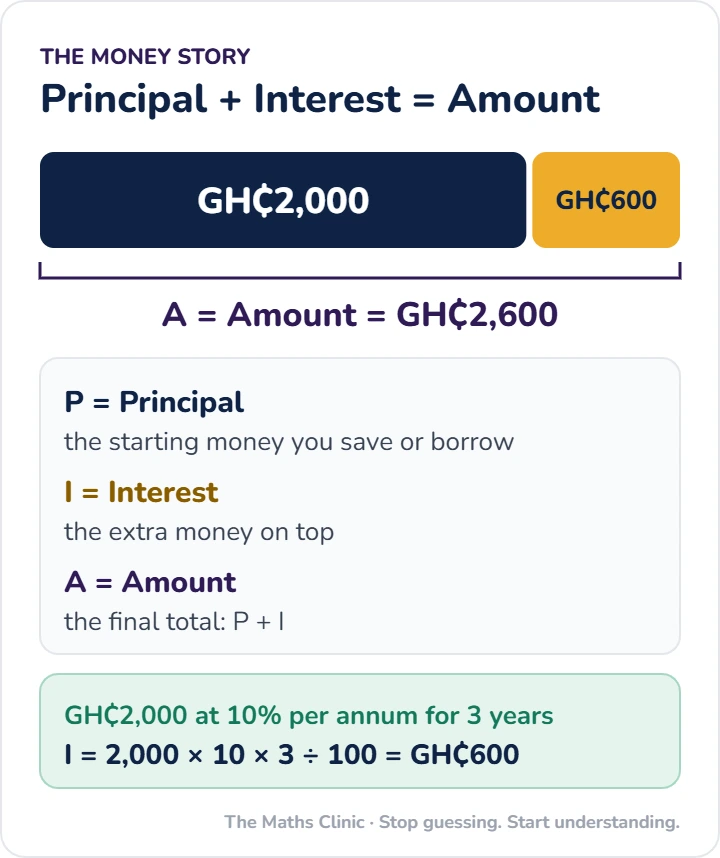
A = P + I
From this relationship:
To find amount
A = P + I
To find interest
I = A - P
To find principal
P = A - I
These relationships are as important as the simple-interest formula.
The Simple-Interest Formula
When the rate is expressed as a percentage:
I = \dfrac{P \times R \times T}{100}Where:
- I = \text{Simple interest}
- P = \text{Principal}
- R = \text{Percentage rate}
- T = Time measured in the period attached to the rate
This formula produces the interest, not the amount.
To find the amount afterwards:
A = P + I
Direct Amount Formula
The two steps may be combined:
A = P + \dfrac{PRT}{100}Factorising P gives:
A = P(1 + \dfrac{RT}{100})This direct formula is correct for simple interest. However, struggling learners should first use the two-step method:
- Find interest.
- Add principal.
The two-step method makes the difference between interest and amount easier to see.
When These Relationships Apply
The lesson assumes:
- Simple interest is being used.
- The principal is positive.
- The interest rate and time are stated clearly.
- No additional fees, deposits or repayments are involved unless stated.
- The amount means principal plus simple interest.
In real financial products, “total repayment” may include fees, insurance or other charges. In a school question, use A = P + I only when the question is clearly a simple-interest situation with no additional charges stated.
Seven Fixes for Interest or Amount

Fix 1: Underline the Demand Word
Before calculating, underline exactly what the question asks you to find.
Possible targets include:
- Interest
- Amount
- Principal
- Extra money
- Final total
- Total repayment
- Gain
- Interest charged
Fix 2: Translate the Target into a Symbol
Write:
Interest required → I = ?
Amount required → A = ?
Principal required → P = ?
This prevents the learner from answering for the wrong quantity.
Fix 3: Separate Original, Extra and Total Money
Use this simple map:
| Money role | Mathematical name |
|---|---|
| Original money | Principal |
| Extra money | Interest |
| Final total | Amount |
Fix 4: Know What the Formula Produces
The formula:
I = \dfrac{PRT}{100}produces interest.
It does not produce amount.
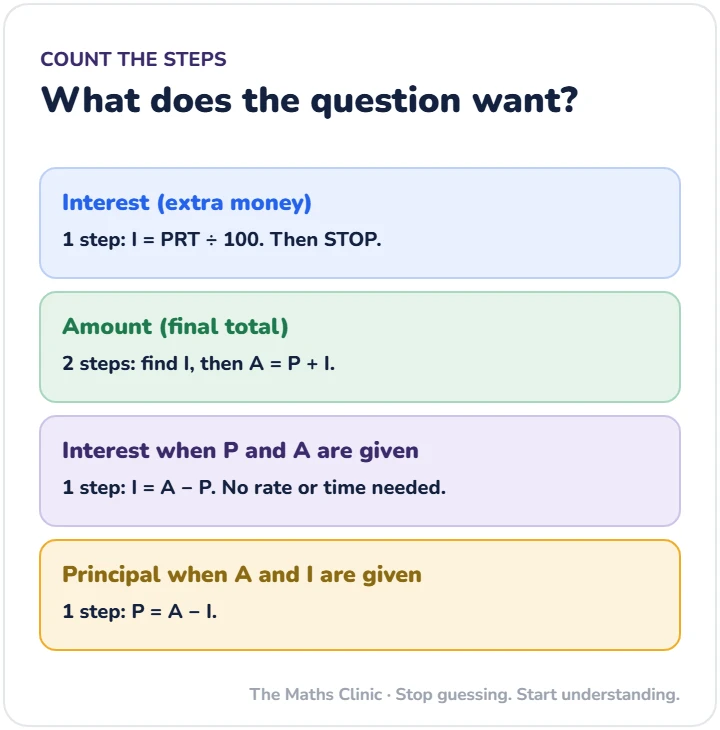
Fix 5: Count the Required Steps
If interest is required:
- Calculate I.
- Stop.
If amount is required:
- Calculate I.
- Add P.
If interest is hidden inside a given amount:
- \text{Calculate} I = A – P.
- Use the interest in any further calculation required.
Fix 6: Watch the Language Around “Total” and “Extra”
“Total” usually points to amount.
“Extra” usually points to interest.
However, always read the full question. The meaning must come from the complete simple-interest story, not from one word taken alone.
Fix 7: Check the Size and Meaning
For a positive principal and positive interest:
- A = P + I
- Amount must be greater than principal.
- Amount must be greater than interest.
- Interest must be less than amount.
Also check whether your answer requires GH₵, a percentage or a time unit.
Demand Words That Point to Interest
In a clear simple-interest question, these phrases usually require interest:
| Wording | Likely target |
|---|---|
| Find the interest | I |
| Interest earned | I |
| Interest charged | I |
| Extra money earned | I |
| Extra paid as interest | I |
| Gain from the investment | I |
| How much interest accumulated | I |
| Difference between amount and principal | I |
Do not add the principal when interest alone is required.
Demand Words That Point to Amount
These phrases usually require amount:
| Wording | Likely target |
|---|---|
| Find the amount | A |
| Total amount | A |
| Amount due | A |
| Total repayment | A |
| Final value | A |
| Accumulated value | A |
| Maturity value | A |
| Total received | A |
| Principal plus interest | A |
In this lesson, these phrases mean amount only within a simple-interest situation where no other fees or payments are stated.
Phrases That Identify Principal
These expressions often point to the original money:
- Invests GH₵…
- Deposits GH₵…
- Borrows GH₵…
- Takes a loan of GH₵…
- Original sum
- Initial capital
- Principal
- Amount invested at the beginning
The same word “amount” may sometimes be used in ordinary English to mean a sum of money. That does not automatically make it the mathematical quantity A.
Read the role of the number, not only the word itself.
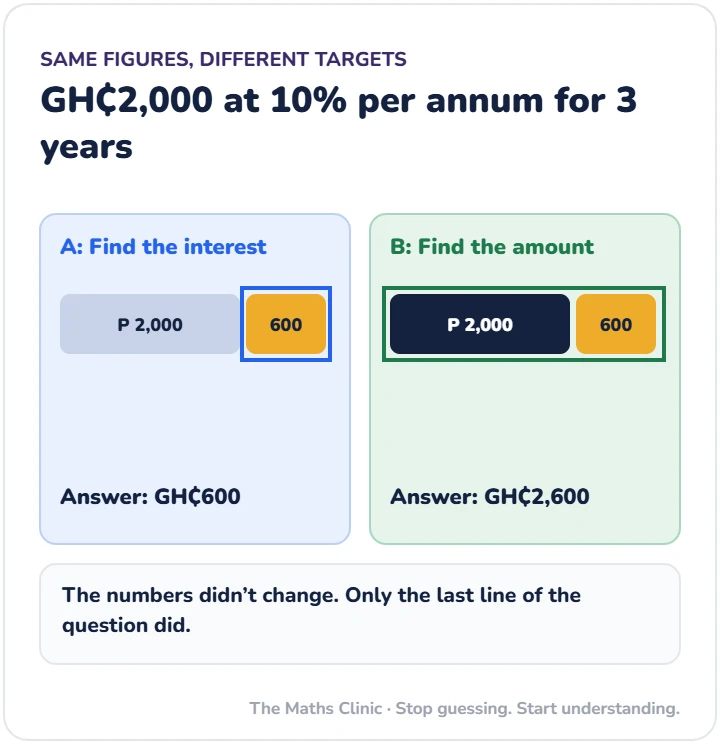
Paired Example: Same Figures, Different Targets
Kofi invests GH₵2,000 at 10% simple interest per annum for 3 years.
Question A: Find the interest
I = \dfrac{2{,}000 \times 10 \times 3}{100}I = \text{GH₵}600\text{Answer}: \text{Interest} = \text{GH₵}600.Stop because the question asks for interest.
Question B: Find the amount
First find the interest:
I = \text{GH₵}600Then:
A = P + I
A = \text{GH₵}2{,}000 + \text{GH₵}600A = \text{GH₵}2{,}600\text{Answer}: \text{Amount} = \text{GH₵}2{,}600.Important lesson
The given figures are the same. Only the demand has changed.
Question A needs one main calculation.
Question B needs an additional step.
Worked Example 1: Find Interest Only
A trader borrows GH₵1,500 at 8% simple interest per annum for 2 years. Find the interest.
P = \text{GH₵}1{,}500
R = 8% per annum
T = 2\ \text{years}
I = ?
I = \dfrac{P \times R \times T}{100}I = \dfrac{1{,}500 \times 8 \times 2}{100}I = \text{GH₵}240\text{Answer}: \text{Interest} = \text{GH₵}240.Do not add the principal because the question asks only for interest.
Worked Example 2: Find Amount
A student saves GH₵900 at 12% simple interest per annum for 3 years. Find the amount.
P = \text{GH₵}900
R = 12% per annum
T = 3\ \text{years}
A = ?
First find the interest:
I = \dfrac{900 \times 12 \times 3}{100}I = \text{GH₵}324Now find the amount:
A = P + I
A = \text{GH₵}900 + \text{GH₵}324A = \text{GH₵}1{,}224\text{Answer}: \text{Amount} = \text{GH₵}1{,}224.Worked Example 3: Interest Is Already Given
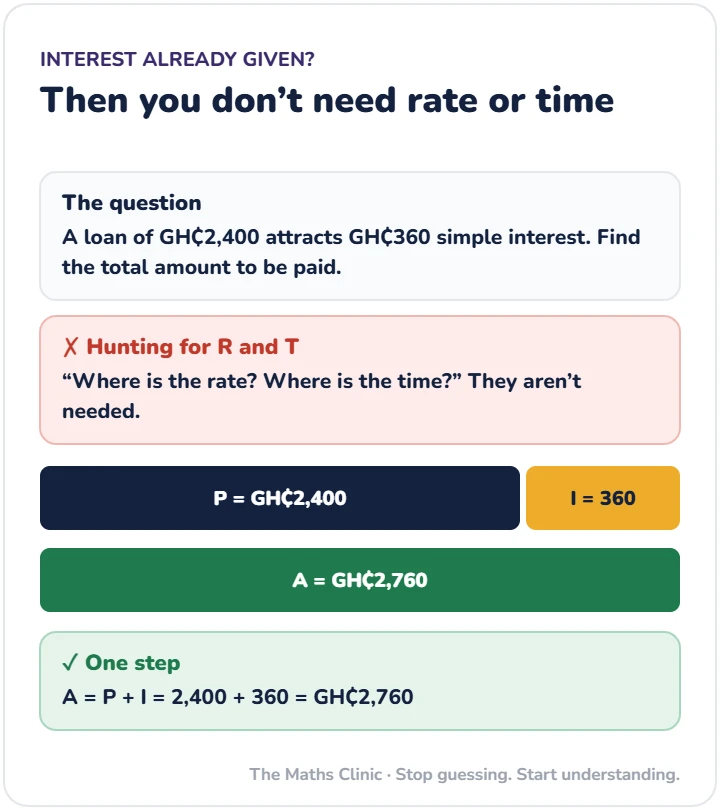
A loan of GH₵2,400 attracts GH₵360 simple interest. Find the total amount to be paid.
P = \text{GH₵}2{,}400
I = \text{GH₵}360
A = ?
There is no need to use PRT/100 because the interest is already given.
A = P + I
A = \text{GH₵}2{,}400 + \text{GH₵}360A = \text{GH₵}2{,}760\text{Answer}: \text{Total amount} = \text{GH₵}2{,}760.Hidden trap
Using the simple-interest formula here would be unnecessary. Rate and time are not needed because interest is already known.
Worked Example 4: Find Extra Money Earned
GH₵1,000 is invested at 15% simple interest per annum for 2 years. Find the extra money earned.
“Extra money earned” means interest.
P = \text{GH₵}1{,}000
R = 15% per annum
T = 2\ \text{years}
I = ?
I = \dfrac{1{,}000 \times 15 \times 2}{100}I = \text{GH₵}300\text{Answer}: \text{Extra money earned} = \text{GH₵}300.Do not add GH₵1,000 because the question asks for the extra money only.
Worked Example 5: Find Interest from Growth
A bank account grows from GH₵800 to GH₵920 under a stated simple-interest arrangement. Find the interest.
P = \text{GH₵}800
A = \text{GH₵}920
I = ?
I = A - P
I = \text{GH₵}920 - \text{GH₵}800I = \text{GH₵}120\text{Answer}: \text{Interest} = \text{GH₵}120.Important assumption
The calculation assumes that no extra deposits, withdrawals or fees occurred. If such changes are included, the increase cannot automatically be treated as interest.

Worked Example 6: Find Principal
An investment has a final amount of GH₵3,500 after earning GH₵500 simple interest. Find the principal.
A = \text{GH₵}3{,}500
I = \text{GH₵}500
P = ?
P = A - I
P = \text{GH₵}3{,}500 - \text{GH₵}500P = \text{GH₵}3{,}000\text{Answer}: \text{Principal} = \text{GH₵}3{,}000.Worked Example 7: Amount with Time Conversion
GH₵2,400 is invested at 5% simple interest per annum for 9 months. Find the amount.
\begin{gathered}P = \text{GH₵}2{,}400 \\ R = 5\%\ \text{per annum} \\ T = \dfrac{9}{12}\ \text{year} = \dfrac{3}{4}\ \text{year}\end{gathered}First find the interest:
I = \dfrac{2{,}400 \times 5 \times \dfrac{3}{4}}{100}I = \text{GH₵}90Now find the amount:
A = P + I
A = \text{GH₵}2{,}400 + \text{GH₵}90A = \text{GH₵}2{,}490\text{Answer}: \text{Amount} = \text{GH₵}2{,}490.Hidden trap
The demand is amount, but the question also contains a time-conversion trap. Both must be handled.
Common Wrong Approaches
Wrong Approach 1: Stopping at Interest When Amount Is Required
For the GH₵2,000 investment:
\text{Interest} = \text{GH₵}600Writing GH₵600 as the amount is unfinished work.
Correct amount:
\text{GH₵}2{,}000 + \text{GH₵}600 = \text{GH₵}2{,}600Hidden gap: The learner did not return to the demand word.
Wrong Approach 2: Adding Principal When Interest Is Required
If interest is GH₵240, writing GH₵1,740 after adding a GH₵1,500 principal answers a different question.
Hidden gap: The learner performed an unnecessary final step.
Wrong Approach 3: Treating Amount as Interest
If GH₵800 grows to GH₵920:
Wrong:
\text{Interest} = \text{GH₵}920Correct:
\text{Interest} = \text{GH₵}920 - \text{GH₵}800\text{Interest} = \text{GH₵}120Hidden gap: Final total has been confused with extra money.
Wrong Approach 4: Using PRT/100 When Interest Is Already Given
If principal and interest are both given and amount is required:
A = P + I
No rate or time calculation is necessary.
Hidden gap: The learner believes every simple-interest question must begin with PRT/100.
Wrong Approach 5: Adding Interest Twice
A learner finds interest, adds it to principal and then adds it again because the phrase “total amount” appears.
Correction: Amount includes the interest once.
Wrong Approach 6: Using A = P + I for Compound Interest
This lesson deals with simple interest.
In compound interest, the process may involve interest being added to the balance during the investment period. Use the method stated for that topic.
Wrong Approach 7: Ignoring Time Units
Even when the correct target is identified, the answer may still be wrong if months are used as years.
Wrong Approach 8: Giving an Unlabelled Answer
Writing only “600” does not show whether the value represents principal, interest or amount.
Write:
\text{Interest} = \text{GH₵}600The Maths Clinic Question-Target Routine
Use this routine before calculating.
Step 1: Read
Read the full question without calculating.
Step 2: Circle the target
Circle or underline:
- Interest
- Amount
- Principal
- Extra
- Final
- Total
Step 3: Write the target symbol
For example:
A = ?
Step 4: Label the given values
Write P, R, T, I and A where appropriate.
Step 5: Count the steps
Interest required → Find I and stop.
Amount required → Find I, then calculate A = P + I.
Step 6: Solve with units
Show the relationship before substituting.
Step 7: Return to the question
Ask:
Have I answered what was requested?

WASSCE-Style Trap Box
Before submitting an answer, complete these statements:
- The original money is __________.
- The extra money is __________.
- The final total is __________.
- The question requires __________.
- My final answer represents __________.
If statements 2 or 3 cannot be completed, the distinction between interest and amount is not yet clear.
Interest or Amount Diagnostic Practice
Attempt all questions before checking the answers.
Questions
- A trader borrows GH₵1,500 at 8% simple interest per annum for 2 years. Find the interest.
- A student saves GH₵900 at 12% simple interest per annum for 3 years. Find the amount.
- A loan of GH₵2,400 attracts GH₵360 simple interest. Find the total amount to be paid.
- GH₵1,000 is invested at 15% simple interest per annum for 2 years. Find the extra money earned.
- An account grows from GH₵800 to GH₵920 under a simple-interest arrangement with no other deposits, withdrawals or fees. Find the interest.
- GH₵2,500 earns GH₵500 simple interest. Find the amount.
- A final amount of GH₵4,200 includes GH₵700 simple interest. Find the principal.
- GH₵3,000 is invested at 6% simple interest per annum for 4 years. Find the interest and amount.
- A loan of GH₵5,000 attracts 10% simple interest per annum for 18 months. Find the total repayment.
- An investment amounts to GH₵6,200 after earning GH₵1,200 simple interest. Find the principal and interest.
- Two learners each invest GH₵2,000 at 5% simple interest per annum for 3 years. Adwoa is asked to find the interest, while Kojo is asked to find the amount. Find both answers.
- A borrower repays a total of GH₵3,360 after borrowing GH₵3,000 under simple interest. Find the interest charged.
Answers and Gap Diagnosis
1. GH₵240
I = \dfrac{1{,}500 \times 8 \times 2}{100}I = \text{GH₵}240If you wrote GH₵1,740: You added the principal when interest only was required.
2. GH₵1,224
I = \dfrac{900 \times 12 \times 3}{100}I = \text{GH₵}324A = \text{GH₵}900 + \text{GH₵}324A = \text{GH₵}1{,}224If you wrote GH₵324: You stopped at interest.
3. GH₵2,760
A = P + I
A = \text{GH₵}2{,}400 + \text{GH₵}360A = \text{GH₵}2{,}760If you searched for rate or time: You failed to notice that interest was already given.
4. GH₵300
I = \dfrac{1{,}000 \times 15 \times 2}{100}I = \text{GH₵}300“Extra money earned” means interest.
5. GH₵120
I = A - P
I = \text{GH₵}920 - \text{GH₵}800I = \text{GH₵}120If you wrote GH₵920: You confused final total with extra money.
6. GH₵3,000
A = P + I
A = \text{GH₵}2{,}500 + \text{GH₵}500A = \text{GH₵}3{,}0007. GH₵3,500
P = A - I
P = \text{GH₵}4{,}200 - \text{GH₵}700P = \text{GH₵}3{,}5008. Interest = GH₵720; amount = GH₵3,720
I = \dfrac{3{,}000 \times 6 \times 4}{100}I = \text{GH₵}720A = \text{GH₵}3{,}000 + \text{GH₵}720A = \text{GH₵}3{,}720This question deliberately requires both quantities.
9. GH₵5,750
T = \dfrac{18}{12}\ \text{years} = 1.5\ \text{years}I = \dfrac{5{,}000 \times 10 \times 1.5}{100}I = \text{GH₵}750A = \text{GH₵}5{,}000 + \text{GH₵}750A = \text{GH₵}5{,}750If you wrote GH₵750: You found interest but not total repayment.
10. Principal = GH₵5,000; interest = GH₵1,200
P = A - I
P = \text{GH₵}6{,}200 - \text{GH₵}1{,}200P = \text{GH₵}5{,}000The interest was already given.
11. Adwoa: GH₵300 interest; Kojo: GH₵2,300 amount
I = \dfrac{2{,}000 \times 5 \times 3}{100}I = \text{GH₵}300Adwoa’s answer:
\text{Interest} = \text{GH₵}300Kojo’s answer:
\text{Amount} = \text{GH₵}2{,}000 + \text{GH₵}300\text{Amount} = \text{GH₵}2{,}300The figures are the same, but the targets are different.
12. GH₵360
I = A - P
I = \text{GH₵}3{,}360 - \text{GH₵}3{,}000I = \text{GH₵}360DoK Progression
| Depth of Knowledge | Main demand | Questions |
|---|---|---|
| DoK 1 | Identify and calculate interest directly | 1 and 4 |
| DoK 2 | Connect interest to amount or principal | 2, 3, 5–8, 10 and 12 |
| DoK 3 | Handle conversion, multiple targets or comparison | 9 and 11 |
The depth comes from the reasoning required, not merely the size of the numbers.
Use the Results to Locate the Gap
| Score | What it suggests | Next action |
|---|---|---|
| 10–12 correct | The question target is becoming secure | Attempt unfamiliar mixed questions |
| 7–9 correct | One or two demand-word traps remain | Correct the missed question types |
| 4–6 correct | Interest, principal and amount are being confused | Return to the three-money map |
| 0–3 correct | Calculation is beginning before the target is identified | Rebuild P, I and A first |
Check the error pattern:
- Stopped at interest → Final-step gap
- Added principal unnecessarily → Target-reading gap
- Used amount as interest → Money-role gap
- Could not find principal → Relationship-rearrangement gap
- Missed months conversion → Time-unit gap
- Used PRT/100 unnecessarily → Formula-selection gap
Learner Reflection
Tick each statement only when you can do it without copying.
- I can explain principal, interest and amount in my own words.
- I know that PRT/100 produces interest.
- I can identify whether a question requires interest or amount.
- I can recognise phrases that mean extra money.
- I can recognise phrases that mean final total.
- I can calculate amount when interest is already given.
- I can separate interest from a given amount.
- I can find principal when amount and interest are given.
- I can handle a time-conversion trap.
- I return to the demand word before writing my final answer.
How This Helps Before WASSCE
This lesson helps the learner to:
- Read the demand before calculating
- Separate original, extra and total money
- Select the correct relationship
- Avoid unnecessary calculations
- Complete multi-step amount questions
- Work backwards from a given total
- Show clear and labelled working
- State the correct money unit
- Check whether the final answer fits the question
The official WAEC Ghana Chief Examiner’s Reports may also be consulted when studying reported examination performance and weaknesses.
Continue the Intervention
If the full wording of simple-interest questions remains difficult, study Part 5 of the Simple Interest Clinic, on word problems.
If percentage or interpretation gaps continue, visit the Intervention Hub.
When the distinction is clear, attempt targeted questions in the WASSCE Maths Practice Zone.
For other examination mistakes, explore WAEC Maths Traps.
Conclusion: Choose Interest or Amount with Understanding
The hidden gap is not always the simple-interest formula. It is often the language of the demand.
Before calculating, ask:
- Is the question asking for the original money?
- Is it asking for the extra money?
- Is it asking for the final total?
- Has interest already been given?
- Is another step needed after finding interest?
- Have I attached the correct meaning to my answer?
If the question asks for interest, calculate interest and stop.
If the question asks for amount, calculate interest and add the principal.
If amount and principal are given, subtract to find interest.
That small reading habit can prevent an otherwise correct calculation from becoming a wrong final answer.
Stop Guessing. Start Understanding.
Practice Zone CTA
Do not guess your way through Mathematics.
Find the exact place where the mistake begins, correct it and practise again with purpose in the WASSCE Maths Practice Zone.
For every wrong answer, identify whether the mistake came from:
- Demand-word reading
- Principal–interest–amount confusion
- An unfinished final step
- An unnecessary addition
- Formula selection
- Time conversion
- Unit control
Correct that exact gap before attempting a fresh question.
✏️ Try it yourself
Esi borrows GH₵5,000 at 6% per annum for 4 years. How much must she pay back altogether?
Tap to see the answer
“Pay back altogether” means the amount. I = 5{,}000 \times 6 \times 4 \div 100 = \text{GH₵}1{,}200, so Amount = 5{,}000 + 1{,}200 = GH₵6,200.
💬 Stuck on a step? Ask Dickson and send the line where you got lost.

Written by
Dickson Sarpong
NTC-certified SHS Mathematics teacher in Ghana with WAEC marking experience, and author of The Bridge Series textbooks. Every lesson here is built around the mistakes WAEC examiners keep reporting.
About DicksonStuck? Ask a question
Want the whole topic, step by step? My textbooks, The Bridge to Mathematics and The Bridge to Additional Mathematics for SHS, follow the new curriculum and rebuild the basics as you go.
Read a free chapter →