Struggling with WASSCE Maths? Stop guessing. Let’s fix the gap step by step.

Simple Interest and Percentage Traps: 9 WASSCE Fixes
These questions look familiar, so it’s easy to relax too early. But a monthly rate, the wrong base or one small demand word can change the whole answer. Here are the traps that catch students who already know how to work out percentages.

📚 Part of the Simple Interest Clinic: every lesson on this topic, in one place.
These questions look familiar, so it’s easy to relax too early. But a monthly rate, the wrong base or one small demand word can change the whole answer. Here are the traps that catch students who already know how to work out percentages.
📘 This lesson is part of the Simple Interest Clinic
Work through the parts in order. Each one fixes a different gap. See the whole series
-
Simple Interest Questions With Answers: P, R, T, I and A Explained
-
Simple Interest Formula (I = PRT/100): How to Use It Correctly
-
Interest or Amount? How to Tell What the Question Wants
-
Simple Interest Examples: 8 WASSCE Fixes, Step by Step
-
Simple Interest Word Problems: 7 Hidden WASSCE Traps
-
Simple Interest and Percentage Traps: 9 WASSCE Fixes
-
Simple Interest Mistakes: 10 Errors and How to Fix Them
-
Wrong Simple Interest Answer? Find Where It First Went Wrong
These questions often look familiar. A learner sees money, a percentage, and time and relaxes too early. The learner may know how to calculate 12% of GH₵2,000 but still fail because:
- The rate is annual, while time is in months.
- The given total is the amount, not the principal.
- The question requires amount, not interest.
- The percentage is applied to the wrong base.
- A reduction is added instead of subtracted.
- An original value must be found by working backwards.
This WASSCE Financial Maths lesson identifies that exam-trap recognition gap and repairs it step by step.
Maths Clinic Diagnosis: The Trap Must Be Recognised Before It Can Be Avoided
Consider this question:
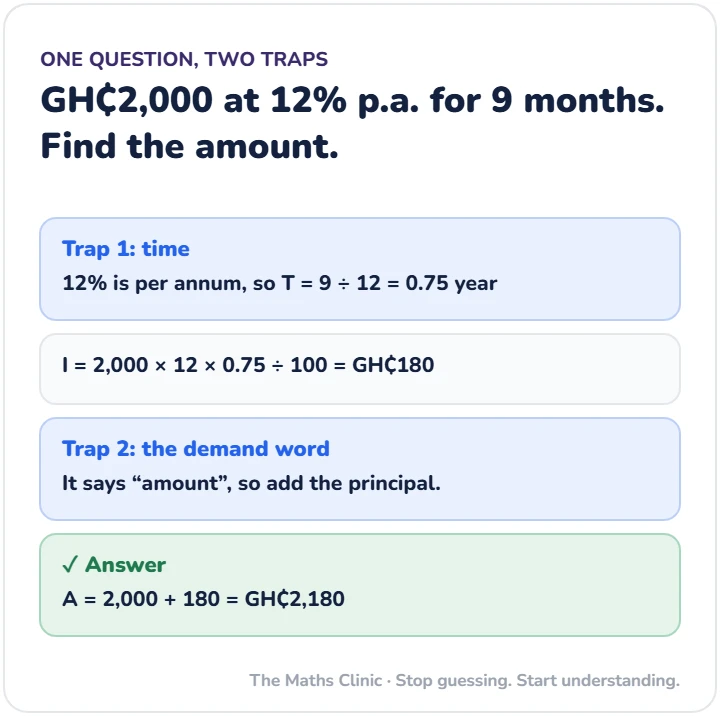
Kofi invests GH₵2,000 at 12% simple interest per annum for 9 months. Find the amount at the end of the period.
Several traps appear together:
- GH₵2,000 is principal.
- 12% is an annual rate.
- Nine months must be converted to years.
- The formula first gives interest.
- The question finally requires amount.
Correct identification:
\begin{gathered}P = \text{GH₵}2{,}000 \\ R = 12\%\ \text{per annum} \\ T = \dfrac{9}{12}\ \text{year} = \dfrac{3}{4}\ \text{year}\end{gathered}Interest:
I = \dfrac{PRT}{100}I = \dfrac{2{,}000 \times 12 \times \dfrac{3}{4}}{100}I = \text{GH₵}180Amount:
A = P + I
A = \text{GH₵}2{,}000 + \text{GH₵}180A = \text{GH₵}2{,}180A learner who writes GH₵180 has handled the formula and time conversion correctly but has fallen into the demand-word trap.
The exact hidden gap is:
The learner can perform the calculation but does not recognise which reading, unit, base or final-answer trap the question contains.
📋 What the WAEC Chief Examiner reported
- In 2025, WAEC listed “solving application problems in Simple Interest” among candidates’ main weaknesses.
- In a 2025 question (two accounts at 11% and 10% for 3½ years, one amount 140% of the other), most candidates “could not calculate the interest at 10% and 11% correctly to help them arrive at the correct equation”.
- “Translating word problems into mathematical expressions” was also a listed weakness.
How to win these marks back
- Write P, R and T with units before substituting; convert months to years (3½ years, not 3.5 months).
- In two-amount questions, call one amount x, write the other in terms of x, write each interest, then add and solve.
- Check by putting your answer back into the story.
Source: WAEC Chief Examiners’ Reports, WASSCE (SC) 2025, Ghana: Mathematics (Core).
Why Simple Interest Is a Percentage Problem
Simple interest is a percentage of the original principal for each stated period.
For one period:
\text{Interest} = \text{Rate}\%\ \text{of Principal}For several periods:
\text{Interest} = \text{Rate}\%\ \text{of Principal} \times \text{Time}Therefore:
I = \dfrac{PRT}{100}The principal is the percentage base.
If the principal is wrong, the interest will also be wrong.
The Percentage Structure Behind Financial Maths
Most Financial Maths percentage questions contain:
- A base or original value
- A percentage rate
- A change
- A final value
Percentage amount
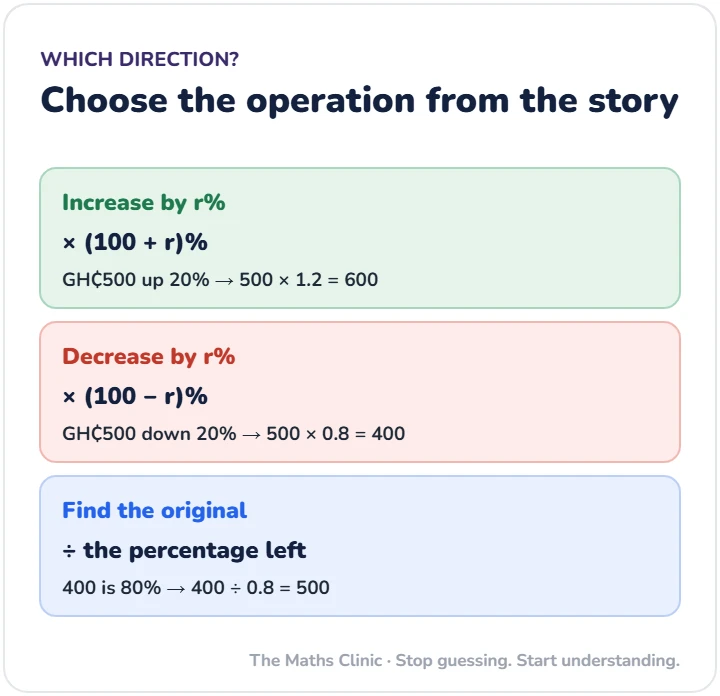
\text{Percentage amount} = (\text{Rate} \div 100) \times \text{Base}Final value after an increase
New value = Original value + Increase
or:
New value = Original value × (100 + Rate)/100
Final value after a reduction
New value = Original value − Reduction
or:
New value = Original value × (100 − Rate)/100
Percentage change
Percentage change = (Change ÷ Original value) × 100%
The original value—not automatically the largest or final value—is the base.
The Money-Action Map
| Situation | Base | Change | Direction |
|---|---|---|---|
| Simple interest | Principal | Interest | Added when finding amount |
| Profit percentage | Cost price | Profit | Increase |
| Loss percentage | Cost price | Loss | Reduction |
| Discount | Marked price | Discount | Reduction |
| Commission | Total sales or stated transaction value | Commission | Earning |
| Tax added | Price before tax | Tax | Increase |
| Percentage increase | Original value | Increase | Increase |
| Percentage decrease | Original value | Decrease | Reduction |
Nine Simple Interest and Percentage Traps
Trap 1: Confusing Interest with Amount
Interest is the extra money.
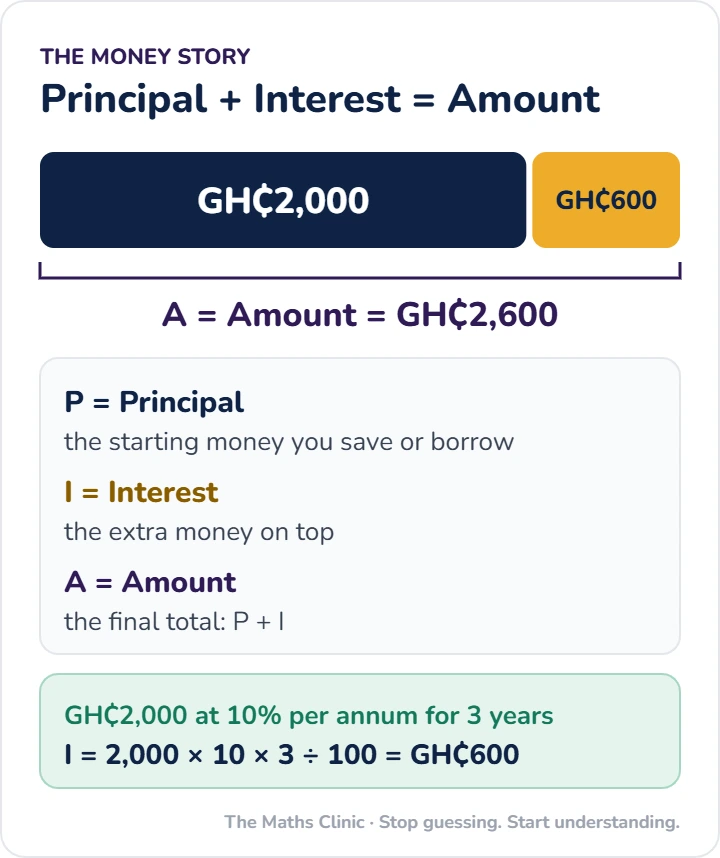
Amount is principal plus interest.
A = P + I
Repair
If the question asks for interest, calculate I and stop.
If it asks for amount, calculate I and add P.
Trap 2: Using Amount as Principal
Suppose:
GH₵1,000 amounts to GH₵1,240.
The correct roles are:
\begin{gathered}P = \text{GH₵}1{,}000 \\ A = \text{GH₵}1{,}240 \\ I = \text{GH₵}240\end{gathered}GH₵1,240 is not principal.
Repair
Ask:
What money existed before interest was added?
That value is P.
Trap 3: Failing to Match Rate and Time Units
If the rate is per annum, time must be in years.
Examples:
\begin{gathered}6\ \text{months} = \dfrac{1}{2}\ \text{year} \\ 9\ \text{months} = \dfrac{3}{4}\ \text{year} \\ 15\ \text{months} = 1.25\ \text{years} \\ 18\ \text{months} = 1.5\ \text{years}\end{gathered}Repair
Read the period attached to the rate before converting time.
Trap 4: Misusing the Percentage Rate
When R is a percentage number:
I = \dfrac{PRT}{100}If R = 12, divide by 100.
If the rate is already decimal, such as r = 0.12:
I = PrT
Do not divide by 100 again.
Repair
Use either percentage form or decimal form consistently.
Trap 5: Using the Wrong Percentage Base
Every percentage is a percentage of something.

Examples:
- Simple interest → Principal
- Percentage profit → Cost price
- Discount → Marked price
- Commission → Stated sales or transaction value
- Percentage increase → Original value
Repair
Complete:
The percentage is acting on __________.
Trap 6: Choosing the Wrong Direction
A percentage can increase or reduce a value.
- Interest added to principal → Increase
- Profit → Increase
- Tax added → Increase
- Discount → Reduction
- Loss → Reduction
- Depreciation → Reduction
Repair
Name the money action before choosing addition or subtraction.
Trap 7: Treating a Reverse Percentage as a Direct Percentage
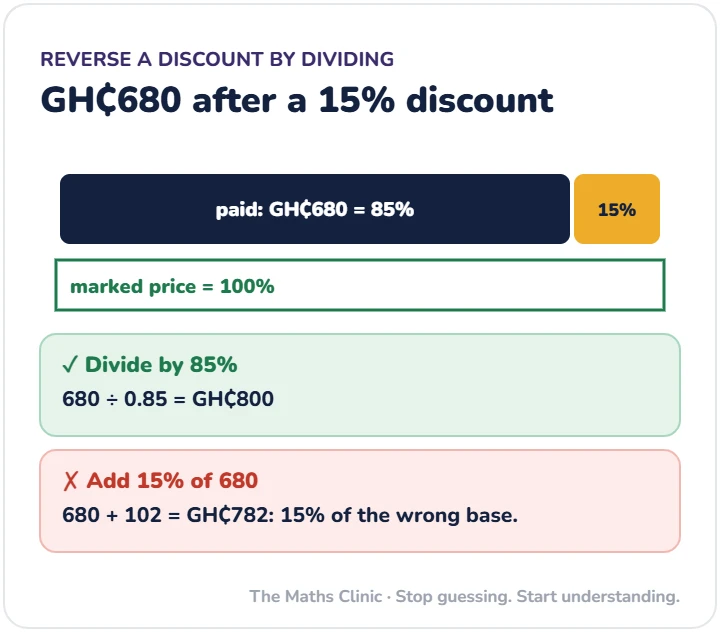
Suppose an item is sold for GH₵680 after a discount of 15%.
The learner cannot find 15% of GH₵680 and add it.
After a 15% discount, GH₵680 represents 85% of the original marked price.
\text{Marked price} = \dfrac{680 \times 100}{85}\text{Marked price} = \text{GH₵}800Repair
When the final value and rate are given, first determine what percentage of the original remains.
Trap 8: Rounding or Labelling the Answer Incorrectly
Common errors include:
- Rounding during an intermediate step
- Writing GH₵ before a rate
- Writing % after a money value
- Leaving time without years or months
- Giving an unlabelled number
Repair
Keep exact values until the final step and label the answer.
Trap 9: Accepting an Unreasonable Answer
A learner may obtain:
- Nine-month interest larger than several years of principal
- Amount smaller than principal under positive interest
- Discounted price greater than marked price
- 5% written as GH₵5
- Percentage increase based on the new value
Repair
Estimate before calculating and check the direction afterwards.
The Four Checks Before Any Formula
Before calculating, write:
- What is the base?
- What is the rate and its period?
- Does the time unit match?
- What does the question require?
For simple interest:
\begin{gathered}P = … \\ R = … \\ T = … \\ \text{Required} = I, A, P, R or T\end{gathered}For a general percentage question:
Original value = …
Rate = …
Change direction = Increase or reduction
Required = Change, final value or percentage
Worked Example 1: Simple Interest with Two Traps
Kofi invests GH₵2,000 at 12% simple interest per annum for 9 months. Find the amount.
\begin{gathered}P = \text{GH₵}2{,}000 \\ R = 12\%\ \text{per annum} \\ T = \dfrac{9}{12}\ \text{year} = \dfrac{3}{4}\ \text{year}\end{gathered}Interest:
I = \dfrac{2{,}000 \times 12 \times \dfrac{3}{4}}{100}I = \text{GH₵}180Amount:
A = \text{GH₵}2{,}000 + \text{GH₵}180A = \text{GH₵}2{,}180\text{Answer}: \text{Amount} = \text{GH₵}2{,}180.Traps avoided
- Nine months was converted to years.
- Principal was used as the base.
- Interest was added because amount was required.
Worked Example 2: Percentage Increase
The price of an item increases from GH₵500 to GH₵650. Find the percentage increase.
\begin{gathered}\text{Original value} = \text{GH₵}500 \\ \text{New value} = \text{GH₵}650\end{gathered}\text{Increase} = \text{GH₵}650 - \text{GH₵}500\text{Increase} = \text{GH₵}150Percentage increase = (Increase ÷ Original value) × 100%
\text{Percentage increase} = (150 \div 500) \times 100\%\text{Percentage increase} = 30\%\text{Answer}: \text{Percentage increase} = 30\%.Common trap
Dividing by GH₵650 uses the new value instead of the original base.

Worked Example 3: Percentage Reduction
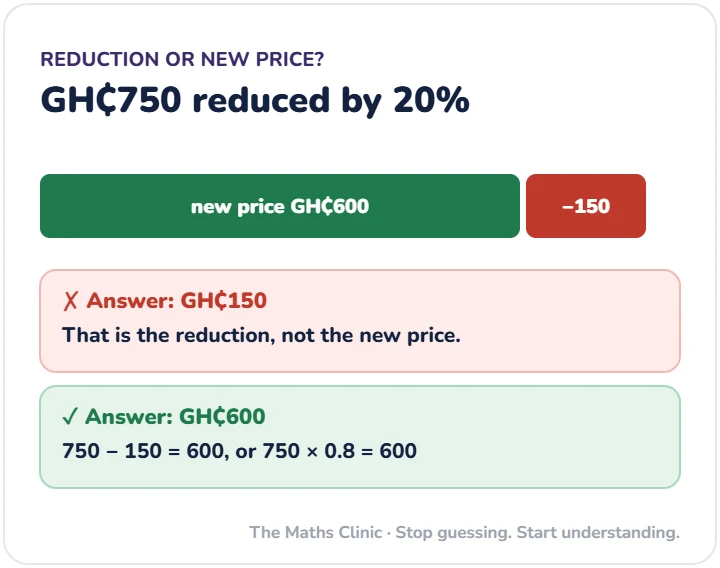
A price of GH₵750 is reduced by 20%. Find the new price.
\begin{gathered}\text{Original price} = \text{GH₵}750 \\ \text{Reduction rate} = 20\%\end{gathered}\text{Reduction} = (20 \div 100) \times \text{GH₵}750\text{Reduction} = \text{GH₵}150\text{New price} = \text{GH₵}750 - \text{GH₵}150\text{New price} = \text{GH₵}600\text{Answer}: \text{New price} = \text{GH₵}600.Common trap
GH₵150 is the reduction, not the new price.
Worked Example 4: Find Principal
A sum earns GH₵240 simple interest in 3 years at 8% per annum. Find the principal.
I = \text{GH₵}240
R = 8% per annum
T = 3\ \text{years}
P = ?
P = \dfrac{100I}{RT}P = (100 \times 240) \div (8 \times 3)
P = 24{,}000 \div 24P = \text{GH₵}1{,}000\text{Answer}: \text{Principal} = \text{GH₵}1{,}000.Trap avoided
The question asks for principal, so the direct interest formula must be rearranged.
Worked Example 5: Reverse Discount
A bag is sold for GH₵240 after a discount of 20%. Find the marked price.
After a 20% discount, the buyer pays:
100\% - 20\% = 80\%
Therefore:
80\%\ \text{of marked price} = \text{GH₵}240\text{Marked price} = \dfrac{240 \times 100}{80}\text{Marked price} = \text{GH₵}300\text{Answer}: \text{Marked price} = \text{GH₵}300.Check
\text{Discount} = 20\%\ \text{of GH₵}300\text{Discount} = \text{GH₵}60\text{Selling price} = \text{GH₵}300 - \text{GH₵}60\text{Selling price} = \text{GH₵}240Worked Example 6: Decimal Rate
GH₵1,500 is invested at a decimal simple-interest rate of 0.06 per annum for 2 years. Find the interest.
The rate is already decimal.
I = PrT
I = \text{GH₵}1{,}500 \times 0.06 \times 2I = \text{GH₵}180\text{Answer}: \text{Interest} = \text{GH₵}180.Do not divide by 100 again.
Common Wrong Approaches
Wrong Approach 1: Using T = 9 for Nine Months
With an annual rate:
T = \dfrac{9}{12}\ \text{year}not 9 years.
Wrong Approach 2: Stopping at Interest
If amount is required:
A = P + I
Wrong Approach 3: Using the Final Value as the Base
Percentage change is normally based on the original value.
Wrong Approach 4: Treating 20% as GH₵20
A percentage becomes a money amount only after it is applied to a base.
Wrong Approach 5: Adding a Reduction
Discount and loss reduce values.
Wrong Approach 6: Subtracting an Increase
Profit, added tax and interest increase final values when the final amount is required.
Wrong Approach 7: Reversing with the Same Direct Operation
If a final value represents 80% of the original, divide by 80% to recover the original.

Wrong Approach 8: Dividing a Decimal Rate by 100
A decimal rate has already been converted.
Wrong Approach 9: Ignoring the Word “Simple”
The simple-interest relationship does not automatically apply to compound-interest or reducing-balance situations.
The Maths Clinic Trap-Recognition Routine
Step 1: Name the topic
Is the story about interest, increase, reduction, profit, loss, discount or commission?
Step 2: Find the base
Write what the percentage acts on.
Step 3: Find the direction
Increase, reduction, earning or comparison?
Step 4: Match units
For interest, match time with the rate period.
Step 5: Identify the target
Change, final value, original value, rate or time?
Step 6: Decide direct or reverse
Are you moving from original to final, or final back to original?
Step 7: Solve visibly
Show the relationship and substitution.
Step 8: Check
Test direction, size, base and unit.
WASSCE-Style Trap Box
Before submitting, complete:
- The original or base value is __________.
- The percentage rate is __________.
- The rate period is __________.
- The time in a matching unit is __________.
- The percentage causes an increase, reduction or earning.
- The question requires __________.
- My answer should carry the unit __________.
Simple Interest and Percentage Diagnostic Practice
Attempt every question before checking the answers.
Questions
- Find the simple interest on GH₵1,500 at 10% per annum for 2 years.
- Find the amount on GH₵800 at 15% simple interest per annum for 6 months.
- A sum earns GH₵240 simple interest in 3 years at 8% per annum. Find the principal.
- An item increases in price from GH₵500 to GH₵650. Find the percentage increase.
- A price of GH₵750 is reduced by 20%. Find the new price.
- GH₵2,000 amounts to GH₵2,480 under simple interest. Find the interest.
- Find the interest on GH₵1,200 at 12% per annum for 15 months.
- A shirt is sold for GH₵340 after a discount of 15%. Find the marked price.
- A trader buys an item for GH₵400 and sells it for GH₵500. Find the percentage profit.
- A salesperson earns 4% commission on sales worth GH₵6,000. Find the commission.
- GH₵2,500 is invested at a decimal simple-interest rate of 0.08 per annum for 18 months. Find the interest.
- The population of a school club falls from 250 to 200. Find the percentage decrease.
- A phone priced at GH₵2,000 attracts a stated tax of 12%. Find the tax and total price.
- An item is sold for GH₵720 at a loss of 10% on cost price. Find the cost price.
Answers and Gap Diagnosis
1. GH₵300
I = \dfrac{1{,}500 \times 10 \times 2}{100}I = \text{GH₵}3002. GH₵860
T = \dfrac{6}{12}\ \text{year} = \dfrac{1}{2}\ \text{year}I = \dfrac{800 \times 15 \times \dfrac{1}{2}}{100}I = \text{GH₵}60A = \text{GH₵}800 + \text{GH₵}60A = \text{GH₵}860If you wrote GH₵60: You found interest but not amount.
3. GH₵1,000
P = (100 \times 240) \div (8 \times 3)
P = \text{GH₵}1{,}0004. 30%
\text{Increase} = \text{GH₵}650 - \text{GH₵}500\text{Increase} = \text{GH₵}150\text{Percentage increase} = (150 \div 500) \times 100\%\text{Percentage increase} = 30\%If you divided by GH₵650: You used the new value as the base.
5. GH₵600
\text{Reduction} = (20 \div 100) \times \text{GH₵}750\text{Reduction} = \text{GH₵}150\text{New price} = \text{GH₵}750 - \text{GH₵}150\text{New price} = \text{GH₵}6006. GH₵480
I = A - P
I = \text{GH₵}2{,}480 - \text{GH₵}2{,}000I = \text{GH₵}480If you used GH₵2,480 as principal: You confused amount with original money.
7. GH₵180
T = \dfrac{15}{12}\ \text{years} = 1.25\ \text{years}I = \dfrac{1{,}200 \times 12 \times 1.25}{100}I = \text{GH₵}1808. GH₵400
After a 15% discount, the buyer pays 85%.
\text{Marked price} = \dfrac{340 \times 100}{85}\text{Marked price} = \text{GH₵}4009. 25%
\text{Profit} = \text{GH₵}500 - \text{GH₵}400\text{Profit} = \text{GH₵}100\text{Percentage profit} = (100 \div 400) \times 100\%\text{Percentage profit} = 25\%If you divided by GH₵500: You used selling price instead of cost price.
10. GH₵240
\text{Commission} = (4 \div 100) \times \text{GH₵}6{,}000\text{Commission} = \text{GH₵}24011. GH₵300
T = \dfrac{18}{12}\ \text{years} = 1.5\ \text{years}The rate is decimal:
I = PrT
I = \text{GH₵}2{,}500 \times 0.08 \times 1.5I = \text{GH₵}300If you divided by 100: You converted the decimal rate twice.
12. 20%
\text{Decrease} = 250 - 200\text{Decrease} = 50\text{Percentage decrease} = (50 \div 250) \times 100\%\text{Percentage decrease} = 20\%The original number, 250, is the base.
13. Tax = GH₵240; total price = GH₵2,240
\text{Tax} = (12 \div 100) \times \text{GH₵}2{,}000\text{Tax} = \text{GH₵}240\text{Total price} = \text{GH₵}2{,}000 + \text{GH₵}240\text{Total price} = \text{GH₵}2{,}24014. GH₵800
A 10% loss means selling price is 90% of cost price.
\text{Cost price} = \dfrac{720 \times 100}{90}\text{Cost price} = \text{GH₵}800DoK Progression
| Depth of Knowledge | Main demand | Questions |
|---|---|---|
| DoK 1 | Identify and calculate a direct percentage | 1, 6 and 10 |
| DoK 2 | Control units, base and final value | 2, 4, 5, 7, 9, 11–13 |
| DoK 3 | Rearrange or reverse a percentage relationship | 3, 8 and 14 |
Use the Results to Locate the Trap
| Score | What it suggests | Next action |
|---|---|---|
| 12–14 correct | Trap recognition is becoming secure | Attempt unfamiliar mixed questions |
| 9–11 correct | One or two traps remain | Correct those specific question types |
| 5–8 correct | Base, unit or target is still being missed | Return to the trap-recognition routine |
| 0–4 correct | Calculation begins before the trap is identified | Rebuild percentage meaning first |
Check the error pattern:
- Stopped at interest → Demand-word trap
- Used amount as principal → Money-role trap
- Used months as years → Time-unit trap
- Used wrong denominator → Percentage-base trap
- Added a reduction → Direction trap
- Failed to recover original value → Reverse-percentage trap
- Divided decimal rate by 100 → Rate-form trap
- Missing GH₵ or % → Unit trap
- Accepted an impossible result → Reasonableness trap
Learner Reflection
Tick each statement only when you can do it independently.
- I can identify the percentage base.
- I can distinguish principal from amount.
- I can distinguish interest from amount.
- I can match rate and time units.
- I can use percentage and decimal rates correctly.
- I can decide whether a value increases or reduces.
- I can recognise a reverse percentage question.
- I can calculate percentage increase and decrease.
- I can state the correct money or percentage unit.
- I can estimate whether an answer is reasonable.
- I can name the exact trap behind a wrong answer.
- I can retest the corrected skill without notes.
How This Helps Before WASSCE
This lesson helps the learner to:
- Recognise hidden demands before calculating
- Identify percentage bases
- Connect simple interest to percentage meaning
- Match time and rate units
- Separate interest and amount
- Control increase and reduction directions
- Solve direct and reverse percentages
- Use correct answer units
- Check whether a result is reasonable
The official WAEC Ghana Chief Examiner’s Reports may also be consulted when studying reported examination performance and weaknesses.
Continue the Intervention
Use the lesson matching the trap you discovered:
- For principal, rate and time identification, study Principal Rate and Time.
- For formula-letter and unit meaning, study Simple Interest Examples.
- For interest and amount confusion, study Interest or Amount.
- For wrong-answer diagnosis, study Wrong Simple Interest Answers.
- For full word-problem interpretation, study Simple Interest Word Problems.
- For broader financial reading, study Read Business Maths Questions Carefully.
If the gap remains broad, visit the Intervention Hub.
When trap recognition is secure, attempt targeted questions in the WASSCE Maths Practice Zone.
For other examination traps, explore WAEC Maths Traps.
Conclusion: Recognise Simple Interest and Percentage Traps
Simple interest and percentage are not difficult only because of formulas. They become difficult when the learner overlooks the meaning of the values.
Before calculating, ask:
- Percentage of what?
- Is the value original or final?
- Is the change an increase or reduction?
- Does the time match the rate period?
- Is the rate a percentage or decimal?
- Does the question require interest, amount or an original value?
- Is this a direct or reverse percentage?
- Does the final answer make sense?
A serious WASSCE candidate slows down at the beginning so that the solution does not break down later.
Stop Guessing. Start Understanding.
Practice Zone CTA
Do not wait until the final answer before looking for the trap.
Visit the WASSCE Maths Practice Zone and attempt mixed Simple Interest and Percentage questions.
For every wrong answer:
- Name the trap.
- Identify the first wrong step.
- Correct the base, unit, direction or target.
- Complete the solution.
- Check the answer.
- Attempt a fresh question without notes.
✏️ Try it yourself
A trader buys a phone for GH₵400 and sells it for GH₵500. Find the percentage profit.
Tap to see the answer
Profit = GH₵100. The base is the cost price: 100 \div 400 \times 100 = 25%. (Dividing by 500 gives 20%, which uses the wrong base.)
💬 Stuck on a step? Ask Dickson and send the line where you got lost.

Written by
Dickson Sarpong
NTC-certified SHS Mathematics teacher in Ghana with WAEC marking experience, and author of The Bridge Series textbooks. Every lesson here is built around the mistakes WAEC examiners keep reporting.
About DicksonStuck? Ask a question
Want the whole topic, step by step? My textbooks, The Bridge to Mathematics and The Bridge to Additional Mathematics for SHS, follow the new curriculum and rebuild the basics as you go.
Read a free chapter →