Struggling with WASSCE Maths? Stop guessing. Let’s fix the gap step by step.

Wrong Simple Interest Answer? Find Where It First Went Wrong
When you get a simple interest question wrong, “go and learn the formula” is rarely the real fix. Usually one particular line went wrong first. This final part shows you how to find that line, name the gap behind it and repair it.

📚 Part of the Simple Interest Clinic: every lesson on this topic, in one place.
When you get a simple interest question wrong, “go and learn the formula” is rarely the real fix. Usually one particular line went wrong first. This final part shows you how to find that line, name the gap behind it and repair it.
📘 This lesson is part of the Simple Interest Clinic
Work through the parts in order. Each one fixes a different gap. See the whole series
-
Simple Interest Questions With Answers: P, R, T, I and A Explained
-
Simple Interest Formula (I = PRT/100): How to Use It Correctly
-
Interest or Amount? How to Tell What the Question Wants
-
Simple Interest Examples: 8 WASSCE Fixes, Step by Step
-
Simple Interest Word Problems: 7 Hidden WASSCE Traps
-
Simple Interest and Percentage Traps: 9 WASSCE Fixes
-
Simple Interest Mistakes: 10 Errors and How to Fix Them
-
Wrong Simple Interest Answer? Find Where It First Went Wrong
When a learner gets a simple-interest question wrong, the correction is sometimes reduced to:
“You did not learn the formula.”
But that diagnosis may be inaccurate.
The learner may know:
I = \dfrac{PRT}{100}The mistake may have started somewhere else:
- The question was misread.
- Amount was mistaken for principal.
- Months were used as years.
- The rate was converted twice.
- A value was placed under the wrong letter.
- The formula was rearranged incorrectly.
- Interest was given as amount.
- The correct answer received the wrong unit.
- An unreasonable result was accepted without checking.
This simple interest mistakes lesson identifies the answer-diagnosis gap and repairs it step by step.
Maths Clinic Diagnosis: Find the First Wrong Step
A wrong final answer does not tell us the full story.
Suppose a learner is asked:
Find the simple interest on GH₵600 at 10% per annum for 6 months.
The learner writes:
\begin{gathered}P = 600 \\ R = 10 \\ T = 6\end{gathered}I = \dfrac{600 \times 10 \times 6}{100}I = \text{GH₵}360The arithmetic follows correctly from the learner’s substitution. However, the substitution is based on a wrong time value.
The rate is per annum, so time must be in years:
T = \dfrac{6}{12}\ \text{year}T = \dfrac{1}{2}\ \text{year}Correct interest:
I = \dfrac{600 \times 10 \times \dfrac{1}{2}}{100}I = \text{GH₵}30The first wrong step was not multiplication. It was time conversion.
The exact hidden gap is:
The learner sees that the final answer is wrong but cannot trace the error back to the first incorrect decision.
📋 What the WAEC Chief Examiner reported
- In 2025, WAEC listed “solving application problems in Simple Interest” among candidates’ main weaknesses.
- In a 2025 question (two accounts at 11% and 10% for 3½ years, one amount 140% of the other), most candidates “could not calculate the interest at 10% and 11% correctly to help them arrive at the correct equation”.
- “Translating word problems into mathematical expressions” was also a listed weakness.
How to win these marks back
- Write P, R and T with units before substituting; convert months to years (3½ years, not 3.5 months).
- In two-amount questions, call one amount x, write the other in terms of x, write each interest, then add and solve.
- Check by putting your answer back into the story.
Source: WAEC Chief Examiners’ Reports, WASSCE (SC) 2025, Ghana: Mathematics (Core).
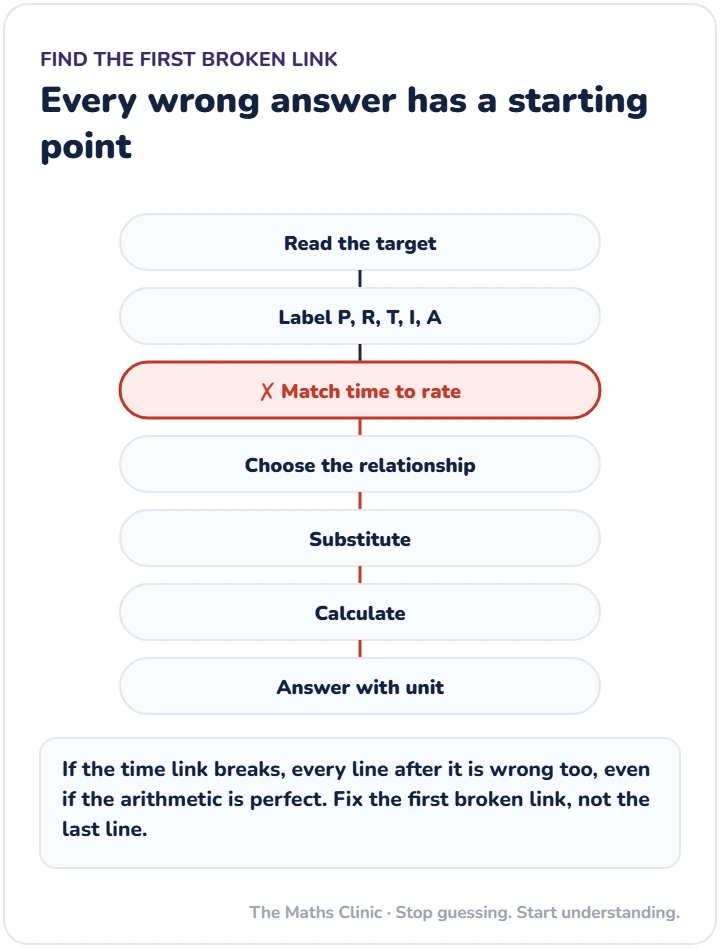
The Error Chain Behind a Wrong Answer
A simple-interest solution normally passes through several stages:

- Read the question.
- Identify the target.
- Label P, R, T, I and A.
- Match the rate and time units.
- Select or rearrange the relationship.
- Substitute the values.
- Calculate.
- Interpret the answer.
- State the correct unit and check reasonableness.
A mistake at an early stage can make every later line wrong.
That is why correction must begin at the first failed stage, not only at the final answer.
The Five Simple-Interest Quantities
| Symbol | Meaning | Usual unit |
|---|---|---|
| P | Principal or original money | GH₵ |
| R | Percentage rate | % per stated period |
| T | Time | Years, months or matching period |
| I | Simple interest or extra money | GH₵ |
| A | Amount or final total | GH₵ |
Main relationships
Interest:
I = \dfrac{PRT}{100}Amount:
A = P + I
Interest from amount:
I = A - P
Principal from amount and interest:
P = A - I
The Complete Reverse Formula Family

Find principal
P = \dfrac{100I}{RT}Find rate
R = \dfrac{100I}{PT}Find time
T = \dfrac{100I}{PR}These forms should come from rearranging:
I = \dfrac{PRT}{100}Do not replace the required letter blindly.
Nine Hidden Gaps Behind Wrong Simple Interest Answers
Gap 1: Question-Target Error
What happens
The learner does not identify whether the question requires:
- Interest
- Amount
- Principal
- Rate
- Time
Example
The learner correctly finds interest as GH₵300, but the question asks for amount.
Diagnosis
The calculation may be correct, but the answer is incomplete.
Repair
Write the target before calculating:
A = ?
Gap 2: Money-Role Error
What happens
The learner confuses:
- Principal with amount
- Interest with amount
- Principal with interest
Example
An investment grows from GH₵1,000 to GH₵1,240.
Correct roles:
\begin{gathered}P = \text{GH₵}1{,}000 \\ A = \text{GH₵}1{,}240 \\ I = \text{GH₵}240\end{gathered}Repair
Ask:
- What was the original money?
- What was the extra money?
- What was the final total?
Gap 3: Time-Conversion Error
What happens
The learner uses months as years when the rate is per annum.
Example
15 months is not 15 years.
T = \dfrac{15}{12}\ \text{years}T = 1.25\ \text{years}Repair
Match the time unit to the rate period before substitution.
Gap 4: Rate-Representation Error
What happens
The learner:
- Forgets to divide a percentage rate by 100
- Uses 0.05 and still divides by 100
- Omits the percentage sign
- Ignores the rate period
Correct percentage form
If R = 5:
I = \dfrac{PRT}{100}Correct decimal form
If r = 0.05:
I = PrT
Do not mix the two forms.
Gap 5: Substitution Error
What happens
The learner knows the meanings but places a value in the wrong position.
Example
\begin{gathered}P = \text{GH₵}1{,}000 \\ R = 8\% \\ T = 2\ \text{years}\end{gathered}Wrong:
I = \dfrac{8 \times 1{,}000 \times 2}{100}This particular order still gives the same product because multiplication is commutative. However, the weak labelling becomes dangerous when the formula is rearranged or when A is mistaken for P.
The true substitution check is not merely the order of multiplication. It is whether each value represents the correct quantity.
Repair
Write the labelled values before substituting.
Gap 6: Formula-Rearrangement Error
What happens
The question asks for P, R or T, but the learner repeats the interest formula or moves terms incorrectly.
Example
To find time:
Wrong:
T = \dfrac{PRT}{100}Correct:
T = \dfrac{100I}{PR}Repair
Rearrange one operation at a time or use the verified formula family.
Gap 7: Calculation Error
What happens
The interpretation and formula are correct, but arithmetic fails.
Examples include:
- Wrong multiplication
- Wrong division
- Missing bracket on a calculator
- Incorrect decimal placement
- Premature rounding
Repair
Estimate first, use brackets and check by substitution.
Gap 8: Final-Meaning and Unit Error
What happens
The learner:
- Stops at interest when amount is required
- Adds principal when interest only is required
- Writes GH₵ before a rate
- Writes % after a money value
- Gives a time answer without years or months
Repair
Label the final line:
\begin{gathered}\text{Interest} = \text{GH₵}… \\ \text{Rate} = …\%\ \text{per annum} \\ \text{Time} = … \text{years}\end{gathered}Gap 9: Reasonableness Error
What happens
The learner accepts an answer that does not fit the question.
Examples:
- Six-month interest is greater than several years of the principal.
- Amount is smaller than principal when positive interest is added.
- A 5% rate is written as GH₵5.
- Time is given as 120 years for a short school-level investment.
Repair
Estimate and substitute the answer back into the original relationship.
The Wrong-Answer Diagnosis Table
| First wrong stage | What the work may show | Gap to repair |
|---|---|---|
| Target | Correct interest but amount required | Question-target gap |
| Labelling | A used as P | Money-role gap |
| Conversion | 9 months used as 9 years | Time-unit gap |
| Rate | 0.05\ \text{used with} \div 100 | Rate-representation gap |
| Formula | PRT/100 used when P is required | Formula-choice gap |
| Rearrangement | T = \dfrac{PRT}{100} | Algebra gap |
| Substitution | Wrong value placed as principal | Substitution gap |
| Calculation | Correct setup, wrong arithmetic | Number-skill gap |
| Final line | Missing GH₵, %, years or final step | Interpretation-and-unit gap |
The Maths Clinic Error-Tracing Routine
Step 1: Hide the Final Answer
Do not begin by staring only at the last number.
Step 2: Restate the Target
Write:
The question wants __________.
Step 3: Check the Labels
Confirm P, R, T, I and A.
Step 4: Check Units
Does time match the rate period?
Step 5: Check the Formula
Does the selected formula produce the required unknown?
Step 6: Check Rearrangement
If P, R or T is unknown, verify the rearranged form.
Step 7: Check Substitution
Confirm that each labelled value entered the correct place.
Step 8: Check Arithmetic
Recalculate using brackets.
Step 9: Check Meaning and Reasonableness
State what the answer represents and substitute it back where possible.
Worked Diagnosis 1: Find Time
GH₵1,200 is invested at 5% simple interest per annum. The interest earned is GH₵180. Find the time.
Correct labelling
P = \text{GH₵}1{,}200
R = 5% per annum
I = \text{GH₵}180
T = ?
Correct relationship
I = \dfrac{PRT}{100}Make T the subject:
T = \dfrac{100I}{PR}Substitute
T = (100 \times 180) \div (1{,}200 \times 5)T = 18{,}000 \div 6{,}000T = 3\ \text{years}\text{Answer}: \text{Time} = 3\ \text{years}.Common wrong approach
Wrong:
T = \dfrac{PRT}{100}This repeats the original relationship without making T the subject.
Check by substitution
I = \dfrac{1{,}200 \times 5 \times 3}{100}I = \text{GH₵}180The result matches the given interest.

Worked Diagnosis 2: Amount Used as Principal
A principal of GH₵1,000 amounts to GH₵1,240 in 3 years. Find the simple interest.
A learner writes:
P = \text{GH₵}1{,}240This is the first wrong step.
Correct labels:
P = \text{GH₵}1{,}000
A = \text{GH₵}1{,}240
I = ?
I = A - P
I = \text{GH₵}1{,}240 - \text{GH₵}1{,}000I = \text{GH₵}240\text{Answer}: \text{Interest} = \text{GH₵}240.
Worked Diagnosis 3: Months Used as Years
Find the simple interest on GH₵600 at 10% per annum for 9 months.
A learner writes:
T = 9
The rate is annual, so this is wrong.
Correct time:
T = \dfrac{9}{12}\ \text{year}T = \dfrac{3}{4}\ \text{year}I = \dfrac{600 \times 10 \times \dfrac{3}{4}}{100}I = \text{GH₵}45\text{Answer}: \text{Interest} = \text{GH₵}45.Quick check
One-year interest is 10% of GH₵600, which is GH₵60.
Nine-month interest should be less than GH₵60. GH₵45 is reasonable.

Worked Diagnosis 4: Interest Given as Amount
GH₵1,000 is invested at 7% simple interest per annum for 4 years. Find the amount.
Interest:
I = \dfrac{1{,}000 \times 7 \times 4}{100}I = \text{GH₵}280A learner stops at GH₵280.
The interest is correct, but the target is amount.
A = P + I
A = \text{GH₵}1{,}000 + \text{GH₵}280A = \text{GH₵}1{,}280\text{Answer}: \text{Amount} = \text{GH₵}1{,}280.Worked Diagnosis 5: Decimal Rate Converted Twice
Find the interest on GH₵2,000 at a decimal simple-interest rate of 0.05 per annum for 2 years.
A learner writes:
I = \dfrac{2{,}000 \times 0.05 \times 2}{100}The rate 0.05 is already decimal.
Correct:
I = PrT
I = \text{GH₵}2{,}000 \times 0.05 \times 2I = \text{GH₵}200\text{Answer}: \text{Interest} = \text{GH₵}200.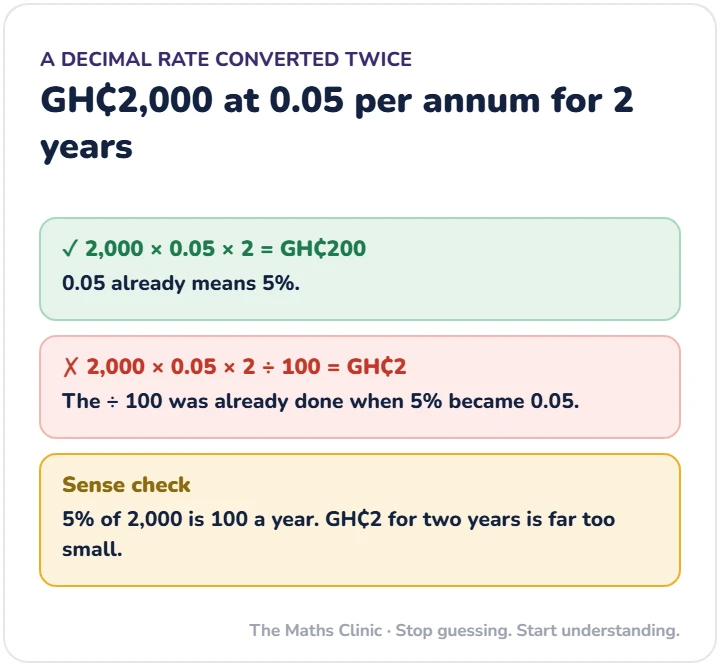
Worked Diagnosis 6: Wrong Calculator Grouping
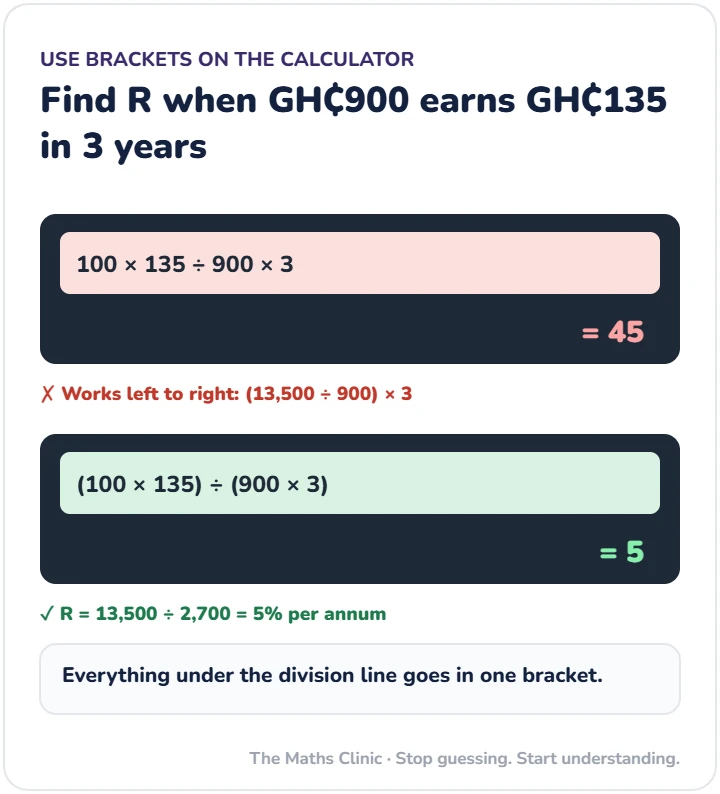
Find the rate when GH₵900 earns GH₵135 in 3 years.
Correct formula:
R = \dfrac{100I}{PT}Correct substitution:
R = (100 \times 135) \div (900 \times 3)
R = 13{,}500 \div 2{,}700R = 5\%
A learner entering:
100 \times 135 \div 900 \times 3
without brackets may obtain a different result because the calculator works from left to right.
Use brackets around the entire denominator.
Nine Questions to Ask About a Wrong Answer
- What did the question ask for?
- Did I label P, R, T, I and A correctly?
- Did I mistake amount for principal?
- Does time match the rate period?
- Did I use percentage or decimal rate form correctly?
- Does the formula produce the unknown?
- Did I rearrange correctly?
- Does my final unit match the quantity?
- Does the answer make sense when substituted back?
Diagnostic Practice: Locate and Repair the Error
Each problem has two tasks:
- Solve the question correctly.
- Identify the likely gap if the stated wrong answer appears.
Questions
- GH₵700 earns GH₵84 simple interest at 6% per annum. Find the time.
A learner answers 11.67 years after calculating 700 \div 60. - Find the rate if GH₵900 earns GH₵135 simple interest in 3 years.
A learner writes GH₵5. - Find the principal that earns GH₵240 simple interest at 8% per annum for 5 years.
A learner uses P = PRT/100. - Find the amount on GH₵1,000 at 7% simple interest per annum for 4 years.
A learner answers GH₵280. - A loan of GH₵2,000 attracts GH₵300 simple interest. Find the amount to be paid.
A learner searches for rate and time before solving. - GH₵600 is invested for 9 months at 10% simple interest per annum. Find the interest.
A learner answers GH₵540. - At 12% simple interest per annum, how long will GH₵500 take to earn GH₵180?
A learner writes T = PRT/100. - A principal becomes GH₵1,560 after earning GH₵360 simple interest. Find the principal.
A learner answers GH₵1,560. - Find the simple interest on GH₵2,500 at 4% per annum for 2 years.
A learner answers GH₵2. - GH₵1,600 is invested at 0.06 simple interest per annum for 18 months. Find the interest.
A learner divides the result by 100. - A principal of GH₵3,000 earns GH₵450 simple interest in 2.5 years. Find the rate.
A learner enters 100 \times 450 \div 3{,}000 \times 2.5. - A sum earns GH₵360 simple interest at 6% per annum for 3 years. Find the principal.
A learner obtains GH₵2,000 but writes 2,000%.
Answers and Gap Diagnosis
1. Time = 2 years
T = \dfrac{100I}{PR}T = (100 \times 84) \div (700 \times 6)
T = 8{,}400 \div 4{,}200T = 2\ \text{years}First wrong gap: Formula selection and rearrangement. Dividing principal by rate does not isolate time.
2. Rate = 5% per annum
R = \dfrac{100I}{PT}R = (100 \times 135) \div (900 \times 3)
R = 5\%
First wrong gap: Final unit. GH₵5 is money, but rate requires %.
3. Principal = GH₵600
P = \dfrac{100I}{RT}P = (100 \times 240) \div (8 \times 5)
P = 24{,}000 \div 40P = \text{GH₵}600First wrong gap: Formula rearrangement. P must be isolated.
4. Amount = GH₵1,280
I = \dfrac{1{,}000 \times 7 \times 4}{100}I = \text{GH₵}280A = \text{GH₵}1{,}000 + \text{GH₵}280A = \text{GH₵}1{,}280First wrong gap: Question target. GH₵280 is interest, but amount was required.
5. Amount = GH₵2,300
A = P + I
A = \text{GH₵}2{,}000 + \text{GH₵}300A = \text{GH₵}2{,}300First wrong gap: Formula choice. Interest is already given, so rate and time are unnecessary.
6. Interest = GH₵45
T = \dfrac{9}{12}\ \text{year}T = \dfrac{3}{4}\ \text{year}I = \dfrac{600 \times 10 \times \dfrac{3}{4}}{100}I = \text{GH₵}45First wrong gap: Time conversion. Nine months was treated as nine years.
7. Time = 3 years
T = \dfrac{100I}{PR}T = (100 \times 180) \div (500 \times 12)
T = 18{,}000 \div 6{,}000T = 3\ \text{years}First wrong gap: Formula rearrangement. The original interest relationship was repeated without isolating T.
8. Principal = GH₵1,200
P = A - I
P = \text{GH₵}1{,}560 - \text{GH₵}360P = \text{GH₵}1{,}200First wrong gap: Money-role identification. GH₵1,560 is amount, not principal.
9. Interest = GH₵200
I = \dfrac{2{,}500 \times 4 \times 2}{100}I = \text{GH₵}200First wrong gap: Substitution or arithmetic. A likely cause is dividing values in the wrong order or omitting a factor.
10. Interest = GH₵144
T = \dfrac{18}{12}\ \text{years}T = 1.5\ \text{years}The rate is already decimal:
I = PrT
I = \text{GH₵}1{,}600 \times 0.06 \times 1.5I = \text{GH₵}144First wrong gap: Rate representation. The decimal rate was divided by 100 again.
11. Rate = 6% per annum
R = (100 \times 450) \div (3{,}000 \times 2.5)R = 45{,}000 \div 7{,}500R = 6\%
First wrong gap: Calculator grouping. The complete denominator requires brackets.
12. Principal = GH₵2,000
P = (100 \times 360) \div (6 \times 3)
P = \text{GH₵}2{,}000First wrong gap: Final unit. Principal is money, so the answer is GH₵2,000, not 2,000%.
DoK Progression
| Depth of Knowledge | Main demand | Questions |
|---|---|---|
| DoK 1 | Identify an obvious unit or target error. | 2, 4, 5 and 12 |
| DoK 2 | Repair conversion, money-role or formula-choice errors | 1, 6, 8–10 |
| DoK 3 | Diagnose rearrangement or calculator-structure errors | 3, 7 and 11 |
The diagnosis raises the depth. The learner must explain why the wrong method failed, not merely produce a correct number.
Use the Results to Locate the Hidden Gap
| Score | What it suggests | Next action |
|---|---|---|
| 10–12 correct | Error diagnosis is becoming secure. | Attempt unfamiliar faulty solutions. |
| 7–9 correct | One or two diagnosis stages remain weak. | Correct those specific error types. |
| 4–6 correct | You can solve some questions but cannot trace errors reliably. | Use the nine-step tracing routine. |
| 0–3 correct | Formula use and diagnosis both need rebuilding. | Return to P, R, T, I, and A. |
Check the pattern:
- Correct calculation but wrong requested value → Question-target gap
- Amount used as principal → Money-role gap
- Months used as years → Time-unit gap
- Decimal rate divided by 100 → Rate-representation gap
- Wrong reverse formula → Rearrangement gap
- Correct formula but wrong result → Arithmetic or calculator gap
- Missing or wrong unit → Final-presentation gap
- Unreasonable result accepted → Checking gap
Learner Correction Record
After every wrong answer, complete this record:
| Correction question | Learner’s response |
|---|---|
| What was the question asking for? | |
| What was my first wrong line? | |
| Which gap caused it? | |
| What is the corrected line? | |
| What answer should follow? | |
| How will I check it? | |
| Did the same gap return in the retest? |
Do not write only, “I made a careless mistake.” Name the exact mistake.
Learner Reflection
Tick each statement only when you can do it independently.
- I can identify the first wrong line in a solution.
- I can distinguish target errors from calculation errors.
- I can identify P, R, T, I and A.
- I can match time to the rate period.
- I can distinguish decimal and percentage rates.
- I can rearrange for P, R or T.
- I can use calculator brackets correctly.
- I can distinguish interest from amount.
- I can attach the correct unit.
- I can check an answer by substitution.
- I can explain why a wrong method fails.
- I can retest the corrected skill without notes.
How This Helps Before WASSCE
This lesson helps the learner to:
- Diagnose rather than merely erase mistakes
- Separate reading errors from formula errors
- Identify formula meanings
- Match rate and time units
- Rearrange relationships accurately
- Use calculator brackets correctly
- Interpret the final answer
- Show correct money, rate and time units
- Check answers through estimation and substitution
- Prevent the same hidden gap from returning
The official WAEC Ghana Chief Examiner’s Reports may also be consulted when studying reported examination performance and weaknesses.
Continue the Simple Interest Intervention
Use the lesson matching the diagnosed gap:
- For formula-letter and unit confusion, study Simple Interest Examples.
- For word-problem interpretation, study Simple Interest Word Problems.
- For interest and amount confusion, study Interest or Amount.
- For wider Business Maths reading problems, study Read Business Maths Questions Carefully.
If the difficulty remains broad, visit the Intervention Hub.
When the gap is repaired, attempt targeted questions in the WASSCE Maths Practice Zone.
For other examination traps, explore WAEC Maths Traps.
Final Word from The Maths Clinic
A wrong answer is evidence. It shows where the learner’s thinking first changed direction.
Do not correct only the last number.
Ask:
- Did I misread the target?
- Did I mislabel a money value?
- Did I convert time correctly?
- Did I represent the rate correctly?
- Did I choose the correct formula?
- Did I rearrange it properly?
- Did I substitute the correct values?
- Did the calculator receive the correct brackets?
- Did I interpret and label the final answer?
Once the first wrong step is found, the correction becomes smaller and clearer.
Stop Guessing. Start Understanding.
Practice Zone CTA
Do not merely check whether an answer is right or wrong.
Visit the WASSCE Maths Practice Zone and diagnose where each Simple Interest answer begins to fail.
For every wrong answer:
- Identify the first wrong line.
- Name the hidden gap.
- Correct that line.
- Complete the solution.
- Check by substitution.
- Attempt a fresh question without notes.
That is how repeated mistakes become repaired understanding.
✏️ Try it yourself
A student found the interest on GH₵900 at 4% per annum for 9 months like this: I = 900 \times 4 \times 9 \div 100 = \text{GH₵}324. Find the first wrong line and correct it.
Tap to see the answer
The first wrong line is T = 9: the time must be in years. T = 9 \div 12 = 0.75, so I = 900 \times 4 \times 0.75 \div 100 = GH₵27.
💬 Stuck on a step? Ask Dickson and send the line where you got lost.

Written by
Dickson Sarpong
NTC-certified SHS Mathematics teacher in Ghana with WAEC marking experience, and author of The Bridge Series textbooks. Every lesson here is built around the mistakes WAEC examiners keep reporting.
About DicksonStuck? Ask a question
Want the whole topic, step by step? My textbooks, The Bridge to Mathematics and The Bridge to Additional Mathematics for SHS, follow the new curriculum and rebuild the basics as you go.
Read a free chapter →