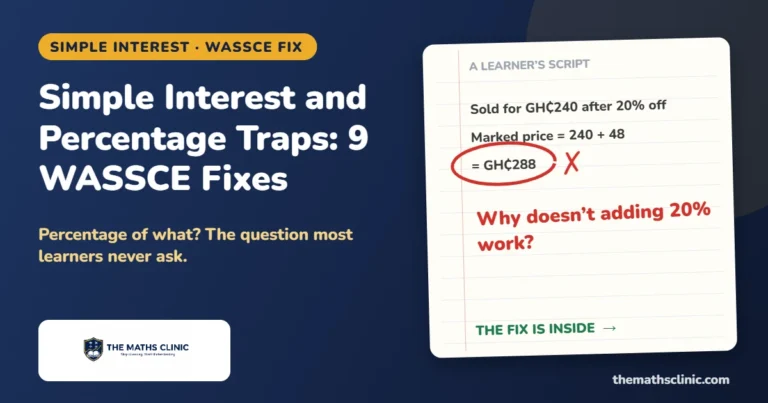
Struggling with WASSCE Maths? Stop guessing. Let’s fix the gap step by step.

Simple Interest Mistakes: 10 Errors and How to Fix Them
Learning the formula doesn’t stop the mistakes. Most students who get simple interest wrong are making one of the same ten small errors, again and again. This part names each one and shows you how to fix it.

📚 Part of the Simple Interest Clinic: every lesson on this topic, in one place.
Learning the formula doesn’t stop the mistakes. Most students who get simple interest wrong are making one of the same ten small errors, again and again. This part names each one and shows you how to fix it.
📘 This lesson is part of the Simple Interest Clinic
Work through the parts in order. Each one fixes a different gap. See the whole series
-
Simple Interest Questions With Answers: P, R, T, I and A Explained
-
Simple Interest Formula (I = PRT/100): How to Use It Correctly
-
Interest or Amount? How to Tell What the Question Wants
-
Simple Interest Examples: 8 WASSCE Fixes, Step by Step
-
Simple Interest Word Problems: 7 Hidden WASSCE Traps
-
Simple Interest and Percentage Traps: 9 WASSCE Fixes
-
Simple Interest Mistakes: 10 Errors and How to Fix Them
-
Wrong Simple Interest Answer? Find Where It First Went Wrong
Many learners can write:
I = \dfrac{PRT}{100}However, remembering the formula does not guarantee a correct answer. A learner may:
- Use the amount as principal
- Treat six months as six years
- Forget to divide a percentage rate by 100
- Stop after finding interest when amount is required
- Add principal when the question asks for interest only
- Rearrange the formula incorrectly
- Write a money answer without GH₵
- Accept an unreasonable answer without checking it
These are not always random careless mistakes. When the same error appears repeatedly, it usually points to a specific learning gap.
This simple-interest formula lesson identifies the error-correction gap and repairs it step by step. It helps the learner stop merely checking whether an answer is right or wrong and start identifying exactly where the wrong thinking began.
📋 What the WAEC Chief Examiner reported
- In 2025, WAEC listed “solving application problems in Simple Interest” among candidates’ main weaknesses.
- In a 2025 question (two accounts at 11% and 10% for 3½ years, one amount 140% of the other), most candidates “could not calculate the interest at 10% and 11% correctly to help them arrive at the correct equation”.
- “Translating word problems into mathematical expressions” was also a listed weakness.
How to win these marks back
- Write P, R and T with units before substituting; convert months to years (3½ years, not 3.5 months).
- In two-amount questions, call one amount x, write the other in terms of x, write each interest, then add and solve.
- Check by putting your answer back into the story.
Source: WAEC Chief Examiners’ Reports, WASSCE (SC) 2025, Ghana: Mathematics (Core).
Maths Clinic Diagnosis: The Same Mistake Keeps Returning
The hidden gap is:
The learner sees that an answer is wrong but cannot identify whether the mistake began in reading, quantity identification, time conversion, formula selection, substitution, algebra, calculation or final interpretation.
A teacher may correct the final answer, but the learner repeats the mistake in another question because the first wrong decision was never identified.
For example, suppose a learner uses T = 6 when a question gives six months and a rate per annum. Correcting only the final answer will not fully solve the problem.
The learner must understand:
- The rate is yearly.
- The time is given in months.
- The units do not match.
- Six months must be written as \frac{6}{12} year.
- The mistake began before substitution.
That is error diagnosis.
The aim of this lesson is not simply to obtain more correct answers. It is to help the learner find and repair the small skill that caused each wrong answer.
Simple Interest Mistakes: The Learner’s Exact Problem
The learner is not separating the parts of the financial story.
The learner may see one money value and assume it is principal. The learner may see one percentage and multiply immediately. If an answer appears on the calculator, the learner accepts it without asking what the answer represents.
The real difficulty may involve one or more of these gaps:
- Money-role gap: Principal, interest and amount are confused.
- Question-target gap: The learner does not identify what must be found.
- Time-unit gap: Time does not match the period attached to the rate.
- Percentage gap: The rate is not handled correctly.
- Formula-selection gap: The learner uses a formula that does not match the unknown.
- Rearrangement gap: The learner cannot make P, R or T the subject.
- Substitution gap: Correct values are placed in the wrong positions.
- Final-step gap: The learner stops too early or adds an unnecessary step.
- Unit gap: The answer is not labelled as money, rate or time.
- Checking gap: The learner does not test whether the result is reasonable.
Until the first wrong decision is identified, the same mistake can continue appearing in different questions.
The Five Quantities That Must Be Separated
Before correcting simple-interest mistakes, the learner must know the role of each quantity.
| Symbol | Quantity | Meaning |
|---|---|---|
| P | Principal | Starting money |
| R | Rate | Percentage charged or earned per stated period |
| T | Time | Number of periods matching the rate |
| I | Interest | Extra money earned or charged |
| A | Amount | Principal plus interest |
The central relationships are:
I = \dfrac{PRT}{100}and:
A = P + I
The formula I = \dfrac{PRT}{100} finds interest when R is used as a percentage number.
The relationship A = P + I finds the final amount.
Before Correcting an Answer, Find the First Wrong Line
Suppose a learner solves a question like this:

Find the interest on GH₵900 at 12% per annum for six months.
The learner writes:
T = 6
I = \dfrac{900 \times 12 \times 6}{100}I = \text{GH₵}648The multiplication is correct for the values entered. However, the answer is wrong because the learner entered the wrong time.
The first wrong line is:
T = 6
The correction must therefore focus on time units:
T = \dfrac{6}{12}\ \text{year} = \dfrac{1}{2}\ \text{year}Then:
I = \dfrac{900 \times 12 \times \dfrac{1}{2}}{100}I = \text{GH₵}54If the teacher focuses only on the multiplication, the actual gap remains hidden.
Ten Common Simple Interest Mistakes and Their Fixes
Mistake 1: Confusing Principal and Amount
Principal is the starting money.
Amount is the final money after interest has been included.
A = P + I
Consider:
A loan of GH₵2,000 amounts to GH₵2,500.
Correct identification:
\begin{gathered}P = \text{GH₵}2{,}000 \\ A = \text{GH₵}2{,}500\end{gathered}Interest:
I = A - P
I = \text{GH₵}2{,}500 - \text{GH₵}2{,}000I = \text{GH₵}500Do not use GH₵2,500 as the principal. It is the final amount.
Error signal: The learner uses words such as “amounts to” or “total due” as if they mean the original money.
Repair: Ask, “What money was present at the beginning?”

Mistake 2: Treating Months as Years
Suppose a question gives:
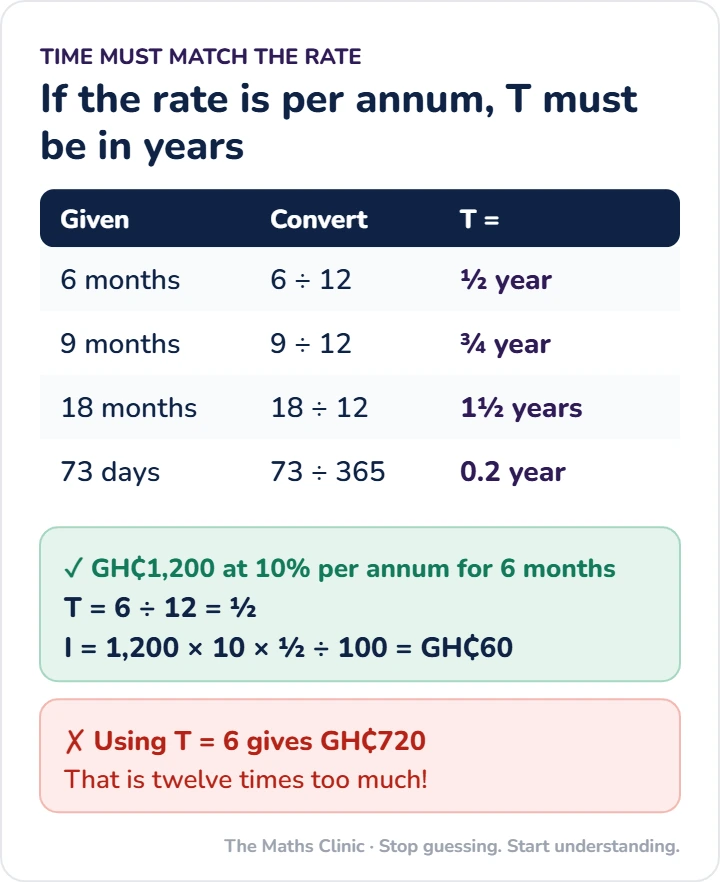
\begin{gathered}R = 12\%\ \text{per annum} \\ T = 10\ \text{months}\end{gathered}Because the rate is per annum, time must be measured in years:
T = \dfrac{10}{12}\ \text{year} = \dfrac{5}{6}\ \text{year}Using T = 10 would calculate ten years of interest instead of ten months.
Error signal: The answer is much larger than expected.
Repair: Keep the rate together with its period and match the time unit before substitution.
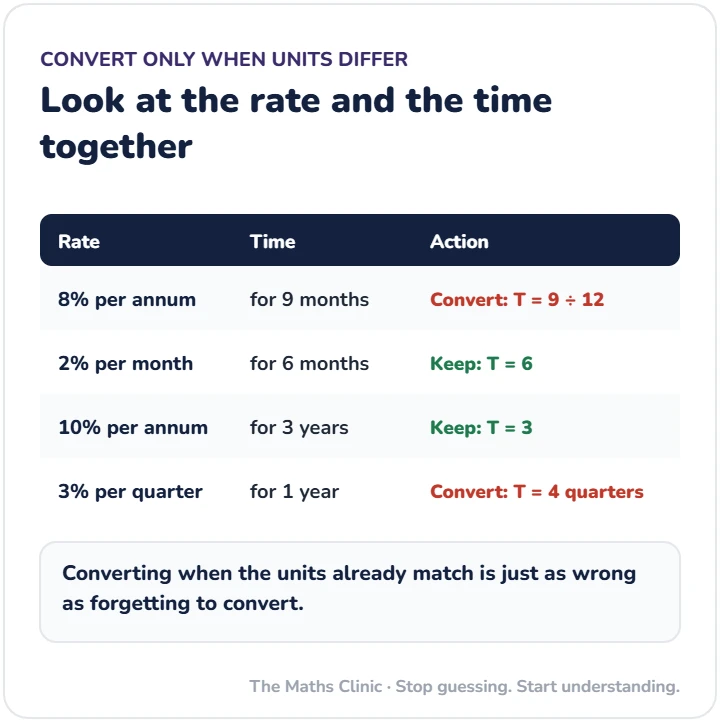
Mistake 3: Converting Time When It Is Already Correct
Time conversion is not automatic.
If the rate is 2% per month and the time is six months:
\begin{gathered}R = 2\%\ \text{per month} \\ T = 6\ \text{months}\end{gathered}The units already match. There is no need to convert six months to half a year.
Error signal: The learner changes every time value to years, even when the rate is monthly.
Repair: Ask, “What period belongs to the rate?”
Mistake 4: Stopping at Interest When Amount Is Required
The formula:
I = \dfrac{PRT}{100}produces interest.
If the question asks for amount, calculate:
A = P + I
For example, if P = \text{GH₵}1{,}000 and I = \text{GH₵}300:
A = \text{GH₵}1{,}000 + \text{GH₵}300A = \text{GH₵}1{,}300Writing GH₵300 as the amount is incomplete.
Error signal: The working is correct, but the final answer does not match the demand.
Repair: Return to the last sentence of the question after calculating interest.
Mistake 5: Adding Principal When Interest Only Is Required
If the question asks for interest and the answer is GH₵300, stop there.
Adding the principal produces the amount, which answers a different question.
Error signal: The learner adds principal at the end of every simple-interest question.
Repair: Write the target before calculating:
I = ?
Mistake 6: Mixing Percentage and Decimal Forms
There are two correct forms.
When R is a percentage number:
I = \dfrac{PRT}{100}For 8%, use R = 8.
Alternatively, write:
8\% = 0.08
and use:
I = PrT
Do not write:
I = \dfrac{P \times 0.08 \times T}{100}The decimal rate already contains the division by 100.
Error signal: The answer is 100 times too small.
Repair: Choose one rate form and use it consistently.
Mistake 7: Forgetting to Divide by 100
If R = 8, the rate means 8%.
Correct:
I = \dfrac{P \times 8 \times T}{100}Wrong:
I = P \times 8 \times T
The second calculation treats 8% as 800%.
Error signal: The interest is extremely large compared with the principal.
Repair: Write the percentage sign beside the rate before choosing the formula form.

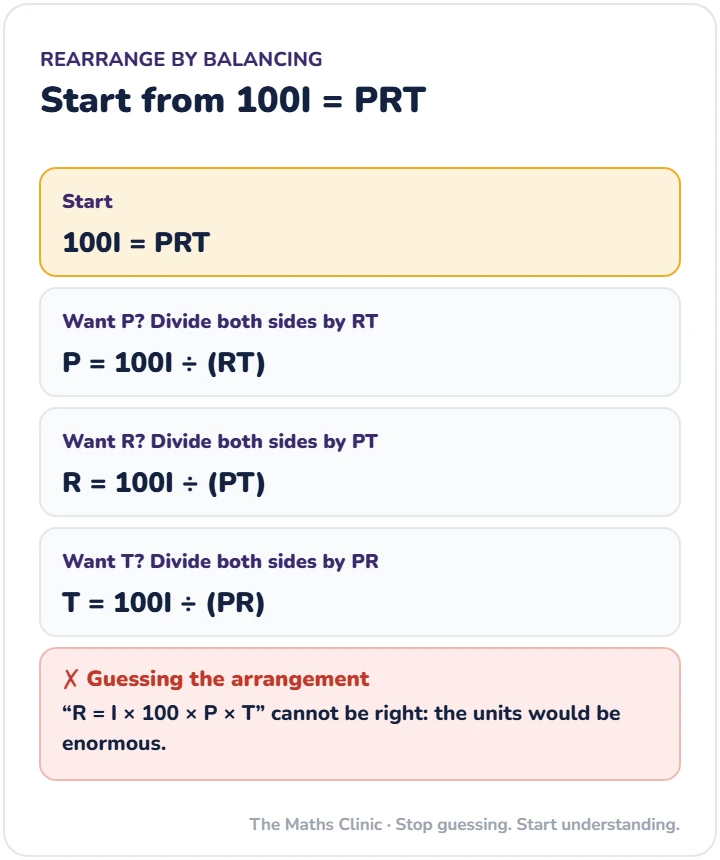
Mistake 8: Rearranging the Formula Incorrectly
Start with:
I = \dfrac{PRT}{100}The correct rearrangements are:
P = \dfrac{100I}{RT}R = \dfrac{100I}{PT}T = \dfrac{100I}{PR}Do not guess the rearranged formula.
For example, to find R:
I = \dfrac{PRT}{100}Multiply both sides by 100:
100I = PRT
Divide both sides by PT:
R = \dfrac{100I}{PT}Error signal: The learner multiplies by a value that should be in the denominator.
Repair: Isolate the unknown one operation at a time.
Mistake 9: Using Amount Directly When Finding an Unknown
If amount is given but interest is required in the formula, first calculate:
I = A - P
For example:
\begin{gathered}A = \text{GH₵}2{,}400 \\ P = \text{GH₵}2{,}000\end{gathered}Then:
I = \text{GH₵}2{,}400 - \text{GH₵}2{,}000I = \text{GH₵}400Use GH₵400 as I, not GH₵2,400.
Error signal: The learner places the final amount in the position of I.
Repair: Separate the final money from the extra money before using the formula.
Mistake 10: Giving an Unlabelled or Unchecked Answer
The answer must show what the value represents.
Write:
- \text{Interest} = \text{GH₵}300
- \text{Amount} = \text{GH₵}1{,}300
- \text{Rate} = 5\%\ \text{per annum}
- \text{Time} = 2\ \text{years}
- \text{Principal} = \text{GH₵}2{,}000
Do not write only:
300
Also check whether the answer makes sense.
For positive simple interest:
- Amount must be greater than principal.
- Interest must be less than amount.
- A short period should normally produce less interest than a longer period at the same principal and rate.
- Ten months should not produce ten years of interest.
- A money answer needs GH₵.
- A rate answer needs %.
- A time answer needs a time unit.
Simple Interest Error Table
| Error | Why it costs marks | Exact correction |
|---|---|---|
| Principal confused with amount | The wrong base money enters the formula | Principal is starting money; amount is final money |
| Months used as years | Too many periods are calculated | Convert months to years when rate is per annum |
| Time converted unnecessarily | Matching units are disturbed | Keep time in months when rate is per month |
| Interest given instead of amount | The response is incomplete | \text{Calculate} A = P + I |
| Amount given instead of interest | An unnecessary addition is made | Stop after finding I |
| Percentage divided twice | Answer becomes 100 times too small | Use either percentage form or decimal form |
| Division by 100 omitted | Answer becomes too large | Use I = \dfrac{PRT}{100} when R is a percentage number |
| Formula rearranged wrongly | Unknown value is calculated incorrectly | Isolate the unknown step by step |
| Amount used as interest | Final money is treated as extra money | \text{Find} I = A – P \text{first} |
| Unit or label omitted | Meaning of the answer is unclear | State GH₵, %, years or months as required |
Worked Example: Find Principal from a Given Amount
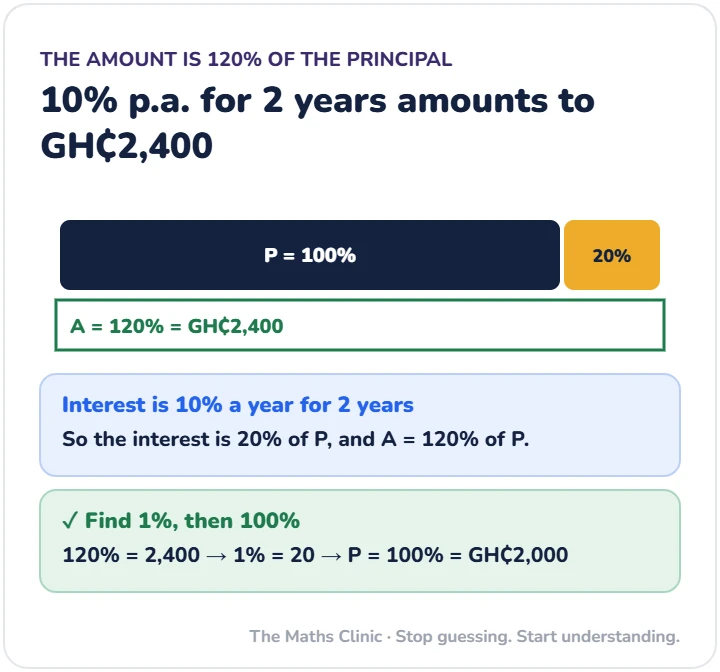
A sum of money invested at 10% simple interest per annum for two years amounts to GH₵2,400. Find the principal.
Step 1: Identify the target
Principal is required:
P = ?
Step 2: Identify the given information
\begin{gathered}A = \text{GH₵}2{,}400 \\ R = 10\%\ \text{per annum} \\ T = 2\ \text{years}\end{gathered}Interest is not given directly.
Step 3: Express interest in terms of P
I = \dfrac{PRT}{100}I = \dfrac{P \times 10 \times 2}{100}I = \dfrac{20P}{100}I = 0.2P
Step 4: Use the amount relationship
A = P + I
\text{GH₵}2{,}400 = P + 0.2P2{,}400 = 1.2PStep 5: Solve for P
P = \dfrac{2{,}400}{1.2}P = \text{GH₵}2{,}000\text{Answer}: \text{Principal} = \text{GH₵}2{,}000.Check the answer
Interest:
I = \dfrac{2{,}000 \times 10 \times 2}{100}I = \text{GH₵}400Amount:
A = \text{GH₵}2{,}000 + \text{GH₵}400A = \text{GH₵}2{,}400The answer is correct.
Why the Common Wrong Approach Fails
A learner may write:
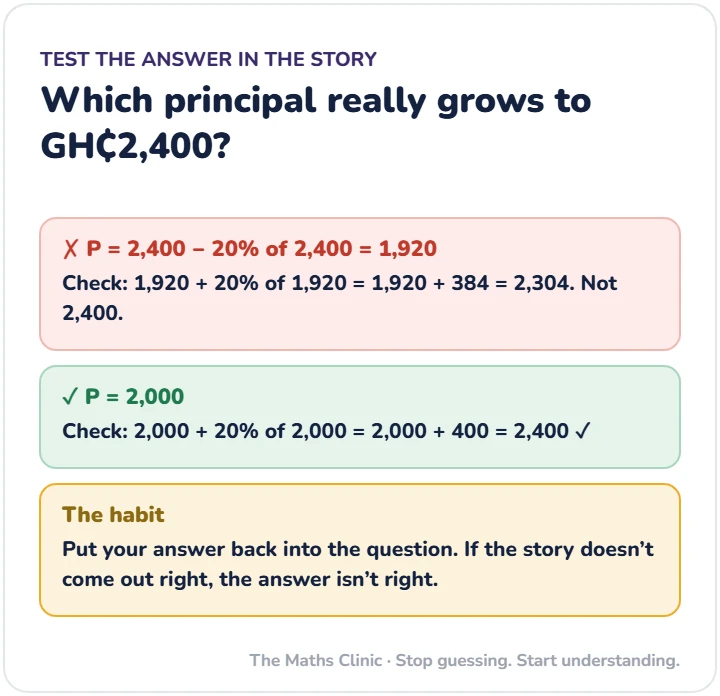
P = \dfrac{2{,}400 \times 10 \times 2}{100}P = \text{GH₵}480This approach fails for two reasons.
First, GH₵2,400 is the amount, not the principal.
Second, the calculation produces 20% of GH₵2,400. It does not isolate the original principal.
The correct relationship is:
A = P + I
Since:
I = 0.2P
then:
A = P + 0.2P
A = 1.2P
The final amount is 120% of the principal, not 20% of the final amount.
Hidden gap: The learner substituted before separating principal, interest and amount.
Another Method for the Worked Example
At 10% per annum for two years:
\text{Total simple}-\text{interest rate} = 10\% \times 2 = 20\%Therefore:
\text{Amount} = 100\%\ \text{of principal} + 20\%\ \text{of principal}\text{Amount} = 120\%\ \text{of principal}So:
120\%\ \text{of} P = \text{GH₵}2{,}4001.2P = 2{,}400P = \text{GH₵}2{,}000This percentage method and the formula method give the same result.
The Maths Clinic Error-Correction Routine
Use this routine whenever a simple-interest answer is wrong.
Step 1: Read the demand again
Was the question asking for:
- Interest?
- Amount?
- Principal?
- Rate?
- Time?
Write the required symbol.
Step 2: Label every given value
Use a P–R–T–I–A table.
| Quantity | Value |
|---|---|
| P | |
| R | |
| T | |
| I | |
| A |
Do not force a value into the wrong row.
Step 3: Match the time to the rate
Ask:
- Is the rate per annum?
- Is it per month?
- Is it for another stated period?
- Does the time use the same period?
Convert only when necessary.
Step 4: Select the relationship
Use:
I = \dfrac{PRT}{100}or:
A = P + I
If amount and principal are given:
I = A - P
Step 5: Rearrange before substituting
If P, R or T is required, make it the subject first.
Step 6: Substitute with brackets
For example:
R = \dfrac{100 \times I}{P \times T}Brackets protect the denominator.
Step 7: Calculate and label
State what the answer represents.
Step 8: Find the first wrong line
When checking an incorrect solution, do not begin with the final answer. Find the first line where the meaning, unit, relationship or operation became wrong.
Step 9: Name the gap
For example:
- Money-role gap
- Time-unit gap
- Percentage-form gap
- Rearrangement gap
- Final-step gap
Step 10: Retest the repaired skill
Attempt a similar question without looking at the correction.
A copied correction is not yet proof that the gap has been repaired.
WASSCE-Style Error Check
Before submitting a solution, answer these questions:
- What is the starting money?
- What is the extra money?
- What is the final money?
- What period belongs to the rate?
- Does the time match that period?
- What quantity is required?
- Does my formula calculate that quantity?
- Is another step needed?
- Does my answer need GH₵, %, years or months?
- Is the size of the answer reasonable?
Simple Interest Mistakes Diagnostic Practice
Attempt every question before checking the answers.
Questions
- GH₵1,000 is invested at 6% simple interest per annum for five years. Find the interest and amount.
- A principal amounts to GH₵1,680 after five years at 8% simple interest per annum. Find the principal.
- Find the rate per annum if GH₵2,500 earns GH₵375 simple interest in three years.
- Find the time if GH₵4,000 earns GH₵800 simple interest at 10% per annum.
- A loan of GH₵900 is taken for ten months at 12% simple interest per annum. Find the interest.
- GH₵1,500 is invested at 7.5% simple interest per annum for eight months. Find the amount.
- A loan of GH₵3,000 amounts to GH₵3,720 after three years under simple interest. Find the rate per annum.
- GH₵800 earns GH₵144 simple interest at 3% per month. Find the time in months.
- A final amount of GH₵5,400 includes GH₵900 simple interest. Find the principal.
- GH₵2,400 is invested at 5% simple interest per annum for 18 months. Find the interest and amount.
- A learner says that GH₵1,200 at 10% per annum for six months earns GH₵720 interest. Identify the mistake and find the correct interest.
- A learner calculates GH₵300 interest correctly on a GH₵1,500 investment but writes GH₵300 as the final amount. Explain the error and find the correct amount.
Answers and Gap Diagnosis
1. Interest = GH₵300; amount = GH₵1,300
I = \dfrac{1{,}000 \times 6 \times 5}{100}I = \text{GH₵}300A = P + I
A = \text{GH₵}1{,}000 + \text{GH₵}300A = \text{GH₵}1{,}300If you wrote only GH₵300: You found interest but did not complete the amount.
2. Principal = GH₵1,200
The interest for five years is:
8\% \times 5 = 40\%
Therefore, the amount is 140% of the principal.
A = 1.4P
1{,}680 = 1.4PP = \dfrac{1{,}680}{1.4}P = \text{GH₵}1{,}200Alternative formula method
A = P(1 + \dfrac{RT}{100})1{,}680 = P(1 + \dfrac{8 \times 5}{100})1{,}680 = 1.4PP = \text{GH₵}1{,}200If you used GH₵1,680 as P: You confused amount with principal.
3. Rate = 5% per annum
R = \dfrac{100I}{PT}R = \dfrac{100 \times 375}{2{,}500 \times 3}R = \dfrac{37{,}500}{7},500R = 5\%\ \text{per annum}If your answer has GH₵: You attached a money unit to a percentage answer.
4. Time = 2 years
T = \dfrac{100I}{PR}T = \dfrac{100 \times 800}{4{,}000 \times 10}T = \dfrac{80{,}000}{40},000T = 2\ \text{years}If you multiplied by R instead of dividing by it: Your formula rearrangement was incorrect.
5. Interest = GH₵90
The rate is per annum, so:
T = \dfrac{10}{12}\ \text{year} = \dfrac{5}{6}\ \text{year}I = \dfrac{900 \times 12 \times \dfrac{5}{6}}{100}I = \text{GH₵}90If you wrote GH₵1,080: You used ten months as ten years.
6. Amount = GH₵1,575
T = \dfrac{8}{12}\ \text{year} = \dfrac{2}{3}\ \text{year}I = \dfrac{1{,}500 \times 7.5 \times \dfrac{2}{3}}{100}I = \text{GH₵}75A = \text{GH₵}1{,}500 + \text{GH₵}75A = \text{GH₵}1{,}575If you wrote GH₵75: You stopped at interest when amount was required.
7. Rate = 8% per annum
First find interest:
I = A - P
I = \text{GH₵}3{,}720 - \text{GH₵}3{,}000I = \text{GH₵}720Then:
R = \dfrac{100I}{PT}R = \dfrac{100 \times 720}{3{,}000 \times 3}R = \dfrac{72{,}000}{9},000R = 8\%\ \text{per annum}If you used GH₵3,720 as I: You confused final amount with extra money.
8. Time = 6 months
The rate is per month, so time should be measured in months.
T = \dfrac{100I}{PR}T = \dfrac{100 \times 144}{800 \times 3}T = \dfrac{14{,}400}{2},400T = 6\ \text{months}If you converted the time to years: You overlooked the monthly rate.
9. Principal = GH₵4,500
P = A - I
P = \text{GH₵}5{,}400 - \text{GH₵}900P = \text{GH₵}4{,}500The simple-interest formula is unnecessary because amount and interest are already known.
10. Interest = GH₵180; amount = GH₵2,580
T = \dfrac{18}{12}\ \text{years} = 1.5\ \text{years}I = \dfrac{2{,}400 \times 5 \times 1.5}{100}I = \text{GH₵}180A = \text{GH₵}2{,}400 + \text{GH₵}180A = \text{GH₵}2{,}580If you used T = 18: You treated 18 months as 18 years.
11. Correct interest = GH₵60
The learner used T = 6 instead of \frac{6}{12} year.
Correct time:
T = \dfrac{6}{12}\ \text{year} = \dfrac{1}{2}\ \text{year}I = \dfrac{1{,}200 \times 10 \times \dfrac{1}{2}}{100}I = \text{GH₵}60Error type: Time-unit gap.
12. Correct amount = GH₵1,800
The learner found the interest correctly but labelled it as the final amount.
A = P + I
A = \text{GH₵}1{,}500 + \text{GH₵}300A = \text{GH₵}1{,}800Error type: Question-target or unfinished-final-step gap.
Use the Results to Locate the Gap
| Score | What it suggests | Next action |
|---|---|---|
| 10–12 correct | The main error patterns are becoming secure | Attempt unfamiliar mixed questions |
| 7–9 correct | One or two repeated errors remain | Correct those error types and retest |
| 4–6 correct | Several stages of the method are still weak | Return to the P–R–T–I–A table |
| 0–3 correct | Calculation is beginning before the story is understood | Rebuild principal, interest and amount first |
A score does not show the whole problem. Two learners may both score 7 out of 12 but need different interventions.
One may have a time-unit gap. The other may have a formula-rearrangement gap.
Study the pattern of wrong answers, not only the total score.
Error-Correction Record
Complete one row for every wrong answer.
| Question | My answer | First wrong line | Type of gap | Correct thinking | Retest |
|---|---|---|---|---|---|
Possible gap labels include:
- Reading gap
- Money-role gap
- Question-target gap
- Time-unit gap
- Percentage-form gap
- Formula-selection gap
- Rearrangement gap
- Substitution gap
- Calculation gap
- Final-step gap
- Unit gap
- Reasonableness gap
The Repair-and-Retest Cycle
Use this cycle after every wrong answer:
- Find the first wrong line.
- Explain why that line is wrong.
- Name the skill gap.
- Correct only that gap.
- Solve the original question again.
- Attempt a similar question without help.
- Check whether the same mistake returns.
- Record the retest result.
If the learner repeats the same error, return to the small skill instead of attempting many more mixed questions.
Ten rushed questions will not repair one misunderstood idea.
Depth of Knowledge Progression
| Depth of Knowledge | Main demand | Questions |
|---|---|---|
| DoK 1 | Apply a familiar relationship directly | 1 and 9 |
| DoK 2 | Convert units, rearrange formulas and connect amount with interest | 2–8 and 10 |
| DoK 3 | Diagnose another learner’s mistake and justify the correction | 11 and 12 |
The depth comes from the reasoning demanded by the task, not merely the number of calculation steps.
Learner Reflection
Tick each statement only when you can do it without copying.
- I can separate principal, interest and amount.
- I can identify what the question requires before calculating.
- I \text{know that} I = \dfrac{PRT}{100}\ \text{produces interest}.
- I \text{know when} to \text{calculate} A = P + I.
- I can find I = A – P when amount and principal are given.
- I match the time unit to the rate period.
- I do not convert months to years when the rate is monthly.
- I can use the percentage and decimal rate forms correctly.
- I can make P, R or T the subject of the formula.
- I can identify the first wrong line in a solution.
- I can name the gap that caused my mistake.
- I include the correct unit in my final answer.
- I check whether the size of my answer makes sense.
- I retest a corrected skill without copying.
How This Helps Before WASSCE
This lesson helps the learner to:
- Separate original, extra and final money
- Identify the exact question target
- Match time to annual or monthly rates
- Avoid incorrect percentage treatment
- Rearrange the formula carefully
- Work backwards from a given amount
- Complete amount questions fully
- Avoid unnecessary calculations
- Show orderly and labelled working
- Check answers for meaning and size
- Locate the first wrong decision
- Use each wrong answer to direct the next practice task
The official WAEC Ghana Chief Examiner’s Reports may also be consulted when studying reported examination performance and weaknesses.
Continue the Intervention
If reading the complete money story remains difficult, study Simple Interest Word Problems: 7 Hidden WASSCE Traps.
If several percentage or interpretation gaps remain, visit the Maths Intervention Hub.
When the errors have been corrected, attempt fresh questions in the WASSCE Maths Practice Zone.
For other examination error patterns, explore WAEC Maths Traps.
Conclusion: Correct the Mistake at Its Starting Point
Simple Interest Mistakes becomes useful when the learner can explain where a wrong answer began.
Do not conclude immediately that every wrong answer came from carelessness or failure to memorise the formula.
The mistake may have started when the learner:
- Misread the money role
- Missed the demand word
- Used an amount as principal
- Failed to convert time
- Converted time unnecessarily
- Used the wrong rate form
- Rearranged the formula incorrectly
- Stopped before completing the amount
- Added principal when it was not required
- Omitted the final unit
Before calculating, identify P, R, T, I and A.
After calculating, return to the question and check the meaning of the result.
After marking, find the first wrong line, repair that exact gap and retest it.
That is how a repeated mistake becomes a corrected skill.
Stop Guessing. Start Understanding.
Practice Zone CTA
Do not guess your way through Mathematics.
Visit the WASSCE Maths Practice Zone and attempt more simple-interest questions with purpose.
For every wrong answer, record:
- What the question required
- What each value represented
- The first wrong line
- The type of gap
- The correct idea
- The result of your retest
Do not move on simply because you have seen the correct answer. Move on when you can complete a similar question without repeating the mistake.
✏️ Try it yourself
GH₵3,000 is invested at 5% per annum for 18 months. Find the amount.
Tap to see the answer
T = 18 \div 12 = 1.5 years. I = 3{,}000 \times 5 \times 1.5 \div 100 = \text{GH₵}225, so Amount = 3{,}000 + 225 = GH₵3,225.
💬 Stuck on a step? Ask Dickson and send the line where you got lost.

Written by
Dickson Sarpong
NTC-certified SHS Mathematics teacher in Ghana with WAEC marking experience, and author of The Bridge Series textbooks. Every lesson here is built around the mistakes WAEC examiners keep reporting.
About DicksonStuck? Ask a question
Want the whole topic, step by step? My textbooks, The Bridge to Mathematics and The Bridge to Additional Mathematics for SHS, follow the new curriculum and rebuild the basics as you go.
Read a free chapter →