Struggling with WASSCE Maths? Stop guessing. Let’s fix the gap step by step.
WAEC Chief Examiner’s Report 2024 for Mathematics: What It Says and How to Win the Marks Back
A teacher’s plain-English guide to the 2024 WAEC Chief Examiner’s Report for Mathematics (Core): every question, every weakness, and what to do about it.

📚 Part of our WAEC report series: 12 years of Chief Examiners’ reports, year by year.
Quick answer: what does the WAEC Chief Examiner’s Report 2024 say about Mathematics (Core)?
The examiners judged the paper comparable to the previous year and reported better performance. Candidates were strong in trigonometric ratios, bearings, probability and the mean. They were weak at showing information in a diagram, global (earth) mathematics, turning diagrams into mathematical statements, mensuration and business mathematics.
The 2024 report is one of the clearest pictures we have of where WASSCE Mathematics marks go. This guide takes Paper 2 question by question, in plain English, then compares 2024 with 2025, so you can see which weaknesses keep coming back.
Everything below comes from the report. The question descriptions are summarised in my own words.
The 2024 report in one minute

| Strengths | Weaknesses |
|---|---|
| Trigonometric ratios | Representing information in a diagram |
| Bearings problems | Global (earth) mathematics |
| Probability problems | Translating diagrams into mathematical statements |
| Using the mean | Mensuration |
| Business mathematics |
Question by question: where the marks went
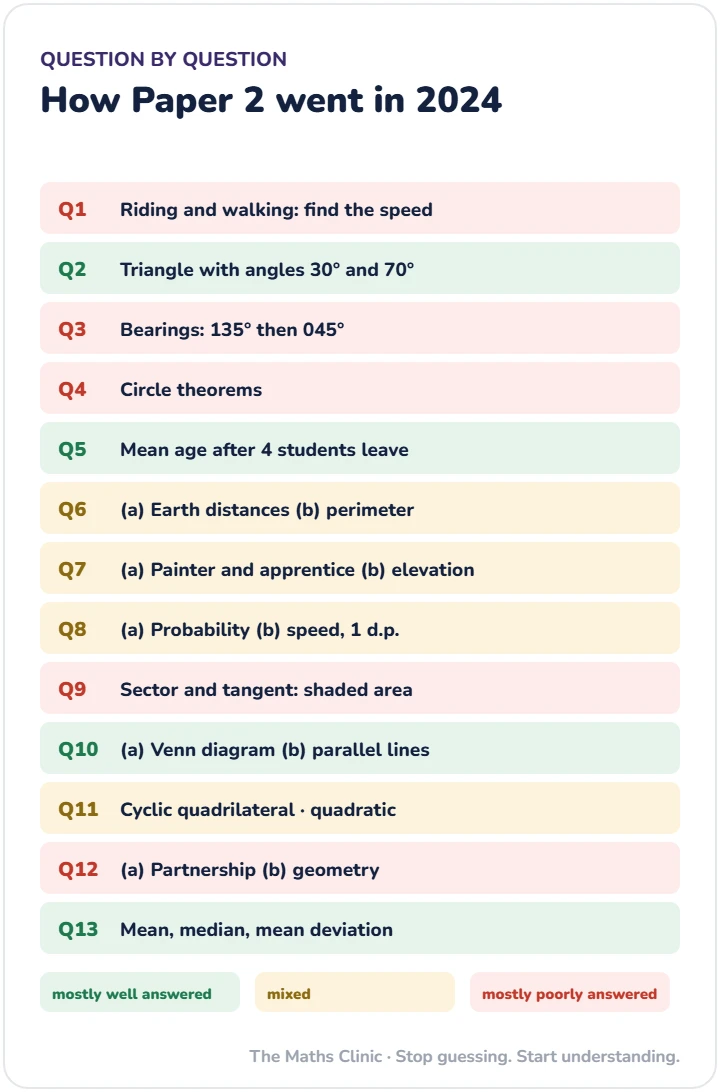
| Q | Topic | What the examiners reported |
|---|---|---|
| 1 | Riding and walking: find the speed | Not well answered. Candidates could not find the times needed to form the equation. |
| 2 | Triangle with angles of 30° and 70° | Well answered by most, though a large number still could not do it. |
| 3 | Bearings: 4 km on 135°, then 13 km on 045° | Most could not draw the diagram, so could not answer the rest. |
| 4 | Circle theorems | Most could not solve it, from weak knowledge of plane geometry. |
| 5 | Mean age after four students leave | Well answered by most. |
| 6 | (a) Distances on the earth (b) perimeter from coordinates | (a) Most could not draw the globe. (b) Well answered. |
| 7 | (a) Painter and apprentice (b) elevation from a building | (a) Well answered. (b) Poorly answered: most could not draw the diagram. |
| 8 | (a) Probability of contracts (b) speed and time | (a) Well answered, but some multiplied instead of adding. (b) Easy, but many did not round to one decimal place. |
| 9 | Sector and tangent: shaded area | Poorly answered. Candidates could not read the diagram as part of a circle and a triangle. |
| 10 | (a) Venn diagram (b) angles with parallel lines | Mostly well answered. |
| 11 | Cyclic quadrilateral and a quadratic | Few attempted it, but those who did showed good knowledge. |
| 12 | (a) Business partnership (b) isosceles triangles | (a) Not attempted by most. (b) Poorly answered. |
| 13 | Mean, median and mean deviation | Popular and well answered; some lost marks on rounding. |
Notice the pattern: bearings are listed as a strength in the summary, yet on Question 3 most candidates could not draw the bearings diagram. The question comments describe the real scripts, so trust them.
Weakness 1: showing information in a diagram
This cost marks in Questions 3, 6(a), 7(b) and 9. In Question 7(b) the angle of elevation was measured from the top of a 5 m building, and most candidates could not draw it.
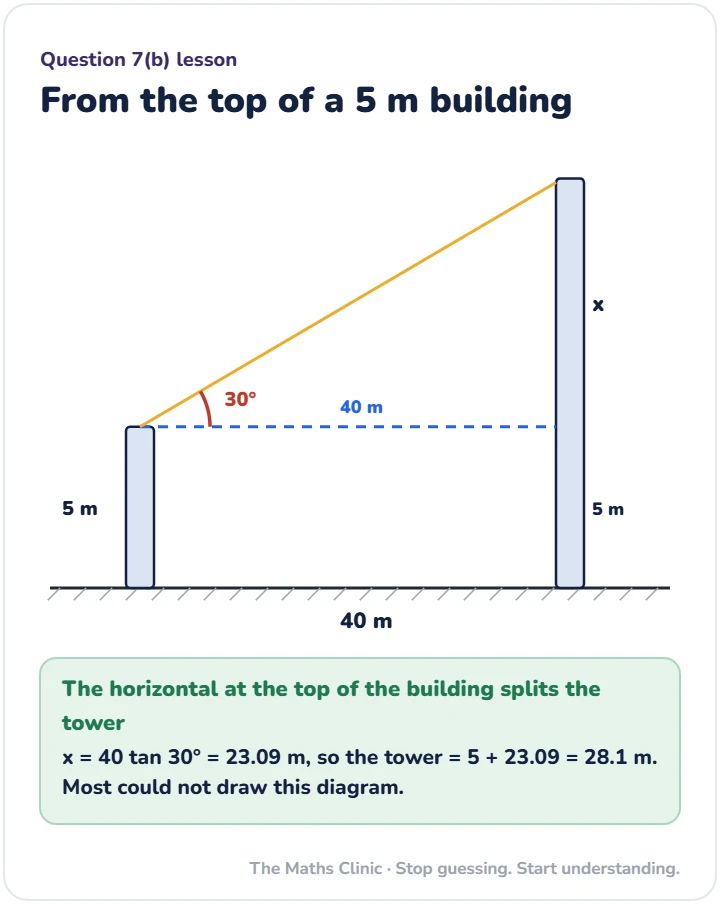
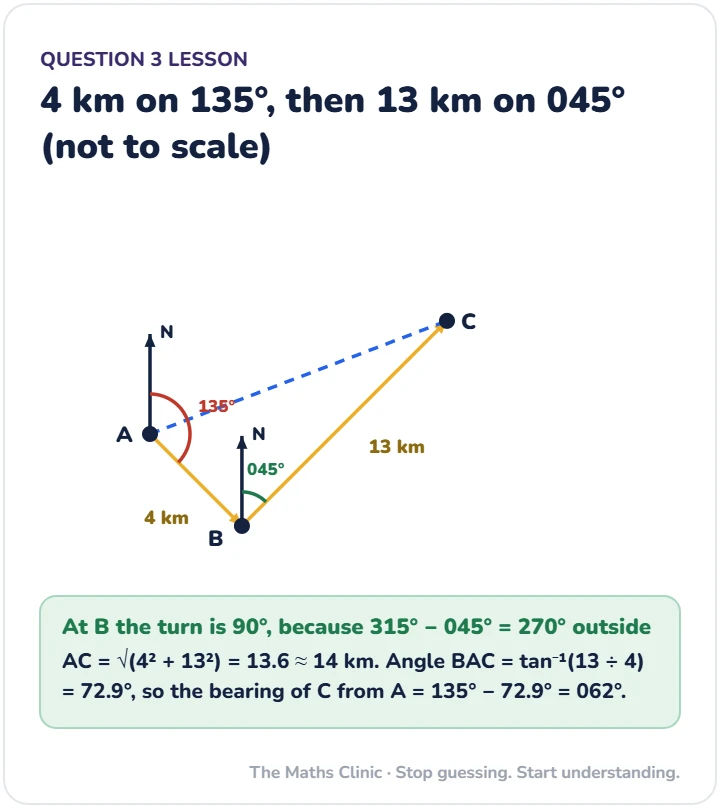
The fix: draw the horizontal or north line at every point first. See Angle of Elevation and Depression and Bearings in Mathematics.
Weakness 2: forming the equation in a word problem
Question 1 was not well answered because candidates could not find the riding and walking times. 45 minutes must become ¾ hour before anything else.
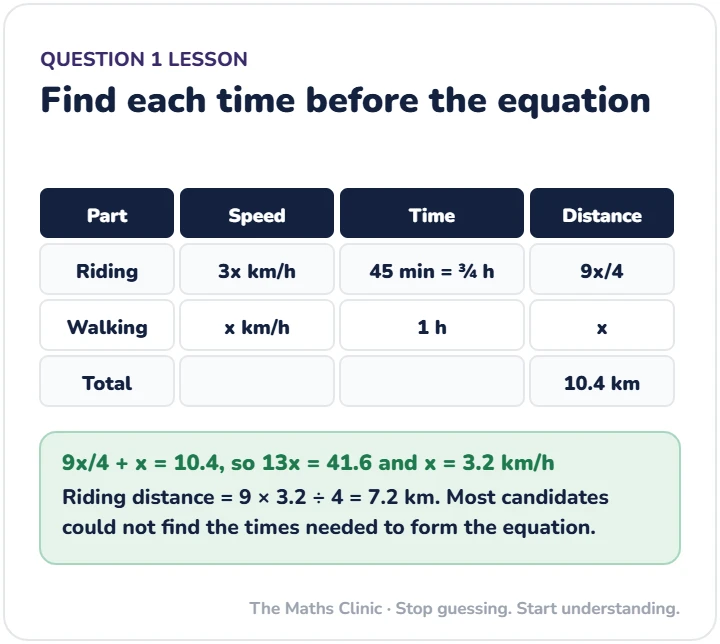
The fix: see Word Problems in WASSCE Mathematics: Questions and Answers.
Weakness 3: geometry and mensuration
Questions 4, 9 and 12(b) were poorly answered. The report links this to weak knowledge of plane geometry and to difficulty seeing a shape as parts (a sector and a triangle). Mensuration was named a weakness in 2024, although it became a strength in 2025. See the Mensuration and Geometry Clinic.
Weakness 4: business mathematics
Question 12(a), on sharing profit in a partnership, was not attempted by most candidates. Business mathematics was named a weakness again in 2025. See the Business Maths Clinic.
Cheap marks that were lost
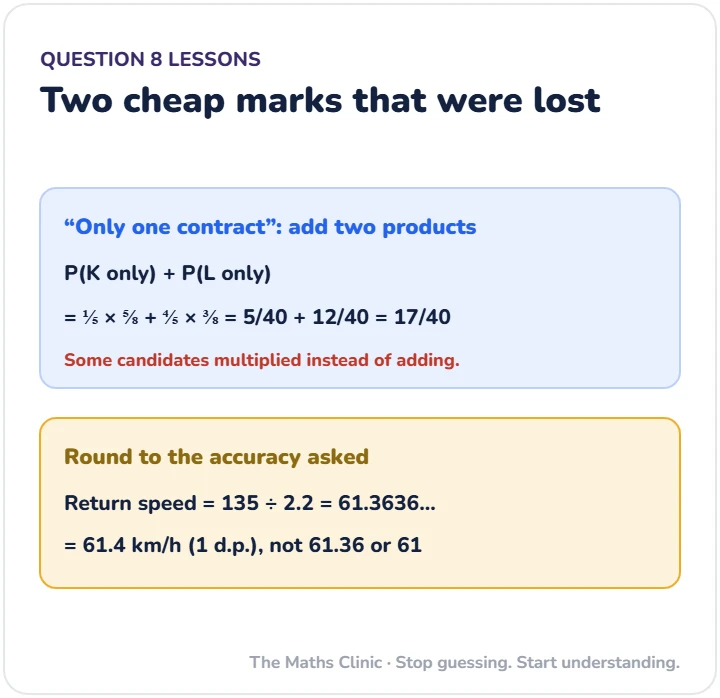
In Question 8, some candidates multiplied where they should have added, and many did not round to one decimal place. In Question 13, rounding again cost marks. These are the easiest marks on the paper to protect: read the question, and give the answer in the form it asks for.
2024 and 2025 compared
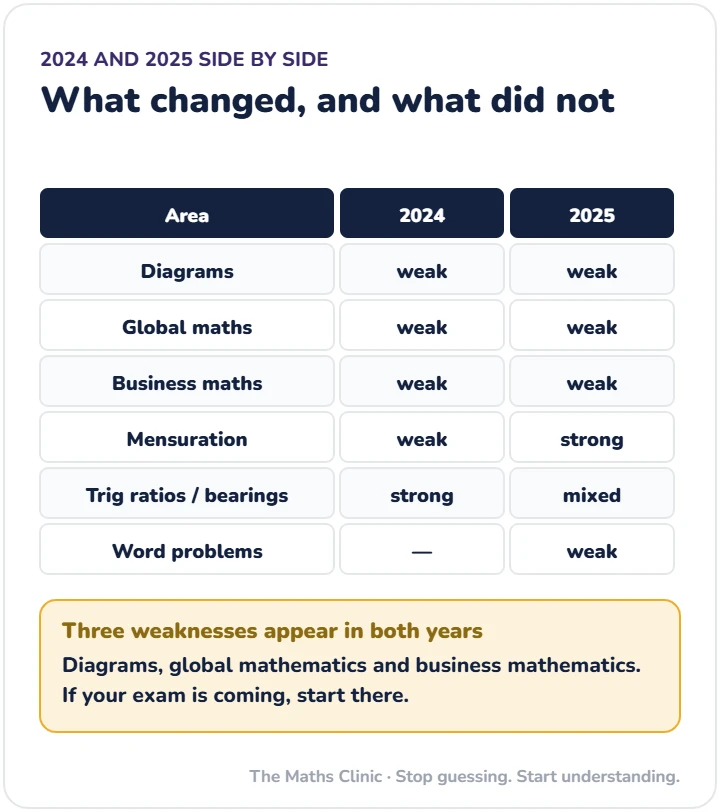
Diagrams, global mathematics and business mathematics were named as weaknesses in both 2024 and 2025. If your examination is coming, these are the areas where practice is most likely to pay. For the 2025 details, read the 2025 report explained.
What the examiners recommend
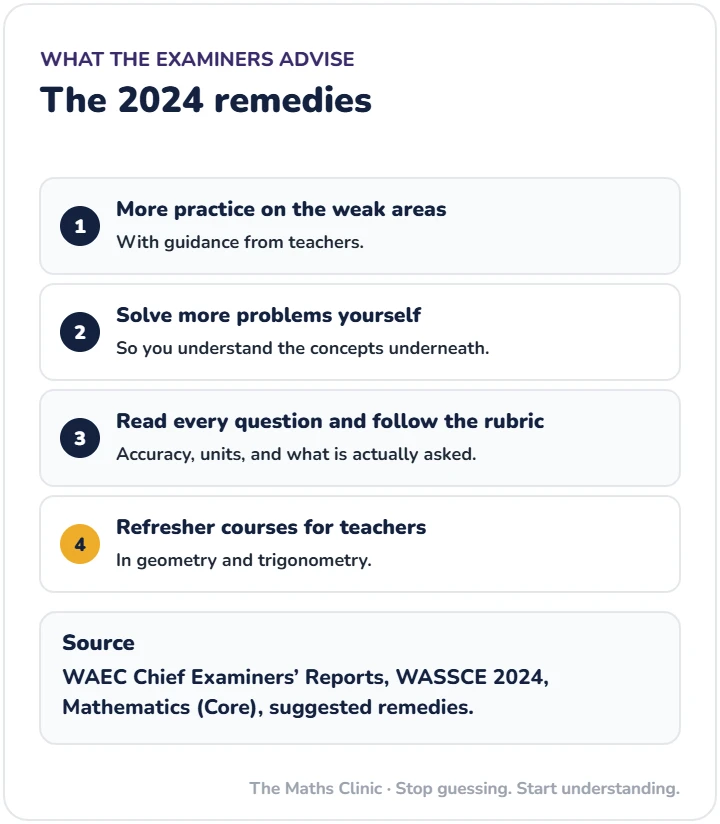
- Teachers should give more exercises on the weak areas and guide candidates.
- Candidates should solve more problems in these areas so that they understand the underlying concepts.
- Candidates should read questions carefully and follow the rubric.
- Refresher courses should be organised for Mathematics teachers in geometry and trigonometry.
Frequently asked questions
Was Mathematics performance better in 2024?
Yes. The 2024 report says performance was better than that of the previous year. Pass-rate figures are published separately by WAEC with the results.
Which topics should I practise first?
Diagram-based questions (elevation, depression and bearings), word problems that need an equation, geometry, and business mathematics. They appear as weaknesses in 2024, 2025 or both.
Source: WAEC Chief Examiners’ Reports, WASSCE 2024, Mathematics (Core) 2, published by WAEC. Question descriptions are summarised; quotations are short extracts from the report.
Keep learning
- WAEC Chief Examiner’s Report 2025 for Mathematics
- What WAEC Examiners Report: 12 Years of Mathematics (2011–2025)
- Angle of Elevation and Depression Questions With Solutions
📚 12 years of WAEC Chief Examiners’ reports, in one place
✏️ Practise in the Practice Zone

Written by
Dickson Sarpong
NTC-certified SHS Mathematics teacher in Ghana with WAEC marking experience, and author of The Bridge Series textbooks. Every lesson here is built around the mistakes WAEC examiners keep reporting.
About DicksonStuck? Ask a question
Want the whole topic, step by step? My textbooks, The Bridge to Mathematics and The Bridge to Additional Mathematics for SHS, follow the new curriculum and rebuild the basics as you go.
Read a free chapter →