Struggling with WASSCE Maths? Stop guessing. Let’s fix the gap step by step.
9 Core Maths Habits That Expose Hidden Weaknesses

Some SHS learners do not discover their weak Core Maths understanding until the WASSCE paper is already in front of them. That is painful because the warning signs were there long before the exam.
The learner was copying notes, solving some class examples, and sometimes even scoring a few marks. But underneath, the understanding was not strong. The work looked active, but the foundation was shaking.
At The Maths Clinic, we do not wait for failure before we diagnose the problem. We look at the small habits that expose weak understanding early so the learner can correct the gap before WASSCE pressure becomes too much.
This post answers one important question:
How does noticing these Core Maths habits help a struggling SHS learner understand Core Maths better?
It helps because habits reveal thinking. When a learner keeps making the same type of mistake, the problem is no longer random. It shows where the learner does not fully understand the idea.
Once the weak habit is exposed, the learner can stop guessing, stop blaming himself or herself, and start fixing the exact gap.
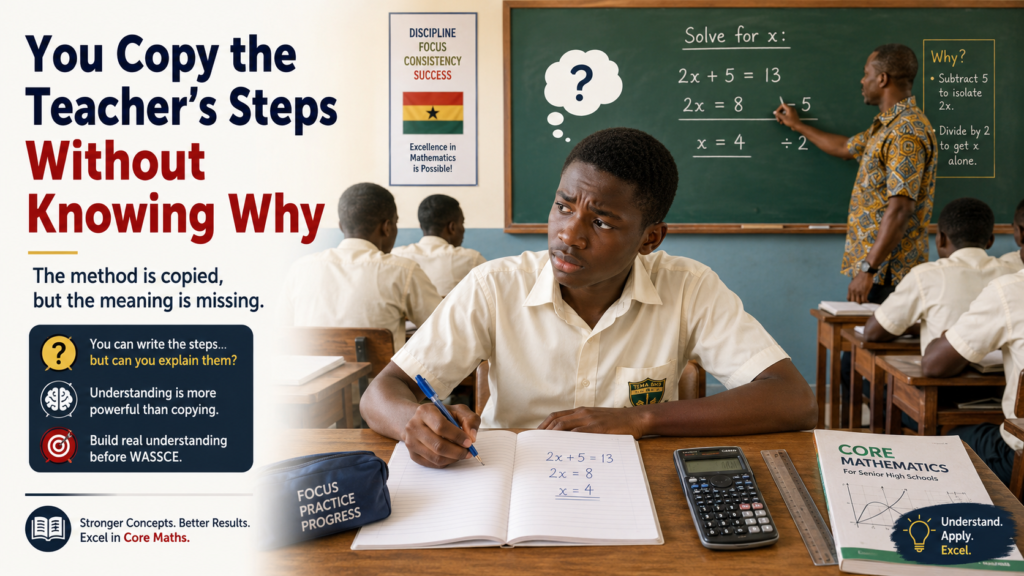
1. You Copy the Teacher’s Steps Without Knowing Why
This is one of the most common habits among struggling SHS Core Maths learners. The learner copies everything neatly from the board, but when the same question is given alone, confusion starts.
In class, the teacher knows the next step. The teacher chooses the method. The teacher decides which operation to use. So the learner feels comfortable because the thinking has already been done by someone else.
Why This Habit Exposes Weak Understanding
Copying steps is not the same as understanding steps. A learner may copy an algebra solution without knowing why a term changed sign, why both sides were divided by the same number, or why a bracket was expanded first.
The notebook may look correct, but the learner’s thinking is not yet independent.
How This Helps the Learner Understand Better
This habit teaches the learner to ask a better question after every example:
Why was this step done?
If the learner cannot explain the reason, that is the gap to fix. Core Maths becomes easier when the learner understands the reason behind the method, not only the writing on the board.
2. You Start Solving Before Reading the Whole Question
Many WASSCE marks are lost because the learner rushes into calculation too early. The learner sees numbers, remembers a formula, and begins to solve before understanding what the question is asking.
This habit is dangerous in Core Maths because many questions are written to test interpretation first, then calculation.
Why This Habit Exposes Weak Understanding
A learner who starts solving too quickly may not know the topic, the condition, the unit, or the actual unknown. The answer may look mathematical, but it may be answering a different question.
For example, a percentage question may ask for the original price, but the learner may calculate the discount only.
How This Helps the Learner Understand Better
This habit shows the learner that reading is part of mathematics. Before solving, the learner must ask:
- What am I being asked to find?
- What information has been given?
- What topic is hiding inside the question?
- Are there units, conditions, or keywords I must note?
A learner who reads properly before solving reduces careless interpretation errors.
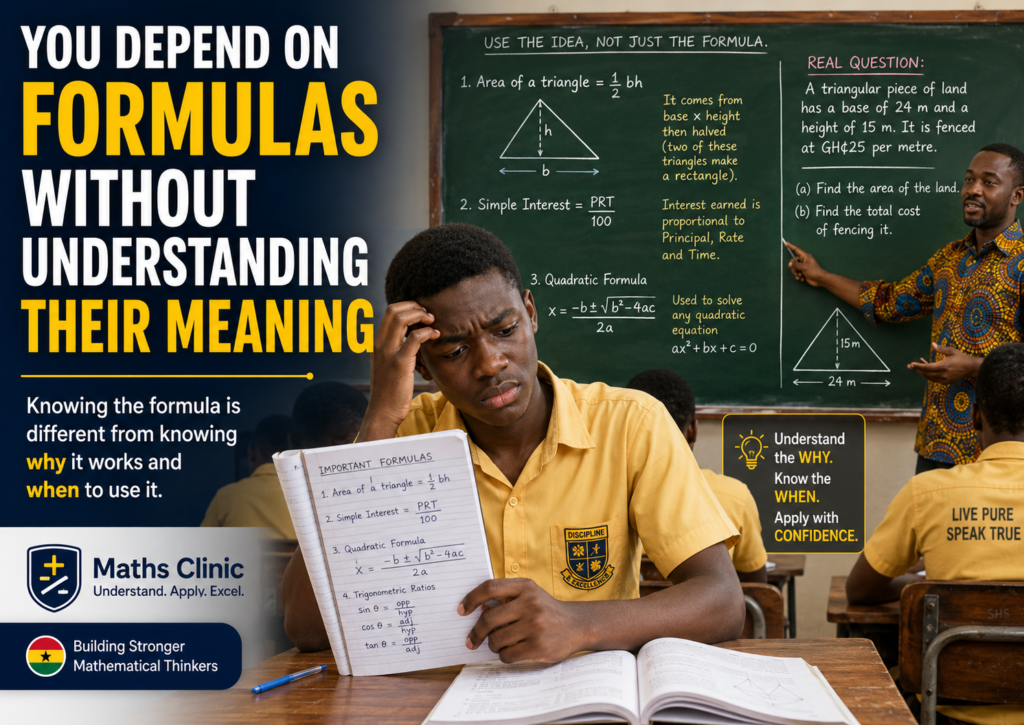
3. You Depend on Formulas Without Understanding Their Meaning
Some learners treat formulas like magic keys. Once they see a topic, they quickly search their memory for a formula. But when the question changes slightly, they become lost.
This happens in simple interest, mensuration, statistics, trigonometry, probability, and many other areas of Core Maths.
Why This Habit Exposes Weak Understanding
A formula is useful only when the learner understands what each part means. If a learner knows SI = PRT/100 but does not know whether the question gives interest or amount, the formula alone will not save the learner.
SI = PRT/100
The letters are not decoration. They carry meaning.
How This Helps the Learner Understand Better
This habit helps the learner slow down and interpret the formula. Instead of only memorizing, the learner asks the following:
- What does each letter represent?
- Is the value given directly or hidden?
- Does the time need conversion?
- Is the question asking for the formula result or another value?
When formulas are connected to meaning, WASSCE-style questions become less frightening.
4. You Always Need the Same Example Before You Can Solve
Some learners can solve only when the question looks exactly like the example in their notes. Once WASSCE changes the wording, diagram, numbers, or arrangement, they become confused.
This habit shows that the learner may be memorizing the appearance of the question instead of understanding the idea behind it.
Why This Habit Exposes Weak Understanding
WASSCE does not always repeat classroom examples in the same form. The examination may test the same idea in a new situation. If the learner only memorized the pattern, the learner will struggle.
For example, a learner may know how to find the area of a rectangle but fail when the rectangle is part of a compound shape.
How This Helps the Learner Understand Better
This habit teaches the learner to look for the main idea of the topic. In percentages, the main idea is part compared to whole. In algebra, the main idea is balance. In graphs, the main idea is the relationship between values.
When the main idea is understood, the learner can handle different versions of the same question.
5. You Make the Same Sign Errors Again and Again
Sign errors are small, but they can destroy a whole solution. Many learners know the general method but lose marks because they mishandle positive and negative signs.
This is very common in algebra, directed numbers, expansion of brackets, factorization, inequalities, and simultaneous equations.
Why This Habit Exposes Weak Understanding
Repeated sign errors often show weak understanding of inverse operations and directed numbers. The learner may be moving terms by memory instead of balancing the equation correctly.
For example, from:
2x – 5 = 13
A learner may wrongly write:
2x = 13 – 5
Instead of:
2x = 13 + 5
How This Helps the Learner Understand Better
This habit tells the learner that the real weakness may not be the whole of algebra. The real weakness may be signs and inverse operations.
Once that is known, the learner can practice balancing equations and directed numbers deliberately. That is better than fearing algebra as a whole.
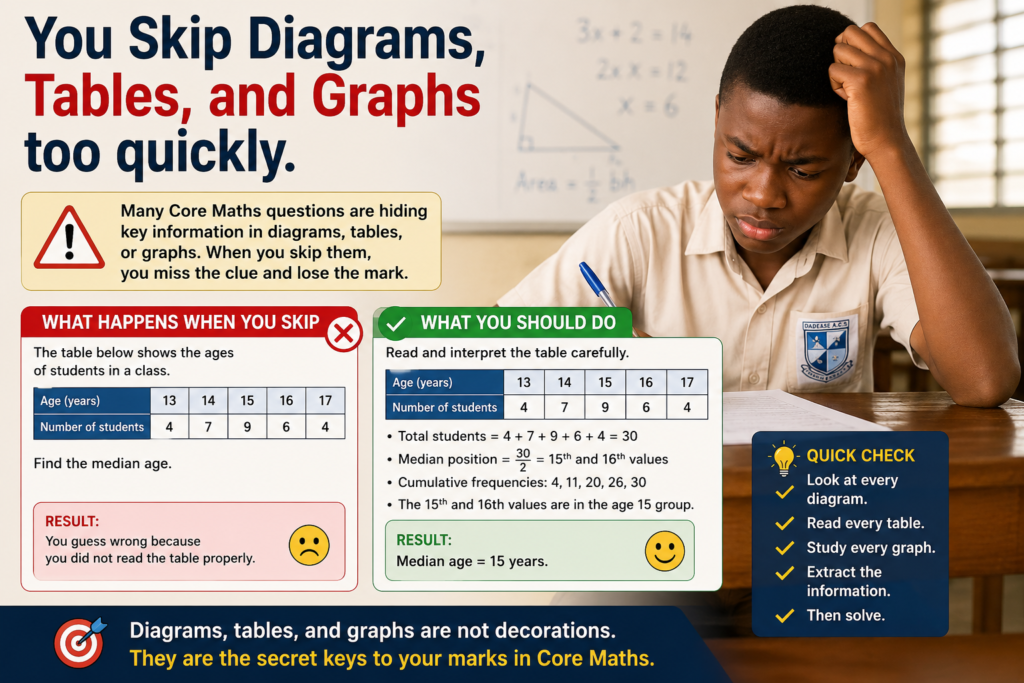
6. You Skip Diagrams, Tables, and Graphs Too Quickly
Some learners become uncomfortable whenever a question includes a diagram, table, graph, chart, or construction. They skip it quickly and look for questions with plain numbers.
This habit exposes weak visual understanding in Core Maths.
Why This Habit Exposes Weak Understanding
Core Maths is not only about numbers. Sometimes the information is hidden in a diagram, a graph scale, a table heading, or a labeled shape.
If a learner cannot read visual information, the learner may miss the starting point of the question.
How This Helps the Learner Understand Better
This habit helps the learner practice reading mathematics visually. The learner must learn to ask the following:
- What does the diagram show?
- Which lengths, angles, or points are given?
- What does the graph scale represent?
- What do the table headings mean?
- Which value must be read before calculation starts?
When visual information becomes clear, topics like graphs, geometry, statistics, bearings, and mensuration become easier to approach.
7. You Mark Answers Without Studying the Mistake
Some learners only want to know whether the answer is right or wrong. Once the answer is wrong, they quickly copy the correct one and move on.
This habit looks serious, but it does not heal the weakness.
Why This Habit Exposes Weak Understanding
A wrong answer is not useless. It shows how the learner was thinking. If the learner does not study the mistake, the same wrong thinking will appear again in another question.
The learner may keep repeating the same error without knowing the cause.
How This Helps the Learner Understand Better
This habit teaches the learner to use wrong answers as a diagnosis. After marking, the learner should write the reason for the mistake, such as:
- Wrong sign
- Wrong formula
- Wrong substitution
- Wrong unit
- Wrong graph scale
- Wrong interpretation
- Careless arithmetic
This makes correction meaningful. The learner is no longer just collecting correct answers. The learner is repairing weak understanding.
8. You Fear Word Problems More Than Direct Questions
A learner may solve direct questions correctly but become confused when the same idea is written as a story. This is very common in WASSCE Core Maths.
For example, the learner may calculate 20% of 500 but struggle when a question describes discount, profit, loss, tax, or increase.
Why This Habit Exposes Weak Understanding
Word problems require translation. The learner must turn English into mathematical statements. If that translation skill is weak, the learner may know the operation but still choose the wrong method.
The problem is not always the topic. Sometimes the problem is reading, identifying the unknown, and choosing the correct relationship.
How This Helps the Learner Understand Better
This habit helps the learner see that word problems must be treated step by step:
1. Read the story slowly.
2. Underline the important numbers and keywords.
3. Identify what you are finding.
4. Decide the topic.
5. Translate the words into an equation, formula, table, or diagram.
6. Solve and check whether the answer fits the story.
Once translation improves, many word problems stop looking impossible.
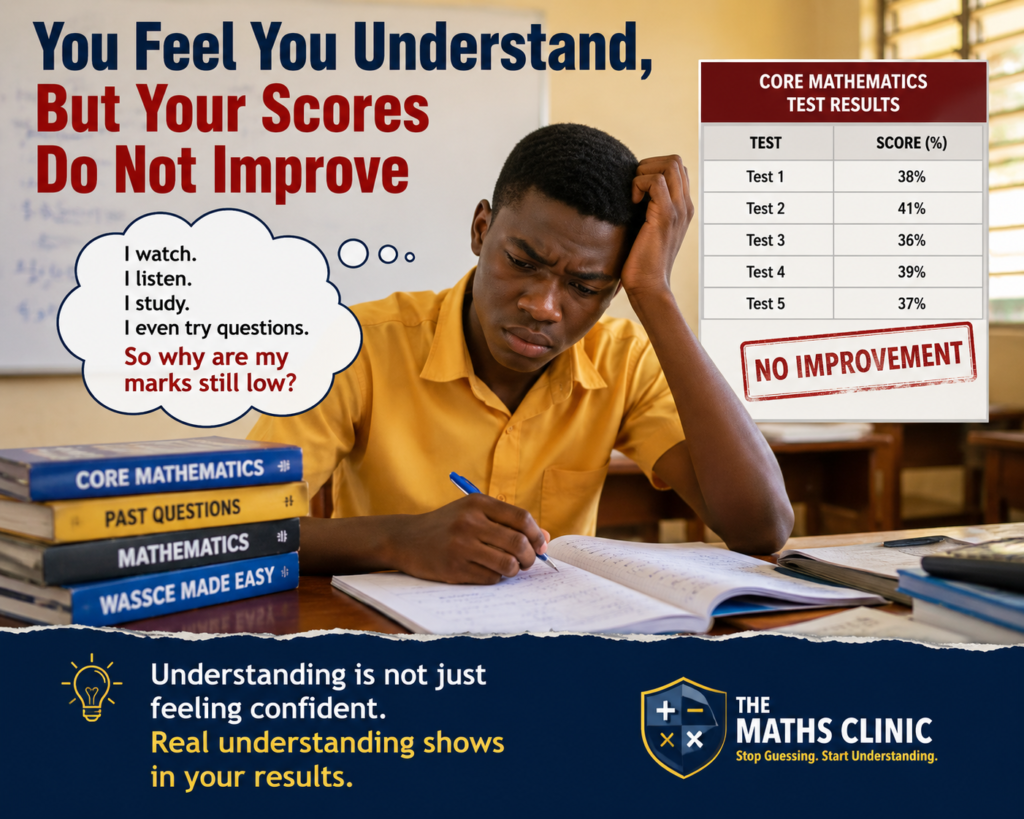
9. You Feel You Understand, But Your Scores Do Not Improve
This is one of the most painful habits. A learner says, “I understand it,” but the test score remains low. The learner feels disappointed because the feeling of understanding is not producing marks.
This habit must be taken seriously before WASSCE.
Why This Habit Exposes Weak Understanding
There is a difference between familiarity and mastery. Familiarity means the learner has seen the topic before. Mastery means the learner can solve, explain, apply, check, and correct the work independently.
Many learners confuse these two.
How This Helps the Learner Understand Better
This habit helps the learner measure understanding properly. Instead of saying, “I know this topic,” the learner should ask the following:
- Can I solve it without help?
- Can I explain the steps?
- Can I solve a WASSCE-style version?
- Can I detect my own mistake?
- Can I apply the idea in a new question?
If the answer is no, the topic still needs practice. That is not shame. That is diagnosis.
Worked Example: How a Small Habit Exposes Weak Understanding
Question
Solve:
5x – 4 = 31
Common Wrong Approach
5x = 31 – 4
5x = 27
x = 27/5
The learner may think the method is correct because something was moved from one side to the other. But the sign was handled wrongly.
Correct Method
5x – 4 = 31
Add 4 to both sides:
5x = 31 + 4
5x = 35
Divide both sides by 5:
x = 7
What the Habit Reveals
The learner’s weakness is not the whole topic of algebra. The real weakness is handling signs and inverse operations. Once the learner sees this, the next practice should focus on balancing equations correctly.
Common Wrong Approach to Revision
Many struggling learners revise by reading everything again from the beginning. That may look hardworking, but it can waste time if the learner does not know the exact weakness.
Another wrong approach is copying many solved examples without solving independently. The learner may feel busy, but the understanding remains weak.
A third wrong approach is avoiding difficult topics and practicing only the comfortable ones. This gives false confidence.
Correct Method: Use Your Habits as Diagnosis
Before WASSCE, do not ignore your learning habits. Use them as evidence. The habit is showing you where to work.
Use this simple Maths Clinic method:
1. Choose one topic that gives you pressure.
2. Solve five questions without checking your notes.
3. Mark your answers carefully.
4. Write the exact habit that caused the mistake.
5. Name the hidden weakness.
6. Practice that weakness again with similar questions.
7. Try one WASSCE-style question to confirm improvement.
This method helps the learner stop revising blindly. It turns mistakes into direction.
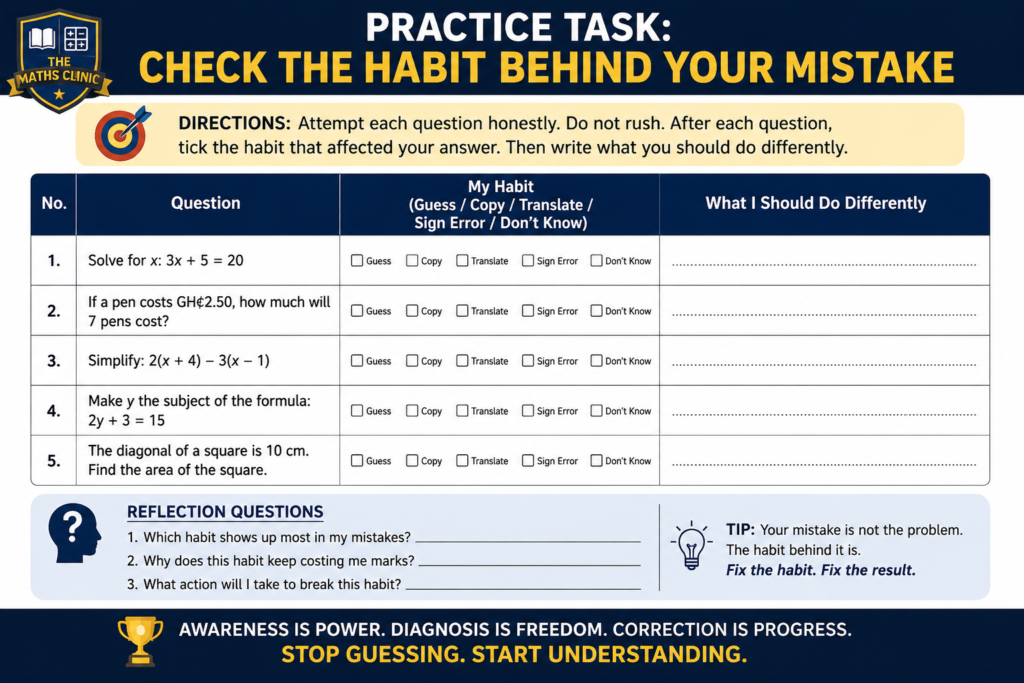
Practice Task: Check the Habit Behind Your Mistake
Solve these questions. After each one, do not only check the answer. Write the habit that affected your work.
| Question | What to Solve | Habit to Check |
| Algebra | Solve 3x + 6 = 24 | Did you move +6 correctly? |
| Percentages | A bag costs GH₵240 after a 20% discount. Find the original price. | Did you identify the correct base? |
| Simple Interest | Find the simple interest on GH₵900 at 10% per annum for 6 months. | Did you convert months to years? |
| Graphs | Find the gradient between (2, 5) and (6, 13). | Did you subtract coordinates in the correct order? |
| Word Problems | The sum of two numbers is 42. One is 6 more than the other. Find the numbers. | Did you translate the words into an equation? |
How This Helps a Struggling SHS Learner Understand Core Maths Better
These nine habits help a struggling learner understand Core Maths better because they expose the hidden gap behind the wrong answer.
A learner may think, “I am bad at Maths.” But after diagnosis, the learner may discover something more specific:
- I rush questions before understanding them.
- I copy steps without knowing the reason.
- I forget what formulas mean.
- I mishandle signs in algebra.
- I cannot read diagrams and graphs well.
- I do not study my mistakes.
- I struggle to translate word problems.
That specific discovery is powerful. It tells the learner where to begin.
Core Maths becomes better when the learner stops treating every mistake as failure and starts treating each mistake as information. The habit reveals the weakness. The weakness points to the correction. The correction builds understanding.
That is how weak learners grow stronger before WASSCE.
Final Advice Before WASSCE
Do not wait until the last week before WASSCE before you check your Core Maths habits.
Your habits are already speaking. Listen to them.
If you always rush, slow down. If you always copy, start explaining. If you always get signs wrong, practice inverse operations. If word problems scare you, practice translation. If graphs confuse you, practice reading scales and points.
A weak understanding can be corrected, but it must first be exposed.
At The Maths Clinic, we believe that a struggling learner is not finished. Sometimes, the learner only needs to see the hidden habit that is blocking understanding.
Once that habit is corrected, Core Maths begins to make better sense.
You do not need to guess your way through WASSCE Core Maths. You need diagnosis, correction, and steady practice.