Struggling with WASSCE Maths? Stop guessing. Let’s fix the gap step by step.

Sign Errors in Algebra: Rules for Negative Numbers and 9 Ways to Avoid Mistakes

📚 Part of the Algebra Clinic: every lesson on this topic, in one place.
Quick answer: most sign errors come from forgetting that a sign belongs to the term after it. Key rules: -(a-b)=-a+b; a negative times a negative is positive; and moving a term across the equals sign really means subtracting it from both sides.
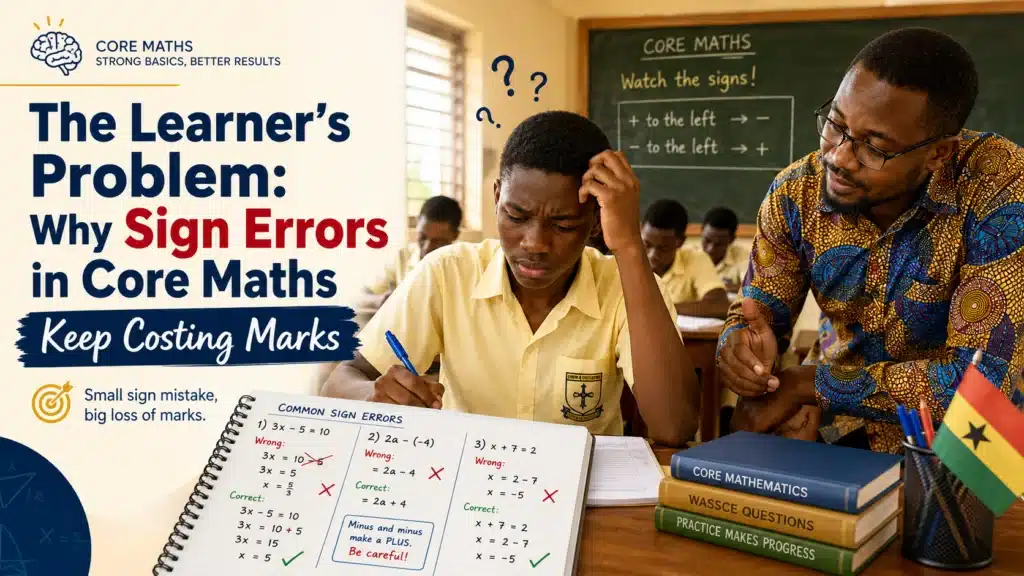
Sign errors in Mathematics are among the small mistakes that cost Ghana SHS students big marks. A learner may know the formula, understand the question, and even start well, but one wrong plus or minus sign can spoil the whole answer.
In many classrooms, when a student gets an algebra question wrong, we often say, “You changed the sign wrongly.” That statement is true, but it does not diagnose the real problem. The learner may not understand what the sign is attached to, what happens when a bracket opens, or why an operation must be done to both sides of an equation.
This lesson is for the weak but serious learner who wants to stop guessing signs in algebra. We shall look at the hidden gap, correct it gently, and practise with examples that look like what WASSCE Mathematics can bring.
📋 What the WAEC Chief Examiner reported
- On 2020 Question 2(b), candidates substituted m = 3, n = −2 and x = −1 into an expression. WAEC said this part “was quite easily done”.
- On 2012 Question 1(a), candidates tried hard to simplify, but “some messed up with the rules of BODMAS”.
- TMC note: the Core reports we checked (2011–2025) do not name sign errors as a weakness on its own. It sits underneath the skills above.
How to win these marks back
- Put every negative value in brackets when you substitute: (−2)² = 4, but −2² = −4.
- Work out the sign first, then the size of the number.
- When you square or expand a bracket, square or multiply every factor and sign inside it.
Source: WAEC Chief Examiner’s Report, WASSCE 2012, Mathematics (Core); WAEC Chief Examiner’s Report, WASSCE 2020, Mathematics (Core).
Why sign errors keep costing marks
Many students do not fail algebra because they cannot think. They fail because signs are quiet. A minus sign is small on the page, but it controls the direction of the whole expression.
For example, a learner may write 5 – 2x as 3x or change –3x + 7 = 10 into 3x = 17. The learner is not lazy. The learner has not yet learned how signs behave when terms move, brackets open, or both sides are balanced.
- The learner treats “minus” as a decoration rather than part of the term.
- The learner changes sides without using inverse operations.
- The learner forgets that a bracket can change more than one sign.
- The learner copies the question wrongly before solving.

Why Sign Errors in Mathematics Happen in the First Place
The mistake usually comes from a weak foundation in integers and inverse operations. Some students were taught a shortcut: “When it crosses the equal sign, the sign changes.” The shortcut works only when the learner understands why it works. Without that understanding, the learner changes signs everywhere, even where no sign should change.
The proper idea is this: an equation is like a balance. Whatever you do to one side, you must do to the other side. Signs change because we are undoing an operation, not because a term has travelled like a tro-tro from one side to another.
What WAEC reports say about sign errors
WASSCE Mathematics questions often hide algebra inside word problems, graphs, formula substitution, simultaneous equations, variation, and financial mathematics. So a learner who has weak sign control does not lose marks only in algebra. The same error follows the learner into many topics.
In the new SHS mathematics curriculum, learners are expected to reason, represent, simplify, generalize, and solve. That means the learner must not only remember rules. The learner must explain why the rule works and apply it in a new situation.

How the Sign Belongs to the Term in Mathematics
In algebra, a sign is not separate from the number or letter after it. The sign belongs to the term.
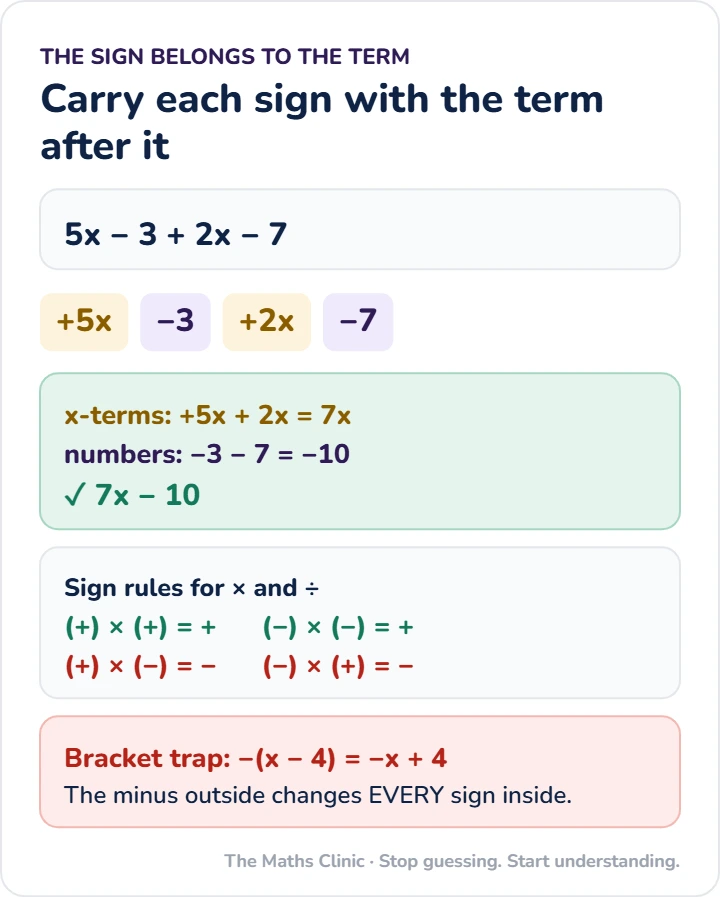
| Expression | Terms you should see | What to notice |
| 7 – 3x | 7 and -3x | The minus belongs to 3x. |
| –4a + 9 | -4a and +9 | The first term is negative. |
| 2x – 5 – x | 2x, -5, and -x | The x at the end is negative. |
Once the learner sees the sign as part of the term, many algebraic mistakes are reduced.
9 Ways to Avoid Sign Errors in Mathematics
1. Read every term with its sign before solving. Say “negative three x” instead of just “three x.”
2. Underline the sign together with the term. Do not separate -5 from the minus sign.
3. When opening brackets, multiply every term inside the bracket, not only the first term.
4. Use inverse operations instead of the loose phrase “send it to the other side.”
5. After each line, check whether the equal sign is still balanced.
6. Be careful when subtracting a negative number. For example, x – (-3) becomes x + 3.

7. Copy the question slowly before solving. A copied sign error is already a lost mark.
8. Keep like terms with their signs when collecting them.
9. Test your final answer in the original equation, especially when negative numbers appear.

Worked Example 1: Solving an Equation Without Guessing Signs
\text{Solve}: 3x - 7 = 11Correct method:
3x - 7 = 11
\text{Add}\ 7 to \text{both sides}: 3x - 7 + 7 = 11 + 73x = 18
\text{Divide both sides} by 3: x = 6Notice the point: the -7 did not change because it “crossed.” We added 7 to both sides to undo subtracting 7.

Worked Example 2: Bracket Sign Trap
Simplify: 4 – (2x – 5)
Correct method:
4 - (2x - 5) = 4 - 2x + 5 = 9 - 2x
The minus before the bracket affects every term inside the bracket. It changes from +2x to -2x and from -5 to +5.

Common Wrong Approaches That Cause Sign Errors in Mathematics
\text{Wrong}: 4 - (2x - 5) = 4 - 2x - 5 = -1 - 2xThis is wrong because the learner changed the sign of 2x but forgot to change the sign of -5. In Mathematics, the bracket is like a classroom instruction given to every student in the room, not only the first student.

Correct Method Learners Should Practise
- Circle any bracket sign before expanding.
- Rewrite subtraction as adding the opposite when confused.
- Collect terms only after signs are clear.
- Check the answer by substituting back when solving equations.
Practice Task: Test Your Understanding of Sign Errors in Mathematics
Solve or simplify the following:
1. x – 8 = 15
2. 5 – (3x – 2)
3. 2a – 7a + 4
4. 6 – (-3)
5. 4y – 9 = 15
Answers:
1) x = 23
2) 7 – 3x
3) –5a + 4
4) 9
5) y = 6
Conclusion: The Sign Is Small, But the Mark Loss Is Big
Sign errors in Mathematics algebra can be corrected when the learner slows down and understands what the sign is doing. Do not only tell the learner, “Be careful.” Show the learner where the sign belongs, why it changes, and when it must not change.
Once a learner masters signs, algebra becomes less frightening. The question becomes clear, the working becomes cleaner, and the learner stops losing marks from avoidable mistakes.
Keep learning
- 8 Simple Examples to Understand Like Terms Properly
- 9 Ways to Stop Mixing Up Expressions and Equations
- When to Expand, Factorise or Simplify: 7 Quick Checks
📚 See every lesson in the Algebra Clinic
✏️ Practise algebraic reasoning
💬 Stuck on a step? Ask Dickson and send the line where you got lost.

Written by
Dickson Sarpong
NTC-certified SHS Mathematics teacher in Ghana with WAEC marking experience, and author of The Bridge Series textbooks. Every lesson here is built around the mistakes WAEC examiners keep reporting.
About DicksonStuck? Ask a question
Want the whole topic, step by step? My textbooks, The Bridge to Mathematics and The Bridge to Additional Mathematics for SHS, follow the new curriculum and rebuild the basics as you go.
Read a free chapter →