Struggling with WASSCE Maths? Stop guessing. Let’s fix the gap step by step.

Algebra Fear: 8 Powerful Beginner-Friendly Examples That Fix It

8 beginner-friendly examples that fix algebra fear can help the learner who freezes immediately after seeing letters in Maths. Some students are not weak in all of Core Maths. They only panic when x, y, brackets, and signs appear. Once fear enters, even simple algebra becomes confusing.
The first treatment is not to insult the learner or shout, “This one, too, you do not know?” The first treatment is to start from examples that are small enough to understand but strong enough to rebuild confidence.

The Learner’s Problem
The learner’s real problem is often not algebra itself. It is algebra phobia. The student sees letters and assumes the question is difficult before reading it. That fear blocks memory, slows thinking, and causes copying errors.
A learner who is afraid of algebra may know addition, subtraction, multiplication, and division very well. But once the numbers mix with letters, the learner stops trusting the same operations. That is the hidden gap we must fix.
Why Did the Mistake Happen?
Algebra fear usually starts when learners meet too many rules too quickly. They are told to collect like terms, transpose, factorize, expand, substitute, and solve. But nobody pauses to show that algebra is still ordinary arithmetic with unknown numbers.
Another cause is repeated failure. When a learner gets algebra wrong many times, the mind starts expecting failure before the question begins. This is why confidence must be rebuilt through small correct steps.
What WAEC or the Curriculum Reveals in Algebra Fear
WASSCE Core Maths expects learners to handle algebra in many topics: equations, inequalities, graphs, functions, mensuration formulas, financial mathematics, and word problems. So algebra fear does not stay inside one topic. It follows the learner into many parts of the paper.
The curriculum also expects learners to use algebra to represent relationships. This means a learner must see algebra not as punishment, but as a tool for saying, “I do not know the number yet, so I will use a letter until I find it.”
Simple Explanation: What Algebra Fear Is Really Doing
Algebra is a way of working with numbers when one or more numbers are not yet known. The letter is not an enemy. The letter is a box waiting for a number. If x + 5 = 12, x simply means the number that, when 5 is added to it, gives 12.
Once the learner understands this, algebra becomes less frightening. The work is not magic. It is organized thinking.
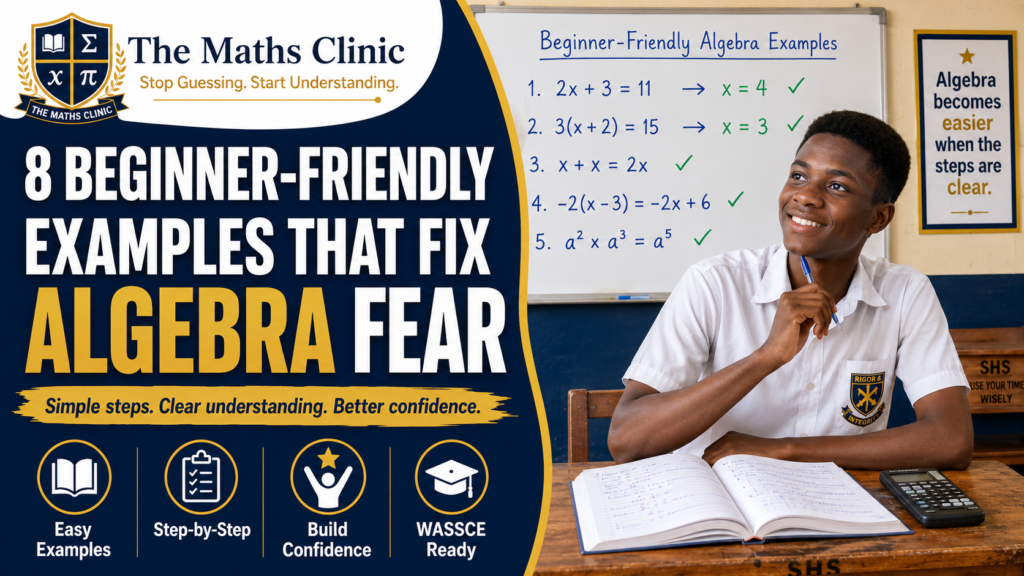
8 Beginner-Friendly Examples That Fix Algebra Fear
These 8 beginner-friendly examples help fix algebra fear because they do not start from difficult questions. They start from the small ideas that many learners missed earlier, such as collecting like terms, using brackets correctly, changing signs carefully, and solving simple equations step by step.
For many SHS students, algebra fear grows when every question looks strange. But when a learner sees simple examples arranged from easy to slightly harder, the mind begins to relax. The learner starts noticing the pattern behind the work instead of guessing which rule to use.
That is why these examples are not just for practice. They are for diagnosis. Each one helps the learner see where the fear is coming from and which foundation skill must be fixed before facing bigger WASSCE algebra questions.
Example 1: Understanding a letter as an unknown number
Question: x + 4 = 10. Ask yourself: what number plus 4 gives 10? The answer is 6, so x = 6. This example teaches that x is not strange. It is just the missing number.
Example 2: Substitution without fear
Question: Find 3a + 2 when a = 5. Replace ‘a‘ with 5: 3(5) + 2 = 15 + 2 = 17. Substitution means putting the given number in place of the letter.
Example 3: Collecting like terms
Question: Simplify 2x + 5x. Since both terms contain x, they are like terms. 2x + 5x = 7x. Think of it like 2 mangoes plus 5 mangoes equals 7 mangoes.
Example 4: Not combining unlike terms
Question: Simplify 3x + 4. This cannot become 7x. The 3x part has a letter, but 4 is a number alone. They are unlike terms, so the expression remains 3x + 4.
Example 5: Opening a simple bracket
Question: Expand 2(x + 3). The 2 must multiply both terms inside the bracket: 2 times x is 2x, and 2 times 3 is 6. So the answer is 2x + 6.
Example 6: Solving a two-step equation
Question: 2x + 3 = 11. First subtract 3 from both sides: 2x = 8. Then divide both sides by 2: x = 4. Check: 2(4) + 3 = 11.
Example 7: Handling a negative sign carefully
Question: x – 7 = 5. Add 7 to both sides because subtraction by 7 must be undone by the addition of 7. So x = 12. Check: 12 – 7 = 5.
Example 8: Turning words into algebra
Question: A number increased by 6 is 14. Let the number be x. Then x + 6 = 14. Subtract 6 from both sides: x = 8. This shows that word problems can become simple algebra when translated carefully.
Worked Example
Question: A number is multiplied by 3, and then 5 is added. The result is 20. Find the number.
Step 1: Let the number be x.
Step 2: Multiplying by 3 gives 3x.
Step 3: Then 5 is added, giving 3x + 5.
Step 4: The result is 20, which gives 3x + 5 = 20.
Step 5: Subtract 5 from both sides: 3x = 15.
Step 6: Divide both sides by 3: x = 5.
So the number is 5.
Common Wrong Approach
| WAEC Trap Box: Treating every letter as something difficult before reading the question. Combining unlike terms such as 3x + 4 into 7x. Opening brackets only halfway, such as 2(x + 3) = 2x + 3. Solving without checking the answer. Changing signs by memory instead of inverse operation. |
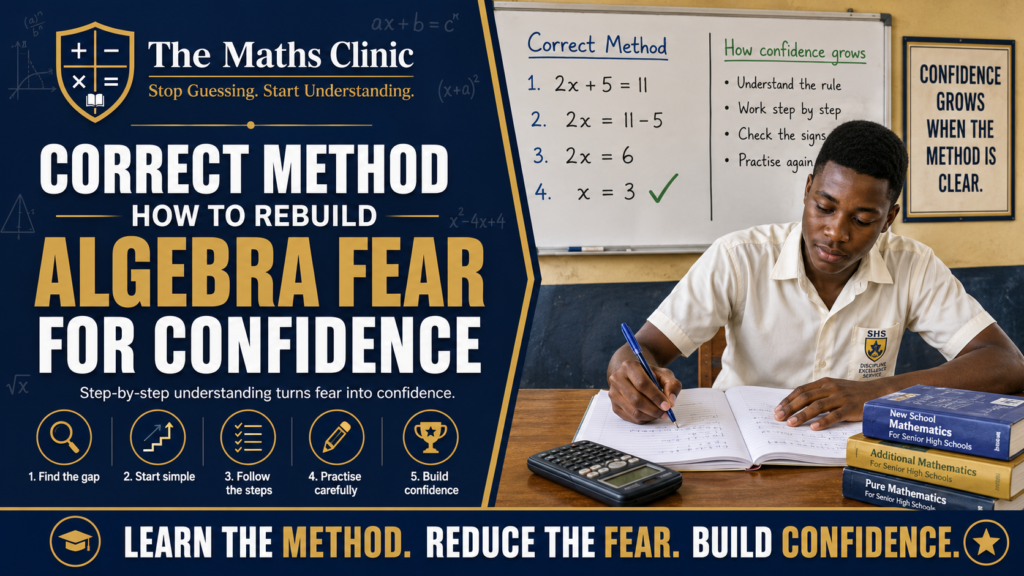
Correct Method: How to Rebuild Algebra Fear for Confidence
- Start with one-line equations before long questions.
- Say what the letter means in simple words.
- Substitute values slowly and clearly.
- Collect only like terms.
- Open brackets by multiplying every term inside.
- Solve equations using inverse operations.
- Check answers by substituting back.
- Practice short tasks daily instead of waiting for exam week.
Practice Task for Algebra Fear
Try these beginner-friendly algebra questions. Do not rush. Write one clear line at a time.
- Solve x + 5 = 13.
- Find 2a + 1 when a = 4.
- Simplify 6y + 3y.
- Can 5p + 2 be simplified further?
- Expand 3(x + 2).
- Solve 4x = 28.
- Solve m – 9 = 6.
- A number decreased by 4 is 11. Form and solve the equation.
Answers
- x = 8
- 9
- 9y
- No, because 5p and 2 are unlike terms.
- 3x + 6
- x = 7
- m = 15
- Let the number be x. x – 4 = 11, so x = 15.
How This Helps a Struggling SHS Learner Before WASSCE
This lesson helps the learner reduce fear before tackling heavier WASSCE algebra. When a student can solve small examples correctly, the mind begins to trust the process. That confidence is not noise. It is built from clear understanding, correct steps, and repeated success.
Conclusion
Algebra fear is real, but it can be corrected. The learner does not need to jump straight into difficult questions. Start with clear examples. Fix the hidden fear. Build the steps. Then practice. In The Maths Clinic, the goal is not to make learners pretend they are confident. The goal is to help them understand enough to become confident for real.