Struggling with WASSCE Maths? Stop guessing. Let’s fix the gap step by step.

When to Expand, Factorize, or Simplify: 7 Powerful Checks

When to expand, factorize, or simplify is a common decision problem among Ghanaian SHS Core Maths learners. A learner may understand the three techniques separately but still struggle to decide which transformation an algebra question requires. This Maths Clinic lesson identifies that algebraic decision gap and repairs it step by step.
One learner may see brackets and expand immediately. Another may see a quadratic expression and try to factorize immediately. Both learners may know the correct algebraic skills but use them at the wrong time. That is why correct working can still move in the wrong direction and cost marks in WASSCE.
In Core Maths, algebra is not a guessing game. The expression and the instruction usually provide clues. The learner must identify what form the answer should take before deciding whether to expand, factorize, or simplify.
This lesson will help you understand when to expand, factorize, or simplify; recognize the clues in WASSCE-style questions; and choose the correct algebraic move with confidence.

When to Expand, Factorize, or Simplify: The Learner’s Exact Problem
The learner’s problem is decision weakness. The learner may know the expansion rule, the factorization method, and how to collect like terms, but they do not know which tool the question is asking for at that moment.
This is like a student carrying a cutlass, a broom, and a ruler, but using the cutlass to sweep the room. The tool is not useless. It is just being used at the wrong time.
Why Learners Struggle to Know When to Expand, Factorize, or Simplify
This mistake happens because many learners learn algebra as separate tricks. They learn expansion today, factorization next week, and simplification later. But in WASSCE questions, the three skills can appear together.
For example, a question may require you to expand first, collect like terms, then factorize the final expression. If you do not know the purpose of each step, you may stop too early or move in the wrong direction.
What WASSCE Reveals About Expand, Factorize, or Simplify
WASSCE Core Maths questions often reward method, not only the final answer. Algebra questions may test whether the learner can transform an expression into a useful form. This means expansion, factorization, and simplification are not isolated topics. They are algebraic tools.
The curriculum direction also expects learners to recognize structure. A strong learner does not only calculate. A strong learner notices what form of the expression will make the next step easier.
When to Expand, Factorize, or Simplify Explained Clearly
To expand means to remove brackets by multiplying every term inside the bracket. To factorize means to put an expression into brackets by finding common factors or special patterns. To simplify means to make an expression shorter or cleaner by collecting like terms, cancelling correctly, or reducing fractions.
The simple clinic question is this: What form will help me answer the question? If the question wants no brackets, expand. If the question wants a product of factors or solving by zero product, factorize. If the expression is untidy, simplify.
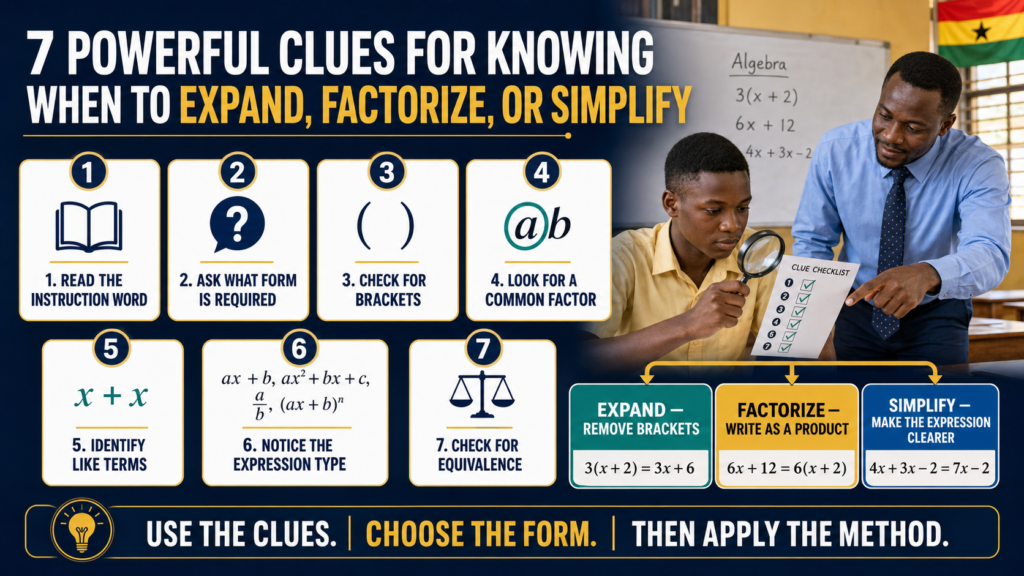
7 Powerful Clues for Knowing When to Expand, Factorize, or Simplify
Expand, Factorize, or Simplify—1. If the instruction says “expand,” remove the brackets.
Example: Expand The answer is . Do not leave the answer as because the instruction has asked you to open the bracket.
Expand, Factorize, or Simplify – 2. If the instruction says “factorize,” look for common factors or patterns.
Example: Factorize . The common factor is 6, so the answer is . Do not expand when the question is asking you to put the expression into brackets.
Expand, factorize, or simplify—3. If the expression has many like terms, simplify first.
Example: becomes . The learner should collect terms together and constants together before doing anything else.
Expand, Factorize, or Simplify – 4. If the expression is a fraction, check whether factorization can help with cancellation.
Example: Factorize the numerator first. Then cancel , so the expression becomes , where x is not equal to 3.
Expand, Factorize, or Simplify – 5. If there is an equation with brackets, expand only when it helps solve
Example: . Expanding gives , then , so But some equations can be solved faster by dividing first. The best method is the one that is correct and clear.
Expand, Factorize, or Simplify: 6. If you see a quadratic equation equal to zero, factorization may be useful.
Example: Factorize to get it. Then
Expand, Factorize, or Simplify—7. If nothing is being solved yet, clean the expression before moving.
An untidy expression hides mistakes. Simplify signs, brackets, and like terms first. A clean expression helps the learner see the next step.
Expand, Factorize, or Simplify the Worked Example
Simplify and factorize:
Step 1: Expand the bracket:
2
Step 2: Rewrite the full expression:
Step 3: Simplify like terms.
Step 4: Factorize.
Final answer: This example shows that one question may require all three skills in the correct order.
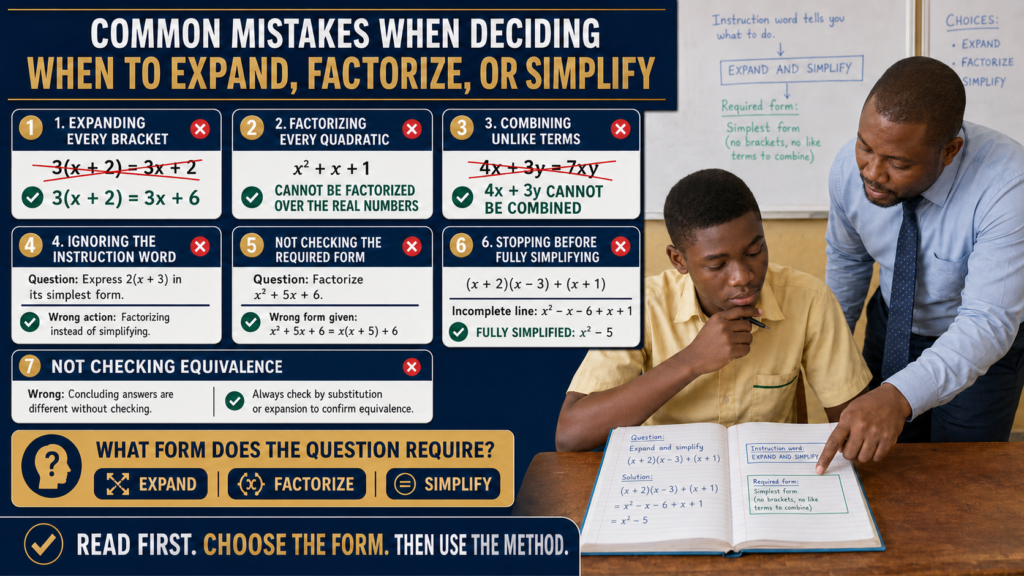
Common Mistakes When Deciding When to Expand, Factorize, or Simplify
A common wrong approach is to see and write . The learner multiplied only x by 2 and left 3 unchanged. That is not expansion. Every term inside the bracket must be multiplied.
Another wrong approach is to factorize too early without simplifying. If the expression is untidy, factorization becomes harder, and mistakes increase.
A Simple Method for Knowing When to Expand, Factorize, or Simplify
Use this decision path: first, read the instruction. Second, check the form of the expression. Third, simplify what is untidy. Fourth, expand brackets when the question demands it or when it helps in solving. Fifth, factorize when you need brackets, cancellation, or solving a quadratic by the zero product.
Practice Task: Decide When to Expand, Factorize, or Simplify
Purpose check: This expand, factorize, or simplify practice is not only for scoring. If the learner misses a question, identify whether the error came from the algebraic decision gap before giving another question.
For each question, decide whether the main action is expand, factorize, simplify, or a combination.
- 1. Expand
- 2. Factorize
- 3. Simplify
- 4. Simplify
- 5. Solve
- 6. Simplify and factorize .
Answers:
1.
2.
3.
4. Where is not equal to 4.
5.
6.
Conclusion: Understand When to Expand, Factorize, or Simplify
“Expand,” “Factorize,” or “Simplify” becomes useful when the learner can explain the next step instead of copying it. Use this algebra in Core Maths lessons to repair the named gap, practice it again, and then retest it. The learner who improves in algebra is not the learner who expands everything. It is the learner who reads the expression and chooses the right tool. Before WASSCE, train your mind to ask: Am I opening brackets, putting them into brackets, or cleaning the expression? That one question can save many marks.