Struggling with WASSCE Maths? Stop guessing. Let’s fix the gap step by step.

Work Rate Problems With Solutions: Working Together Questions for WASSCE
Work rate problems with solutions: the rate table, working together, pipes and leaks, and the changed-plan questions WAEC asks.

📚 Part of the Word Problems Clinic: every word problem lesson, in the right order.
Quick answer: how do you solve work rate problems?
Turn each time into a rate: if a job takes 6 days, the rate is \tfrac{1}{6} of the job per day. When people or pipes work together, add the rates (never the times), then the time together is 1 ÷ the total rate. For a plan that changes, use rate × days = work, with work done + work left = planned total.
“If one tap takes 4 hours and another takes 6 hours, together they take 10 hours.” It sounds logical, and it is wrong: two taps together fill a tank faster than either alone. Work rate questions punish the learner who adds times.
This lesson shows you the one idea behind every work question, the rate table, and how WAEC builds “planned versus actual” stories, like the 2025 ploughing question that most candidates could not complete.
Why work rate problems feel difficult
- Adding the times. Times do not add; the work done each hour does.
- Forgetting the leftover. In a changed plan, the work done plus the work still left equals the planned total.
- Mixed units. 72 minutes is 1.2 hours. Rates and times must use the same unit.
The idea behind it
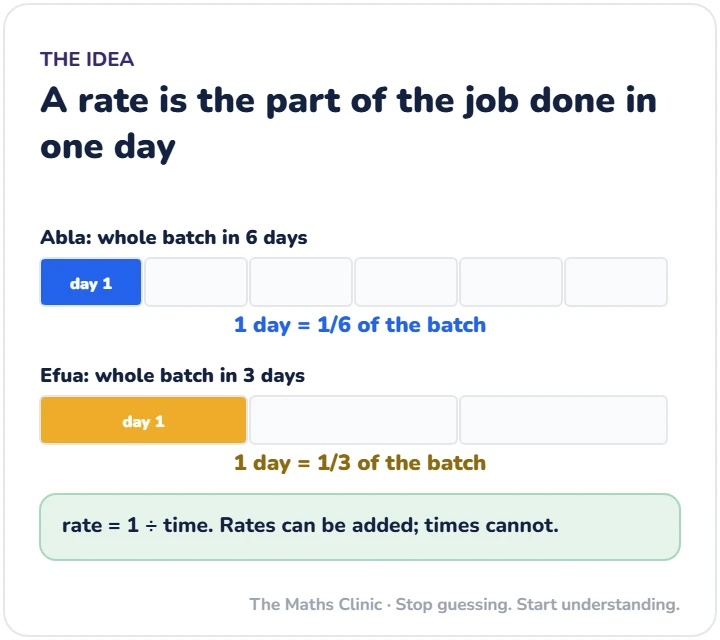
A rate is the fraction of the job done in one unit of time. If Abla needs 6 days to sew a batch of uniforms, she sews \tfrac{1}{6} of the batch each day. When two people work together, the parts they finish each day add up:
\text{rate together} = \text{rate}_1 + \text{rate}_2And because rate × time = work, a whole job (1) done at a rate r takes 1 \div r.
The method: the rate table
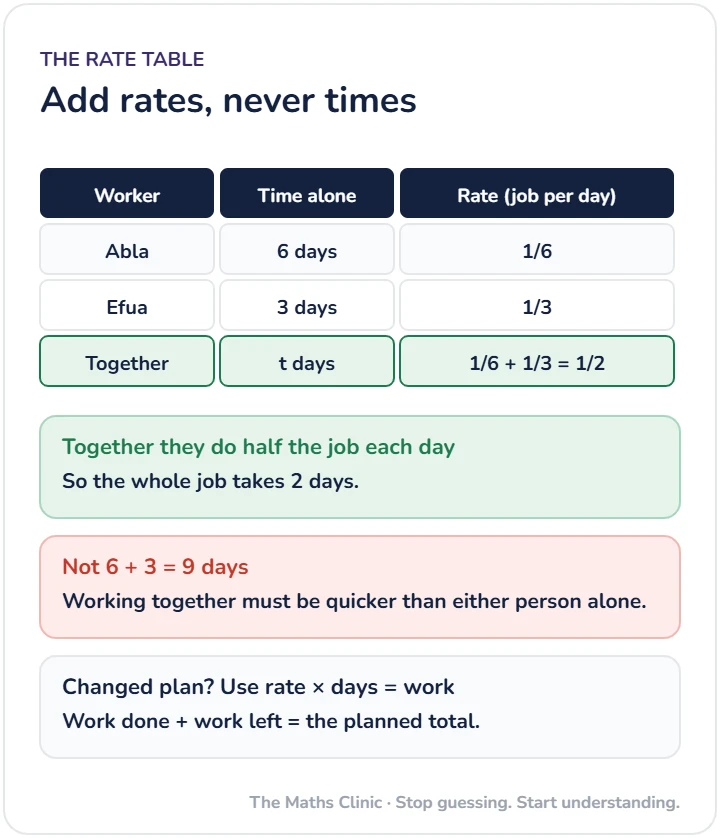
- Give each worker (or pipe) a row: time alone, then rate = 1 ÷ time.
- Add the rates. A pipe that empties a tank has a negative rate.
- Time together = 1 ÷ total rate.
- For a changed plan, give the plan and the actual work a row each: rate × days = work. Then: work done + work left = planned total.
- Check: the time together must be less than the fastest worker’s time alone.

The common wrong approach
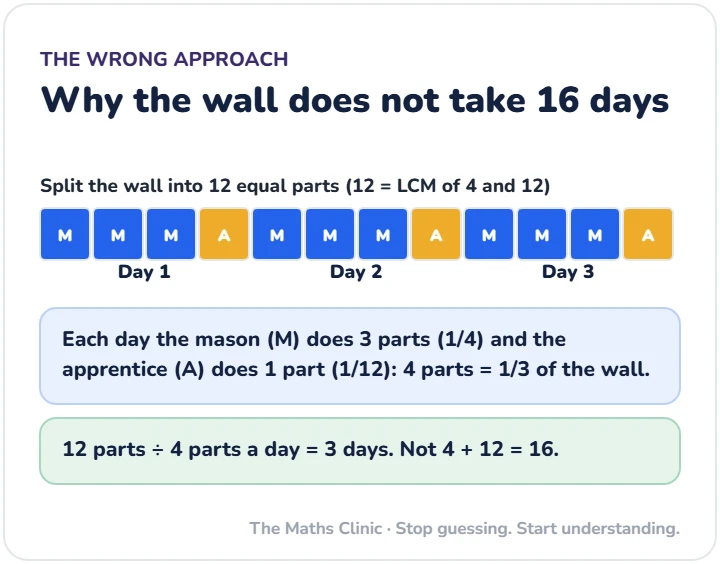
Question: A mason can build a wall in 4 days and his apprentice can build it in 12 days. How long will they take working together?
| Line | Working |
|---|---|
| 1 | Time together = 4 + 12 |
| 2 | = 16 days |
Sixteen days is longer than the mason takes alone, which cannot be right. The rates are \tfrac{1}{4} and \tfrac{1}{12} of the wall per day:
\tfrac{1}{4} + \tfrac{1}{12} = \tfrac{3}{12} + \tfrac{1}{12} = \tfrac{1}{3}Together they build a third of the wall each day, so the wall takes 3 days, which is less than 4 ✓
Worked example 1: working together
Abla can sew a batch of school uniforms in 6 days and Efua can sew it in 3 days. How long will they take working together?
Step 1. Rates: Abla \tfrac{1}{6} per day, Efua \tfrac{1}{3} per day.
Step 2. Add the rates:
\tfrac{1}{6} + \tfrac{1}{3} = \tfrac{1}{6} + \tfrac{2}{6} = \tfrac{1}{2}Step 3. Half the batch each day, so the whole batch takes 1 \div \tfrac{1}{2} = 2 days.
Answer: 2 days. Check: less than 3 days (Efua alone) ✓. In 2 days Abla does \tfrac{2}{6} and Efua \tfrac{4}{6}, which make one batch ✓

Worked example 2: a plan that changes
A farmer planned to weed 30 plots a day. He weeded only 24 plots a day, worked 3 days longer than planned, and still had 18 plots left. How many days had he planned, and how many plots are there?
Step 1. Planned days = x. Planned work = 30x plots (the whole farm).
Step 2. Actual work: x + 3 days at 24 plots a day = 24(x + 3), with 18 plots left.
30x = 24(x + 3) + 18
Step 3. 30x = 24x + 90, so 6x = 90 and x = 15.
Answer: he planned 15 days, and there are 30 \times 15 = 450 plots. Check: 24 \times 18 = 432 and 432 + 18 = 450 ✓

📋 What the WAEC Chief Examiner reported
- On 2025 Question 8(a), Mr Afenyo planned to plough 120 acres a day, managed only 85, took 2 days longer and still had 40 acres left. WAEC reported that this part “was not well answered by most of the candidates”. The expected equation was 120x = 85(x + 2) + 40.
- On 2024 Question 7(a), a man and his apprentice paint a room together in 72 minutes. That part was well answered: “most of them converted the minutes to hours correctly and went on to form the correct equation”.
What WAEC recommends
In 2020 the Chief Examiner advised: “Teachers should teach students on how to translate word problems into mathematics statements.” In 2019: “Sufficient exercises should be given on word-problems for students to practice.” This lesson does both: every translation step is shown, and you get six questions with full solutions.
How to win these marks back
- Write each rate (job per hour or per day) before any equation.
- Add rates, never times; convert minutes to hours first.
- In a changed plan, write work done + work left = planned total.
Source: WAEC Chief Examiner’s Report, WASSCE 2024, Mathematics (Core); WAEC Chief Examiners’ Reports, WASSCE (SC) 2025, Ghana: Mathematics (Core).
Work rate problems: practice questions
Fill in a rate table for each question. Answers are below.
Question 1
Tap A fills a tank in 4 hours and tap B fills it in 6 hours. How long do both taps take together?
Question 2
Kofi can mow a field in 5 hours. With Yaw helping, it takes 3 hours. How long would Yaw take alone?
Question 3
A man and his son paint a fence together in 1 hour 12 minutes. The man alone takes 2 hours. How long would the son take alone?
Question 4
A pipe fills a tank in 6 hours, but a leak can empty a full tank in 15 hours. With the leak open, how long does the pipe take to fill the empty tank?
Question 5
A contractor planned to lay 200 blocks a day. He laid only 160 blocks a day, worked 4 days longer than planned, and still had 80 blocks left. How many days had he planned, and how many blocks were there?
Question 6
6 workers can harvest a farm in 10 days. Working at the same rate, how many days would 15 workers take?
Work rate problems with solutions
Solution 1
Rates: \tfrac{1}{4} + \tfrac{1}{6} = \tfrac{3}{12} + \tfrac{2}{12} = \tfrac{5}{12} of the tank per hour.
Time = 1 \div \tfrac{5}{12} = \tfrac{12}{5} = 2.4 hours.
Answer: 2 hours 24 minutes.
Solution 2
Together: \tfrac{1}{3} per hour. Yaw’s rate = \tfrac{1}{3} – \tfrac{1}{5} = \tfrac{2}{15}.
Time = \tfrac{15}{2} = 7.5 hours.
Answer: 7 hours 30 minutes.
Solution 3
1 hour 12 minutes = 1.2 hours, so together they paint 1 \div 1.2 = \tfrac{5}{6} of the fence per hour.
Son’s rate = \tfrac{5}{6} – \tfrac{1}{2} = \tfrac{1}{3}.
Answer: 3 hours.
Solution 4
Net rate = \tfrac{1}{6} – \tfrac{1}{15} = \tfrac{5}{30} – \tfrac{2}{30} = \tfrac{1}{10} of the tank per hour.
Answer: 10 hours.

Solution 5
Planned days x. Equation: 200x = 160(x + 4) + 80.
200x = 160x + 720, so 40x = 720 and x = 18.
Answer: 18 days planned; 200 \times 18 = 3600 blocks. Check: 160 × 22 = 3,520 and 3,520 + 80 = 3,600 ✓
Solution 6
The job needs 6 \times 10 = 60 worker-days. With 15 workers: 60 \div 15 = 4.
Answer: 4 days.
📘 New SHS curriculum link
This builds on Year 1 (1.2.1.LO.2), modelling and solving linear equations from real-life problems, and Year 2 (2.1.2.LO.1): ratios, rates and proportions.
For parents
Ask: “If I can sweep the compound in 30 minutes and you take 60 minutes, will it take us longer or shorter than 30 minutes together?” The answer must be shorter. That one sense check catches most work-rate mistakes.
Frequently asked questions
What is the formula for work rate?
Rate = 1 ÷ time for one whole job. Rate × time = the part of the job done. For two workers: \tfrac{1}{a} + \tfrac{1}{b} = \tfrac{1}{t}, where t is the time together.
Why can’t I add the times?
Because working together is faster than working alone. Adding times gives a longer time, which is impossible. The work done each hour adds; the times do not.
How do I handle a leak or an emptying pipe?
Give it a negative rate and subtract it from the filling rate.
What to do next
Redo any question you missed, starting from the rate table. Then try mixed questions in the Practice Zone.
Keep learning
- Speed, Distance and Time Word Problems: How to Find Average Speed
- Age Word Problems With Solutions: The Age Table Method
- Word Problems in WASSCE Mathematics: Questions and Answers, Step by Step
📚 See every lesson in the Algebra Clinic
✏️ Practise word problems
💬 Stuck on a step? Ask Dickson and send the line where you got lost.

Written by
Dickson Sarpong
NTC-certified SHS Mathematics teacher in Ghana with WAEC marking experience, and author of The Bridge Series textbooks. Every lesson here is built around the mistakes WAEC examiners keep reporting.
About DicksonStuck? Ask a question
Want the whole topic, step by step? My textbooks, The Bridge to Mathematics and The Bridge to Additional Mathematics for SHS, follow the new curriculum and rebuild the basics as you go.
Read a free chapter →