Struggling with WASSCE Maths? Stop guessing. Let’s fix the gap step by step.

Ratio Word Problems With Answers: How to Share in a Ratio, Step by Step
Ratio word problems with answers: find one part first, sharing a total or a difference, and the changing-cost questions WAEC reports as poorly answered.

📚 Part of the Word Problems Clinic: every word problem lesson, in the right order.
Quick answer: how do you solve ratio word problems?
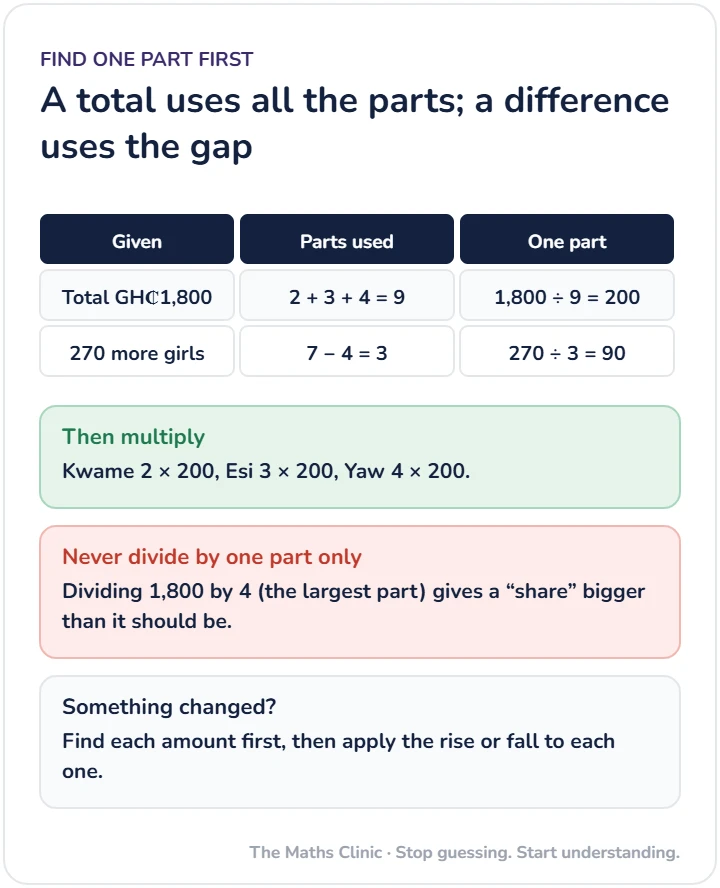
Find the value of one part first. If the question gives a total, divide it by the sum of all the parts. If it gives a difference (“270 more”), divide by the difference between the parts. Then multiply each person’s number of parts by the value of one part, and check that the shares add up.
Ratio questions hide inside many WASSCE topics: sharing money, ages, costs that rise with inflation, mixtures. The arithmetic is simple. The marks are lost when a learner divides by the wrong number of parts, or applies a ratio to the wrong amount.
This lesson gives you one habit, find one part first, that works for every sharing question, plus the “something changed” questions that WAEC reported as poorly answered in 2025.
Why ratio word problems feel difficult
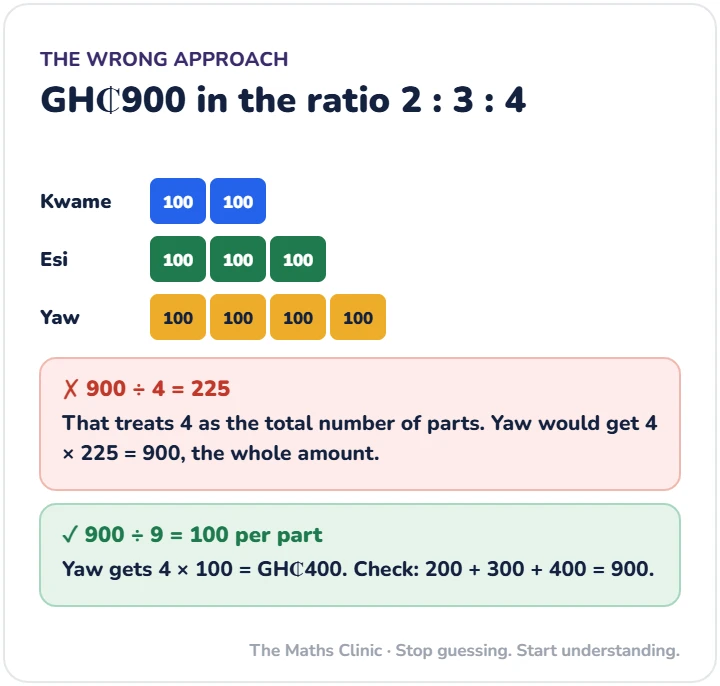
- Dividing by one part. GH₵900 in the ratio 2 : 3 : 4 is 9 parts, not 4.
- Using the ratio on the wrong amount. A ratio can be matched to a total (all the parts) or to a difference (the gap between parts). Mixing them up gives nonsense.
- Forgetting what changed. After a rise, a fall or someone joining, recalculate each amount before comparing.
The idea behind it
A ratio tells you how many equal parts each person gets, not how much money. In the ratio 2 : 3 : 4, there are 9 equal parts; Kwame gets 2 of them. Once you know what one part is worth, every share follows. A question can only tell you the value of one part in two ways: through a total, or through a difference.

The method: find one part first
- Write the ratio as parts, for example 2k : 3k : 4k.
- Decide what the question gives: a total (add all the parts) or a difference (subtract the parts).
- Find one part: k = total ÷ sum of parts, or difference ÷ difference of parts.
- Multiply to get each share.
- Check: the shares add up to the total, and they are in the given ratio.
The common wrong approach
Question: GH₵900 is shared in the ratio 2 : 3 : 4. Find the largest share.
| Line | Working |
|---|---|
| 1 | 900 ÷ 4 = 225 |
| 2 | Largest share = 4 × 225 |
| 3 | = GH₵900 |
The “largest share” is the whole amount, which leaves nothing for the other two people. Line 1 is the mistake: there are 2 + 3 + 4 = 9 parts, so one part is 900 \div 9 = 100 and the largest share is 4 \times 100 = 400. Answer: GH₵400.
Worked example 1: sharing a total
GH₵1,800 is shared among Kwame, Esi and Yaw in the ratio 2 : 3 : 4. How much does each receive?
Step 1. Total parts: 2 + 3 + 4 = 9.
9k = 1800, \text{ so } k = 200Step 2. Kwame 2 \times 200 = 400, Esi 3 \times 200 = 600, Yaw 4 \times 200 = 800.
Answer: GH₵400, GH₵600 and GH₵800. Check: 400 + 600 + 800 = 1,800 ✓

Worked example 2: using a difference
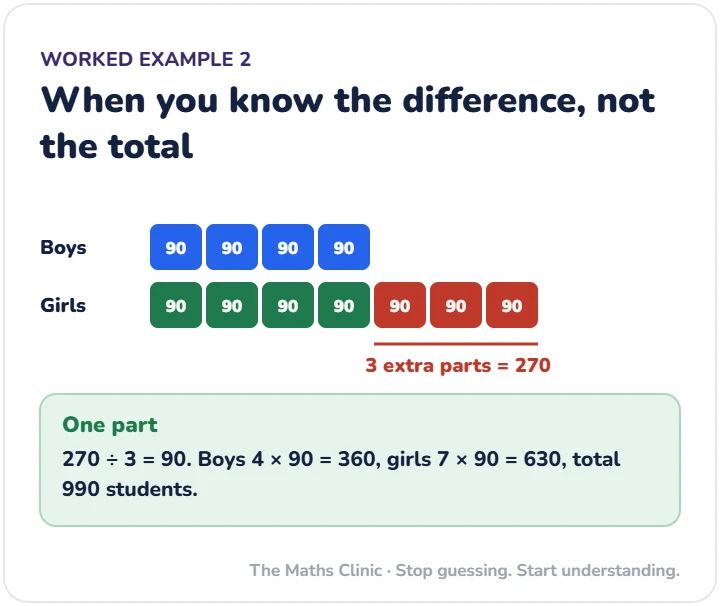
The ratio of boys to girls in a school is 4 : 7. There are 270 more girls than boys. How many students are in the school?
Step 1. The difference is 7 – 4 = 3 parts, and those 3 parts are 270 students.
7k - 4k = 270, \text{ so } k = 90Step 2. Boys 4 \times 90 = 360, girls 7 \times 90 = 630.
Answer: 990 students. Check: 630 − 360 = 270 ✓
Worked example 3: when the amounts change
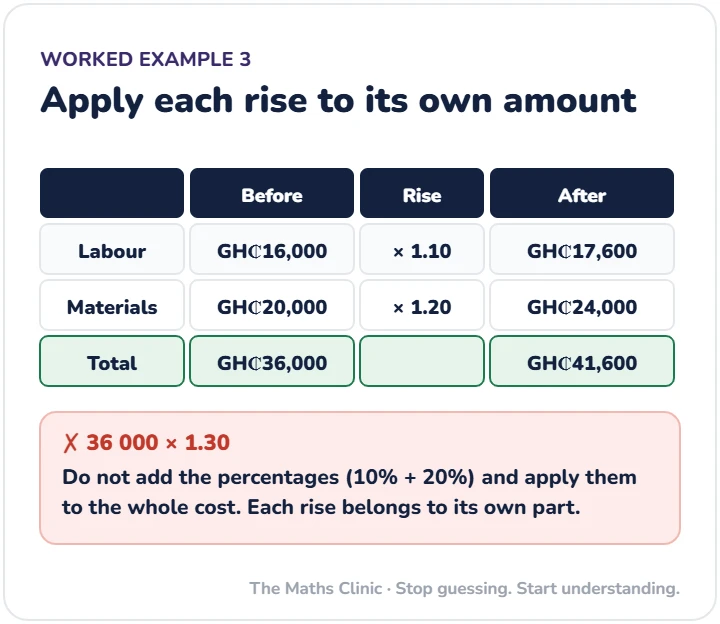
The cost of a project, GH₵36,000, is shared between labour and materials in the ratio 4 : 5. The labour cost then rises by 10% and the materials cost rises by 20%. Find the new total cost.
Step 1. One part: 36000 \div 9 = 4000. Labour 4 \times 4000 = 16000; materials 5 \times 4000 = 20000.
Step 2. Apply each rise to its own amount: labour 16000 \times 1.1 = 17600; materials 20000 \times 1.2 = 24000.
Answer: 17600 + 24000 = 41600, so the new total cost is GH₵41,600. Trap: do not add the percentages (30%) and apply them to the total.
📋 What the WAEC Chief Examiner reported
- In 2020, WAEC listed the ability to “solve problems involving ratio and proportions” among candidates’ weaknesses.
- On 2012 Question 2(a), the “majority of them used the ratio 2 :9 as basis for dividing the total age of Kwasi and Yaw, which was unacceptable”: the ratio belonged to one moment and the total to another.
- On 2021 Question 9(a) (cars and motorcycles in the ratio 5 : 7, with 142 more motorcycles), “most candidates were able to come up with the respective equations required, solved them correctly”. The difference-of-parts method works.
- On 2025 Question 6 (building costs in the ratio 12 : 15 : 5, with labour and materials rising by different percentages), “The part (b) was poorly answered by most candidates. Good solutions for this part of the question were few.”
What WAEC recommends
In 2020 the Chief Examiner advised: “Teachers should teach students on how to translate word problems into mathematics statements.” In 2019: “Sufficient exercises should be given on word-problems for students to practice.” This lesson does both: every translation step is shown, and you get six questions with full solutions.
How to win these marks back
- Find the value of one part before anything else.
- Decide whether you were given a total or a difference.
- When amounts change, find each amount first, then apply each change to its own amount.
Source: WAEC Chief Examiner’s Report, WASSCE 2012, Mathematics (Core); WAEC Chief Examiner’s Report, WASSCE 2020, Mathematics (Core); WAEC Chief Examiner’s Report, WASSCE 2021, Mathematics (Core); WAEC Chief Examiners’ Reports, WASSCE (SC) 2025, Ghana: Mathematics (Core).
Ratio word problems: practice questions
Find one part first in every question. Answers are below.
Question 1
Ama and Kojo share GH₵640 in the ratio 3 : 5. How much does Kojo get?
Question 2
The ratio of red pens to green pens in a box is 5 : 2. There are 45 more red pens than green pens. How many green pens are there?
Question 3
A sum of money is shared between Akua and Baaba in the ratio 7 : 4. Akua receives GH₵150 more than Baaba. Find the sum shared.
Question 4
In a class of 48 students, the ratio of boys to girls is 5 : 7. Then 4 more boys join the class. Find the new ratio of boys to girls.
Question 5
Sugar and flour are mixed in the ratio 2 : 9 by mass. Find the mass of sugar in 990 g of the mixture.
Question 6
A family’s monthly electricity and water bills are in the ratio 5 : 3, and together they cost GH₵480. Electricity then rises by 20% and water by 10%. Find (a) the new total, and (b) the percentage increase in the total.
Ratio word problems with answers
Solution 1
8 parts; one part = 640 \div 8 = 80. Kojo: 5 \times 80 = 400.
Answer: GH₵400.
Solution 2
Difference: 5k – 2k = 45, so k = 15. Green: 2 \times 15 = 30.
Answer: 30 green pens. Check: 75 − 30 = 45 ✓
Solution 3
Difference: 7k – 4k = 150, so k = 50. Sum: 11 \times 50 = 550.
Answer: GH₵550. Check: 350 − 200 = 150 ✓
Solution 4
12 parts; one part = 4. Boys 20, girls 28. After: boys 24, girls 28.
24 : 28 = 6 : 7.
Answer: 6 : 7.

Solution 5
11 parts; one part = 990 \div 11 = 90. Sugar: 2 \times 90 = 180.
Answer: 180 g.
Solution 6
One part = 480 \div 8 = 60. Electricity 300, water 180.
(a) 300 \times 1.2 + 180 \times 1.1 = 360 + 198 = 558. Answer: GH₵558.
(b) Increase = 78; 78 \div 480 \times 100 = 16.25. Answer: 16.25%.
📘 New SHS curriculum link
This builds on Year 1 (1.2.1.LO.2), modelling and solving linear equations from real-life problems, and Year 2 (2.1.2.LO.1): ratios, rates and proportions.
For parents
Give your child 12 sweets to share with a sibling in the ratio 1 : 2. Watch: do they count the parts (1 + 2 = 3) first? If yes, they understand ratio sharing. If they give 1 and 2 sweets, this lesson is for them.
Frequently asked questions
How do you share an amount in a ratio?
Add the parts, divide the amount by that sum to find one part, then multiply by each person’s number of parts.
What if the question gives “how many more”?
Use the difference between the parts. In the ratio 4 : 7, “270 more” matches 7 – 4 = 3 parts.
How do I check a ratio answer?
The shares must add up to the total, and dividing each share by one part must give back the ratio.
What to do next
Mark your answers and redo any you missed, writing the value of one part first. Then try mixed questions in the Practice Zone. For percentage increases, see Percentages in Mathematics.
Keep learning
- Work Rate Problems With Solutions: Working Together Questions
- Age Word Problems With Solutions: The Age Table Method
- Percentages in Mathematics: How to Calculate Them, With Questions and Answers
📚 See every lesson in the Algebra Clinic
✏️ Practise word problems
💬 Stuck on a step? Ask Dickson and send the line where you got lost.

Written by
Dickson Sarpong
NTC-certified SHS Mathematics teacher in Ghana with WAEC marking experience, and author of The Bridge Series textbooks. Every lesson here is built around the mistakes WAEC examiners keep reporting.
About DicksonStuck? Ask a question
Want the whole topic, step by step? My textbooks, The Bridge to Mathematics and The Bridge to Additional Mathematics for SHS, follow the new curriculum and rebuild the basics as you go.
Read a free chapter →