Struggling with WASSCE Maths? Stop guessing. Let’s fix the gap step by step.

Age Word Problems With Solutions: The Age Table Method for WASSCE
Age word problems with solutions: the age table method, the two mistakes WAEC examiners report, worked examples and practice questions with answers.

📚 Part of the Word Problems Clinic: every word problem lesson, in the right order.
Quick answer: how do you solve age word problems?
Make an age table: one row per person, one column per moment (now, in 5 years, 4 years ago). Name one unknown, fill every box with an expression, then write the equation using only the column the sentence describes. Check that your answers make every sentence true.
“Sir, I can solve 3x + 8 = 2(x + 8). I just don’t know how to get it from the story.” Many SHS students say this about age questions, and they are right: the algebra is easy. The marks are lost in the translation from words to an equation.
This lesson gives you one tool, the age table, that makes the translation almost automatic. You will see the two mistakes WAEC examiners keep reporting, two worked examples, and six practice questions with full solutions.
Why age word problems feel difficult
An age question tells a story across time. One sentence is about now, another is about in 5 years or 4 years ago. If you mix up the moments, you write a perfectly neat equation that is simply wrong.
Most wrong answers come from just two slips:
- Changing only one person’s age. If 8 years pass, everyone in the story is 8 years older, not just the first person mentioned.
- Using a ratio or a total at the wrong moment. “Five years ago, the sum of their ages was 62” is about five years ago. Using 62 for their ages now gives the wrong equation.
The idea behind every age question
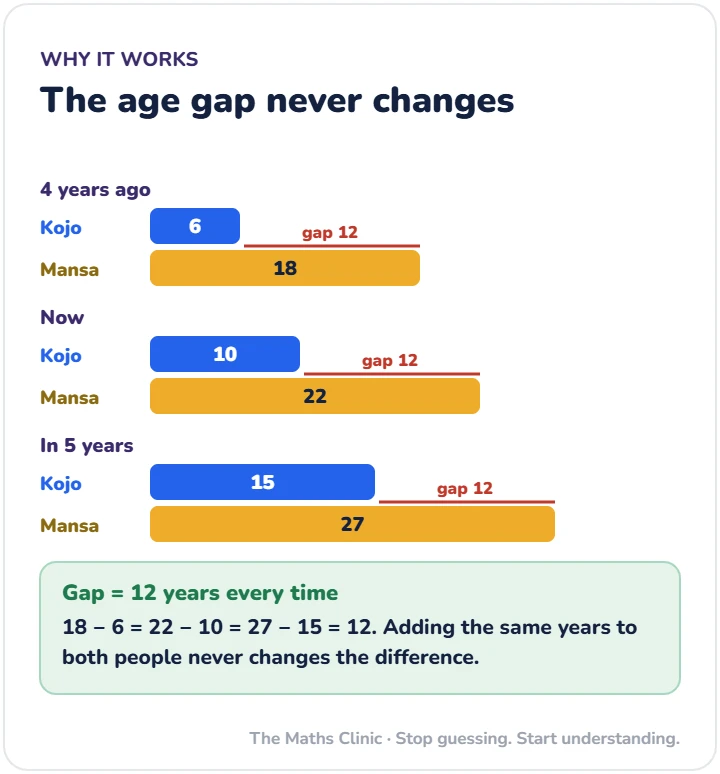
Time passes equally for everyone. If Kojo is k years old now, then in 5 years he is k + 5 and 4 years ago he was k – 4. The difference between two people’s ages never changes, but their ratio does. That is why you must compare ages from the same moment.

The method: the age table
- Name one unknown in words: “Let Kojo’s age now be k years.”
- Write everyone else’s age now in terms of k.
- Add a column for each other moment in the story, and fill every box: add or subtract the same number of years for everyone.
- Find the sentence that links two boxes in the same column. Write it as an equation.
- Solve, then put your answers back into every sentence of the story.

The common wrong approach
Question: Yaw is 3 times as old as Ato. In 8 years’ time, Yaw will be twice as old as Ato. Find their present ages.
A learner’s script:
| Line | Working |
|---|---|
| 1 | Let Ato = a, so Yaw = 3a |
| 2 | In 8 years: Yaw = 3a + 8 |
| 3 | 3a + 8 = 2a |
| 4 | a = −8 |
An age of −8 is a warning sign. The mistake is in line 3: Yaw got 8 years older, but Ato did not. In 8 years, Ato is a + 8, so the equation is:
3a + 8 = 2(a + 8)
That gives 3a + 8 = 2a + 16, so a = 8. Ato is 8 and Yaw is 24. Check: in 8 years they are 16 and 32, and 32 = 2 × 16 ✓

Worked example 1: a sum and “years ago”
The sum of the ages of Mansa and her brother Kojo is 32 years. Four years ago, Mansa was three times as old as Kojo. Find their present ages.
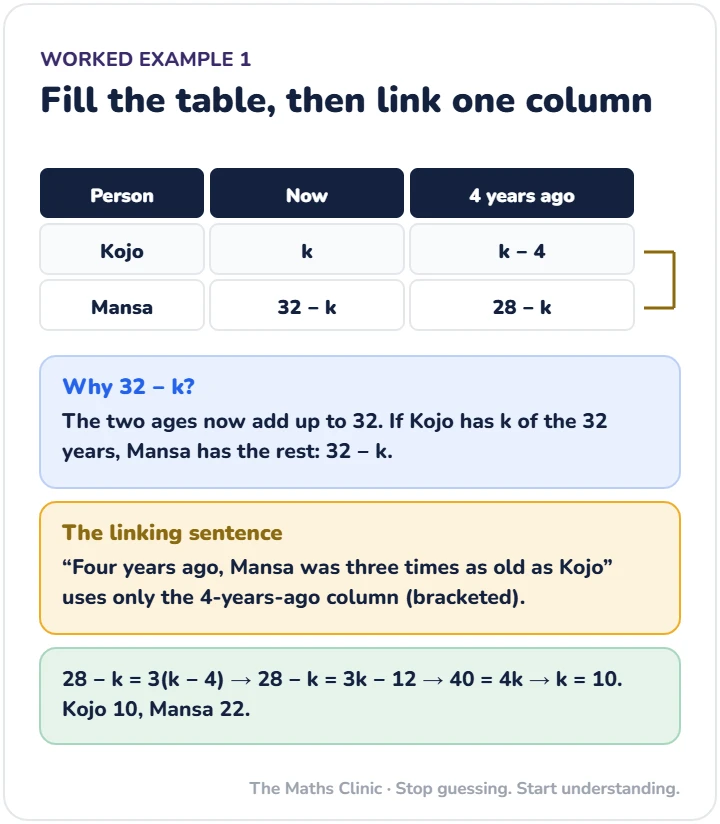
| Person | Now | 4 years ago |
|---|---|---|
| Kojo | k | k − 4 |
| Mansa | 32 − k | 28 − k |
Step 1. Kojo now = k. Because the sum now is 32, Mansa now = 32 – k.
Step 2. Four years ago, take 4 from both: Kojo k – 4, Mansa 28 – k.
Step 3. “Four years ago, Mansa was three times as old as Kojo” links the two boxes in the “4 years ago” column:
28 - k = 3(k - 4)
Step 4. 28 – k = 3k – 12, so 40 = 4k and k = 10.
Answer: Kojo is 10 and Mansa is 22. Check: 10 + 22 = 32 ✓. Four years ago they were 6 and 18, and 18 = 3 × 6 ✓
Worked example 2: a ratio and a total at different moments
The ratio of the present ages of Akosua and her uncle is 2 : 7. Five years ago, the sum of their ages was 62 years. Find their present ages.
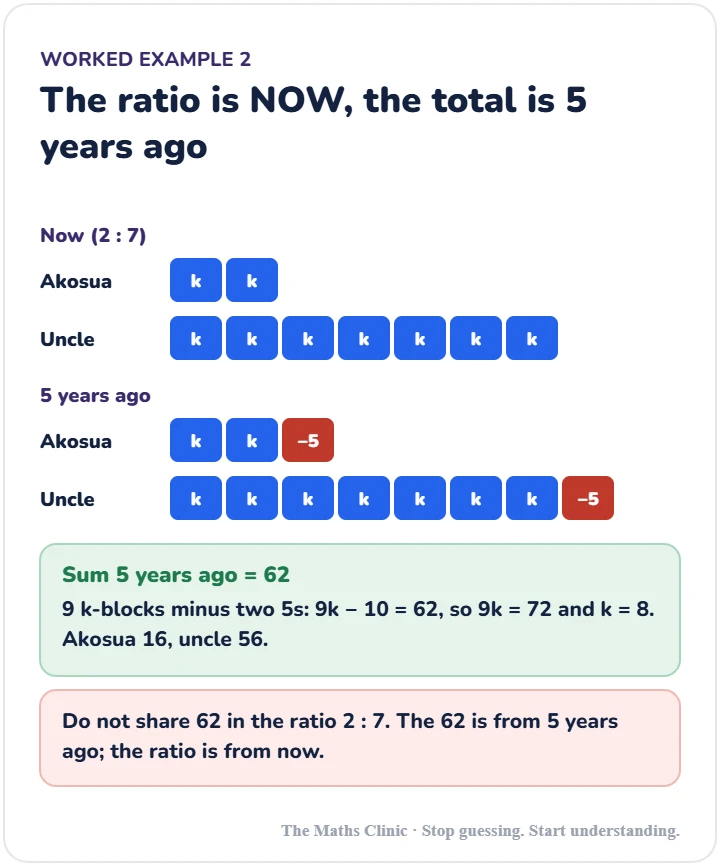
The trap: sharing 62 in the ratio 2 : 7. That uses a total from five years ago with a ratio from now. (It does not even divide evenly: 62 ÷ 9 is not a whole number, which is another warning sign.)
Step 1. Ages now: Akosua 2k, uncle 7k.
Step 2. Five years ago: 2k – 5 and 7k – 5. Their sum then was 62:
(2k - 5) + (7k - 5) = 62
Step 3. 9k – 10 = 62, so 9k = 72 and k = 8.
Answer: Akosua is 16 and her uncle is 56. Check: 16 : 56 = 2 : 7 ✓. Five years ago they were 11 and 51, and 11 + 51 = 62 ✓
📋 What the WAEC Chief Examiner reported
- On 2012 Question 2(a), an age question, “most of the candidates could not write algebraic equations from the word problem, let alone solve them correctly”. WAEC added that the “majority of them used the ratio 2 :9 as basis for dividing the total age of Kwasi and Yaw, which was unacceptable”: the ratio and the total belonged to different moments.
- On 2013 Question 2 (two brothers’ ages now and four years ago), most candidates wrote the first equation correctly, but “most of them could not write the second equation”.
- On 2016 Question 3(b) (the ages of Felicia and Asare now and in three years), “candidates could not translate word problem into mathematical equation”.
What WAEC recommends
In 2020 the Chief Examiner advised: “Teachers should teach students on how to translate word problems into mathematics statements.” In 2019: “Sufficient exercises should be given on word-problems for students to practice.” This lesson does both: every translation step is shown, and you get six questions with full solutions.
How to win these marks back
- Draw the age table before writing any equation.
- Add or subtract the years for every person in the story.
- Use each ratio or total only in the column it describes, then check your answer in every sentence.
Source: WAEC Chief Examiner’s Report, WASSCE 2012, Mathematics (Core); WAEC Chief Examiner’s Report, WASSCE 2013, Mathematics (Core); WAEC Chief Examiner’s Report, WASSCE 2016, Mathematics (Core).
Age word problems: practice questions
Draw the age table for each question before you write an equation. Answers are below.
Question 1
Ewurabena is 6 years older than Fiifi. In 3 years’ time, the sum of their ages will be 40. Find their present ages.
Question 2
A mother is 3 times as old as her daughter. In 12 years’ time, the mother will be twice as old as her daughter. Find their present ages.
Question 3
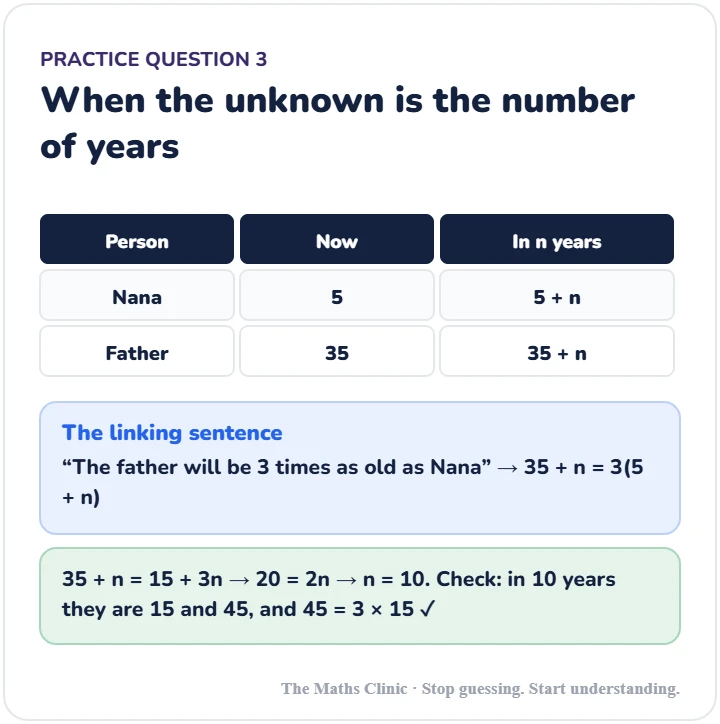
Nana is 5 years old and her father is 35. In how many years will the father be 3 times as old as Nana?
Question 4
Kweku is twice as old as his niece Efua. Six years ago, he was 4 times as old as she was. Find their present ages.
Question 5
The ratio of the present ages of Serwaa and Adjoa is 3 : 4. In 8 years’ time, the ratio of their ages will be 5 : 6. Find their present ages.
Question 6
The sum of the ages of a man and his son is 50 years. Five years ago, the man was 7 times as old as his son. Find their present ages.
Age word problems with solutions
Solution 1
Fiifi now f, Ewurabena f + 6. In 3 years: f + 3 and f + 9.
Equation: (f + 3) + (f + 9) = 40, so 2f + 12 = 40 and f = 14.
Answer: Fiifi 14, Ewurabena 20. Check: 17 + 23 = 40 ✓
Solution 2
Daughter d, mother 3d. In 12 years: d + 12 and 3d + 12.
Equation: 3d + 12 = 2(d + 12), so 3d + 12 = 2d + 24 and d = 12.
Answer: daughter 12, mother 36. Check: 48 = 2 × 24 ✓
Solution 3
Let the number of years be n. Then: Nana 5 + n, father 35 + n.
Equation: 35 + n = 3(5 + n), so 35 + n = 15 + 3n and n = 10.
Answer: in 10 years. Check: 45 = 3 × 15 ✓
Solution 4
Efua now e, Kweku 2e. Six years ago: e – 6 and 2e – 6.
Equation: 2e – 6 = 4(e – 6), so 2e – 6 = 4e – 24 and e = 9.
Answer: Efua 9, Kweku 18. Check: six years ago 3 and 12, and 12 = 4 × 3 ✓
Solution 5
Now: 3k and 4k. In 8 years: 3k + 8 and 4k + 8.
Equation: 6(3k + 8) = 5(4k + 8), so 18k + 48 = 20k + 40 and k = 4.
Answer: Serwaa 12, Adjoa 16. Check: in 8 years, 20 : 24 = 5 : 6 ✓
Solution 6
Son s, man 50 – s. Five years ago: s – 5 and 45 – s.
Equation: 45 – s = 7(s – 5), so 45 – s = 7s – 35, 80 = 8s and s = 10.
Answer: son 10, man 40. Check: five years ago 5 and 35, and 35 = 7 × 5 ✓
📘 New SHS curriculum link
This is Year 1 of the new SHS Mathematics curriculum (1.2.1.LO.2): model and solve linear equations in one variable, including problems in real life.
For parents
Ask your child: “In 5 years’ time, how old will you be, and how old will I be?” Then: “5 years ago?” If they change both ages every time, they have the key idea of this lesson: time passes for everyone in the story.
Frequently asked questions
How do I start an age word problem?
Name one person’s present age as x (or a letter like k), write everyone else’s present age in terms of it, then build the age table.
What does “in 5 years’ time” mean?
Add 5 to every person’s present age. “5 years ago” means subtract 5 from every person’s age.
What if I get a negative or impossible age?
Go back to your table. A negative age almost always means you changed only one person’s age, or used a ratio or total in the wrong column.
What to do next
Do the six practice questions without looking at the solutions, then mark them. If you missed any, write the age table for it again before reading the solution. Then try mixed word problems in the Practice Zone.
Keep learning
- Word Problems in WASSCE Mathematics: Questions and Answers, Step by Step
- How to Solve Linear Equations Step by Step, Without Guessing
- Simultaneous Equations: How to Solve Them, With WASSCE Practice and Answers
📚 See every lesson in the Algebra Clinic
✏️ Practise word problems
💬 Stuck on a step? Ask Dickson and send the line where you got lost.

Written by
Dickson Sarpong
NTC-certified SHS Mathematics teacher in Ghana with WAEC marking experience, and author of The Bridge Series textbooks. Every lesson here is built around the mistakes WAEC examiners keep reporting.
About DicksonStuck? Ask a question
Want the whole topic, step by step? My textbooks, The Bridge to Mathematics and The Bridge to Additional Mathematics for SHS, follow the new curriculum and rebuild the basics as you go.
Read a free chapter →