Struggling with WASSCE Maths? Stop guessing. Let’s fix the gap step by step.

Speed, Distance and Time Word Problems: How to Find Average Speed (With Answers)
Speed, distance and time word problems: the journey table, how to find average speed correctly, and practice questions with full answers.

📚 Part of the Word Problems Clinic: every word problem lesson, in the right order.
Quick answer: how do you find average speed in a word problem?
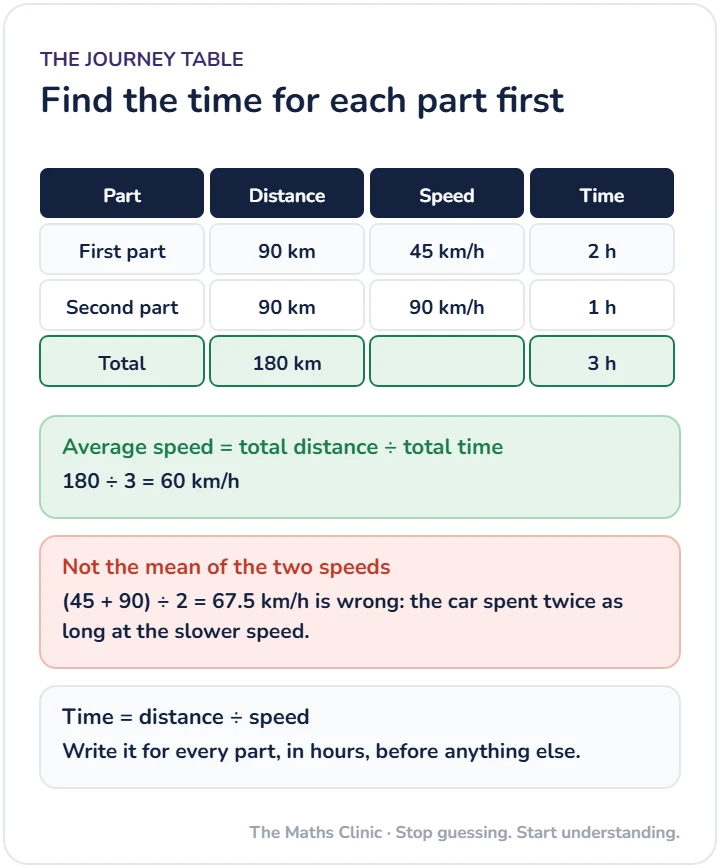
Average speed = total distance ÷ total time. Find the time for each part of the journey first (time = distance ÷ speed, in hours), add the distances and add the times, then divide. Do not take the mean of the speeds.
Journey questions look friendly: a trotro, a cyclist, a train. Then the question mixes minutes with hours, or asks for an average speed, and good students lose marks they should have kept.
This lesson gives you the journey table, a simple layout that forces you to find the time for every part of the journey. That single step is exactly where WAEC examiners say candidates go wrong.
Why speed, distance and time questions feel difficult
- Minutes left as minutes. Speed is in kilometres per hour, so 45 minutes must become 0.75 hours, not 45 and not 0.45.
- Averaging the speeds. Average speed is not (first speed + second speed) ÷ 2, because the journey usually spends longer at the slower speed.
- Skipping the time for each part. Without each time written down, there is nothing to build the equation from.

The idea behind it
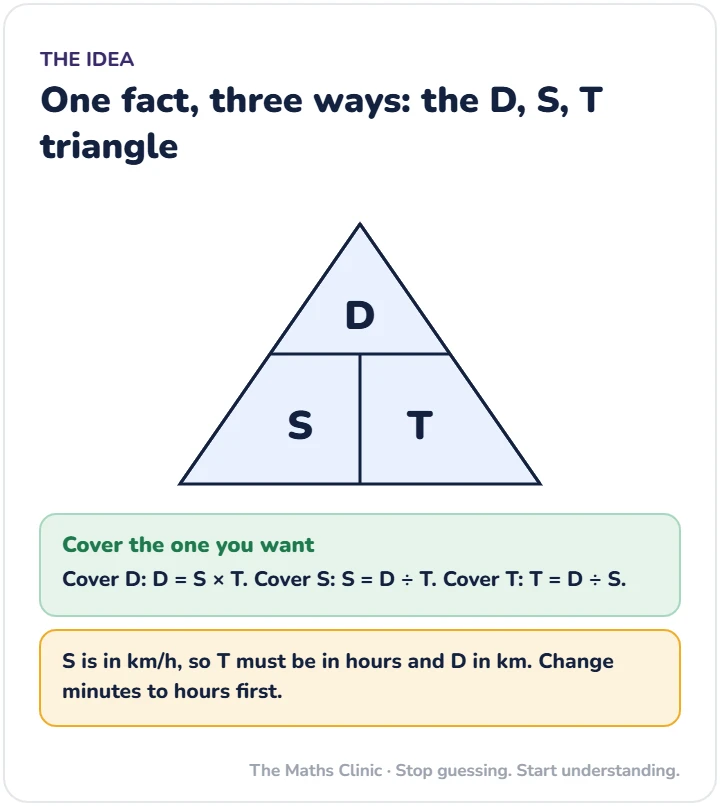
Distance, speed and time are one fact written three ways:
\text{distance} = \text{speed} \times \text{time}So \text{time} = \text{distance} \div \text{speed} and \text{speed} = \text{distance} \div \text{time}. When a journey has two parts, each part has its own time. A part that takes longer counts more in the average, which is why the times must be found first.
The method: the journey table
- Draw a table with one row for each part of the journey, and columns for distance, speed and time.
- Convert every time to hours: minutes ÷ 60.
- Fill in what you know. Use distance = speed × time to fill the gap in each row.
- Add the distances and the times in a “Total” row.
- For average speed, divide total distance by total time. For an equation, use the sentence that links the rows.
The common wrong approach
Question: A taxi travels 60 km to Kasoa at 60 km/h and returns along the same road at 30 km/h. Find its average speed for the whole trip.
| Line | Working |
|---|---|
| 1 | Average speed = (60 + 30) ÷ 2 |
| 2 | = 90 ÷ 2 |
| 3 | = 45 km/h |
Line 1 is the mistake: speeds cannot be averaged like that. The times are 60 \div 60 = 1 hour and 60 \div 30 = 2 hours. The total distance is 120 km and the total time is 3 hours, so:
\text{average speed} = 120 \div 3 = 40 \text{ km/h}The answer is lower than 45 because the taxi spent twice as long at the slower speed.

Worked example 1: average speed for two parts
A car travels 90 km at 45 km/h and then another 90 km at 90 km/h. Find its average speed for the whole journey.
Step 1. Time for each part: 90 \div 45 = 2 hours and 90 \div 90 = 1 hour.
Step 2. Totals: 180 km in 3 hours.
180 \div 3 = 60 \text{ km/h}Check: 60 km/h lies between 45 and 90, and closer to 45, because more time was spent at 45 km/h ✓

Worked example 2: minutes and an unknown speed
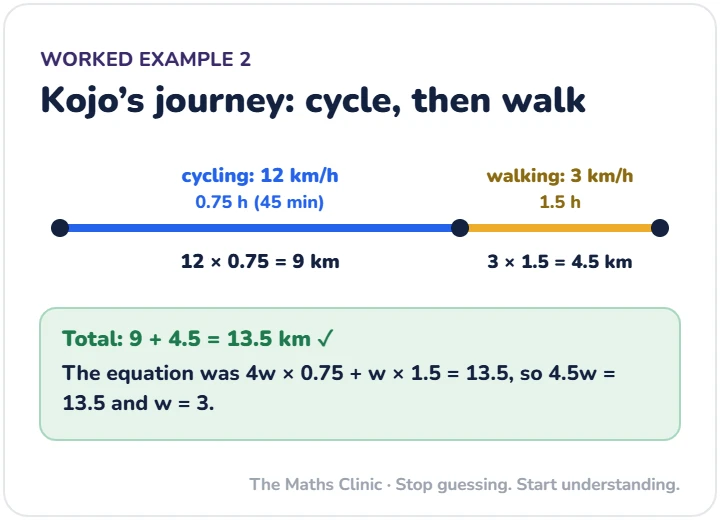
Kojo cycled for 45 minutes and then walked for 1½ hours, covering 13.5 km altogether. His cycling speed is 4 times his walking speed. Find his walking speed.
Step 1. Walking speed = w km/h, so cycling speed = 4w km/h.
Step 2. Convert: 45 minutes = 45 \div 60 = 0.75 hours.
Step 3. Distance for each part: cycling 4w \times 0.75 = 3w, walking w \times 1.5 = 1.5w.
3w + 1.5w = 13.5
Step 4. 4.5w = 13.5, so w = 3.
Answer: he walks at 3 km/h (and cycles at 12 km/h). Check: 12 × 0.75 = 9 km and 3 × 1.5 = 4.5 km; 9 + 4.5 = 13.5 ✓
📋 What the WAEC Chief Examiner reported
- On 2024 Question 1 (Adama rode a bicycle for 45 minutes and walked for an hour), the question “was not well answered by most candidates. They could not find the required time to form an equation”.
- On 2025 Question 1 (a journey in two halves at different speeds), “Most candidates could not find the time for the first half and second half respectively to enable them calculate the average speed.” Yet “solving simple problems on average speed” was listed as a strength that year.
- The method works when the times are written: on 2021 Question 12(b) (a train slowed down by 5 km/h), most candidates formed the time equation, “cleared fractions and came out with the correct quadratic equation”.
What WAEC recommends
In 2020 the Chief Examiner advised: “Teachers should teach students on how to translate word problems into mathematics statements.” In 2019: “Sufficient exercises should be given on word-problems for students to practice.” This lesson does both: every translation step is shown, and you get six questions with full solutions.
How to win these marks back
- Draw the journey table and write the time for every part.
- Convert all minutes to hours before calculating.
- Average speed is total distance ÷ total time, never the mean of the speeds.
Source: WAEC Chief Examiner’s Report, WASSCE 2021, Mathematics (Core); WAEC Chief Examiner’s Report, WASSCE 2024, Mathematics (Core); WAEC Chief Examiners’ Reports, WASSCE (SC) 2025, Ghana: Mathematics (Core).
Speed, distance and time: practice questions
Draw the journey table for each question. Answers are below.
Question 1
A trotro travels for 2 hours 15 minutes at 64 km/h. How far does it travel?
Question 2
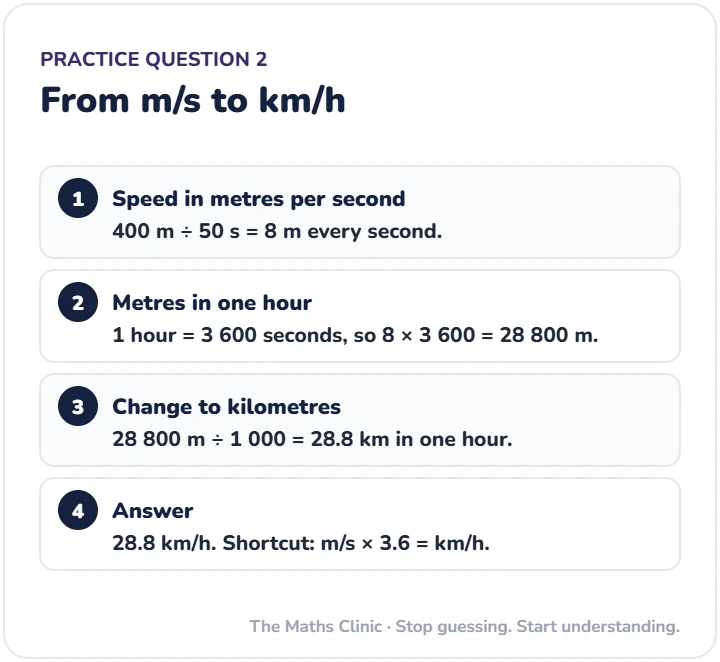
A runner covers 400 m in 50 seconds. Find her speed in km/h.
Question 3
Esi walks 6 km at 4 km/h and then cycles 12 km at 12 km/h. Find her average speed for the 18 km.
Question 4
A car travels for 3 hours at x km/h and then for 2 hours at (x – 10) km/h, covering 380 km altogether. Find x.
Question 5
Two towns are 390 km apart. Two buses leave the towns at the same time and travel towards each other at 70 km/h and 60 km/h. After how long do they meet?
Question 6
A cyclist rides 60 km. If she rode 5 km/h faster, she would arrive 1 hour earlier. Find her usual speed.
Speed, distance and time questions with answers
Solution 1
2 hours 15 minutes = 2 + 15 \div 60 = 2.25 hours.
Distance = 64 \times 2.25 = 144.
Answer: 144 km.
Solution 2
Speed = 400 \div 50 = 8 m/s. In one hour (3,600 s) she covers 8 \times 3600 = 28800 m = 28.8 km.
Answer: 28.8 km/h.
Solution 3
Times: 6 \div 4 = 1.5 h and 12 \div 12 = 1 h. Total: 18 km in 2.5 h.
Average speed = 18 \div 2.5 = 7.2.
Answer: 7.2 km/h (not 8 km/h, the mean of the speeds).
Solution 4
Distances: 3x and 2(x – 10).
Equation: 3x + 2(x – 10) = 380, so 5x – 20 = 380 and x = 80.
Answer: x = 80. Check: 240 + 140 = 380 ✓
Solution 5
Each hour, the gap closes by 70 + 60 = 130 km.
Equation: 130t = 390, so t = 3.
Answer: 3 hours. Check: 210 + 180 = 390 ✓
Solution 6
Usual speed x km/h. Times: \dfrac{60}{x} and \dfrac{60}{x + 5}.
Equation: \dfrac{60}{x} – \dfrac{60}{x + 5} = 1.
Multiply by x(x + 5): 60(x + 5) – 60x = x^2 + 5x, so x^2 + 5x – 300 = 0.
(x + 20)(x – 15) = 0, so x = 15 (a speed cannot be −20).
Answer: 15 km/h. Check: 60 ÷ 15 = 4 h and 60 ÷ 20 = 3 h: one hour earlier ✓
📘 New SHS curriculum link
This builds on Year 1 (1.2.1.LO.2), modelling and solving linear equations from real-life problems, and Year 2 (2.1.2.LO.1): ratios, rates and proportions.
For parents
On your next journey, ask: “If we travel at 60 km/h for 2 hours, how far do we go? And for 30 minutes?” If they turn 30 minutes into half an hour before multiplying, they have the step most candidates skip.
Frequently asked questions
How do I find average speed?
Divide the total distance by the total time. Find the time for each part first.
How do I change minutes to hours?
Divide by 60. For example, 20 minutes = 20 \div 60 = \tfrac{1}{3} hour and 45 minutes = 0.75 hour.
How do I change m/s to km/h?
Multiply by 3.6. For example, 8 m/s = 28.8 km/h.
What to do next
Mark your answers, then redo any question you missed by drawing the journey table again. For more on averages, see the Statistics Clinic, then try mixed questions in the Practice Zone.
Keep learning
- Age Word Problems With Solutions: The Age Table Method
- Word Problems in WASSCE Mathematics: Questions and Answers, Step by Step
- How to Solve Linear Equations Step by Step, Without Guessing
📚 See every lesson in the Algebra Clinic
✏️ Practise word problems
💬 Stuck on a step? Ask Dickson and send the line where you got lost.

Written by
Dickson Sarpong
NTC-certified SHS Mathematics teacher in Ghana with WAEC marking experience, and author of The Bridge Series textbooks. Every lesson here is built around the mistakes WAEC examiners keep reporting.
About DicksonStuck? Ask a question
Want the whole topic, step by step? My textbooks, The Bridge to Mathematics and The Bridge to Additional Mathematics for SHS, follow the new curriculum and rebuild the basics as you go.
Read a free chapter →