Struggling with WASSCE Maths? Stop guessing. Let’s fix the gap step by step.

How to Turn Word Problems into Equations, Step by Step (WASSCE)
Can't write the first line? Learn 5 steps to translate word problems into equations, with a word-to-symbol table, worked WASSCE examples and answers.

📚 Part of the Word Problems Clinic: every word problem lesson, in the right order.
Quick answer: how do you turn a word problem into an equation?
Use five steps. 1. Find what the question wants and give it a letter. 2. Write every other amount using that letter. 3. Change the words into symbols, one small phrase at a time. 4. Find the sentence that says two amounts are the same: that sentence is your “=”. 5. Solve, then check your answer in the story, not just in the equation.
You read the question. You understand the story: Ama, Kofi, their ages, five years from now. But when you pick up your pen, you do not know what to write first. So you stare, try a few numbers, and move on to the next question.
If this is you, you are not alone, and you are not “bad at maths”. WAEC examiners call it “translating word problems into mathematical statements”, and they have named it as a weakness of WASSCE candidates in almost every report from 2012 to 2025. The solving is usually not the problem. The marks are lost in the first line.
Why word problems feel impossible (the step nobody shows you)
In many classrooms, the teacher reads the question, says “Let x be the number”, and writes the whole equation on the board in one go. It looks easy because the teacher does three or four small steps in their head. You only see the finished equation, so you never see how it was built.
Those hidden steps are:
- Naming the unknown. Deciding which amount gets the letter, and writing it down in a full sentence.
- Building each amount. Writing every other amount using that letter, one at a time.
- Finding the “equals” sentence. Spotting the one sentence that says two amounts are the same.
- Reading in the right order. In English, “5 less than x” puts the 5 first, but in maths it is x − 5.
This lesson shows every one of those steps. Nothing is done in the head.
Words into symbols: the translation table
Keep this table beside you. Read the whole phrase, not just one key word, because a few phrases turn the order around.
| When the question says… | Write | Example |
|---|---|---|
| sum, total, altogether, added to, plus | + | the sum of x and 7 → x + 7 |
| more than, increased by, older than | + | 5 more than x → x + 5 |
| less than, reduced by, younger than, fewer than | − | 5 less than x → x − 5 (not 5 − x) |
| subtract 5 from x, take 5 away from x | − | x − 5 |
| the difference between x and y | − | x − y (bigger minus smaller) |
| times, product, of, twice, thrice | × | twice x → 2x; thrice x → 3x; half of x → x ÷ 2 |
| shared equally, divided by, per | ÷ | x shared among 4 → x ÷ 4 |
| is, was, will be, gives, equals, the result is | = | … the result is 20 → … = 20 |
| in 3 years’ time | + 3 to every age | x → x + 3 |
| 3 years ago | − 3 from every age | x → x − 3 |
| consecutive numbers | n, n + 1, n + 2 | three consecutive numbers |
| consecutive even (or odd) numbers | n, n + 2, n + 4 | three consecutive odd numbers |
| a two-digit number, tens digit t, units digit u | 10t + u | 47 = 10 × 4 + 7 |
The trap row. “5 less than x” means start with x and take 5 away: x − 5. But “x less than 5” means start with 5 and take x away: 5 − x. Always ask: less than what? That amount comes first.

How to solve any word problem: the method, every step
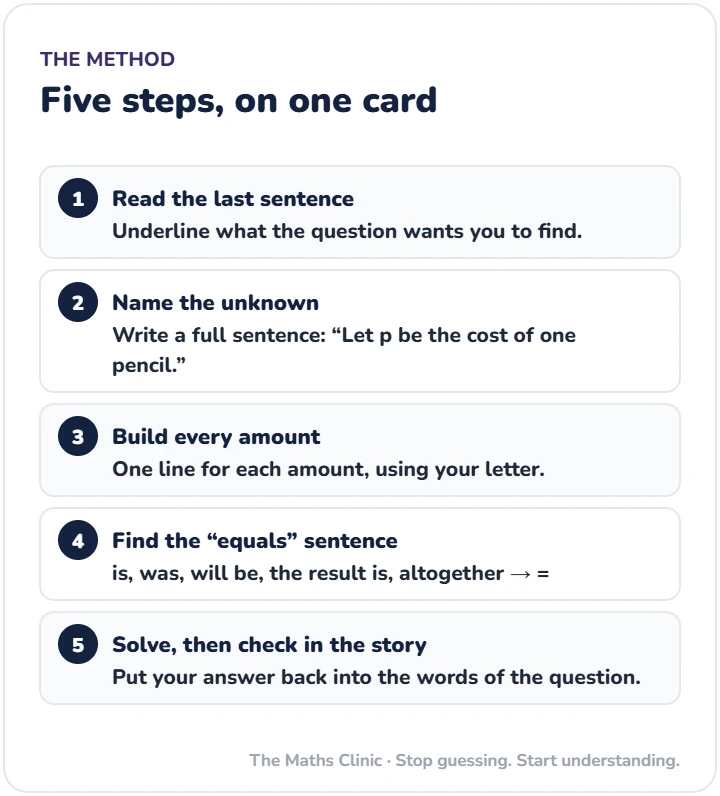
Step 1: Read the last sentence first
The last sentence tells you what to find: “Find the number.” “How old is Yaw now?” “Find the cost of a pencil.” Underline it.
Step 2: Give the unknown a letter, in a full sentence
Write “Let p be the cost of one pencil, in cedis.” Not just “p”. The full sentence stops you mixing up what p stands for halfway through. If there is a second unknown amount, try to write it using the first letter (for example, a pen that costs GH₵3 more is p + 3).
Step 3: Build every other amount using that letter
Go through the question one sentence at a time. Write each amount on its own line before you write any equation. This is the step most often skipped, and it is where most errors begin.
Step 4: Find the “equals” sentence
Look for the sentence that says two amounts are the same: “the result is 20”, “will be three times as old”, “paid GH₵42 altogether”. Put one amount on each side of “=”.
Step 5: Solve, then check in the story
Solve the equation, then put your answer back into the words of the question, not into your equation. If your equation is wrong, checking in the equation will not catch it. Checking in the story will.
Worked example 1: a number problem
Question. When 7 is subtracted from three times a number, the result is 20. Find the number.
Step 1. What do we want? “Find the number.”
Step 2. Name it. Let n be the number.
Step 3. Build the amount, one phrase at a time.
- “three times a number” → 3n
- “7 is subtracted from three times a number” → start with 3n and take away 7 → 3n − 7
Step 4. Find the “equals” sentence. “the result is 20” → = 20. So the equation is 3n − 7 = 20.

Step 5. Solve. Add 7 to both sides: 3n = 27. Divide both sides by 3: n = 9.
Check in the story. Three times 9 is 27. Subtract 7: 27 − 7 = 20 ✓. Answer: the number is 9.
The wrong way. Writing 7 − 3n = 20 because the 7 came first in the sentence. “Subtracted from three times a number” means 3n comes first.
Worked example 2: age word problems (“in 5 years’ time”)
Question. Ama is 4 times as old as her brother Kofi. In 5 years’ time, Ama will be 3 times as old as Kofi. Find their present ages.
This is the kind of question WAEC wrote about in 2016, when candidates did not build the years into their equation properly. Here is every step.
Step 1. What do we want? Both present ages.
Step 2. Name one of them. Ama’s age is described using Kofi’s, so let k be Kofi’s age now, in years.
Step 3. Build every amount. Make a small table with “Now” and “In 5 years”.
- Kofi now: k
- Ama now: “4 times as old as Kofi” → 4k
- Kofi in 5 years: k + 5
- Ama in 5 years: 4k + 5. The 5 years is added to both people, because both get older.
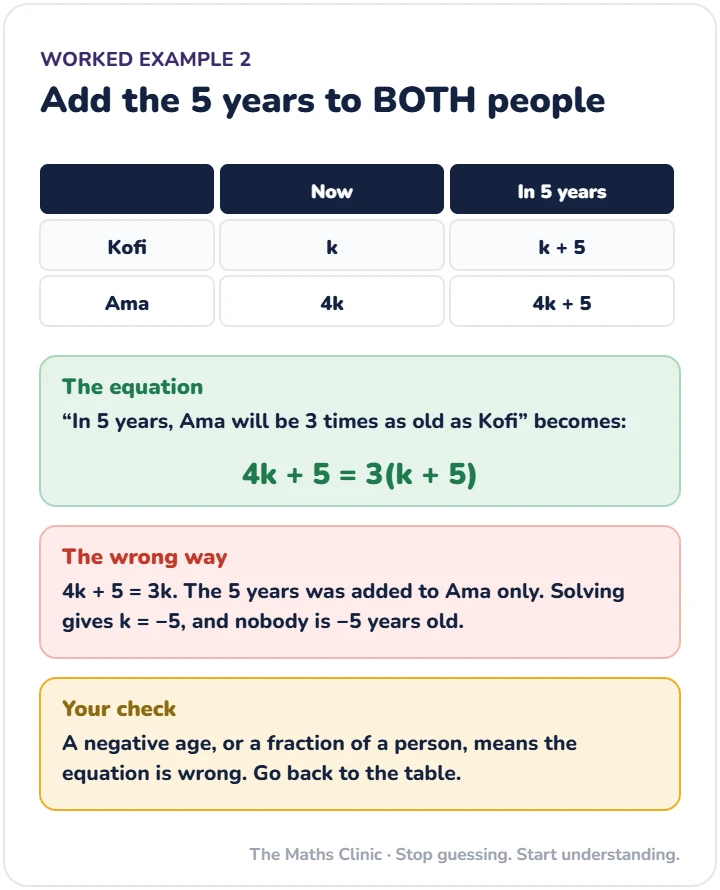
Step 4. Find the “equals” sentence. “In 5 years’ time, Ama will be 3 times as old as Kofi.” Ama in 5 years is 4k + 5. Three times Kofi in 5 years is 3 × (k + 5). Keep the bracket: the whole of Kofi’s future age is multiplied by 3. So 4k + 5 = 3(k + 5).
Step 5. Solve. Expand the bracket: 4k + 5 = 3k + 15. Subtract 3k from both sides: k + 5 = 15. Subtract 5 from both sides: k = 10. So Kofi is 10, and Ama is 4 × 10 = 40.
Check in the story. Is Ama 4 times as old as Kofi? 40 = 4 × 10 ✓. In 5 years they will be 15 and 45. Is 45 three times 15? Yes ✓. Answer: Kofi is 10 years old and Ama is 40.
The wrong way. 4k + 5 = 3k (forgetting to add 5 to Kofi) gives k = −5. A negative age is your warning sign. Another common slip is 4k + 5 = 3k + 5, which drops the bracket: the 3 must multiply the 5 as well.
Worked example 3: a shopping problem (two items, one letter)
Question. A pen costs GH₵3 more than a pencil. Kwame buys 4 pens and 6 pencils for GH₵42. Find the cost of one pencil.
Step 1. We want the cost of one pencil.
Step 2. Let p be the cost of one pencil, in cedis.
Step 3. Build every amount.
- One pencil: p
- One pen: “GH₵3 more than a pencil” → p + 3
- 4 pens: 4 × (p + 3) = 4(p + 3). The bracket matters: each of the 4 pens costs p + 3.
- 6 pencils: 6 × p = 6p
Step 4. “for GH₵42” means the total is 42: 4(p + 3) + 6p = 42.

Step 5. Solve. Expand: 4p + 12 + 6p = 42. Collect like terms: 10p + 12 = 42. Subtract 12: 10p = 30. Divide by 10: p = 3.
Check in the story. A pencil is GH₵3, so a pen is GH₵6. 4 pens cost GH₵24 and 6 pencils cost GH₵18. 24 + 18 = 42 ✓. Answer: one pencil costs GH₵3.
The wrong way. 4p + 3 + 6p = 42 (no bracket) adds the extra GH₵3 only once, instead of once for each pen.
Worked example 4: a two-digit number (WASSCE style)
Question. The digits of a two-digit number add up to 9. When the digits are swapped, the new number is 27 more than the original number. Find the number.
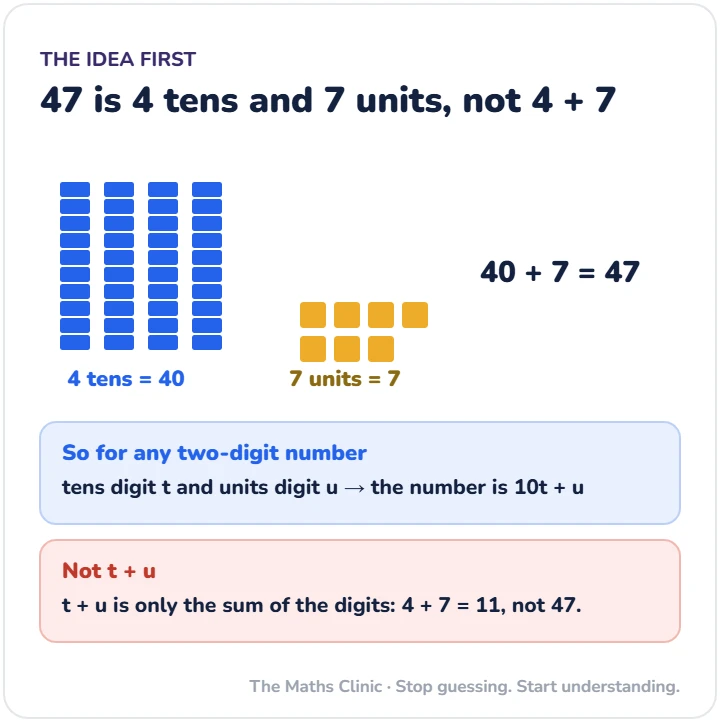
The idea first. The number 47 is not 4 + 7. It is 4 tens and 7 units: 10 × 4 + 7 = 47. So a number with tens digit t and units digit u is 10t + u. Many learners have never been shown this.
Step 1. We want the number.
Step 2. Let t be the tens digit and u be the units digit. The number is 10t + u.
Step 3. Build every amount.
- Sum of the digits: t + u
- Swapped number: u is now in the tens place, so it is 10u + t
- “27 more than the original number” → 10t + u + 27
Step 4. There are two “equals” sentences, so there are two equations.
- “the digits add up to 9” → t + u = 9
- “the new number is 27 more than the original” → 10u + t = 10t + u + 27
Step 5. Solve. Tidy the second equation: subtract t and u from both sides to get 9u = 9t + 27. Divide every term by 9: u = t + 3. Put this into the first equation: t + (t + 3) = 9, so 2t + 3 = 9, then 2t = 6, and t = 3. So u = 3 + 3 = 6.
Check in the story. The number is 36. Its digits add up to 3 + 6 = 9 ✓. Swapped, it is 63, and 63 − 36 = 27 ✓. Answer: 36.

The wrong ways that cost marks
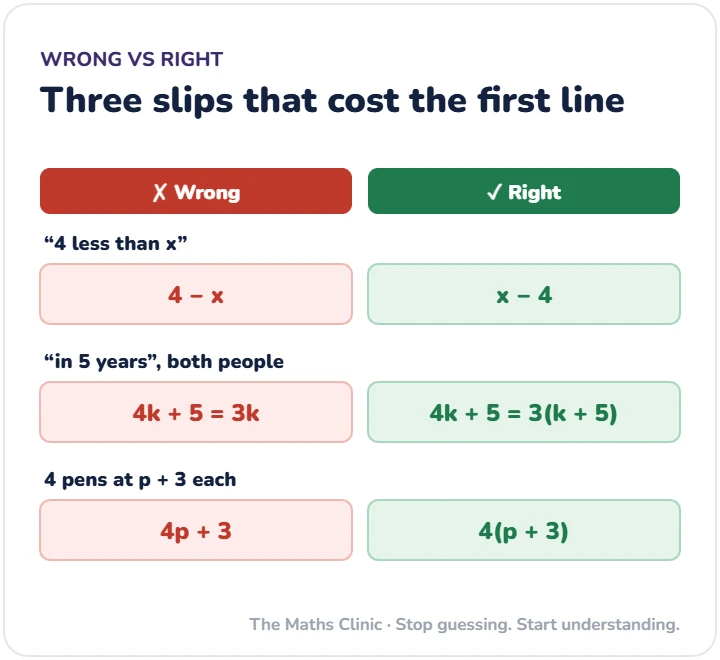
- Reversing “less than”. “4 less than x” is x − 4, not 4 − x.
- Adding the years to one person only. “In 5 years” adds 5 to every age in the question.
- Dropping the bracket. “3 times Kofi’s age in 5 years” is 3(k + 5), not 3k + 5.
- Sharing the wrong total in a ratio. If the present ages are in the ratio 2 : 9, write them as 2x and 9x; do not share some other total in that ratio.
- No “Let” sentence. Without it, you forget what your letter stands for, and the examiner cannot follow your working.
- Checking in your own equation. Always check in the words of the question.
📋 What WAEC advises, turned into your plan
WAEC Chief Examiners have named “translating word problems into mathematical equations” as a weakness in almost every report from 2012 to 2025 (2012, 2013, 2017, 2018, 2019, 2020, 2021, 2023 and 2025 in the reports we studied). In 2012 they wrote that “most of the candidates could not write algebraic equations from the word problem, let alone solve them correctly.” In 2016: “candidates could not translate word problem into mathematical equation. The phrase ‘in three years’ was not properly factored into their equation.”
WAEC’s advice in 2020: “Algebraic concepts should be explained meticulously to help candidates translate word-problems into mathematical equations.” And in 2013: candidates “should be given adequate exercises in solving word problems.” That is exactly what this lesson does: every step explained, then practice.
Here is how to put that advice into practice yourself:
- Write a “Let …” sentence before anything else.
- Build each amount on its own line before you write the equation.
- Underline the “equals” sentence, then write the equation from it.
- Check your answer in the words of the question.
- Do the six questions below without looking at the solutions, then mark yourself.
Source: WAEC Chief Examiner’s Report, WASSCE 2012, Mathematics (Core); WAEC Chief Examiner’s Report, WASSCE 2013, Mathematics (Core); WAEC Chief Examiner’s Report, WASSCE 2016, Mathematics (Core); WAEC Chief Examiner’s Report, WASSCE 2017, Mathematics (Core); WAEC Chief Examiner’s Report, WASSCE 2018, Mathematics (Core); WAEC Chief Examiner’s Report, WASSCE 2019, Mathematics (Core); WAEC Chief Examiner’s Report, WASSCE 2020, Mathematics (Core); WAEC Chief Examiner’s Report, WASSCE 2021, Mathematics (Core); WAEC Chief Examiner’s Report, WASSCE 2023, Mathematics (Core); WAEC Chief Examiners’ Reports, WASSCE (SC) 2025, Ghana: Mathematics (Core).
Try it now
Cover the solutions. For each question, write the “Let” sentence, build the amounts, then write the equation. Only then solve.
Question 1
When 8 is added to a number, the result is three times the number. Find the number.
Question 2
The sum of three consecutive numbers is 72. Find the numbers.
Question 3
Esi is 6 years older than Yaw. Four years ago, Esi was twice as old as Yaw. How old is Yaw now?
Question 4
A trader sold oranges at 50 pesewas each and pineapples at GH₵4 each. She sold 20 fruits altogether and received GH₵31. How many pineapples did she sell?
Question 5 (WASSCE style)
The length of a rectangle is 5 cm more than its width. Its perimeter is 38 cm. Find the area of the rectangle.
Question 6 (new curriculum)
A taxi driver charges GH₵5 to start a trip plus GH₵3 for every kilometre. A trip cost GH₵41. How long was the trip?
Solutions
Solution 1
Let n be the number. “8 is added to a number” → n + 8. “three times the number” → 3n. “the result is” → =. Equation: n + 8 = 3n. Subtract n from both sides: 8 = 2n, so n = 4. Check: 4 + 8 = 12 and 3 × 4 = 12 ✓. Answer: 4.
Solution 2
Let the smallest number be n. The next two are n + 1 and n + 2. Sum: n + (n + 1) + (n + 2) = 72, so 3n + 3 = 72. Subtract 3: 3n = 69. Divide by 3: n = 23. Check: 23 + 24 + 25 = 72 ✓. Answer: 23, 24 and 25.
Solution 3
Let y be Yaw’s age now. Esi now: y + 6. Four years ago, subtract 4 from both: Yaw was y − 4, and Esi was y + 6 − 4 = y + 2. “Esi was twice as old as Yaw”: y + 2 = 2(y − 4). Expand: y + 2 = 2y − 8. Subtract y: 2 = y − 8. Add 8: y = 10. Check: now Yaw is 10 and Esi is 16; four years ago they were 6 and 12, and 12 = 2 × 6 ✓. Answer: Yaw is 10.
Solution 4
Let x be the number of pineapples. The rest are oranges: 20 − x. Write 50 pesewas as GH₵0.50, so all the money is in cedis. Pineapple money: 4x. Orange money: 0.5(20 − x). Total: 4x + 0.5(20 − x) = 31. Expand: 4x + 10 − 0.5x = 31. Collect like terms: 3.5x + 10 = 31. Subtract 10: 3.5x = 21. Divide by 3.5: x = 6. Check: 6 pineapples = GH₵24; 14 oranges = GH₵7; 24 + 7 = 31 ✓. Answer: 6 pineapples.
Solution 5
Let the width be w cm. Length: w + 5. Perimeter = 2 × (length + width) = 2(w + 5 + w) = 2(2w + 5). Equation: 2(2w + 5) = 38. Expand: 4w + 10 = 38. Subtract 10: 4w = 28. Divide by 4: w = 7, so the length is 12 cm. The question asks for the area, so keep going: 12 × 7 = 84. Check: 2(12 + 7) = 38 ✓. Answer: 84 cm².
Solution 6
Let d be the distance in kilometres. Cost of the kilometres: 3d. Total cost: 5 + 3d. “A trip cost GH₵41”: 5 + 3d = 41. Subtract 5: 3d = 36. Divide by 3: d = 12. Check: 5 + 3 × 12 = 41 ✓. Answer: 12 km.
Check yourself: did you write a “Let” sentence each time? Did you subtract the 4 years from both ages in Question 3? Did you stop at the width in Question 5, or go on to the area? Those are the three places marks are usually lost.
📘 New SHS curriculum link
Year 1 (1.2.1): model and solve linear equations in one variable, including problems in real life. Year 2 (2.2.1): analyse, model and solve word problems on simultaneous linear equations involving numbers, ages and more. Worked example 4 and Question 6 are modelling questions of exactly this kind.
For parents
You do not need to know the maths to help. Ask your child to read one question aloud and answer two questions before writing anything: “What is the unknown?” and “Which sentence is the equals sign?” If they can answer both, they are on the right track. If not, read the “method, every step” section together.
Frequently asked questions
What is the first step in solving a word problem?
Read the last sentence to find what the question wants, then give it a letter in a full sentence, such as “Let n be the number.” Everything else is built from that letter.
How do I know which operation to use?
Use the translation table above, but read the whole phrase, not just one word. “Less than” and “subtracted from” turn the order around. For more practice spotting the operation, see key words in word problems.
What is the difference between an expression and an equation?
An expression is an amount, like 3n − 7. An equation says two amounts are equal, like 3n − 7 = 20. You build the expressions first; the “equals” sentence turns them into an equation. See expression vs equation.
How do I translate “less than” in maths?
“a less than b” means b − a. So “5 less than x” is x − 5, and “x less than 5” is 5 − x. Ask “less than what?” and write that amount first.
When do I need two letters?
When there are two unknown amounts and you cannot write one using the other, use two letters and look for two “equals” sentences, as in Worked example 4. Then solve them together using simultaneous equations.
Why does my equation give a negative or fraction answer?
If the answer is a number of people, an age or a number of items, a negative or a fraction usually means the equation is wrong, not the arithmetic. Go back to Step 3 and check each amount, especially brackets, and years added to everyone.
What to do next
Practise forming and solving equations with more examples in Word Problems in WASSCE Mathematics: Questions and Answers. If solving the equation itself is the hard part, start with how to solve linear equations step by step. Coming next in this series: age, speed, work-rate and ratio word problems, each with the same step-by-step method.
Keep learning
- Word Problems in WASSCE Mathematics: Questions and Answers, Step by Step
- How to Solve Linear Equations Step by Step, Without Guessing
- Simultaneous Equations: How to Solve Them, With WASSCE Practice and Answers
- Key Words in Word Problems: 7 Clues That Show the Operation
📚 See every lesson in the Algebra Clinic
✏️ Practise word problems
💬 Stuck on a step? Ask Dickson and send the line where you got lost.

Written by
Dickson Sarpong
NTC-certified SHS Mathematics teacher in Ghana with WAEC marking experience, and author of The Bridge Series textbooks. Every lesson here is built around the mistakes WAEC examiners keep reporting.
About DicksonStuck? Ask a question
Want the whole topic, step by step? My textbooks, The Bridge to Mathematics and The Bridge to Additional Mathematics for SHS, follow the new curriculum and rebuild the basics as you go.
Read a free chapter →